
Areca nut and coconut plantation
Areca and coconut planted together. Areca starts bearing in 4-5 years and coconut later still; a mature areca palm carries 200-500 nuts a year, and the Agriculture Information Service puts the profit at Tk 1-1.5 lakh an acre a year.
- Last reviewed: 21 September 2026
- Version 1
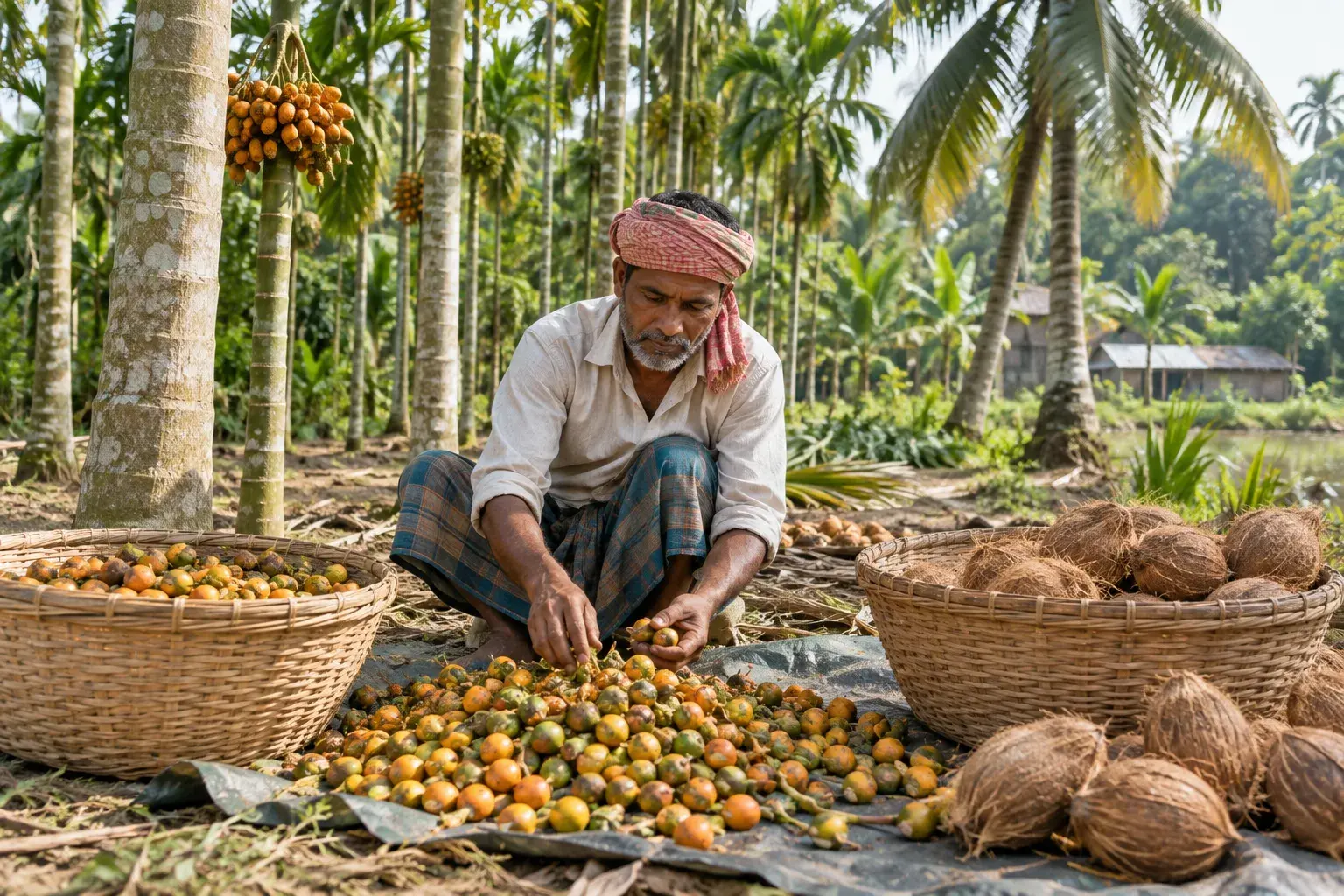
Areca nut and coconut plantation
- Starting capital
- ৳60,000 – ৳5,00,000 Editorial estimate
- Manpower
- 1 – 5 people
- First sale
- 1,460 – 2,555 days Official source
- Break-even
- 72 – 120 months Editorial estimate
- Kind of work
- Farm · Medium difficulty
About the business
Areca and coconut are an old pairing in the south of the country. Once planted they run for decades: an areca palm bears for up to fifty years and yields most between its tenth and fortieth. But the start is slow. The Agriculture Information Service puts first bearing at 4 to 5 years from planting out, with another 9 to 10 months from flower to ripe nut, and before that the seedling sits in the nursery bed for 1 to 2 years, so counted from seed the wait is longer again. Coconut is slower. BARI Narikel-1 and 2 carry 65 to 75 nuts a year on a mature tree, 278 saplings fill a hectare at 6 by 6 metres, and a nut is ready 11 to 12 months after the flower opens. There are loud claims about the Vietnamese dwarf hybrid, fruit in two to two and a half years and 150 to 250 nuts a tree, but those come from sapling sellers and newspapers, not from the official variety descriptions, which say 65 to 75. On price: on 21 September 2026 an online grocer in Dhaka listed a coconut at Tk 215, a green drinking coconut at Tk 200 and 250 g of dried areca nut at Tk 169, which is Tk 676 a kg. At the field it is different: the national news agency reported (11 November 2023) areca at Tk 250-300 per kuri of 210 nuts in Barguna, which is Tk 1.19-1.43 a nut. Ninety percent of the country's areca grows in the southern districts, chiefly Barishal, Khulna and Noakhali.
Unit economics
| Item | Range | Evidence | Suggest a correction |
|---|---|---|---|
| Monthly working capital | ৳2,000 – ৳25,000 | Editorial estimate | |
| Selling price | ৳1 – ৳1 / unit | Market quote | |
| Variable cost | ৳0 – ৳1 / unit | Editorial estimate | |
| Gross margin | 33% – 76% | Editorial estimate | |
| Time to first revenue | 1,460 – 2,555 days | Official source | |
| Break-even time | 72 – 120 months | Editorial estimate | |
| Cash cycle | 180 – 365 days | Editorial estimate | |
| Waste / loss | 10% – 35% | Editorial estimate | |
| Daily capacity | 60 – 400 | Editorial estimate |
What you need to start
- Climbing rope and rope to lower the bunches, a sprayer, spade and weeding hoe, an irrigation arrangement (basin or flood, with flood giving the better yield), and open ground to sun-dry the areca nut.Equipment
- Fertiliser and pesticide: cow dung in every pit (10 kg for areca, 20-30 kg for coconut), TSP, MOP, gypsum, zinc sulphate and boric acid, twice a year. For disease, Bordeaux mixture or Cupravit, Dithane M-45; Kelthane for mites, Sumithion for the spadix caterpillar, Furadan 3G for root grubs. Prices could not be verified here.Starting stock
- Planting stock. Areca seedlings can be raised at home; a 12-18 month old seedling is what goes out to the field. Coconut saplings have to be bought: in 2021 the Vietnamese dwarf was Tk 500 from government horticulture centres and upazila agriculture offices, while a private nursery in 2026 asks over Tk 3,000 for the same thing. The official varieties are BARI Narikel-1 and BARI Narikel-2.Starting stock
- Trade licence from the city corporation, municipality or union parishad: form Tk 10, licence book Tk 50, standard tax Tk 30, stamp Tk 150-300, licence fee Tk 100-60,000, issued in 3-5 working days, renewed yearly. Not needed to sell your own orchard's fruit; needed to run an areca warehouse or trade in dried nut.Licence
- Climbing, and roping bunches down without splitting the fruit or damaging the palm. Recognising the diseases: fruit rot, bud rot, spadix drying, red and white mites, the spadix caterpillar and root grubs on areca; the rhinoceros beetle and red palm weevil on coconut.Skill
- A relationship with an areca warehouse or a trader who buys by the kuri, and with a coconut wholesaler. Ninety percent of the country's areca grows in the south so the warehouses are thick there, but because everyone harvests at once the price sags in season.Supplier
- High, well-drained sandy loam at pH 5.5-6.5. Coconut at 6 by 6 metres is 278 to a hectare, about 113 to an acre, with areca between them at 4 hands. The land yields nothing for 4-5 years, so starting beside the homestead, on a pond bank or along a road carries less risk.Workspace
How the work is done
- 1Choose the land: high, fertile, well-drained, with some shade and shelter from strong wind. Standing water rots the roots of both palms. Sandy loam suits best, at a soil pH of 5.5 to 6.5.
- 2Raise your own areca seedlings. Beds 1-1.5 m wide and 3 m long, rows 30 cm apart, seeds 25 cm apart and 1-2 cm deep. Sow as soon as the seed is collected.
- 3Select the good seedlings. Those that germinate within three months make the best plants. For planting out take seedlings 12-18 months old, short and thick, with at least five or six leaves.
- 4Plant the shade trees before the areca goes in: a young areca palm cannot take strong wind or hard sun. The coconut does this job as well.
- 5Dig the pits. For areca 70x70x70 cm at a 4-hand square spacing (or 8 hands between lines and 4 between plants), with 10 kg rotted cow dung and 1 kg oil cake in each. For coconut 1x1x1 m pits at 6 by 6 metres, 278 saplings a hectare, each with 20-30 kg cow dung, 250 g TSP, 400 g MOP, 100 g zinc sulphate and 50 g boric acid.
- 6Plant in June or July. May to September will do, but June-July is best. Set the coconut sapling so that the husk-joined base stays above the soil, then stake it and fence it.
- 7For the first two years mulch a circle 60-70 cm out from the base, 8-10 cm thick. Termites nest in mulch, so spray an insecticide over it every 10-15 days.
- 8Watch the potash. Coconut needs more potash than anything else, and without it the fruit is late, the flowers drop and disease increases. Apply in two doses, in May and September, in a band from 1 metre out to 2.5 metres from the base, 20-30 cm deep.
- 9Irrigate. Trials cited by the Agriculture Information Service show coconut yield rising by up to 75 percent with proper watering: every 10-15 days in the dry season for coconut, every 5-10 for areca.
- 10At the first monsoon rain spray the areca bunches and leaves with 1 percent Bordeaux mixture or 1.5 percent Macuprax, three or four times at 15-30 day intervals; that is how fruit rot is held off. Burn the affected bunches.
- 11Never cut green coconut fronds; it is forbidden outright. The leaf will yellow, dry and fall of itself. Clean the crown only when rubbish collects in it or the rhinoceros beetle strikes, and only with someone who knows the work.
- 12Harvest on time. Areca ripens 9 to 10 months after flowering and the bunches must be roped down. It can be taken fully ripe, half ripe or mature green depending on what it is for. Coconut is ready 11 to 12 months after the flower, and at 5 to 7 months if it is to be sold as a green drinking nut.
- 13Learn the selling units. Areca sells by the pon and the kuri, and a kuri is 210 nuts. The kuri price moves with size and quality, and dried nut fetches far more than wet. Which state you sell in is the biggest single difference in what you get.
Seasons
- JanLow
- FebNormal
- MarNormal
- AprNormal
- MayNormal
- JunNormal
- JulLow
- AugNormal
- SepHigh
- OctHigh
- NovHigh
- DecNormal
Where it works well
- Strong fitBarguna · About 1,000 hectares of commercial areca across six upazilas; output rose from 10,000 to 30,000 tonnes in one season, with the kuri at Tk 250-300 (BSS, 11 November 2023).
- Strong fitBarishal · One of the three districts the Agriculture Information Service names for areca; ninety percent of the crop grows in the south and the warehouses are thickest here.
- Strong fitJhalokathi · Inside the southern areca belt, where nuts from small orchards are sold by the kuri at the local markets.
- Strong fitKhulna · Named by the Agriculture Information Service as a main areca district, with the divisional city market and dried-nut wholesalers close by.
- Strong fitNoakhali · Named by the Agriculture Information Service as a main areca district, with old homestead areca and coconut plantings.
- Strong fitPatuakhali · A coastal district with heavy coconut production, listed among those where the Vietnamese dwarf saplings were distributed.
- Strong fitPirojpur · Dense homestead and canal-bank areca and coconut, and one of the districts where the Vietnamese dwarf coconut was distributed.
- PossibleBagerhat · Coconut does well on the coast and it is one of the dwarf-sapling districts, though rising salinity cuts the yield.
- PossibleBhola · Coastal and good for coconut, but the storm risk to the palms is high and the low land waterlogs.
- PossibleChattogram · Areca grows in the tropical coastal belt here, with the city's large market and the exporters nearby.
- PossibleCox's Bazar · The warm, humid coastal climate suits both palms, though sandy soil and salt air mean the site must be chosen with care.
- PossibleLakshmipur · Both coconut and areca grow along the Meghna, and the Noakhali markets are close.
Risks and cautions
- HighWorking capital: Four to five years before a single nut comes off the palm, and longer again counting the year or two in the nursery bed. Pits, seedlings, fertiliser, water and fencing are paid for through every one of those years. The coconut wait is longer still; the official page does not even give a bearing age for the BARI varieties. For anyone turning rice land into orchard, those five lost crops are the real price.
- HighSpoilage: Fruit rot. In the Agriculture Information Service's description, water-soaked spots appear on the stalk, run together, and the whole nut rots and drops. It comes with the monsoon rain, which is exactly when the bunches have set. Holding it off means spraying three or four times at 15-30 day intervals from the first rain; miss the timing once and that bunch is gone.
- HighOther: On coconut the rhinoceros beetle and the red palm weevil kill the tree outright. They bore into the soft crown and eat the tissue inside; heavy attack dries the crown and the palm dies, and with the weevil the trunk hollows until the palm snaps in a light wind. A dead palm is seven or eight years dead. Stem bleeding disease ends the same way.
- MediumDemand: Everyone harvests at once and the price falls. BSS reported Barguna's output tripling in a single season, from 10,000 to 30,000 tonnes. The bigger the crop the lower the kuri price, and a small grower with no store has no way to wait it out. Dried nut fetches more, but drying needs both space and time.
- MediumDependency: The improved areca seedlings are not available. The Agriculture Information Service says so itself: BARI Supari-1 and BARI Supari-2 exist, but because the improved varieties are in short supply growers plant local types, which are smaller and yield less. In other words the varieties the official fertiliser schedule is written for are the ones you cannot get.
- MediumOther: The claims made for dwarf coconut, fruit in two to two and a half years and 150-250 or even 350-500 nuts a tree, come almost entirely from sapling sellers. The official variety descriptions put BARI Narikel-1 and 2 at 65-75 nuts a tree. A sapling was Tk 500 at a government centre in 2021 and is over Tk 3,000 at a private nursery in 2026, a difference of more than Tk 2 lakh across an acre. Buying saplings without checking is the biggest single loss available here.
Sources
নারিকেল চাষ ব্যবস্থাপনা — ই-কৃষি, অর্থকরী ফসল (প্রকাশ ০১-০৬-২০২৬)
Collected: 21 Sept 2026Supports: Starting capital, Break-even time, risks · বাংলাদেশ
সুপারি — ই-কৃষি, মসলা (প্রকাশ ১৫-০১-২০২৬, হালনাগাদ ০১-০৬-২০২৬)
Collected: 21 Sept 2026Supports: districts, Daily capacity, Gross margin, Monthly working capital, Time to first revenue, Variable cost, Waste / loss, risks · বাংলাদেশ — বিশেষত বরিশাল, খুলনা ও নোয়াখালী
সিটি কর্পোরেশন থেকে ট্রেড লাইসেন্স প্রাপ্তির ধাপ সমূহ
Collected: 16 Sept 2026Supports: requirements · বাংলাদেশ
- Collected: 11 Nov 2023
Supports: Selling price · বরগুনা — ছয়টি উপজেলা
খাটো জাতের নারিকেল গাছে তিন বছরেই ফল
Collected: 20 Oct 2021Supports: Starting capital · বাংলাদেশ — বরিশাল, বরগুনা, পটুয়াখালী, পিরোজপুর, বাগেরহাট, খুলনা, দিনাজপুর, কুষ্টিয়া, মেহেরপুর, বান্দরবান, রাঙামাটি
What changed
No corrections have been published yet.
Questions and answers
No questions yet. Be the first to ask.
Stories about this business
A 25-30 percent bigger crop, and income halving from 8 lakh to 4
Five hundred areca nut trees brought about 800,000 taka last year. This season the trees yielded 25-30 percent more, but wholesale prices fell 60-65 percent, and he expects no more than 400,000.
- Reasons
- Price drop
Similar businesses
 Agriculture & farming
Beekeeping and honey
Keeping bees in boxes and harvesting honey. Honey runs Tk 650-1,200 a kg depending on the flower, but bottling under your own name needs BSTI certification with a Tk 7,500 test fee.
- Capital
- ৳60k – ৳5 lakh
- People
- 1 – 6
- First income
- 30 – 135 days
 Agriculture & farming
Poultry and duck hatchery
Setting eggs in an incubator and selling day-old chicks to farmers. Ducklings cost Tk 30-35 and sell at Tk 72-75, but chicken chick prices swing from Tk 25 to Tk 85 and back to Tk 5 within months.
- Capital
- ৳50k – ৳8 lakh
- People
- 2 – 15
- First income
- 28 – 60 days
 Agriculture & farming
Aloe vera farming
Cutting aloe leaves and selling them to companies. About Tk 50,000 a bigha to grow and Tk 1.5-2.5 lakh of leaves, but the only buyers are a few pharmaceutical and juice companies.
- Capital
- ৳50k – ৳2 lakh
- People
- 1 – 6
- First income
- 90 – 120 days
 Agriculture & farming
Milk collection and supply
Buying milk from farmers and delivering it to chilling centres and shops. Farmers get Tk 35-50 a litre and plants pay Tk 48-58; that gap is the business.
- Capital
- ৳50k – ৳4 lakh
- People
- 1 – 4
- First income
- 7 – 21 days