
Banana ripening chamber
Buying green bananas, ripening them in a controlled chamber and selling them on. Section 23 of the Food Safety Act names calcium carbide as prohibited and the offence is non-bailable; ethylene and ethephon are permitted within prescribed limits.
- Last reviewed: 19 September 2026
- Version 1
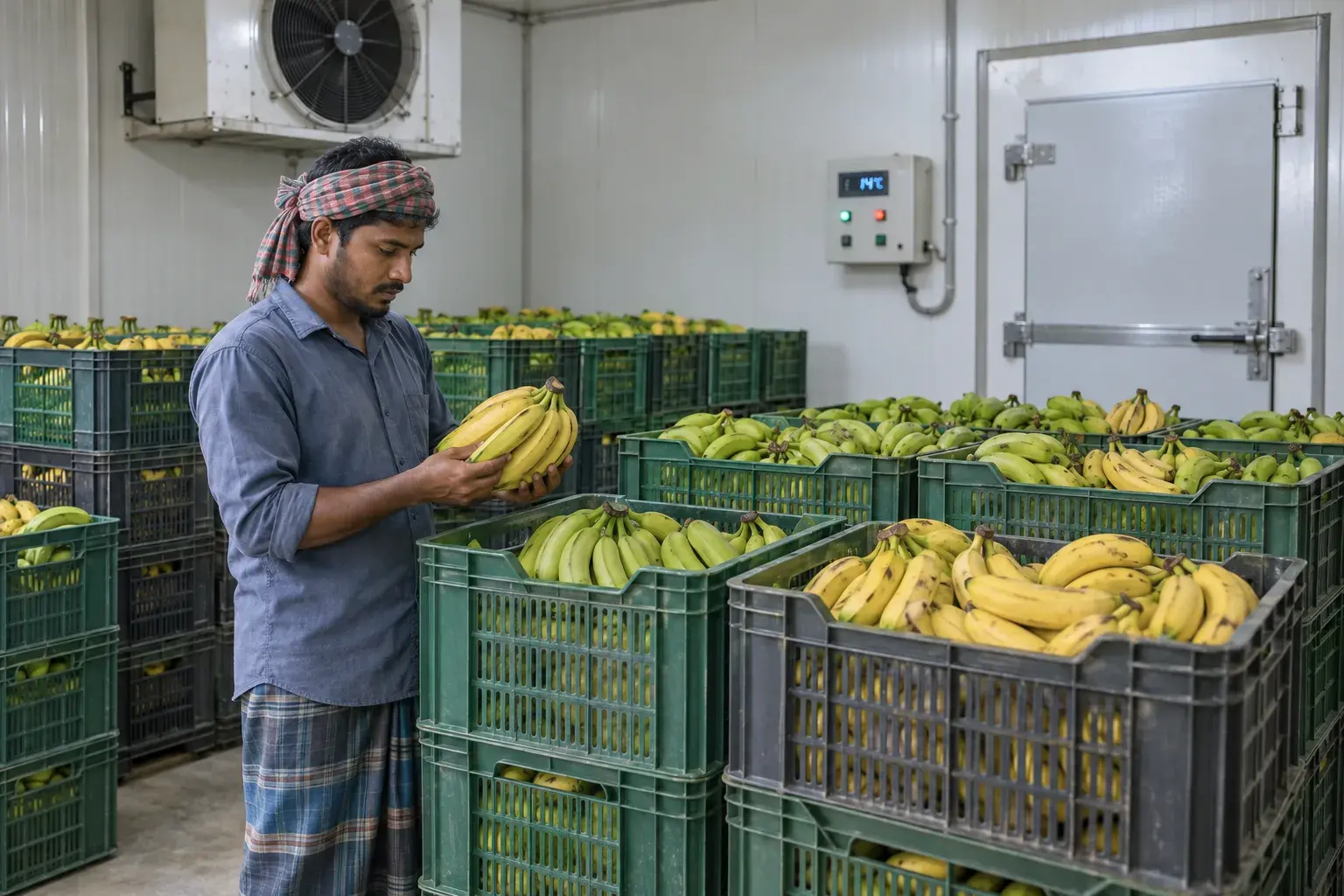
Banana ripening chamber
- Starting capital
- ৳2,00,000 – ৳20,00,000 Editorial estimate
- Manpower
- 2 – 8 people
- First sale
- 30 – 90 days Editorial estimate
- Break-even
- 5 – 10 months Editorial estimate
- Kind of work
- Workshop · Medium difficulty
About the business
Buying green bananas, ripening them under control in a closed room, and selling them on to wholesalers or shops. Bananas are cut green because ripe fruit will not survive handling, so somewhere along the way someone has to ripen them, and that step is the business. The law here is clear and hard. Section 23 of the Food Safety Act, 2013 names calcium carbide as a chemical harmful to human health, bars its use in food, and bars storing, marketing or selling food it has been used on. Section 60 makes the offence cognizable and non-bailable, and section 78(6) bars settling it with an administrative fine - the case goes straight to the Food Court. The Food Safety Authority's position on ethylene and ethephon is different: its then chairman said ethephon within the prescribed limit is accepted worldwide and that residues fall below the regulated level within 24 hours of application, and that carbide is banned mainly because of the health risk to the person applying it. One route is banned by name in the statute and the other is regulated, and that difference is the whole basis of the chamber business. One warning: what a chamber costs to build, what a bunch of green bananas costs, and what ripe bananas sell for - none of these three could be found in a reliable Bangladeshi source, so this page carries no financial figures.
Unit economics
| Item | Range | Evidence | Suggest a correction |
|---|---|---|---|
| Monthly working capital | ৳1,00,000 – ৳7,00,000 | Editorial estimate | |
| Selling price | ৳70 – ৳110 / unit | Editorial estimate | |
| Variable cost | ৳60 – ৳85 / unit | Editorial estimate | |
| Gross margin | 14% – 23% | Editorial estimate | |
| Time to first revenue | 30 – 90 days | Editorial estimate | |
| Break-even time | 5 – 10 months | Editorial estimate | |
| Cash cycle | 5 – 30 days | Editorial estimate | |
| Waste / loss | 5% – 12% | Editorial estimate | |
| Daily capacity | 300 – 2,000 | Editorial estimate |
What you need to start
- Temperature and humidity instruments, a means of applying ethylene, racks or crates to stack the fruit, and fans to move the air. Equipment prices could not be verified here.Equipment
- Bangladesh Food Safety Authority registration: Tk 1,000 new, Tk 500 renewal, valid three years, under the Food Safety (Registration and Licensing) Regulations, 2026. Whether a chamber needs a separate licence must be confirmed with the district food safety officer.Licence
- Compliance with section 23 of the Food Safety Act, 2013: using calcium carbide, and storing, marketing or selling food treated with it, is prohibited. Under section 60 the offence is cognizable and non-bailable, and under section 78(6) it cannot be settled by administrative fine.Licence
- Trade licence from the union parishad, municipality or city corporation: form Tk 10, licence book Tk 50, standard tax Tk 30, stamp Tk 150-300, licence fee Tk 100-60,000 by trade type.Licence
- Reading how long each bunch will take and batching accordingly, and holding the room's temperature and humidity. If a batch does not ripen evenly, half the load goes cheap.Skill
- A standing link with growers or a green banana arot in a banana area, and a legitimate supplier of ethylene or an approved ripening agent.Supplier
- An insulated room that holds air, with a sealing door and a way to vent the gas afterwards. The size and build cost could not be verified here.Workspace
How the work is done
- 1Decide first whether you will buy the bananas and ripen them, or ripen other people's fruit for a fee. The risks differ: buy and the price risk is yours, ripen for a fee and it is not.
- 2Pick a banana area. An upazila like Madhupur had 2,660 hectares under banana in one season, so green fruit is close by and comes steadily.
- 3Build a room that holds air: insulated walls and roof, a door that seals, and instruments to read temperature and humidity inside. If the air leaks the gas does nothing.
- 4Take the trade licence from the union parishad or municipality and register with the Bangladesh Food Safety Authority - Tk 1,000, renewal Tk 500, valid three years.
- 5Go to the district food safety officer and get it in writing: at what dose ethylene or ethephon may be used, and whether your chamber needs a separate approval. This could not be verified here, so you must get it from the office yourself.
- 6Do not even keep calcium carbide on the premises. Section 23 also makes storing food treated with it an offence, and carbide in the next room becomes the evidence in a raid.
- 7When buying, check the age and size of the bunch. Fruit cut too young does not ripen in the chamber, it only goes soft.
- 8Once the room is loaded, write down temperature, humidity and time for every batch. Which batch ripened how fast, in your own notebook, becomes your own recipe within a few months.
- 9Have the sale arranged for the day the fruit comes out. Ripe bananas last a day or two; left standing they are a total loss.
- 10Fix weekly quantities with wholesalers and shopkeepers, and put the payment dates in writing.
- 11Sell your chamber's fruit as ripened without carbide. That is your only distinct claim to a buyer, and any price difference will come from it.
Seasons
- JanNormal
- FebNormal
- MarNormal
- AprNormal
- MayNormal
- JunNormal
- JulNormal
- AugNormal
- SepNormal
- OctNormal
- NovNormal
- DecNormal
Where it works well
- Strong fitDhaka · The country's biggest fruit market and wholesale trade is here, and since ripe fruit must be sold the day it leaves the chamber, being near the market matters.
- Strong fitTangail · Madhupur upazila alone had 2,660 hectares under banana in one season, so green fruit is steady and close, with the Dhaka market a few hours away by road.
- PossibleBogura · The trading centre of the north with big fruit arots, from where northern bananas are distributed.
- PossibleChapai Nawabganj · Known as a fruit district, with the arots and transport for mango and banana already in place.
- PossibleChattogram · A large city market with supermarkets, and where the hill districts' bananas land.
- PossibleGazipur · Adjoining Dhaka, with strong banana demand among factory workers, and Madhupur fruit passes this way.
- PossibleJhenaidah · Known as a banana growing area with the Khulna and Jashore markets close by, though acreage for this district could not be verified here.
- PossibleMeherpur · A border farming district where bananas are grown, though the acreage could not be verified here.
- PossibleNarsingdi · Next door to Dhaka with large fruit and vegetable arots; the short run to the city means less loss on ripe fruit.
- PossibleRangpur · Farming country with cheap land and labour, though the big markets are far and transport losses are higher.
Risks and cautions
- HighCompliance: Calcium carbide is prohibited by name in section 23 of the Food Safety Act, 2013, and not only its use: storing, marketing and selling food treated with it are offences too. Section 60 makes it cognizable and non-bailable and section 78(6) bars settling it with an administrative fine, so the case goes to the Food Court. Entering this business means the cheap route is closed to you while many competitors are still on it.
- HighSpoilage: Ripe bananas last a day or two. Not sold the day they leave the chamber, they soften and the price halves. If temperature or humidity slips in one batch the whole room ripens unevenly - some stays green, some goes over, and both have to go cheap.
- HighWorking capital: Green bananas are bought for cash from the grower or the arot, and the money comes back from shopkeepers after ripening, often on credit. In between the money sits in the chamber, and if the fruit does not ripen properly it does not come back at all. An idle chamber is worse still: the cost of the room is spent whether it is full or not.
- MediumDemand: Whether buyers will pay more for fruit ripened without carbide is unproven. The two look identical on the stall and a customer has no way to tell them apart. Until buyers or supermarkets can see the difference, a compliant chamber has to sell at an unregulated competitor's price.
- HighOther: This page publishes no financial figures because no reliable Bangladeshi source was found for the cost of building a chamber, the buying price of green bananas or the selling price of ripe ones. The capital range shown is an editorial estimate, not a quotation or a shop price. Before putting money in, get three numbers yourself: a builder's quotation for the chamber, the green rate at a banana arot, and the wholesale rate for ripe fruit.
Sources
- Collected: 16 Sept 2026
Supports: Starting capital · বাংলাদেশ
সিটি কর্পোরেশন থেকে ট্রেড লাইসেন্স প্রাপ্তির ধাপ সমূহ
Collected: 16 Sept 2026Supports: Starting capital · বাংলাদেশ
All food businesses now need safety registration
Collected: 22 Jul 2026Supports: Starting capital · বাংলাদেশ
What changed
No corrections have been published yet.
Questions and answers
No questions yet. Be the first to ask.
Similar businesses
 Food processing
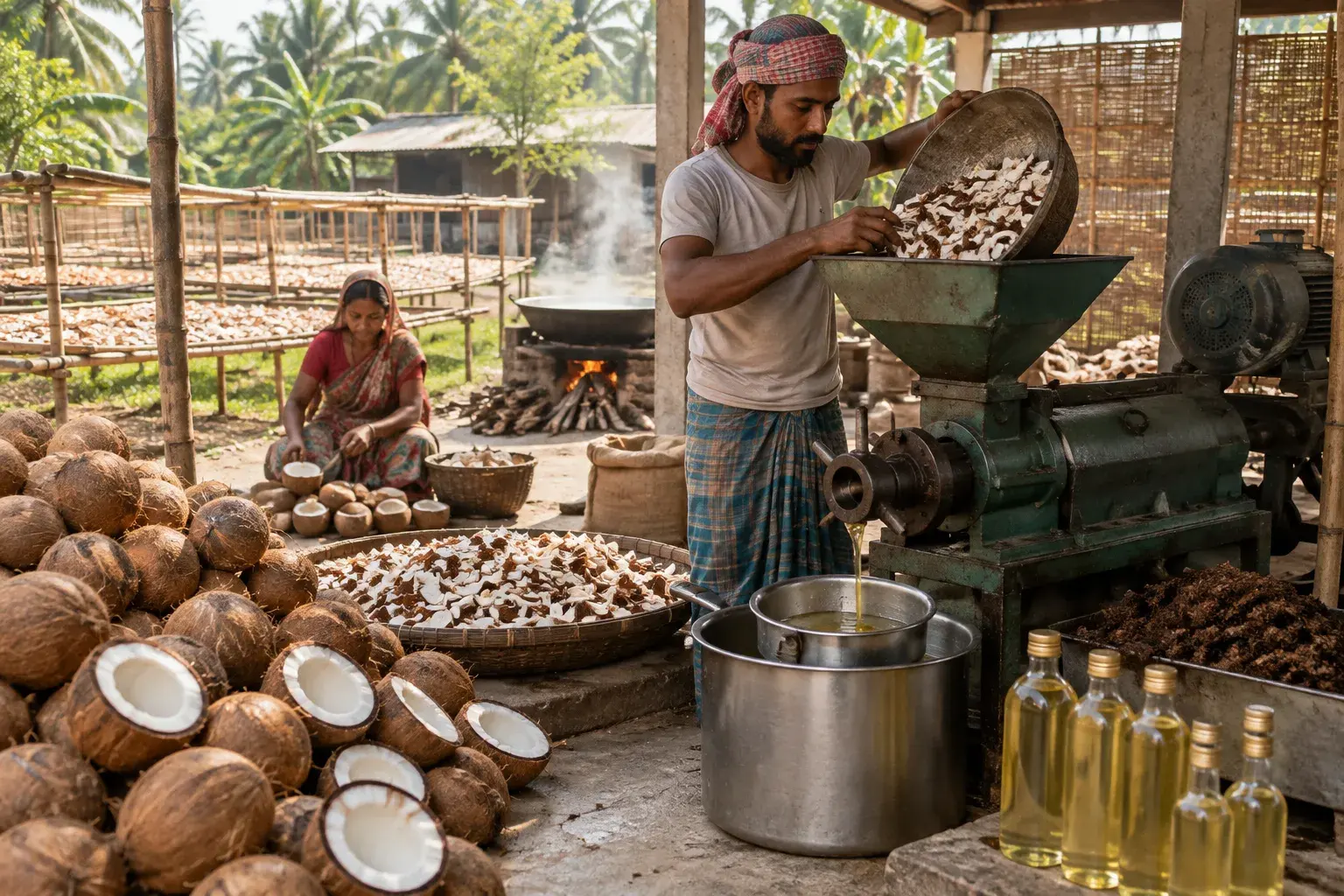
Coconut oil making
Turning coconuts into copra and crushing it for oil. Ordinary coconut oil sells at Tk 800-1,000 a litre and virgin at Tk 2,420-3,180, and both need a BSTI CM licence.
- Capital
- ৳2 lakh – ৳12 lakh
- People
- 2 – 8
- First income
- 45 – 150 days
 Food processing
Cake and pastry shop
Baking cakes, pastries and cupcakes for the counter and to order. The display case carries the spoilage risk; the decorated order cakes carry the margin.
- Capital
- ৳2 lakh – ৳15 lakh
- People
- 2 – 10
- First income
- 30 – 90 days
 Food processing
Cattle feed mill
Grinding and blending bran, broken rice and cake into granular cattle feed for farmers. Company feed is Tk 55-60/kg while inputs run Tk 38-62/kg, so the gap is thin. Operating without a DLS licence carries a Tk 50,000 fine.
- Capital
- ৳2 lakh – ৳15 lakh
- People
- 2 – 8
- First income
- 30 – 75 days
 Food processing
Coffee shop
An espresso machine and imported beans. A cup sells from Tk 50 to Tk 400, but a shop moves 70-100 cups a day - customers sit for hours over a single cup.
- Capital
- ৳2.3 lakh – ৳25 lakh
- People
- 2 – 8
- First income
- 30 – 90 days