
Bedsheet and home textile
Weaving bed sheets and home textiles on power looms for the wholesale haats. One loom makes 8-15 pieces a day, and a plain double bed sheet set retails at Tk 389-489.
- Last reviewed: 19 September 2026
- Version 1
Bedsheet and home textile
- Starting capital
- ৳1,50,000 – ৳15,00,000 Editorial estimate
- Manpower
- 3 – 12 people
- First sale
- 30 – 75 days Editorial estimate
- Break-even
- 13 – 21 months Editorial estimate
- Kind of work
- Workshop · Hard
About the business
Bed sheets, pillow covers, curtains and gamcha are woven on power looms and sold at wholesale haats. The biggest is Shekherchar-Baburhat in Narsingdi, with about 5,500 wholesale shops in domestic cloth trading three days a week - Thursday, Friday and Saturday. The traders' association puts turnover at around Tk 400 crore per haat and Tk 2,000-2,500 crore over the Eid season. Bed sheets and curtain cloth come to this haat alongside sarees and lungi, and several lakh looms have grown up around it across Narsingdi, Narayanganj and Gazipur. The other centre is Sirajganj, where the Handloom Board counts about five lakh looms across nine upazilas supporting roughly ten lakh people. The labour arithmetic is simple: each loom needs three to four workers, and one weaver on one loom turns out eight to fifteen pieces a day. The risk is not hidden. Yarn rises while cloth does not: in April 2026 Sirajganj weavers said a lungi that sold for Tk 220-240 at Eid-ul-Fitr had dropped to Tk 180-200 afterwards, while one dope of yarn had gone from Tk 15,000 to Tk 22,000. On top of that comes load-shedding, which roughly quadruples the cost of running on a generator and halves output. The selling side is clear enough: on 16 September 2026 Rokomari listed a plain cotton double bed sheet with two pillow covers at Tk 389-489, with branded sheets running from Tk 2,000 to Tk 4,150.
Unit economics
| Item | Range | Evidence | Suggest a correction |
|---|---|---|---|
| Monthly working capital | ৳1,25,000 – ৳7,30,000 | Editorial estimate | |
| Selling price | ৳389 – ৳1,339 / unit | Market quote | |
| Variable cost | ৳300 – ৳820 / unit | Editorial estimate | |
| Gross margin | 23% – 39% | Editorial estimate | |
| Time to first revenue | 30 – 75 days | Editorial estimate | |
| Break-even time | 13 – 21 months | Editorial estimate | |
| Cash cycle | 15 – 45 days | Editorial estimate | |
| Waste / loss | 3% – 7% | Editorial estimate | |
| Daily capacity | 8 – 15 | Practitioner verified |
What you need to start
- Power looms, shuttles and spares, a winder for bobbins, dyeing vessels and drying arrangements. Spares are imported; a Korean shuttle has gone as high as Tk 1,300.Equipment
- Yarn: 60-count at Tk 293-295 a pound on 20 October 2024, and in April 2026 Sirajganj weavers said a dope of yarn that cost Tk 15,000 last year is now Tk 22,000. Plus dyes and chemicals.Starting stock
- Trade licence from the union parishad, municipality or city corporation: form Tk 10, licence book Tk 50, standard tax Tk 30, stamp Tk 150-300, licence fee Tk 100-60,000 by trade type, issued in 3-5 working days.Licence
- Running and repairing a loom, dyeing yarn, and reading which designs the haat wants. Finding skilled weavers is now the hardest part, because low piece rates are driving them out of the trade.Skill
- A yarn arot and a dye supplier, and at least two arotdars at the wholesale haat to sell through.Supplier
- A shed with a power connection, dry storage for yarn, and open space for dyeing and drying.Workspace
How the work is done
- 1Decide which haat you will sell into. Baburhat trades on Thursday, Friday and Saturday, and those three days are your selling week.
- 2Go to that haat and see which designs are moving and what the arotdars are paying. Cloth in the wrong design simply sits.
- 3Take the trade licence from the union parishad or municipality.
- 4Get in touch with the local loom owners' association. The district branch of the Bangladesh Handloom and Power Loom Owners Association tracks yarn rates and market news.
- 5Fix the shed: a power connection, dry storage for yarn, and an open yard for dyeing and drying.
- 6Write down the yarn rate before you buy. On 20 October 2024, 60-count yarn was Tk 293-295 a pound against Tk 275-280 two months earlier, and it moves Tk 7-8 at a time.
- 7Get the looms, shuttles and spares. The spares are imported too: a Korean shuttle went from Tk 1,020 to Tk 1,300 in six weeks.
- 8Budget three to four workers per loom, covering dyeing, drying, winding onto bobbins and weaving.
- 9Plan for load-shedding now. Running the looms on a generator costs about four times as much and halves output, and the workers still have to be paid.
- 10Decide early whether you will market under your own name or sell grey cloth to companies. Many Tamai weavers do both.
- 11Lift output before Eid, Puja and Ramadan, when the most money moves through the haat.
- 12Be ready for the price to fall right after Eid. In 2026 lungi prices dropped 15-20 percent once Eid-ul-Fitr passed.
Seasons
- JanNormal
- FebHigh
- MarHigh
- AprNormal
- MayHigh
- JunNormal
- JulNormal
- AugNormal
- SepNormal
- OctHigh
- NovHigh
- DecHigh
Where it works well
- Strong fitGazipur · Several lakh looms have grown up here alongside Narsingdi and Narayanganj around Baburhat.
- Strong fitNarayanganj · A large share of the looms feeding Baburhat sit here, with yarn and dye suppliers close at hand.
- Strong fitNarsingdi · Shekherchar-Baburhat has about 5,500 wholesale shops in domestic cloth; bed sheets and curtain cloth come here, and about Tk 400 crore changes hands every haat.
- Strong fitSirajganj · The Handloom Board counts about five lakh looms across nine upazilas supporting ten lakh people, with roughly two lakh looms in Belkuchi, Shahjadpur and Enayetpur alone.
- PossibleChattogram · Large city retail and wholesale demand, but far from the weaving belt.
- PossibleDhaka · The country's biggest retail market and where branded sheets sell, though factory space and power cost more.
- PossiblePabna · Next to the Sirajganj weaving belt, and Tamai's factories draw workers from Pabna, so the skills are here.
- PossibleSylhet · Remittance families have more to spend, so the market for costlier sheets is relatively good.
- PossibleTangail · An old weaving district whose sarees are a regular part of Baburhat's stock.
- Weak fitRangpur · Workers from here go to weave in Sirajganj - the skills exist, but the factories, the yarn arot and the haat do not.
Risks and cautions
- HighWorking capital: Yarn rises and cloth does not. In April 2026 Sirajganj weavers said a dope of yarn that cost Tk 15,000 last year is now Tk 22,000, while a lungi that sold for Tk 220-240 at Eid-ul-Fitr had fallen to Tk 180-200 afterwards. Yarn bought dear and woven into cloth sold cheap is a loss you carry alone.
- HighDependency: Load-shedding eats production directly. In April 2026 output in Sirajganj factories had halved, and running the looms on a diesel generator was costing about four times as much. The workers are paid whether the looms run or not.
- HighDemand: Sales rest on Eid, Puja and Ramadan. Baburhat turns over Tk 2,000-2,500 crore in the Eid season and prices fall 15-20 percent the moment it passes. Overproduce before a season that does not arrive and the cloth sits in the store.
- HighOther: Labour is running out. Each loom needs three to four workers, but where ten used to work in Sirajganj there are now six. Weavers say the workers want higher rates and yarn prices leave no room to pay them, and that squeeze is what closes the factories.
- MediumLate payment: Money from an arotdar does not come in one lot. Baburhat trades three days a week and you chase the balance at the next haat. There is no written rule on how long payment takes, so the safe move is to start with a small consignment.
Sources
What changed
No corrections have been published yet.
Questions and answers
No questions yet. Be the first to ask.
Similar businesses
 Light manufacturing & workshop
Small shoe making unit
A small unit making sandals and shoes for wholesalers. Sandals sell at Tk 250-700 and leather shoes at Tk 1,200. Bhairab alone has 3,500-5,000 units employing about 25,000 people.
- Capital
- ৳1.5 lakh – ৳10 lakh
- People
- 4 – 20
- First income
- 30 – 90 days
 Light manufacturing & workshop
Thai glass and aluminium fitting
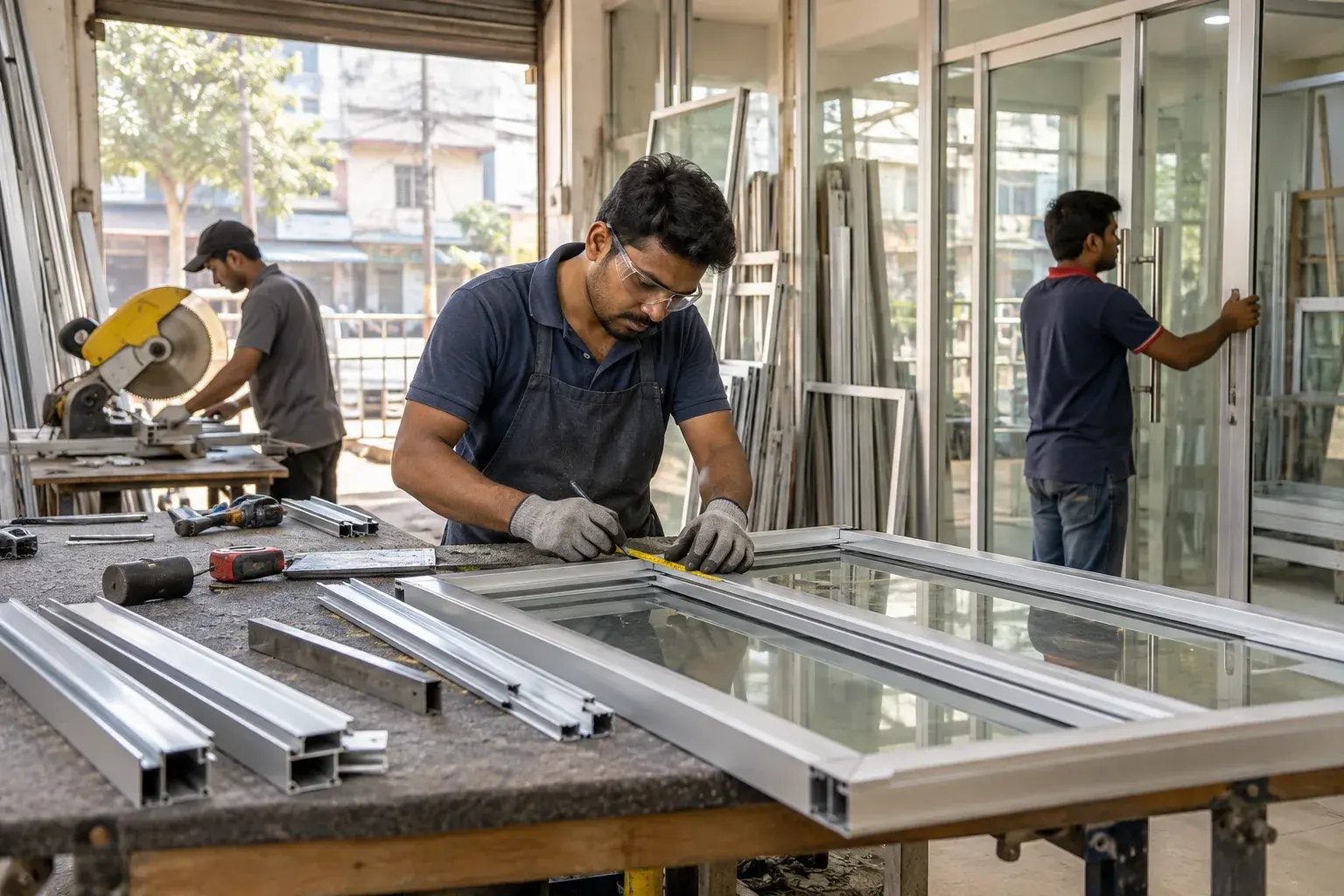
Cutting and fitting aluminium profile and glass into doors, windows and partitions. Ordinary work is about Tk 470-750 per square foot, and a wrong measurement cannot be returned.
- Capital
- ৳1.5 lakh – ৳6 lakh
- People
- 2 – 6
- First income
- 20 – 60 days
 Light manufacturing & workshop
Notebook making
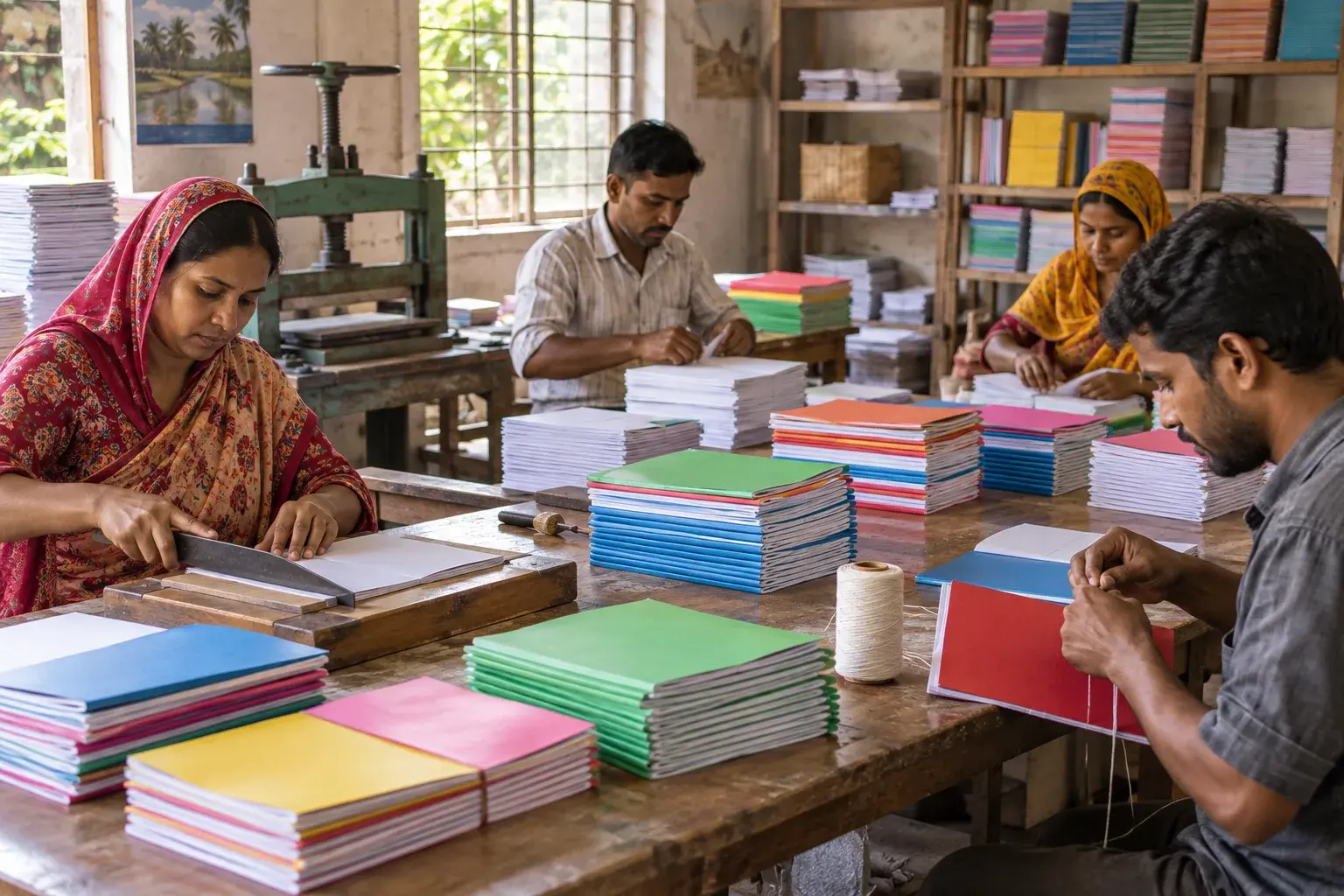
Cutting, folding and binding paper into exercise books. A 300-page khata sells online at Tk 169 and a 120-page one at Tk 75, while a packet of paper costs Tk 100-150 more than a year ago.
- Capital
- ৳1.5 lakh – ৳7 lakh
- People
- 3 – 15
- First income
- 15 – 45 days
 Light manufacturing & workshop
Agarwood attar distilling
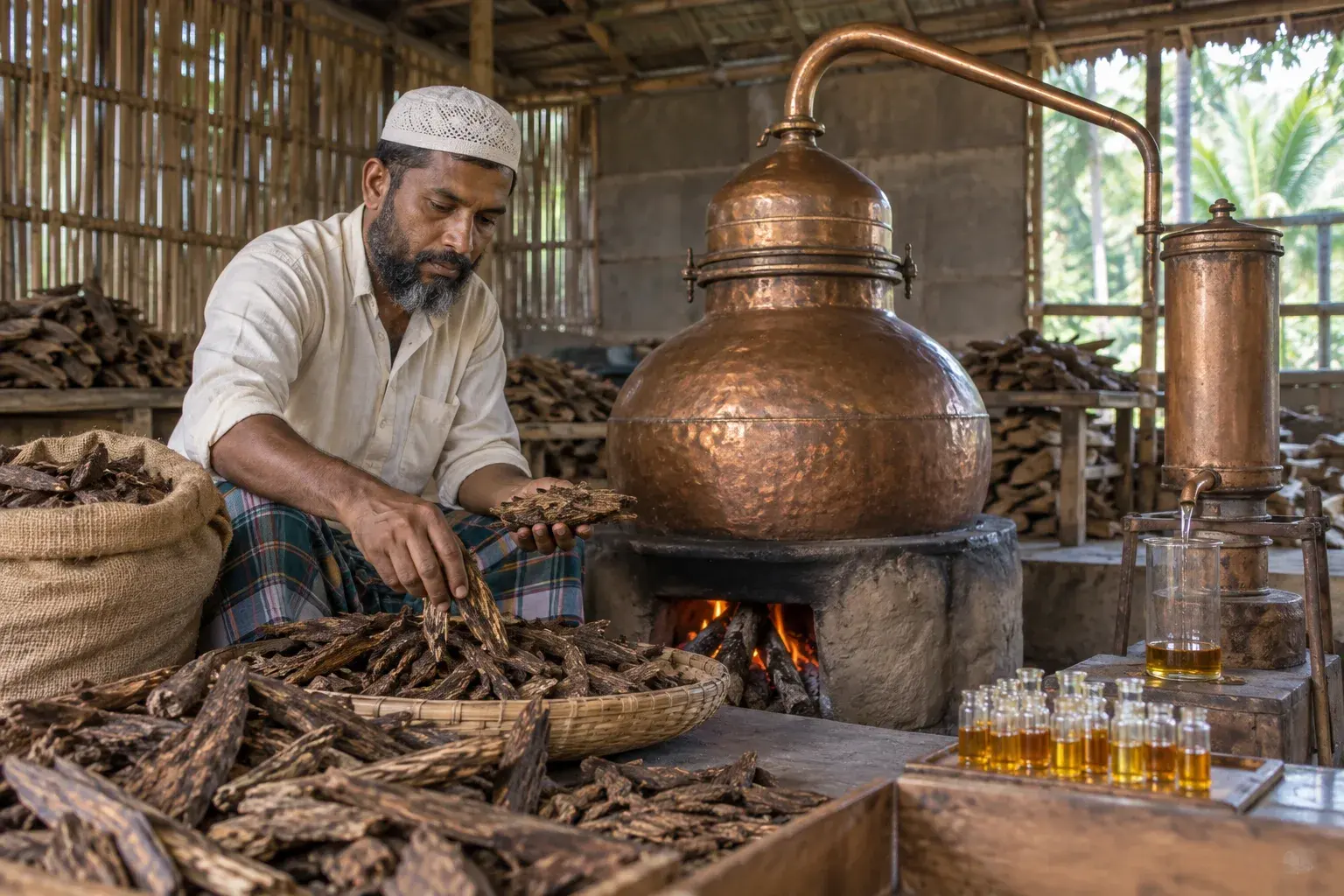
Soaking and boiling agarwood to draw off fragrant attar. Barlekha's Sujanagar has about 250 units, attar sells at Tk 6,000-10,000 a tola by grade, and nearly all of it is exported.
- Capital
- ৳1.5 lakh – ৳10 lakh
- People
- 3 – 15
- First income
- 2,555 – 10,950 days