
Beekeeping and honey
Keeping bees in boxes and harvesting honey. Honey runs Tk 650-1,200 a kg depending on the flower, but bottling under your own name needs BSTI certification with a Tk 7,500 test fee.
- Last reviewed: 19 September 2026
- Version 1

Beekeeping and honey
- Starting capital
- ৳60,000 – ৳5,00,000 Editorial estimate
- Manpower
- 1 – 6 people
- First sale
- 30 – 135 days Editorial estimate
- Break-even
- 6 – 14 months Editorial estimate
- Kind of work
- Farm · Hard
About the business
Keeping bees in wooden boxes and taking the honey. In Bangladesh it happens in two quite different ways. The first is migratory: the boxes travel, standing beside mustard fields in winter, litchi orchards in spring, then black cumin or coriander. The bees bring in the nectar, the keeper hauls the boxes from one field to the next, and when the flowering ends the colony has to be fed sugar syrup to survive. The second is Sundarbans honey, where collectors go into the forest in groups and cut natural combs. That is gathering, not keeping, and it cannot be done without Forest Department permission. Price follows the flower. On 16 September 2026 online listings ran mustard flower honey at Tk 650 a kg, litchi at Tk 700, black cumin at Tk 1,150, kholisha at Tk 1,150 and Sundarbans honey at Tk 1,200, while the government's own e-commerce platform sold Palli Modhu at Tk 450 for 500g, which is Tk 900 a kg. Bottling it under your own name brings rules: honey is on BSTI's mandatory certification list (BDS 1039:2022), the sample test fee is Tk 7,500, and the licence takes 19 to 94 working days. Selling loose to a trader needs none of that, but fetches roughly half. That is the real fork in this business: whether your own name goes on the bottle.
Unit economics
| Item | Range | Evidence | Suggest a correction |
|---|---|---|---|
| Monthly working capital | ৳25,000 – ৳2,00,000 | Editorial estimate | |
| Selling price | ৳580 – ৳1,200 / kg | Market quote | |
| Variable cost | ৳250 – ৳450 / kg | Editorial estimate | |
| Gross margin | 57% – 63% | Editorial estimate | |
| Time to first revenue | 30 – 135 days | Editorial estimate | |
| Break-even time | 6 – 14 months | Editorial estimate | |
| Cash cycle | 30 – 150 days | Editorial estimate | |
| Waste / loss | 5% – 15% | Editorial estimate | |
| Daily capacity | 2 – 22 | Editorial estimate |
What you need to start
- Wooden hives and frames, wax foundation, a honey extractor, strainers, a smoker, veil and gloves, and food-grade containers or bottles. Prices could not be verified here.Equipment
- Sugar to feed the colonies through the dearth season, at Tk 110-115 a kg (TCB, 15 September 2026). How much sugar per box could not be verified here.Starting stock
- Packaged-commodity registration certificate from BSTI's Metrology Wing under the Weights and Measures Standards Act 2018, required when a declared weight is sold in a bottle. Selling without it carries up to Tk 20 lakh in fines and up to five years in prison. The fee could not be verified.Licence
- Food Safety Authority registration as a packaged food producer: Tk 1,000 new, Tk 500 renewal, valid three years.Licence
- Collecting honey in the Sundarbans requires Forest Department permission, with passes for collectors and a fixed season. The fee, validity and application process could not be verified here and must be checked with the divisional Forest Office.Licence
- Trade licence from the city corporation, municipality or union parishad: form Tk 10, licence book Tk 50, standard tax Tk 30, stamp Tk 150-300, licence fee Tk 100-60,000, issued in 3-5 working days.Licence
- BSTI CM licence. Honey is item 34 on the mandatory list (BDS 1039:2022). New application fee Tk 1,000, sample test Tk 7,500 over 14 working days or Tk 15,000 urgent over 4, and an annual CM fee of 0.10 percent of production value with a Tk 3,500 floor. Required as soon as it is bottled under a brand.Licence
- Recognising and replacing the queen, preventing swarming, spotting disease and mites, and knowing when the honey is ready. Starting without training usually means losing colonies in the first season.Skill
- An understanding with the owners of the flowering land to place boxes in mustard, litchi, black cumin or coriander fields, and a truck or van to move them.Supplier
How the work is done
- 1Decide which path: moving boxes from field to field, or collecting in the Sundarbans. The skills, the costs and the law are entirely different for the two.
- 2Take hands-on beekeeping training. BSCIC and the Department of Agricultural Extension run beekeeping courses; ask the local office where and when.
- 3Start with a few boxes. Adding boxes before you know how many you can handle in a season kills colonies, and a dead colony costs more than the box did.
- 4Build a flowering map: which flower opens in which district in which month, and settle with the landowner in advance. Turning up in season to look for a spot does not work.
- 5Arrange the haulage: truck or van, night movement, and keeping the boxes cool on the road. Moving the boxes is the riskiest part of the job.
- 6Set sugar aside for the months after the flowering ends. Colonies have to be fed syrup to survive, and sugar is now Tk 110-115 a kg, which is the main cost of the empty season.
- 7Get an extractor, strainers and clean containers. Honey with too much moisture ferments and loses its price.
- 8Decide early whether you sell loose to a trader or in your own bottle. The trader pays cash but pays less; bottling gets close to double, but needs the licence and the testing.
- 9To sell in bottles, take the trade licence, trademark registration and Food Safety Authority registration (Tk 1,000, three years).
- 10Apply to BSTI for the CM licence: Tk 1,000 application fee, Tk 7,500 to test the honey sample (Tk 15,000 urgent), and an annual CM fee of 0.10 percent of production value with a Tk 3,500 floor.
- 11Take the packaged-commodity registration certificate from BSTI's Metrology Wing; it is required the moment a weight is printed on the bottle.
- 12Record the flower, the date and the place of every batch. When a buyer asks which flower the honey came from, that written record is what makes the price difference.
Seasons
- JanHigh
- FebHigh
- MarHigh
- AprHigh
- MayNormal
- JunNormal
- JulLow
- AugLow
- SepLow
- OctLow
- NovNormal
- DecHigh
Where it works well
- Strong fitBagerhat · The eastern Sundarbans, source of kholisha and goran honey, where the Sundarbans name alone lifts the price to Tk 1,150-1,200 a kg.
- Strong fitDinajpur · The litchi district: boxes travel here for the spring blossom, and litchi flower honey sells at Tk 700 a kg.
- Strong fitKhulna · The collection and marketing centre for Sundarbans honey, with small bottling operations based here.
- Strong fitSatkhira · The western Sundarbans, where the collectors' villages are and where the Forest Department permissions are handled.
- Strong fitSirajganj · Extensive mustard and black cumin on the Jamuna chars, one of the main winter box-placing areas.
- Strong fitTangail · Large areas under mustard in winter, and close enough to Dhaka to haul boxes easily.
- PossibleFaridpur · Good mustard and black cumin acreage, with the Dhaka market close.
- PossibleJashore · Heavy flower and vegetable cultivation, and close to the Khulna bottlers.
- PossibleMagura · Large mustard fields in winter, though with few local buyers the honey has to go out of the district.
- PossibleThakurgaon · Both litchi and mustard, with space easier to find than in Dinajpur.
Risks and cautions
- HighDependency: Income rests entirely on the flowering. Less mustard sown, litchi blossom dropping, or unseasonal rain and that season's honey does not come, while the cost of boxes, bees and labour still runs. If the landowner gives the spot to someone else you are left mid-season with boxes and nowhere to stand them.
- HighOther: Losing colonies is the biggest loss in this trade. Pesticide sprayed on the field wipes out a box in hours and the farmer does not warn you first. Disease, mites and swarming take colonies too, and replacing them costs both money and time, with no income in between.
- HighDemand: So much adulterated syrup is sold as honey that ordinary buyers do not trust even the real thing. The honest producer pays for that distrust, selling at Tk 650 a kg while tested, certified, bottled honey moves at Tk 1,150-1,200. Without BSTI certification that gap cannot be crossed.
- MediumCompliance: Bottling under your own name puts honey inside mandatory certification. The sample test alone is Tk 7,500, the licence takes 19-94 working days, and a failed sample means paying again. For a small keeper that cost and wait is the real barrier to the bottled market.
- MediumSpoilage: Honey extracted while still too moist ferments and sours and can no longer be sold as food, and dirty containers or sun exposure do the same. The damage shows up weeks later, not the same day, and by then the whole batch comes back.
Sources
- Collected: 16 Sept 2026
Supports: Starting capital · বাংলাদেশ
মেট্রোলজি উইং-এর আইনগত কার্যক্রম — ওজন ও পরিমাপ মানদণ্ড আইন, ২০১৮ এবং পণ্যমোড়কজাতকরণ নিবন্ধন সনদ
Collected: 16 Sept 2026Supports: Starting capital · বাংলাদেশ
সারণী-২: পণ্যের পরীক্ষণ ফি'র তালিকা, রসায়ন পরীক্ষণ উইং (ফুড, কেমিক্যাল ও হালাল ডিভিশন)
Collected: 16 Sept 2026Supports: Starting capital · বাংলাদেশ
সিএম লাইসেন্স প্রসেস ফ্লো (বাধ্যতামূলক পণ্য) — সেবা প্রোফাইল ও প্রসেস ম্যাপ
Collected: 16 Sept 2026Supports: Time to first revenue · বাংলাদেশ
- Collected: 16 Sept 2026
Supports: Starting capital · বাংলাদেশ
সিটি কর্পোরেশন থেকে ট্রেড লাইসেন্স প্রাপ্তির ধাপ সমূহ
Collected: 16 Sept 2026Supports: Starting capital, Time to first revenue · বাংলাদেশ
- Collected: 15 Sept 2026
Supports: Starting capital · ঢাকা মহানগর — সিপাহীবাগ, মিরপুর-৬, মোহাম্মদপুর টাউন হল, নিউমার্কেট, রামপুরা, মহাখালী বাজার
All food businesses now need safety registration
Collected: 22 Jul 2026Supports: Starting capital · বাংলাদেশ
What changed
No corrections have been published yet.
Questions and answers
No questions yet. Be the first to ask.
Stories about this business
250 hives, 2.5 to 3 lakh taka a year
Beekeeping since 2007, now about 250 colonies. Each box yields around 2 kg of honey per collection, and after all costs the year brings 2.5 to 3 lakh taka.
- Reasons
- Working capital, Strong network
Similar businesses
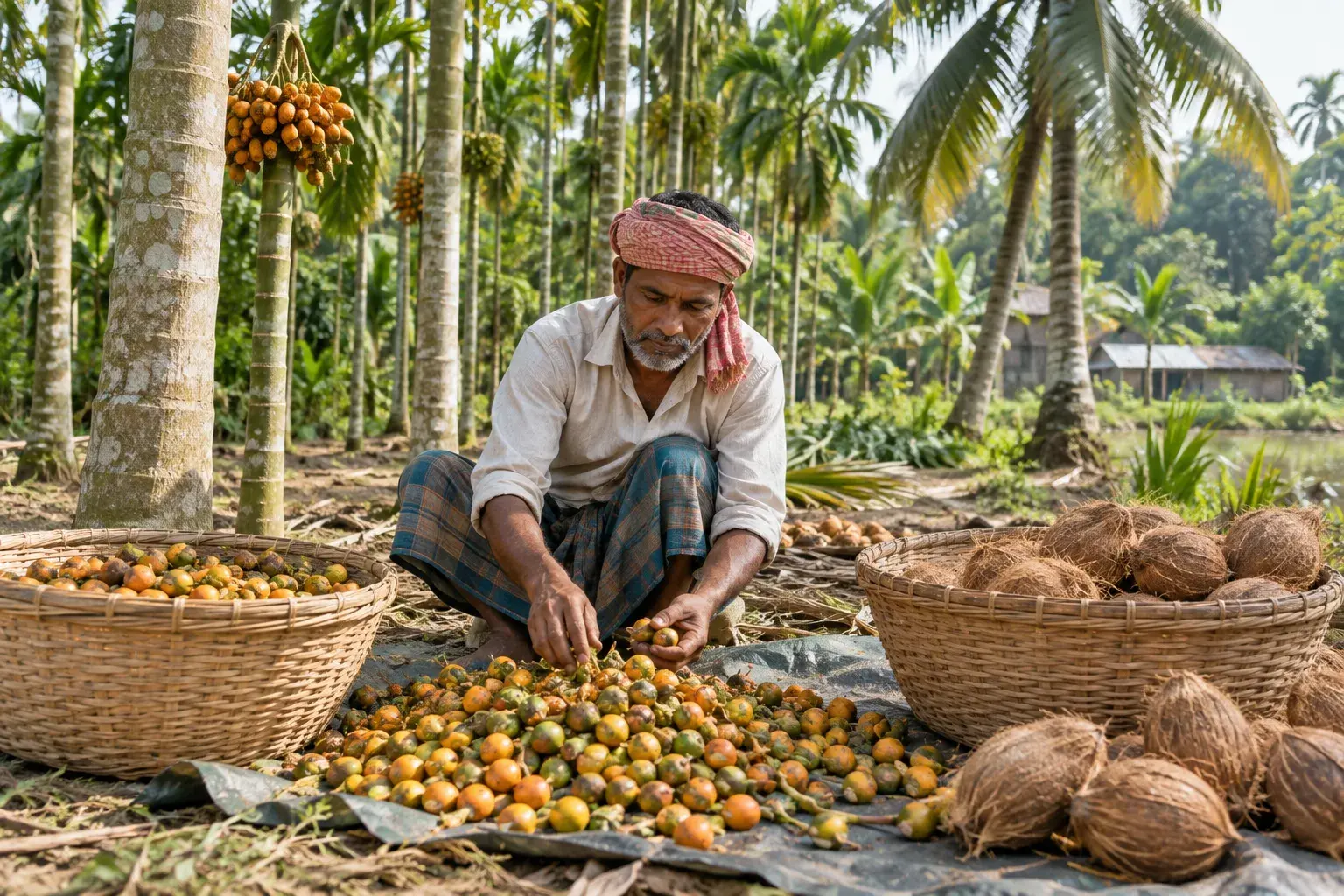 Agriculture & farming
Areca nut and coconut plantation
Areca and coconut planted together. Areca starts bearing in 4-5 years and coconut later still; a mature areca palm carries 200-500 nuts a year, and the Agriculture Information Service puts the profit at Tk 1-1.5 lakh an acre a year.
- Capital
- ৳60k – ৳5 lakh
- People
- 1 – 5
- First income
- 1,460 – 2,555 days
 Agriculture & farming
Poultry and duck hatchery
Setting eggs in an incubator and selling day-old chicks to farmers. Ducklings cost Tk 30-35 and sell at Tk 72-75, but chicken chick prices swing from Tk 25 to Tk 85 and back to Tk 5 within months.
- Capital
- ৳50k – ৳8 lakh
- People
- 2 – 15
- First income
- 28 – 60 days
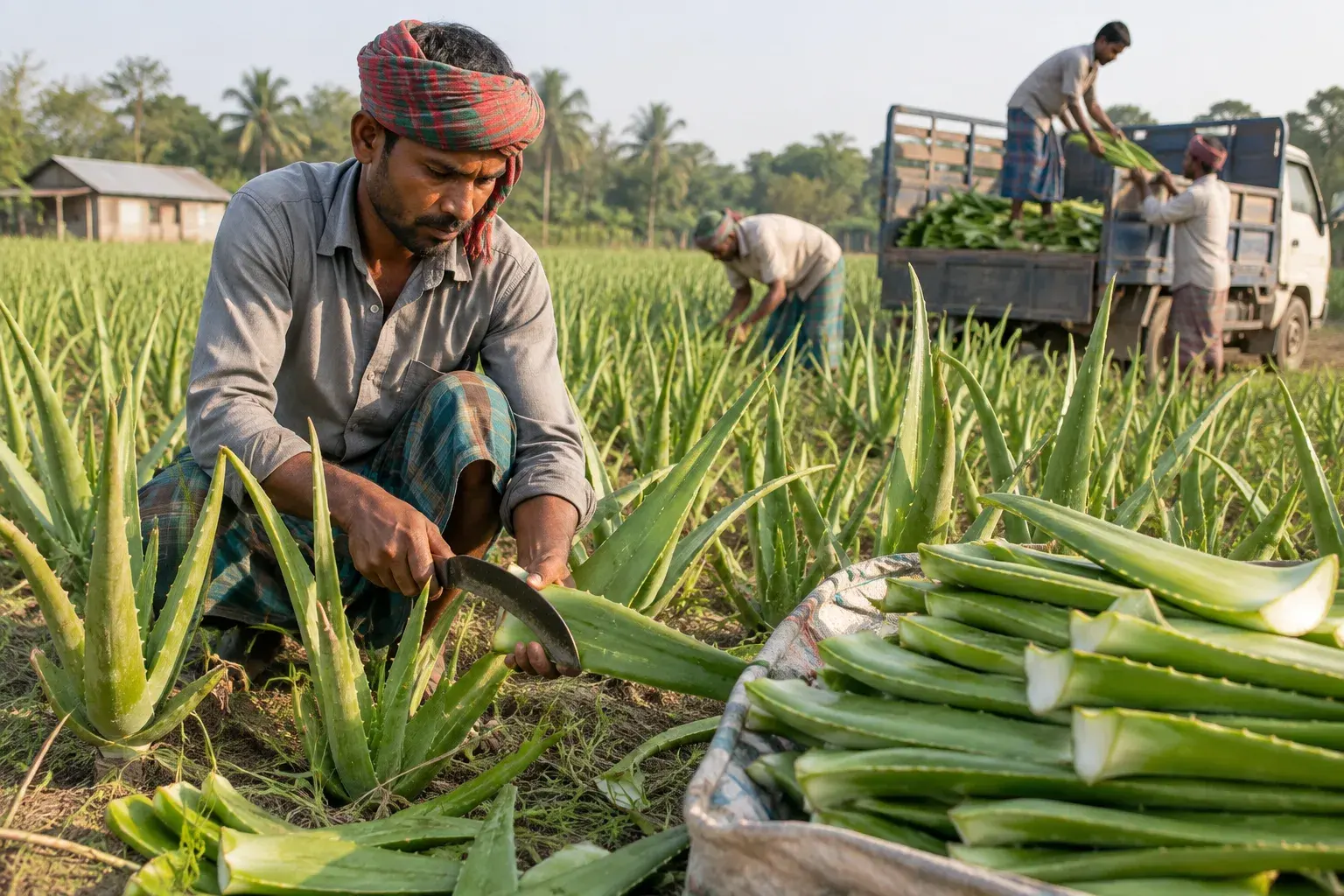 Agriculture & farming
Aloe vera farming
Cutting aloe leaves and selling them to companies. About Tk 50,000 a bigha to grow and Tk 1.5-2.5 lakh of leaves, but the only buyers are a few pharmaceutical and juice companies.
- Capital
- ৳50k – ৳2 lakh
- People
- 1 – 6
- First income
- 90 – 120 days
 Agriculture & farming
Milk collection and supply
Buying milk from farmers and delivering it to chilling centres and shops. Farmers get Tk 35-50 a litre and plants pay Tk 48-58; that gap is the business.
- Capital
- ৳50k – ৳4 lakh
- People
- 1 – 4
- First income
- 7 – 21 days