
Fodder grass cultivation
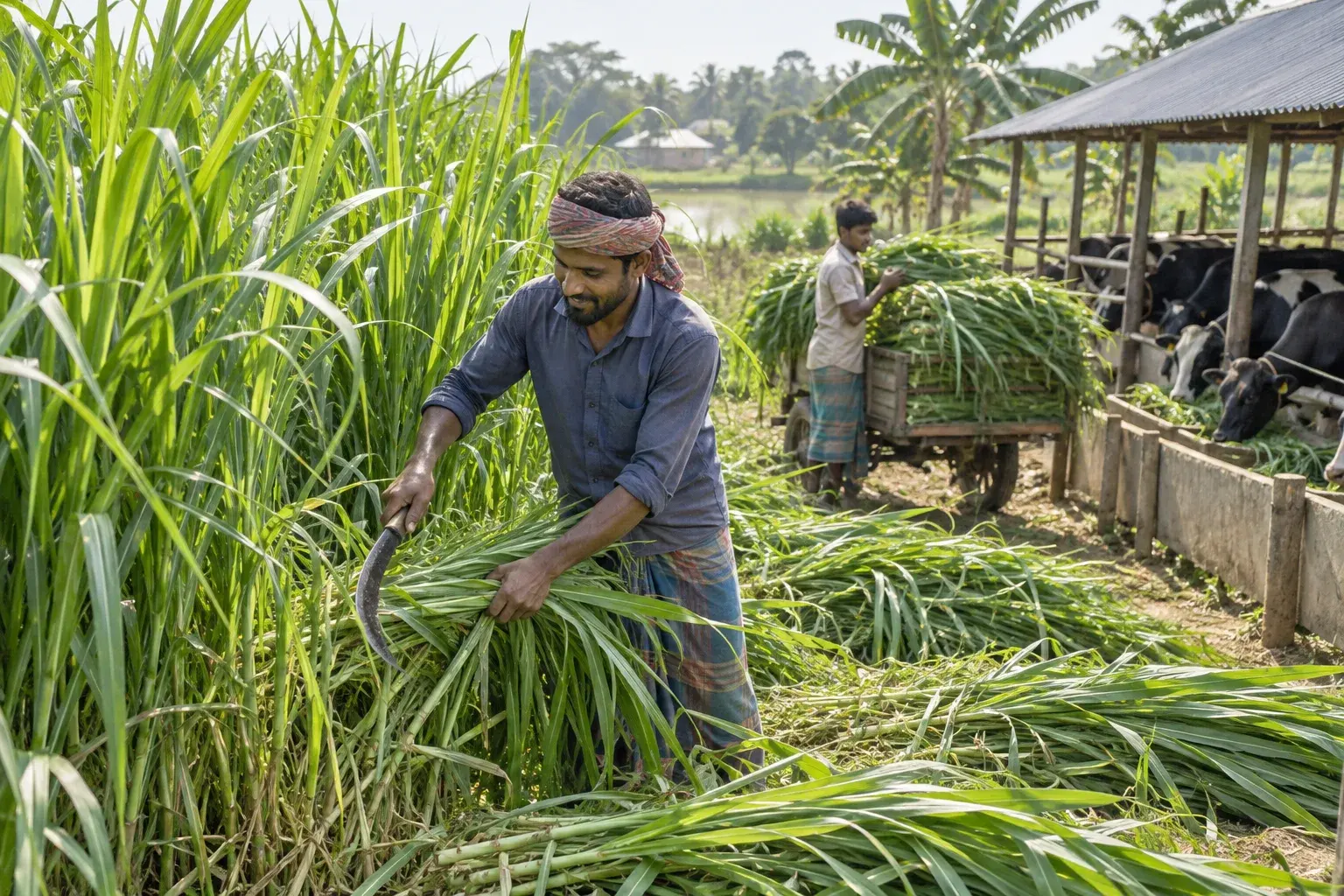
Growing napier fodder for cattle farms. One planting yields for four to five years with four to six cuts a year, and surplus grass off one bigha brings Tk 30,000-35,000 extra a year.
- Last reviewed: 19 September 2026
- Version 1
Fodder grass cultivation
- Starting capital
- ৳10,000 – ৳50,000 Editorial estimate
- Manpower
- 1 – 3 people
- First sale
- 50 – 70 days Practitioner verified
- Break-even
- 6 – 8 months Editorial estimate
- Kind of work
- Farm · Easy
About the business
Growing green fodder grass and selling it to cattle and dairy farms. Unlike paddy or maize this is not a one-season crop: one planting of napier stems keeps yielding from the same land for four to five years. The first cut comes about 50 days after planting, and after that the field can be cut four to six times a year. Reporting by the state news agency BSS on 2 June 2026 quotes Momdel Hossain of Badarganj saying that after feeding his own cattle he sells the surplus for an extra Tk 30,000-35,000 per bigha (30 decimals) a year; Solaiman Mondal of Kaliganj in Lalmonirhat makes Tk 200,000 a year off three bighas and has given up paddy. At Khamar Mor in Rangpur town grass is traded in bundles: the seller Sabur Ali buys a bundle from farmers at Tk 4 and sells it at Tk 9-10. That gap is the whole lesson of this business - sell straight to a farm and the money is yours, sell to a middleman and more than half of it stops there. Costs are light: fertiliser, pesticide and labour are far lower than for paddy, and the upazila livestock office gives improved napier cuttings free. Twenty days after planting, 50 kg of urea and 15 kg of TSP per acre is the main dose. Across the eight districts of Rangpur division the area grew from 4,040 acres in FY2023-24 to over 11,090 acres in FY2025-26. The single real risk is the buyer. Cut grass does not keep for more than a day or two, so the buyer has to be fixed before the knife goes in. And if the land is rented, the year's rent against the year's cuttings is the only sum that matters.
Unit economics
| Item | Range | Evidence | Suggest a correction |
|---|---|---|---|
| Monthly working capital | ৳1,500 – ৳6,000 | Editorial estimate | |
| Selling price | ৳4 – ৳10 / unit | Market quote | |
| Variable cost | ৳1 – ৳3 / unit | Editorial estimate | |
| Gross margin | 38% – 90% | Editorial estimate | |
| Time to first revenue | 50 – 70 days | Practitioner verified | |
| Break-even time | 6 – 8 months | Editorial estimate | |
| Cash cycle | 0 – 2 days | Editorial estimate | |
| Waste / loss | 5% – 15% | Editorial estimate | |
| Daily capacity | 25 – 80 | Editorial estimate |
What you need to start
- A sickle or machete, rope for tying bundles, and a van or hired transport to get the grass to the farms.Equipment
- Plenty of cow dung at planting, then 50 kg of urea and 15 kg of TSP per acre twenty days later.Starting stock
- Trade licence from the union parishad, municipality or city corporation: form Tk 10, licence book Tk 50, standard tax Tk 30, non-judicial stamp Tk 150-300, licence fee Tk 100-60,000 by trade type. Not needed to grow fodder for your own cattle, needed once you sell regularly.Licence
- Judging which land will take the grass, and matching how much you cut to what is actually ordered. Cut too much and it comes back; cut too little and the farm goes to someone else.Skill
- Improved napier cuttings, distributed free by the upazila livestock office. Stems can also be taken from a neighbouring grower's field.Supplier
- High land that does not waterlog; one bigha (30 decimals) is enough to start. If the land is rented, the year's rent is the largest single cost.Workspace
How the work is done
- 1Count your buyers before you plant. How many cattle or dairy farms are nearby and how much grass they take a day is the sum that decides everything; get it wrong and the grass sits in the field.
- 2Pick high land. Khaybar Ali, a Rangpur Sadar farmer, says the grass does well on high ground.
- 3Go to the upazila livestock office. The government distributes improved napier cuttings free and runs training on how to grow them.
- 4Prepare the land with plenty of cow dung. Plant the stems with 3.5 to 4 feet between rows. Planting in the monsoon takes best.
- 5Twenty days after planting, apply 50 kg of urea and 15 kg of TSP per acre.
- 6First cut at 50 days. After that the field gives four to six cuts a year, and one planting keeps yielding for four to five years.
- 7Tie the cut grass into bundles. Grass is traded by the bundle just like paddy, so keeping the bundles a consistent size cuts out arguments over price.
- 8Sell straight to the farms as far as you can. Middlemen buy a bundle from the farmer at Tk 4 and sell it at Tk 9-10; that gap can be yours.
- 9Plan separately for the two months before Qurbani Eid, when demand for this grass rises several times over.
- 10After four or five years the old stock has to be lifted and replanted. Budget for that cost and for the months with no cutting.
Seasons
- JanLow
- FebLow
- MarNormal
- AprNormal
- MayHigh
- JunHigh
- JulHigh
- AugHigh
- SepHigh
- OctNormal
- NovNormal
- DecLow
Where it works well
- Strong fitKurigram · One of the eight Rangpur division districts where napier area rose from 4,040 to 11,090 acres, with a growing cattle farm base.
- Strong fitLalmonirhat · In villages like Shialkhowa in Kaliganj growers are making Tk 200,000 a year off three bighas, and many have left paddy for grass.
- Strong fitNilphamari · Another district of the same division where commercial grass has spread onto fallow and cropped land, with farms in Domar and Dimla close by.
- Strong fitRangpur · Field after field of napier in Badarganj, Taraganj, Pirgacha and Mithapukur, with a regular bundle trade at Khamar Mor in Rangpur town.
- PossibleDinajpur · A Rangpur division district with heavy cattle rearing, though maize pays well and competes for the same land.
- PossibleGaibandha · Plenty of char and fallow land where the grass does well, and the sharpest fodder shortage after floods.
- PossibleKushtia · A cattle fattening area where the pull for green fodder before Qurbani is strongest.
- PossiblePabna · Part of the same milk collection area, with dense dairy holdings and buyers close at hand.
- PossiblePanchagarh · Same division; grass pays on land close to the many small dairy farms.
- PossibleSirajganj · The Shahjadpur-Baghabari dairy belt puts the buyer next door, and dairy farms want green fodder all year.
- PossibleThakurgaon · A Rangpur division district with a rising number of farms and ongoing free distribution of cuttings by the livestock office.
Risks and cautions
- HighDependency: The buyers are few and local: the cattle and dairy farms nearby. If one or two big farms shut, or simply start growing their own, a whole field loses its market. Unlike rice this cannot be shipped far, because moving green fodder costs more than the fodder is worth.
- HighSpoilage: Once cut, green fodder cannot be held; within a day or two it heats up or rots. The buyer has to be fixed before the cutting. It is worse in the monsoon, when wet grass spoils fast and farms take less.
- MediumDemand: Demand multiplies before Qurbani Eid and collapses right after it, because the seasonal cattle keepers stop buying. Expanding the plot on Eid prices leaves grass unsold for the months that follow.
- MediumWorking capital: If the land is rented the whole business is the year's rent against the year's cuttings. BSS reports Tk 30,000-35,000 a year from surplus grass off one bigha; if rent is anywhere near that, nothing is left. Rent varies everywhere, so find out the local figure before starting.
- MediumOther: After four or five years the stock must be lifted and replanted: land preparation and planting costs come round again and there is close to two months with no cutting at all. Many growers never budget for it.
Sources
সিটি কর্পোরেশন থেকে ট্রেড লাইসেন্স প্রাপ্তির ধাপ সমূহ
Collected: 16 Sept 2026Supports: Starting capital · বাংলাদেশ
What changed
No corrections have been published yet.
Questions and answers
No questions yet. Be the first to ask.
Stories about this business
Three bighas out of paddy and into Napier grass, 2 lakh taka a year
Three bighas moved from paddy to Napier fodder grass now bring 200,000 taka a year. It is cut four to five times a year, one planting lasts four to five years, and bought-feed costs are down about 40 percent.
- Reasons
- Weak demand
Similar businesses
 Agriculture & farming
Date palm sap and gur
Tapping date palms in winter and boiling the sap into gur. In the 2025-26 season granulated gur ran Tk 350-400 a kg and patali Tk 450-600, but the work lasts only three or four months a year and the gachhi who can climb are disappearing.
- Capital
- ৳10k – ৳60k
- People
- 1 – 4
- First income
- 20 – 35 days
 Agriculture & farming
Maize farming
Feed mills buy every kilo, so the buyer is fixed in advance. One bigha costs Tk 12,000-14,000 and yields 30-36 maunds, worth Tk 750-800 a maund wet and Tk 1,040-1,060 dried.
- Capital
- ৳12k – ৳42k
- People
- 1 – 4
- First income
- 120 – 160 days
 Agriculture & farming
Wheat farming
A single winter crop, sown mid-November and cut in March. The government bought wheat from farmers at Tk 36 a kg in the 2025 procurement, against a reported Tk 6,000-7,000 to grow one bigha.
- Capital
- ৳6k – ৳35k
- People
- 1 – 4
- First income
- 108 – 180 days
 Agriculture & farming
Bamboo cultivation
Planting bamboo clumps and cutting culms year after year. Nothing can be cut for the first 3-4 years after planting; after that a culm fetches Tk 100-250 in the village and Tk 125-350 wholesale at the market.
- Capital
- ৳15k – ৳3 lakh
- People
- 1 – 4
- First income
- 1,095 – 2,920 days