
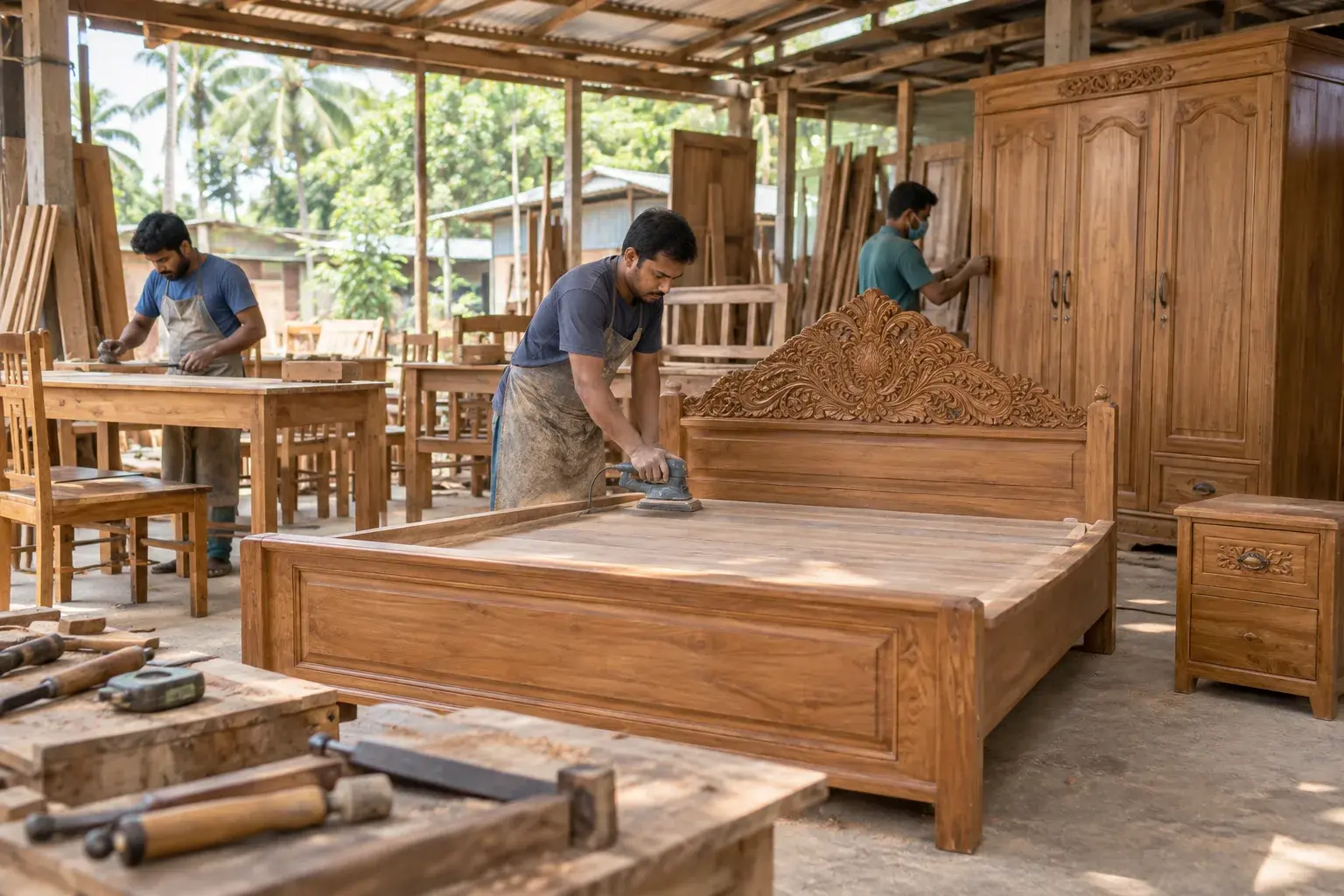
Wooden furniture workshop
Building beds, wardrobes and tables to order. An MDF bed starts near Tk 12,000 and a solid teak king bed runs to Tk 1,80,000 - but the timber is paid for first and the money comes after delivery.
- Last reviewed: 19 September 2026
- Version 1
Wooden furniture workshop
- Starting capital
- ৳1,50,000 – ৳12,00,000 Editorial estimate
- Manpower
- 2 – 10 people
- First sale
- 30 – 90 days Editorial estimate
- Break-even
- 7 – 12 months Editorial estimate
- Kind of work
- Workshop · Medium difficulty
About the business
A furniture workshop takes orders and builds beds, wardrobes, tables and sofas. The work looks simple; the money does not, because the timber is bought first and the full payment arrives after delivery. That gap is what kills small workshops. How wide it is can be read off a big brand's own terms: HATIL's billing conditions say that if it misses the delivery deadline it pays the customer 0.5 per cent of the value of the goods per week after a 15-day buffer, and that a customer who does not take delivery of completed goods pays the same 0.5 per cent a week as an inventory holding cost, again after a 15-day buffer. Two to three weeks between order and delivery is treated as normal in this market. Prices: one Dhaka furniture firm's 2026 list puts a plain MDF single bed at Tk 12,000-22,000, a queen bed in Malaysian processed wood at Tk 25,000-45,000, a semi-solid teak and gorjon box bed at Tk 45,000-85,000, and a solid Chittagong teak king bed at Tk 60,000-1,80,000. Change the timber and the price changes three or four times over. The real skill is knowing timber and accounting for it - how much of a cubic foot ends up in the furniture and how much is lost in the cutting is what decides the profit.
Unit economics
| Item | Range | Evidence | Suggest a correction |
|---|---|---|---|
| Monthly working capital | ৳80,000 – ৳6,00,000 | Editorial estimate | |
| Selling price | ৳12,000 – ৳1,80,000 / unit | Market quote | |
| Variable cost | ৳9,000 – ৳1,17,000 / unit | Editorial estimate | |
| Gross margin | 25% – 35% | Editorial estimate | |
| Time to first revenue | 30 – 90 days | Editorial estimate | |
| Break-even time | 7 – 12 months | Editorial estimate | |
| Cash cycle | 15 – 30 days | Market quote | |
| Waste / loss | 10% – 20% | Editorial estimate | |
| Daily capacity | 0.3 – 2.5 | Editorial estimate |
What you need to start
- Table saw, planer, router, drill, sander, clamps and hand tools, plus a spray gun or polishing kit. Machine prices could not be verified here.Equipment
- Timber - Chittagong teak, gorjon, sil-koroi, Malaysian processed wood or MDF. Which one you use changes the price of the finished piece three or four times over.Starting stock
- Trade licence from the city corporation or municipality: form Tk 10, licence book Tk 50, standard tax Tk 30, stamp Tk 150-300, licence fee Tk 100-60,000 by trade type. Issued in three to five working days.Licence
- Selecting timber, cutting to size, joinery and finishing. Miss damp or under-seasoned wood and the piece cracks later, and the warranty work comes back to you.Skill
- A reliable sawmill or timber depot, plus a hardware supplier for hinges, handles, channels, glue, nails and finishes.Supplier
- An open shed with room for saws and machines, racks to keep timber dry, a separate corner for finishing, and a way to move goods out.Workspace
How the work is done
- 1Take a shed where saw and machine noise is tolerated and finished goods can be got out. A workshop inside a residential block gets shut down by the neighbours.
- 2Take the trade licence from the city corporation or municipality with 'furniture manufacturing' as the trade.
- 3Decide where the wood comes from - sawn timber from a sawmill, or imported processed wood and MDF. The price, the work and the customer are different for each.
- 4Install the machines: table saw, planer, router, drill, sander and spraying gear. Polishing or lacquering needs its own space.
- 5Hire one good carpenter. In this trade the workshop's name rests more on the carpenter's hands than on the owner's.
- 6Build samples. Customers do not read drawings; they understand a finished piece.
- 7Take an advance on every order and cost the timber first - which wood, how many cubic feet, at what rate. You pay for the timber before anyone pays you.
- 8Give the delivery date in writing and keep it. Big firms pay a 0.5 per cent a week penalty for being late; a small workshop that is late simply loses the customer.
- 9Keep the offcuts and use them for small pieces - stools, racks, children's cots. The offcuts are part of the profit.
- 10Chase work from showrooms and interior contractors. One set order gives more certainty than a string of retail orders, though the money comes later.
- 11Build stock ahead of the wedding season, and keep timber dry in the rains - furniture built from damp wood cracks later.
Seasons
- JanHigh
- FebHigh
- MarNormal
- AprNormal
- MayNormal
- JunLow
- JulLow
- AugNormal
- SepNormal
- OctNormal
- NovHigh
- DecHigh
Where it works well
- Strong fitChattogram · Teak is named after this district - sellers price their best beds as 'Chittagong Teak'.
- Strong fitDhaka · The biggest buying market and the brands' base - HATIL's head office is at Shewrapara in Mirpur - and most showroom and interior-contractor subcontracting is here.
- Strong fitGazipur · Close to Dhaka, cheap sheds, and local demand from dense factory-worker settlement.
- PossibleBandarban · Close to the timber source, though forest and transit permission rules are strict.
- PossibleBogura · The trading centre of the north, where machines and hardware are easy to get.
- PossibleCumilla · On the highway, with new housing going up and orders from remittance families.
- PossibleKhulna · There is city demand, but established workshops are thick on the ground.
- PossibleNarayanganj · Dense settlement and quick delivery into the Dhaka market.
- PossibleRajshahi · University and office furniture orders come through; the household market is smaller.
- PossibleRangamati · Hill timber is close at hand, but the big buying markets are far and freight is expensive.
- PossibleSylhet · Remittance families have the money, so orders for expensive timber are relatively common.
Risks and cautions
- HighLate payment: Even when the piece is finished the customer delays taking it, and the goods sit in the shed. A big firm charges 0.5 per cent of the value per week as an inventory holding cost; a small workshop cannot even ask, and loses both the space and the money.
- HighWorking capital: The timber is paid for in full up front and the customer's money arrives after delivery. Two to three weeks sit in between - big firms write a 15-day buffer into their own terms. Through that stretch carpenters' wages, rent and electricity do not stop. Take three or four orders at once and a small workshop runs out of cash.
- HighDependency: The timber price is the product price. A teak bed and an MDF bed are three to ten times apart, so a small move in the timber rate wrecks the costing. If wood costs more on the day you buy it than on the day you quoted, the loss is the workshop's - the customer will not reopen the price.
- MediumSpoilage: Furniture built from under-seasoned wood cracks or opens at the joints within months, and it comes back to be fixed free. The risk is worst in the rains. Big firms give a one-year service warranty on manufacturing faults, and customers expect the same from a small workshop.
- MediumDemand: Demand is seasonal - orders come with weddings and house moves and dry up in the rains. Rent and carpenters' wages run all twelve months, and a good carpenter let go does not come back.
Sources
সিটি কর্পোরেশন থেকে ট্রেড লাইসেন্স প্রাপ্তির ধাপ সমূহ
Collected: 16 Sept 2026Supports: Starting capital · বাংলাদেশ
What changed
No corrections have been published yet.
Questions and answers
No questions yet. Be the first to ask.
Stories about this business
From carpenter on someone else's bench to owner, with 25 lakh taka in the business
One of the roughly 300 furniture workshops across seven villages in Sherpur Sadar is run by a former carpenter whose investment in the business now stands at 25 lakh taka.
- Reasons
- Good location, Strong network
Similar businesses
 Light manufacturing & workshop
Small shoe making unit
A small unit making sandals and shoes for wholesalers. Sandals sell at Tk 250-700 and leather shoes at Tk 1,200. Bhairab alone has 3,500-5,000 units employing about 25,000 people.
- Capital
- ৳1.5 lakh – ৳10 lakh
- People
- 4 – 20
- First income
- 30 – 90 days
 Light manufacturing & workshop
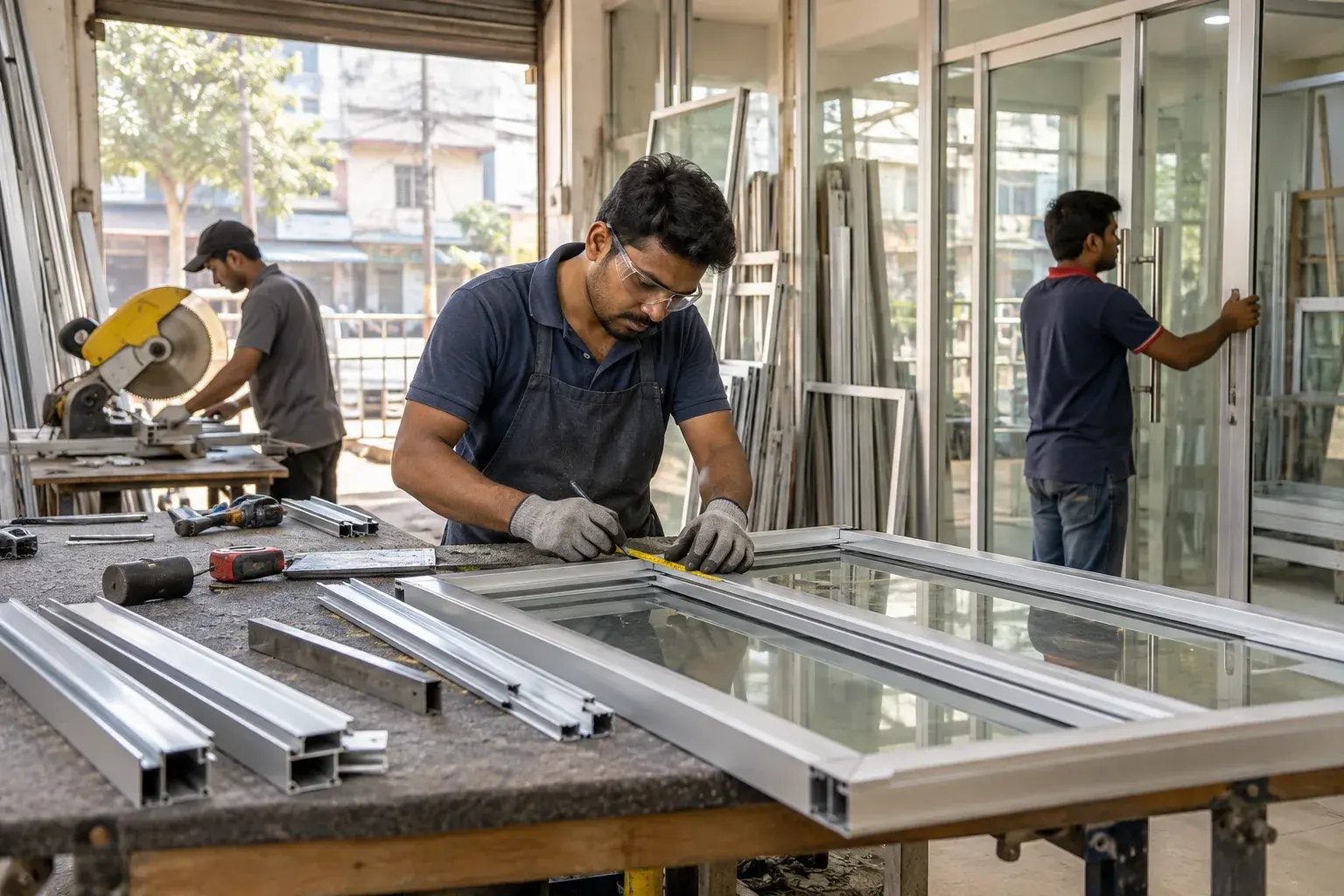
Thai glass and aluminium fitting
Cutting and fitting aluminium profile and glass into doors, windows and partitions. Ordinary work is about Tk 470-750 per square foot, and a wrong measurement cannot be returned.
- Capital
- ৳1.5 lakh – ৳6 lakh
- People
- 2 – 6
- First income
- 20 – 60 days
 Light manufacturing & workshop
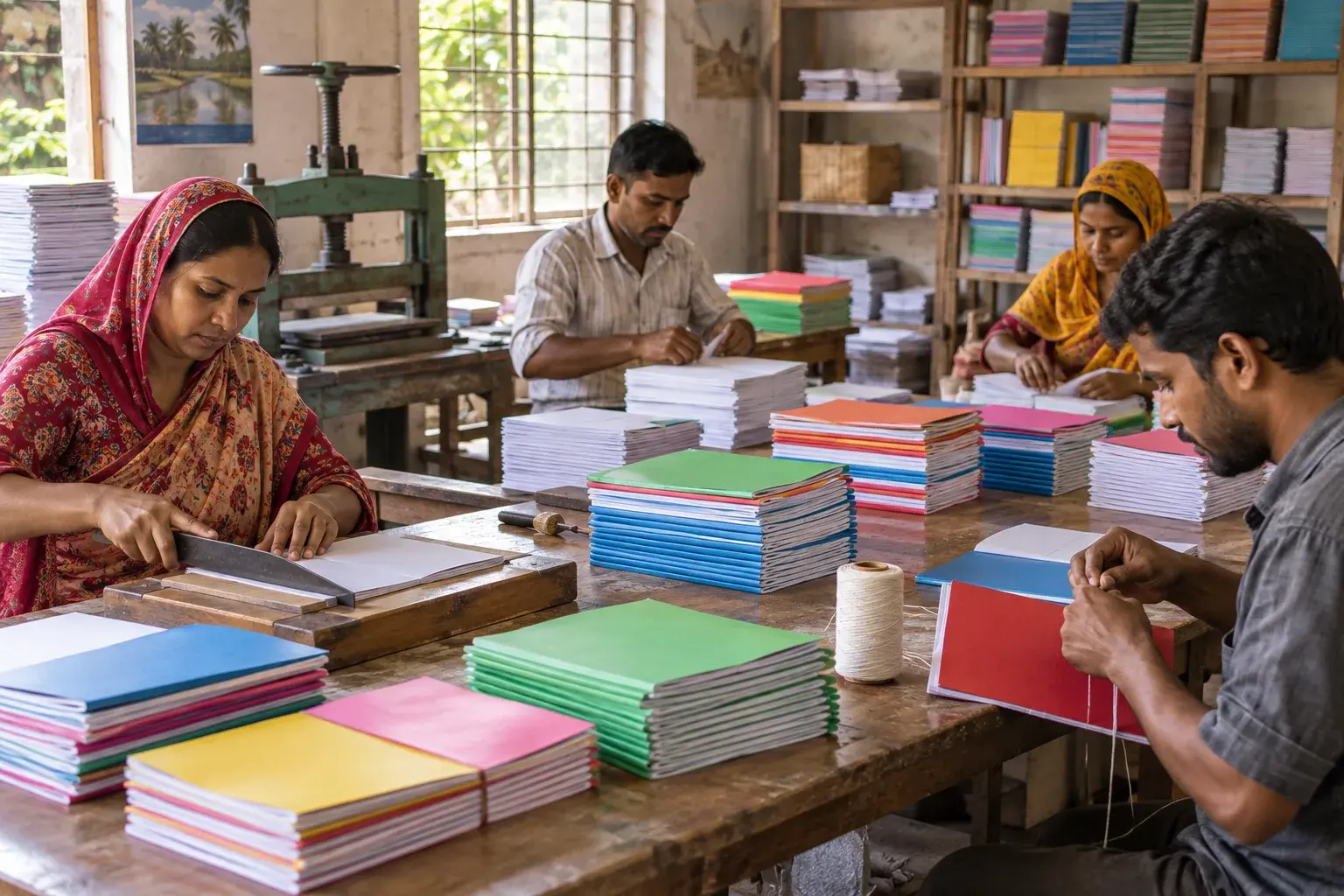
Notebook making
Cutting, folding and binding paper into exercise books. A 300-page khata sells online at Tk 169 and a 120-page one at Tk 75, while a packet of paper costs Tk 100-150 more than a year ago.
- Capital
- ৳1.5 lakh – ৳7 lakh
- People
- 3 – 15
- First income
- 15 – 45 days
 Light manufacturing & workshop
Agarwood attar distilling
Soaking and boiling agarwood to draw off fragrant attar. Barlekha's Sujanagar has about 250 units, attar sells at Tk 6,000-10,000 a tola by grade, and nearly all of it is exported.
- Capital
- ৳1.5 lakh – ৳10 lakh
- People
- 3 – 15
- First income
- 2,555 – 10,950 days