
Guava orchard and floating market
Canal-side guava orchards selling at the Bhimruli floating market. A maund fetched Tk 1,000-1,200 in 2026, but a ten-bigha orchard was yielding three to five maunds a day instead of ten, and with no cold store the rest rots.
- Last reviewed: 19 September 2026
- Version 1

Guava orchard and floating market
- Starting capital
- ৳50,000 – ৳5,00,000 Editorial estimate
- Manpower
- 1 – 8 people
- First sale
- 365 – 730 days Editorial estimate
- Break-even
- 24 – 36 months Editorial estimate
- Kind of work
- Farm · Medium difficulty
About the business
Guava orchards on raised beds beside the canals, and the fruit carried out by koshā boat at dawn to a floating market. The commercial belt is three places: 937 hectares across 16 villages in Banaripara (Barishal), 350 hectares across 13 villages in Jhalokathi Sadar, and 645 hectares across 26 villages in Nesarabad (Pirojpur), with about 50,000 farmers still in the crop. The season is three months, Ashar, Shrabon and Bhadra; trading peaks from 9am to noon and more than twenty seasonal mokams sit around Bhimruli. From there the fruit goes to Dhaka, Chattogram, Khulna, Sylhet, Barishal, Feni, Patuakhali, Bhola and Madaripur. The price has tripled in three years, from Tk 300-450 a maund in 2023 to Tk 600-800 in 2025 and Tk 1,000-1,200 in 2026 by size and grade. But the price rose because the crop fell: no rain at flowering in Falgun and heavy heat strip the blossom, and a ten-bigha orchard that should yield ten maunds a day was giving three to five in 2026. The deepest weakness is that guava rots fast and there is no cold store or processing plant anywhere in the belt; growers say crores of taka of fruit is lost every year. The floating market has a second side, tourism: Bhimruli runs eight to ten floating eateries, more than a hundred trawlers and 30-35 tourist boats. But a short crop keeps the tourists away too, so the blow lands twice.
Unit economics
| Item | Range | Evidence | Suggest a correction |
|---|---|---|---|
| Monthly working capital | ৳4,000 – ৳50,000 | Editorial estimate | |
| Selling price | ৳8 – ৳30 / kg | Practitioner verified | |
| Variable cost | ৳6 – ৳16 / kg | Editorial estimate | |
| Gross margin | 25% – 70% | Editorial estimate | |
| Time to first revenue | 365 – 730 days | Editorial estimate | |
| Break-even time | 24 – 36 months | Editorial estimate | |
| Cash cycle | 0 – 1 days | Editorial estimate | |
| Waste / loss | 50% – 70% | Editorial estimate | |
| Daily capacity | 120 – 400 | Practitioner verified |
What you need to start
- A koshā or dinghy boat, baskets and sacks, and a scale. At the mokam the trading happens off the boat, so the boat is the shop.Equipment
- Local guava saplings, and each year in Magh and Falgun the fertiliser and mud for the tree bases, which growers put at over Tk 300 a tree.Starting stock
- Trade licence from the union parishad, municipality or city corporation, needed to sell or supply the crop wholesale yourself: form Tk 10, licence book Tk 50, standard tax Tk 30, stamp Tk 150-300, licence fee Tk 100-60,000 by trade type.Licence
- Bangladesh Food Safety Authority registration is not needed for selling fresh guava, but making and packing pickle, jelly or juice brings you in as a packaged food producer: Tk 1,000 new, Tk 500 renewal, valid three years.Licence
- Timing the base cleaning and fertiliser, protecting the blossom, and picking just before ripeness. One day late and the fruit softens and the price drops.Skill
- The arotdars and paikars at the mokam. More than twenty seasonal mokams sit around Bhimruli, and from them the fruit goes to Dhaka, Chattogram, Khulna, Sylhet, Barishal, Feni, Patuakhali, Bhola and Madaripur.Supplier
- Raised bed land beside a canal, close enough for a boat to reach the orchard. The 55 villages of Banaripara, Jhalokathi Sadar and Nesarabad grow it on exactly this kind of land.Workspace
How the work is done
- 1Look for raised beds beside a canal. Guava here grows on narrow raised beds along the khals, and without a canal a boat can enter, getting the fruit out is the hard part.
- 2Ask at the upazila agriculture office about local guava saplings and the incentive fertiliser and seed. In Jhalokathi the Department of Agricultural Extension distributes both.
- 3In Magh and Falgun clean the base of each tree, apply fertiliser and pack the base with mud. Growers put this at over Tk 300 a tree on average, and it is the main cost of the year.
- 4Keep water ready for the Falgun flowering. Repeated years of no rain and high heat have stripped the blossom and taken the crop below half, and irrigation is what limits that loss.
- 5Get a koshā boat. The fruit goes from orchard to mokam by small dinghy, and Kuriana to Bhimruli is about forty minutes on the water.
- 6Reach the mokam early. More than twenty seasonal mokams sit around Bhimruli and the heaviest trading is between 9am and noon.
- 7Sort by size and colour before you go. The price is set by size and grade, so unsorted fruit drags the good guavas down with it.
- 8Pick only what will certainly sell that day. Guava ripens and rots fast and there is no cold store in the belt, so anything unsold is a straight loss.
- 9Treat tourism as a separate income line. Bhimruli runs eight to ten floating eateries, more than a hundred trawlers and 30-35 tourist boats, and orchard-based visitor sites have come up at Kathurakathi and Adamkathi.
- 10Work out the interest before borrowing. With no low-interest farm credit in the belt, growers take high-interest NGO loans and most of whatever profit there is goes back out as interest.
- 11If you think of pickle, jelly or juice, register with the Bangladesh Food Safety Authority first. Processing is what cuts the rot loss, but no such plant has yet come up in the belt.
Seasons
- JanLow
- FebLow
- MarLow
- AprLow
- MayLow
- JunHigh
- JulHigh
- AugHigh
- SepHigh
- OctLow
- NovLow
- DecLow
Where it works well
- Strong fitBarishal · 937 hectares across 16 villages in Banaripara, the largest of the three districts by area.
- Strong fitJhalokathi · Home of the Bhimruli floating market. Commercial cultivation runs to 350 hectares across 13 villages in Sadar upazila, and in 2026 the district planted 562 hectares in all with about 5,626 tonnes expected.
- Strong fitPirojpur · 645 hectares across 26 villages in Nesarabad, also called Swarupkathi; Kuriana is forty minutes by boat from the Bhimruli mokam.
- PossibleBhola · Guava goes regularly from the Bhimruli mokam to this district, and the river route is close.
- PossibleChattogram · One of the larger districts Bhimruli guava is sent to, with big fruit arots.
- PossibleDhaka · The biggest selling market; growers say both buyers and tourists increased after the Padma Bridge opened.
- PossibleFeni · One of the districts the Bhimruli mokam sends guava to.
- PossibleKhulna · Guava goes there regularly from the mokam and the road route is short.
- PossibleMadaripur · It sits on the Dhaka road since the Padma Bridge opened, and Bhimruli guava is sold here too.
- PossiblePatuakhali · The same canal-laced delta land, and one of the districts Bhimruli guava is sent to, so the selling market exists.
- Weak fitBarguna · Guava is grown here and there, but there is no commercial orchard belt and no mokam.
Risks and cautions
- HighWorking capital: The income comes in only three months of the year, Ashar, Shrabon and Bhadra, and has to run the household for twelve. The spending happens before that, over Tk 300 a tree in Magh and Falgun. With no low-interest farm credit available, growers borrow from NGOs at high rates and most of the profit leaves again as interest.
- MediumDependency: The whole income rests on one seasonal market. The price is as good as the number of arotdars and paikars who turn up, and when the crop is short fewer come and the tourists thin out with them. In a bad year yield, price and tourism fall together.
- MediumOther: Growers are leaving the crop. Bhimruli farmer Zahid Mia says many have stopped guava altogether and others have shrunk their orchards, turning to amra, lemon, malta and vegetables because the income no longer covers the cost. As the orchards shrink the mokam shrinks too, and the price falls for those who stay.
- HighSpoilage: Guava ripens and rots very fast, yet there is no cold store anywhere in the belt and no processing plant has come up. Jagadishpur grower Bimal Mistri says crores of taka of fruit is lost every year for want of one. What is not sold at the mokam by midday does not survive, and that is the biggest hole in the business.
- HighDemand: The weather decides the crop. No rain at the Falgun flowering plus a heat wave strips the blossom and the young fruit. In 2026 a ten-bigha orchard was giving three to five maunds a day instead of ten, and 2024 took the same blow. The price rises but with so little fruit the grower's income does not rise with it; it falls.
Sources
সিটি কর্পোরেশন থেকে ট্রেড লাইসেন্স প্রাপ্তির ধাপ সমূহ
Collected: 16 Sept 2026Supports: Starting capital · বাংলাদেশ
All food businesses now need safety registration
Collected: 22 Jul 2026Supports: Starting capital · বাংলাদেশ
What changed
No corrections have been published yet.
Questions and answers
No questions yet. Be the first to ask.
Stories about this business
6,000 guava trees on 36 bighas, and 1.5 crore taka of sales a year
He first tried guava in 2015 and expanded seriously from 2018. Thirty-six bighas now carry about 6,000 bearing trees at 1.5 maunds each a year, giving 1.5 crore taka of guava sales and over 1 crore of net profit.
- Reasons
- Strong network, Weak demand
Similar businesses
 Agriculture & farming
Poultry and duck hatchery
Setting eggs in an incubator and selling day-old chicks to farmers. Ducklings cost Tk 30-35 and sell at Tk 72-75, but chicken chick prices swing from Tk 25 to Tk 85 and back to Tk 5 within months.
- Capital
- ৳50k – ৳8 lakh
- People
- 2 – 15
- First income
- 28 – 60 days
 Agriculture & farming
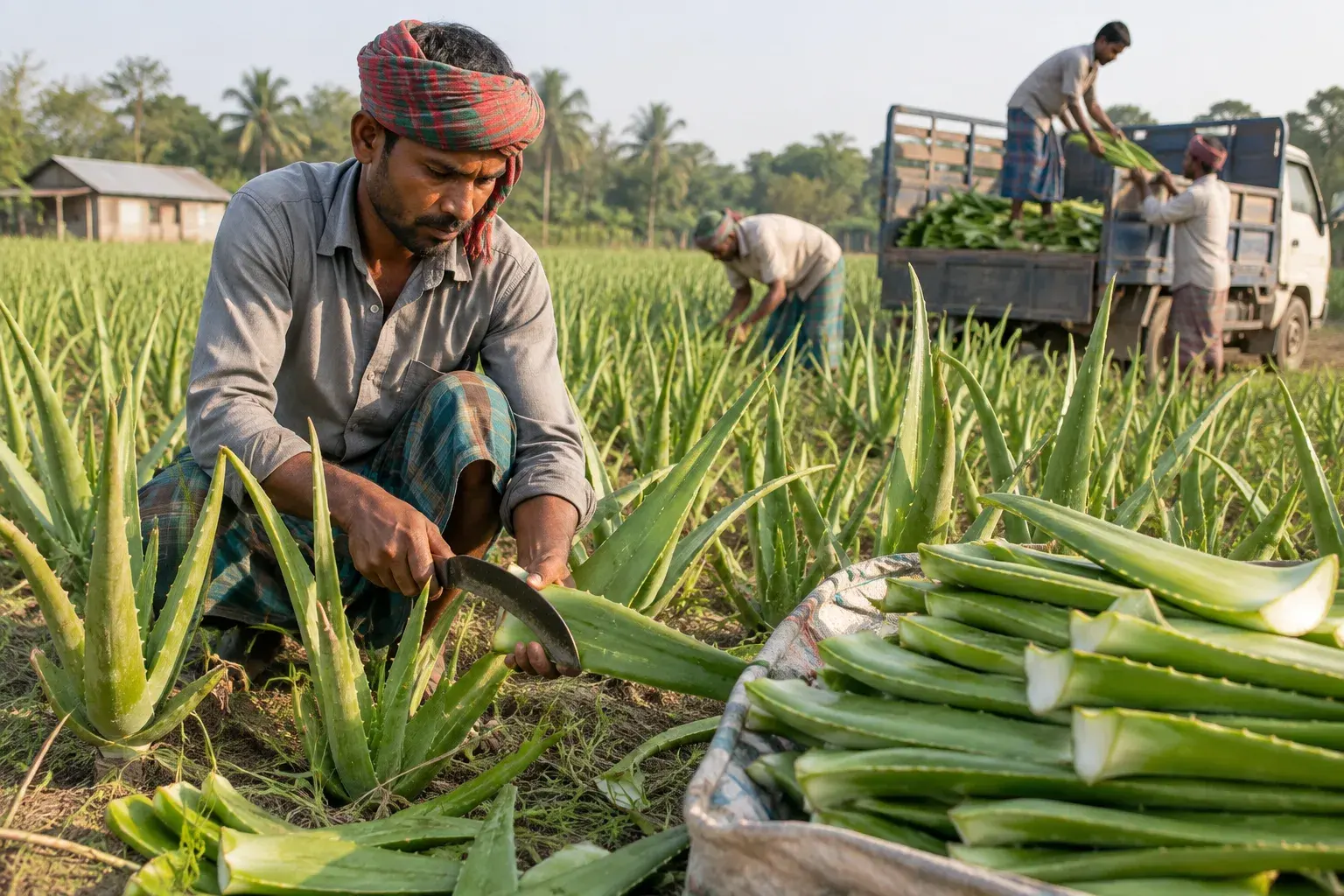
Aloe vera farming
Cutting aloe leaves and selling them to companies. About Tk 50,000 a bigha to grow and Tk 1.5-2.5 lakh of leaves, but the only buyers are a few pharmaceutical and juice companies.
- Capital
- ৳50k – ৳2 lakh
- People
- 1 – 6
- First income
- 90 – 120 days
 Agriculture & farming
Milk collection and supply
Buying milk from farmers and delivering it to chilling centres and shops. Farmers get Tk 35-50 a litre and plants pay Tk 48-58; that gap is the business.
- Capital
- ৳50k – ৳4 lakh
- People
- 1 – 4
- First income
- 7 – 21 days
 Agriculture & farming
Cashew and coffee farming
Cashew and coffee orchards on hill land. Farmers get Tk 180-200 a kg for raw cashew and Tk 350-400 for raw coffee, but the first crop comes three to four years after planting for coffee and four to five for cashew.
- Capital
- ৳50k – ৳5 lakh
- People
- 1 – 6
- First income
- 1,095 – 1,825 days