
Jute farming
Sown in March-April, cut and retted in July-August. National average wholesale in August 2026 was Tk 98.75 a kg for white jute (Tk 3,950 a maund) and Tk 91.84 for tossa (Tk 3,673), against a production cost of Tk 2,600-3,200 a maund.
- Last reviewed: 21 September 2026
- Version 1

Jute farming
- Starting capital
- ৳24,000 – ৳1,50,000 Editorial estimate
- Manpower
- 2 – 8 people
- First sale
- 120 – 150 days Official source
- Break-even
- 4 – 6 months Editorial estimate
- Kind of work
- Farm · Medium difficulty
About the business
Jute is sown from the last week of February through March and April, and deshi jute is cut at 105-110 days and tossa at 100-105 days; cutting within two weeks of flowering gives the best fibre. The Agriculture Information Service recommends 6.5-7.5 kg of seed a hectare broadcast, or 3.5-5 kg in lines; 15 kg of urea, 17 kg of TSP and 22 kg of MoP on sowing day, and another 100 kg of urea at six to seven weeks. Weeding twice, at 15-21 days and again at 35-42 days. The real work in this crop comes after cutting. Retting needs clean water, and that is the biggest problem; ret in still or muddy water and the fibre grades low and the price goes with it. Where water is short, ribbon retting works: strip the bark from the green plant and ret it in a pit 6 m by 2 m by 1 m with 8,000-8,500 litres of water, adding 300-350 g of urea per bigha of bark, and it is done in 10-12 days. Jute sells at all because of a law. Under the Mandatory Jute Packaging Act 2010, the products named in the rules, paddy, rice, wheat, maize, fertiliser and sugar, cannot be sold, distributed or supplied except in jute packaging, and breaking that carries up to a year in prison or a fine of up to Tk 50,000 or both. The Department of Jute enforces this law and the Jute (Licensing and Enforcement) Rules 1964, and issues the trading licences. The sticks sell too, as a separate income.
Unit economics
| Item | Range | Evidence | Suggest a correction |
|---|---|---|---|
| Monthly working capital | ৳23,400 – ৳28,800 | Editorial estimate | |
| Selling price | ৳84 – ৳99 / kg | Official source | |
| Variable cost | ৳65 – ৳80 / kg | Disputed | |
| Gross margin | 5% – 24% | Editorial estimate | |
| Time to first revenue | 120 – 150 days | Official source | |
| Break-even time | 4 – 6 months | Editorial estimate | |
| Cash cycle | 120 – 180 days | Editorial estimate | |
| Waste / loss | 5% – 15% | Editorial estimate | |
| Daily capacity | 4 – 20 | Editorial estimate |
What you need to start
- A plough or power tiller and harrow, hoes, sickles, a bamboo mallet for stripping leaves and crushing the butt, a ribboner if you are ribbon retting, polythene sheeting, and rope for tying the fibre.Equipment
- Fertiliser as recommended by the Agriculture Information Service: 3.5 tonnes of cowdung a hectare two or three weeks before sowing; 15 kg of urea, 17 kg of TSP and 22 kg of MoP on sowing day; another 100 kg of urea at six to seven weeks. Government farmer-level rates are Tk 27 for urea and TSP, Tk 21 for DAP and Tk 20 for MoP.Starting stock
- Jute seed at BADC's fixed 2025-26 rates (14 January 2026): at farmer level deshi Tk 115, tossa Tk 120 and kenaf Tk 135 a kg; to seed dealers and contract growers Tk 100, Tk 105 and Tk 120. Tossa seed for the extension department's incentive programme and the Department of Jute is Tk 220. Rate: 6.5-7.5 kg a hectare broadcast, 3.5-5 kg in lines.Starting stock
- Trade licence from the city corporation, municipality or union parishad: form Tk 10, licence book Tk 50, standard tax Tk 30, stamp Tk 150-300, licence fee Tk 100-60,000, issued in 3-5 working days and renewed yearly. Not needed to sell jute you grew yourself.Licence
- Jute trading licence from the Department of Jute under the Jute (Licensing and Enforcement) Rules 1964 and the Jute Act 2017, needed to buy and sell raw jute, to bale, to warehouse or to export. It is not needed by the grower. Trading without it is one of the irregularities the Department lists, and it prosecutes through mobile courts. The fee and validity could not be verified here.Licence
- Retting is the skill in this trade: how long to keep it under, knowing when it is ready, and stripping the fibre off the stick by hand and washing it without tearing it. With that, recognising the cutting stage within two weeks of flowering, and bargaining on grade.Skill
- A BADC jute seed dealer or the foundation seed farms at Nashipur and Chingla, a fertiliser dealer, a jute trader or kancha baler at the haat, and a labour gang for cutting, retting and washing (Tk 800-900 a day in Pabna in 2025).Supplier
- Somewhere to ret: a canal, pond or beel with clean moving water, or failing that a ribbon retting pit of 6 m by 2 m by 1 m per bigha of bark, lined with polythene and filled with 8,000-8,500 litres of water. Each kg of bark needs 2.5-3 litres. Plus somewhere to wash and bamboo racks to dry on.Workspace
How the work is done
- 1Pick the land. Silty loam is best, and it must be land where rainwater does not stand and the flood does not arrive before the end of June.
- 2Right after rain, cross-plough five to seven times and harrow the land to a fine tilth, weed-free. Jute seed does not come up through clods.
- 3Settle the seed and the rate. The Agriculture Information Service gives 6.5-7.5 kg a hectare broadcast and 3.5-5 kg in lines. BADC's 2025-26 farmer-level prices are Tk 115 a kg for deshi jute seed, Tk 120 for tossa and Tk 135 for kenaf.
- 4Sow in lines if you can, 30 cm between lines and 7-10 cm between plants. Line sowing yields more, is easier to tend and takes less seed.
- 5Mix in 3.5 tonnes of cowdung a hectare two or three weeks before sowing, and on sowing day apply 15 kg of urea, 17 kg of TSP and 22 kg of MoP. If you get the incentive, 5 kg of DAP and 5 kg of MoP per bigha come free.
- 6Weed twice, first at 15-21 days and again at 35-42 days, thinning the stand at the second pass. At six to seven weeks broadcast another 100 kg of urea a hectare.
- 7Arrange the retting water before you cut. This is the biggest problem in the crop: ret in still or muddy water and the fibre comes out low grade, and low grade means cuttings price, about Tk 600 a maund less.
- 8Cut within two weeks of flowering, at 105-110 days for deshi and 100-105 for tossa. Leave it longer and the fibre turns coarse and harsh.
- 9If water is short, use ribbon retting. After cutting, strip the leaves, crush the bottom three or four inches with a bamboo mallet and pull the bark off through a ribboner. For one bigha's bark, dig a pit 6 m by 2 m by 1 m, line it with polythene, fill it with 8,000-8,500 litres of water, add 300-350 g of urea and 20-40 litres of old retting water, and it is done in 10-12 days.
- 10When the retting is done, wash the fibre in clean water or an earthen trough, dry it thoroughly on bamboo racks and store it. Mud left on it, or storing it damp, spoils the colour and drops the grade.
- 11Dry and keep the sticks separately; there is a market for them as fuel and for charcoal. When the fibre price falls, that side income is often what covers the cost.
- 12Sell on grade, not in a hurry. In the August 2026 national average, white jute was Tk 98.75 a kg and average cuttings Tk 84.03, a gap of about Tk 600 a maund. The price can differ between places on the same day: on 15 September 2026 Sharsha topped out at Tk 3,500 a maund while other areas paid Tk 4,000.
Seasons
- JanLow
- FebNormal
- MarHigh
- AprHigh
- MayNormal
- JunNormal
- JulHigh
- AugHigh
- SepHigh
- OctNormal
- NovLow
- DecLow
Where it works well
- Strong fitFaridpur · The country's leading jute district, with 87,000 hectares sown in 2026, above target, and an expected 195,000 tonnes. The trading arots and baling works are thickest here.
- Strong fitJamalpur · The largest district allocation in the Ministry of Agriculture's kharif 2025-26 jute incentive, 3,800 farmer-bighas; both jute and jute seed are grown on the Jamuna chars here.
- Strong fitJashore · Bagachra, Goga and Rudrapur in Sharsha are big jute haats, though in September 2026 the price here ran Tk 500 a maund below the rest of the country.
- Strong fitKishoreganj · 2,400 farmer-bighas in the kharif jute incentive; water is easier to find on the haor edge, so retting is less of a problem here.
- Strong fitPabna · Early-jute haats including Karamja Chaturhat in Santhia; in 2025 the yield here was 9 maunds a bigha at Tk 3,700-3,800 a maund. But this is also where the shortage of retting water bites hardest.
- Strong fitRajbari · Part of the Faridpur jute belt, with retting water available along the Padma and the Faridpur arots within easy reach.
- Strong fitRajshahi · 2,600 farmer-bighas in the kharif jute incentive, second to Jamalpur; jute grows on the Padma chars and there are baling works here.
- Strong fitTangail · 2,500 farmer-bighas in the kharif jute incentive; a large jute area along the Jamuna with the Dhaka jute mills and sack factories close by.
- PossibleKushtia · One of BADC's jute seed production zones (Dhaka, Tangail, Bogura, Jashore, Kushtia and Rajshahi), so quality seed is close at hand.
- PossibleMadaripur · Part of the Faridpur-Rajbari-Madaripur belt, where jute does well on low land and retting water is available.
- PossibleNarail · An old jute area where the Chitra and Nabaganga provide retting water; the crop mostly sells through the Jashore and Khulna arots.
- PossibleSirajganj · Jute grows on the Jamuna chars, but an early flood forces an unripe cut.
Risks and cautions
- HighDependency: Retting water. If the canals and beels are dry at cutting time the jute cannot be retted, and retting in muddy or still water gives low-grade fibre. A lower grade means a lower price: in the August 2026 national average white jute was Tk 98.75 a kg against Tk 84.03 for cuttings, a gap of about Tk 600 a maund. In Santhia and Bera in Pabna the shortage of water has pushed up the cost of retting on its own. Ribbon retting is the answer, but it means digging pits, buying polythene and finding extra labour.
- HighDemand: The price differing between places on the same day. On 15 September 2026 good jute made at most Tk 3,500 a maund at the Bagachra, Goga and Rudrapur haats in Sharsha, Jashore, while the same quality fetched about Tk 4,000 elsewhere in the country, Tk 500 a maund less. Farmers suspect local traders of acting together. The gap survives even a bumper harvest, because the grower has no second buyer.
- MediumCompliance: A large part of the demand for jute rests on a law. Under the Mandatory Jute Packaging Act 2010, the products named in the rules, paddy, rice, wheat, maize, fertiliser and sugar, cannot be sold, distributed or supplied except in jute packaging, on pain of up to a year in prison or a fine of up to Tk 50,000 or both. But the act itself lets the government grant exemptions, and enforcement depends on the Department of Jute's mobile courts. When enforcement slackens the plastic sacks come back and the sack factories' demand for raw jute falls with them.
- MediumWorking capital: Wages. Almost the whole cost of this crop is labour: inputs are only Tk 415 a bigha against a total of Tk 23,400-28,800. In Pabna in 2025 the daily rate for cutting, retting and stripping went from Tk 700 to Tk 800-900 in a single year. And that money falls due just before the sale, when there is least cash in hand.
- MediumOther: Floods and unseasonal rain. Jute is cut in July and August, which is exactly when the flood can arrive. Early water means cutting the crop unripe and losing yield; no water means nowhere to ret. Either way it costs, and neither is in the farmer's hands.
Sources
পণ্যভিত্তিক মাসিক পাইকারী ও খুচরা জাতীয় গড় বাজারদর, আগষ্ট ২০২৬ (২৭১টি কৃষিপণ্যের বুলেটিন)
Collected: 21 Sept 2026Supports: Selling price · বাংলাদেশ (জাতীয় গড়)
- Collected: 21 Sept 2026
Supports: risks · বাংলাদেশ
- Collected: 21 Sept 2026
Supports: risks · বাংলাদেশ
সারের বিক্রয়মূল্য — টিএসপি, এমওপি ও ডিএপি সারের ডিলার ও কৃষক পর্যায়ে বিক্রয়মূল্য
Collected: 21 Sept 2026Supports: requirements · বাংলাদেশ
সিটি কর্পোরেশন থেকে ট্রেড লাইসেন্স প্রাপ্তির ধাপ সমূহ ও ফি
Collected: 21 Sept 2026Supports: requirements · বাংলাদেশ
শার্শায় পাটের বাম্পার ফলন, দামে হতাশ কৃষক! অন্য এলাকায় ৪ হাজার, শার্শায় সর্বোচ্চ ৩৫০০
Collected: 15 Sept 2026Supports: Selling price, Variable cost · শার্শা, যশোর — বাগআঁচড়া, গোগা ও রুদ্রপুর হাট
- Collected: 2 Sept 2026
Supports: requirements · বাংলাদেশ
ই-কৃষি: পাট — পাটের উৎপাদন প্রযুক্তি, বীজহার, সার, নিড়ানি ও রিবন রেটিং
Collected: 9 Mar 2026Supports: Time to first revenue, requirements · বাংলাদেশ
- Collected: 28 Jan 2026
Supports: districts, Monthly working capital · বাংলাদেশ
- Collected: 14 Jan 2026
Supports: districts, requirements · বাংলাদেশ
পাবনায় আগাম পাটের বাজার চড়া, বেশি দাম পেয়ে কৃষক খুশি — করমজা চতুরহাট, সাঁথিয়া
Collected: 29 Jul 2025Supports: Starting capital, Selling price, Variable cost · সাঁথিয়া, পাবনা — করমজা চতুরহাট
- Collected: 11 Apr 2023
Supports: requirements · বাংলাদেশ
- Collected: 3 Jun 2013
Supports: risks · বাংলাদেশ
What changed
No corrections have been published yet.
Questions and answers
No questions yet. Be the first to ask.
Stories about this business
29,000 taka a bigha to grow, and no offer above 2,000 a maund
A bigha of jute in Rajbari costs about 29,000 taka to grow and yields 8-10 maund, while even the best fibre fetches 2,400 taka a maund: roughly 5,000 taka of loss per bigha.
- Reasons
- Price drop, Working capital
Similar businesses
 Agriculture & farming
Mushroom cultivation
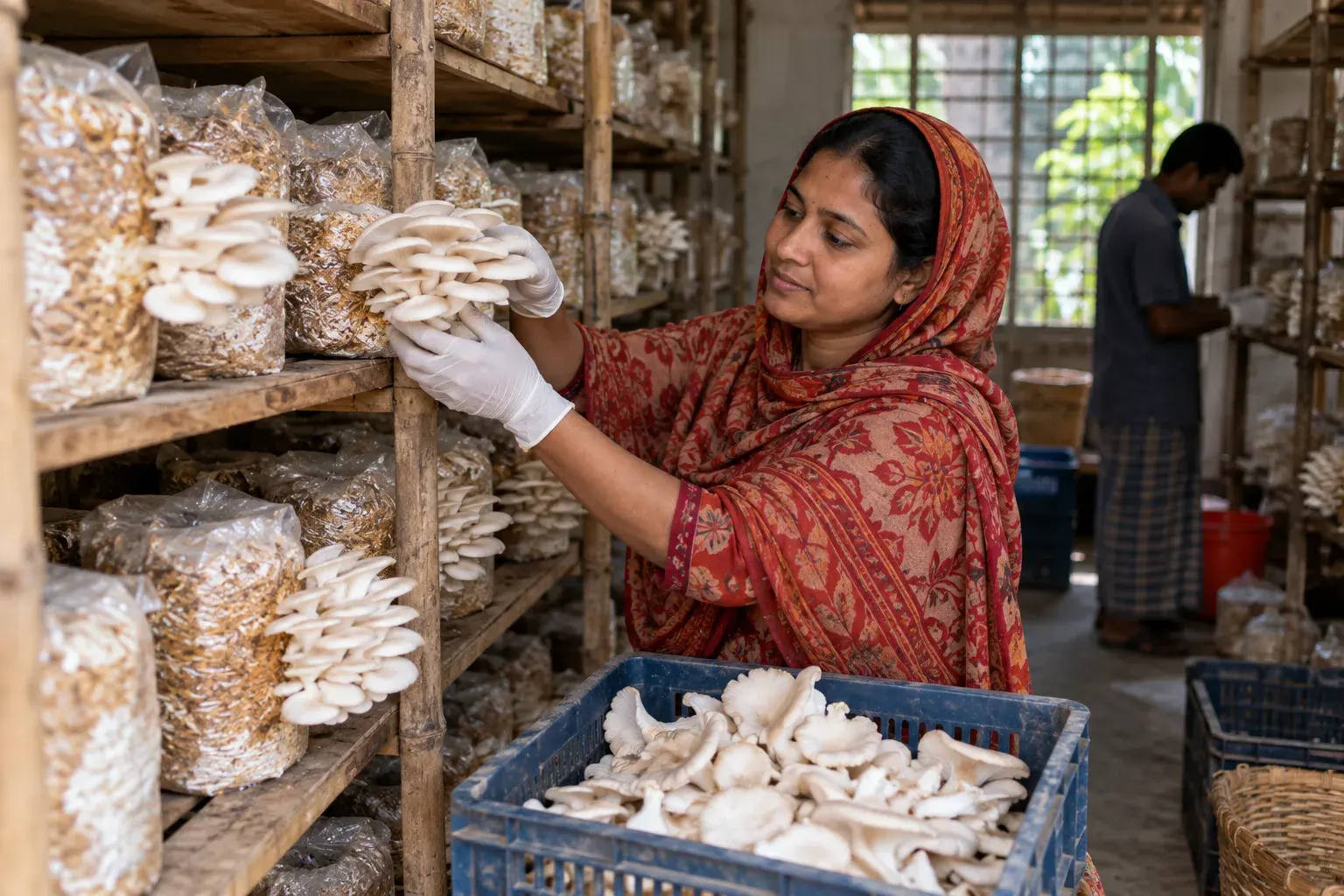
Spawn packets on indoor racks yield in 25-30 days. Cost is Tk 80-90 a kilo against Tk 250-300 selling, but outside Dhaka finding the buyer is the real work.
- Capital
- ৳25k – ৳5 lakh
- People
- 1 – 3
- First income
- 25 – 45 days
 Agriculture & farming
Floating bed vegetable and seedling farming
Building beds of water hyacinth and algae on open water to raise vegetable seedlings. No land and no irrigation needed. In Nazirpur a bed costs Tk 11,000 to build against an expected Tk 20,000 of seedling sales.
- Capital
- ৳22k – ৳2.2 lakh
- People
- 2 – 6
- First income
- 35 – 60 days
 Agriculture & farming
Ginger and turmeric farming
A ten to eleven month crop where the biggest slice of capital is seed rhizome: 375-400 kg a bigha, which at today's prices is Tk 45,000-70,000.
- Capital
- ৳20k – ৳2.5 lakh
- People
- 1 – 6
- First income
- 75 – 315 days
 Agriculture & farming
Vermicompost
Worms turn cow dung into organic fertiliser in 45 days. Nurseries and vegetable growers buy it.
- Capital
- ৳20k – ৳60k
- People
- 1 – 2
- First income
- 45 – 60 days