
Jute handicraft
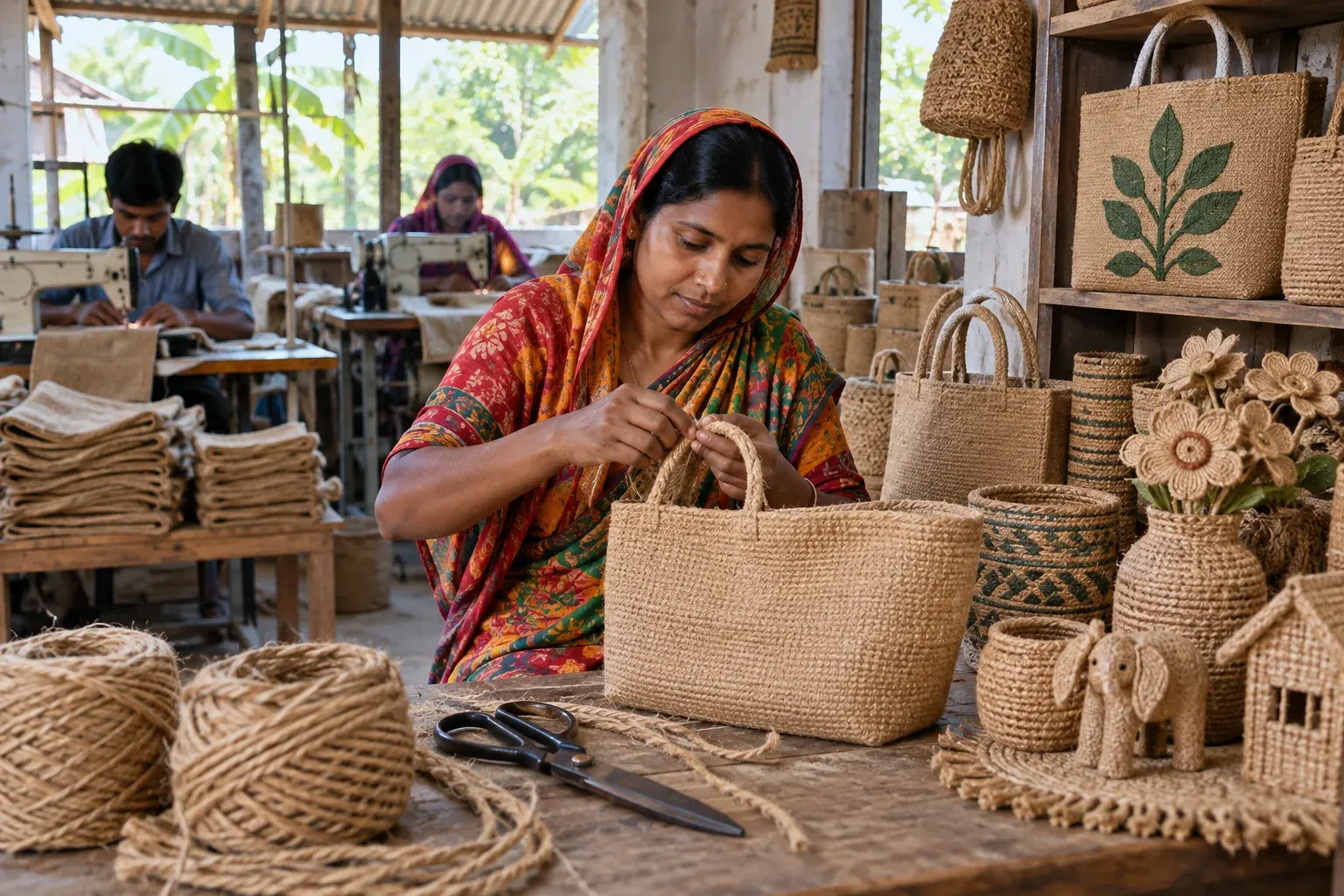
Making bags, pots and showpieces from jute. Tk 2,000 of scissors and rope starts it by hand, but an export order needs a workshop, and ten machines cost about Tk 500,000.
- Last reviewed: 19 September 2026
- Version 1
Jute handicraft
- Starting capital
- ৳2,000 – ৳10,00,000 Practitioner verified
- Manpower
- 1 – 40 people
- First sale
- 7 – 120 days Editorial estimate
- Break-even
- 1 – 8.5 months Editorial estimate
- Kind of work
- Workshop · Medium difficulty
About the business
Bags, school bags, ladies' bags, flower pots, showpieces and mats made by hand out of jute. Polythene shopping bags are banned at home and European and American buyers want eco-friendly goods, so the market for jute bags exists. Having a market and getting an order are two different things. What Afroza Akter Akhi of Bhaina village in Sujanagar, Pabna, went through shows the real rule of this trade. She learnt jute work from YouTube videos and started by hand after borrowing Tk 2,000 for scissors and rope. When she took samples to BD Creation, an export supply house, she was turned away because she had no factory; after much pleading she was given a sample order of ten pieces. Delivering that on time is what opened the door. A small factory with ten machines then cost her about Tk 500,000 - Tk 100,000 of her own savings, Tk 200,000 raised against her husband's land and Tk 200,000 borrowed. In 2023 she took a Tk 1,000,000 bank loan and built a 40-machine unit where about 40 village women now work, supplying 1,000 to 1,500 pieces a week for around Tk 200,000, going to France, the Netherlands and the United States. The lesson is that the barrier to entry here is not the raw material but the workshop and the ability to deliver a fixed number on a fixed day. No exporter or supply house will place an order until they can see that. The raw material is dear too: at the Ghior market in Manikganj on 8 September 2026, deshi jute was Tk 4,000-4,200 a maund and tossa Tk 4,300.
Unit economics
| Item | Range | Evidence | Suggest a correction |
|---|---|---|---|
| Monthly working capital | ৳5,000 – ৳6,50,000 | Editorial estimate | |
| Selling price | ৳133 – ৳667 / unit | Editorial estimate | |
| Variable cost | ৳100 – ৳250 / unit | Editorial estimate | |
| Gross margin | 25% – 63% | Editorial estimate | |
| Time to first revenue | 7 – 120 days | Editorial estimate | |
| Break-even time | 1 – 8.5 months | Editorial estimate | |
| Cash cycle | 5 – 90 days | Editorial estimate | |
| Waste / loss | 3% – 10% | Editorial estimate | |
| Daily capacity | 40 – 214 | Editorial estimate |
What you need to start
- To begin, only scissors and rope, about Tk 2,000. Later, sewing and cutting machines: ten in Akhi's first unit and 40 in the larger one.Equipment
- Raw jute, jute yarn and hessian. At the Ghior market on 8 September 2026 deshi jute was Tk 4,000-4,200 a maund and tossa Tk 4,300. Plus lining cloth, dye, handles and zips.Starting stock
- Exporting directly needs an Export Registration Certificate and a business bank account, and the government pays a cash incentive on jute goods exports. The fee and renewal conditions have to be obtained from the Chief Controller of Imports and Exports, as they could not be verified. Supplying through a supply house means you need no ERC of your own.Licence
- Trade licence from the union parishad, municipality or city corporation: form Tk 10, licence book Tk 50, standard tax Tk 30, non-judicial stamp Tk 150-300, licence fee Tk 100-60,000 by trade type. Normally issued in 3-5 working days.Licence
- Hand skill, and the ability to make the same thing to the same measurement every time. Export buyers look less at the design than at consistency: all hundred bags have to be the same.Skill
- Local jute markets and jute merchants for the raw material, and an export supply house or buying house for the orders. Jute merchants from Narayanganj, Khulna, Faridpur and Rajbari come to the Ghior market.Supplier
- A dry, dust-free room; your own house is enough at the start. Moving to machines needs a separate shed: Afroza Akhi's ten-machine unit cost about Tk 500,000 and the 40-machine one took a Tk 1,000,000 bank loan.Workspace
How the work is done
- 1Learn the craft by hand. Afroza Akhi taught herself jute mats and other products from YouTube videos with no formal training. The Jute Diversification Promotion Centre (JDPC) also runs training on export-oriented jute goods.
- 2Start small. The first step needs no machine: Tk 2,000 of scissors and rope is enough to begin hand work.
- 3Make samples and take them to a supply house. Exporters and buying houses do not come to the village; you go to them with samples. The first order may be ten sample pieces, and that is the test.
- 4Deliver the first order on time. That is exactly what worked for Akhi: only after she delivered to specification on time did the supply house take interest and the regular work start.
- 5Train a few women nearby and handle small orders from home. Akhi earned about Tk 100,000 in a year that way before she thought about a factory at all.
- 6Check that orders are steady before building a workshop. Akhi's ten-machine unit cost about Tk 500,000 - Tk 100,000 saved, Tk 200,000 against mortgaged land, Tk 200,000 borrowed. Without orders that money is a millstone.
- 7Check the raw jute rate. At the Ghior market in Manikganj on 8 September 2026 deshi jute was Tk 4,000-4,200 a maund and tossa Tk 4,300. When it rises the whole sum changes, so know the market rate before you quote.
- 8Take the trade licence, and if you want to export directly, get the EPB Export Registration Certificate and the bank account in order. Supplying through a supply house instead means you do not need them.
- 9When the work grows, consider a bank loan. In 2023 Akhi took Tk 1,000,000 from a bank and built a 40-machine unit where about 40 women now work.
- 10Go to the fairs. The Dhaka International Trade Fair and the SME fairs carry stalls of jute bags, pots, mats and showpieces, and that is where new buyers and supply houses are met.
- 11Do not lean only on export orders. There is a home market too: the Dhaka brand Kalindi sells 1,200-3,000 bags a month between its outlet and its website.
Seasons
- JanHigh
- FebNormal
- MarNormal
- AprNormal
- MayNormal
- JunNormal
- JulNormal
- AugNormal
- SepNormal
- OctNormal
- NovNormal
- DecNormal
Where it works well
- Strong fitDhaka · Export supply houses, buying houses, JDPC and the Dhaka International Trade Fair - both the orders and the buyers come from here, and the jute bag brand Kalindi has its outlet at Jatra in Banani.
- Strong fitFaridpur · One of the largest jute-growing districts; Faridpur merchants buy at markets in other districts too, so the raw material is close at hand.
- Strong fitNarayanganj · The old jute mill and jute trading centre; Narayanganj merchants buy at markets across the country and yarn and hessian are easiest to source here.
- Strong fitPabna · A 40-machine handicraft unit at Bhaina village in Sujanagar upazila employs about 40 women, and its jute bags and showpieces go to France, the Netherlands and the United States.
- PossibleChattogram · The export port through which foreign orders ship, with buying house offices as well.
- PossibleKhulna · Another old jute mill and trading centre; Khulna merchants buy at distant markets too, and JDPC testing facilities are located here.
- PossibleManikganj · At the Ghior jute market on 8 September 2026 deshi jute was Tk 4,000-4,200 a maund and tossa Tk 4,300, with a yield of 13-14 maunds a bigha against Tk 7,000-8,000 of cost.
- PossibleRajbari · A jute district whose merchants buy regularly at Ghior and nearby markets, so both the rate and the supply are known.
Risks and cautions
- HighDependency: Without a workshop nobody will give you an order, and that is the least talked-about barrier in this trade. When Afroza Akhi took her samples to the export supply house BD Creation she struggled to get work precisely because she had no factory, and only after much pleading was given a ten-piece sample order. Good products are not enough; you have to show you can deliver a set quantity on a set day.
- HighDemand: The export market is a shaky thing to lean on. EPB puts jute and jute goods exports at $880 million in FY2025-26, the highest in three years and up 7.8 percent. But diversified jute products within that were $74.4 million, down 11 percent on the year. The sector grew while the handicraft slice shrank, and the earnings rose mainly because raw jute got dearer, not because more was shipped.
- HighWorking capital: The raw material is bought first and the money comes after delivery. Raw jute jumped in a year from Tk 3,000-3,500 a maund to as much as Tk 5,500-6,000 after flooding damaged the crop. Take a large order and watch the input price rise and that order loses money, because the price was fixed in advance.
- MediumCompliance: A large part of jute demand stands on a law: the Mandatory Jute Packaging Act 2010. On 21 April 2026 an auto rice mill in Kalapara, Patuakhali, was fined Tk 10,000 under sections 4 and 14 of that act for selling rice in plastic sacks, with a month's simple imprisonment in default. When enforcement slackens, sack demand falls and that shock runs through the whole jute market.
- MediumLate payment: Working through a supply house or buying house means the money comes back through their hands and on their schedule, and most people entering this trade never put those terms in writing. How many days to payment, who pays freight, what happens to rejected goods - get it on paper before accepting the order.
Sources
সিটি কর্পোরেশন থেকে ট্রেড লাইসেন্স প্রাপ্তির ধাপ সমূহ
Collected: 16 Sept 2026Supports: Starting capital · বাংলাদেশ
What changed
No corrections have been published yet.
Questions and answers
No questions yet. Be the first to ask.
Stories about this business
From 50 workers to 15, from export toys to bags for the home market
Before March 2020 the factory made jute toys for export and employed 50 people. After the pandemic the workforce fell to 15 and the product changed to bags for the domestic market; no lender would advance credit because her bank account showed too little turnover.
- Reasons
- Dependency, Working capital
Started hawking from a van, now 30-35 lakh taka of goods a month
Began on 31 October 2016 selling from a van. The unit now makes 30-35 lakh taka of hogla, jute and twine goods a month for more than 2 lakh taka of profit, with 54 permanent and over 250 contract workers.
- Reasons
- Weak demand, Strong network
Similar businesses
 Light manufacturing & workshop
Water hyacinth and hogla handicraft
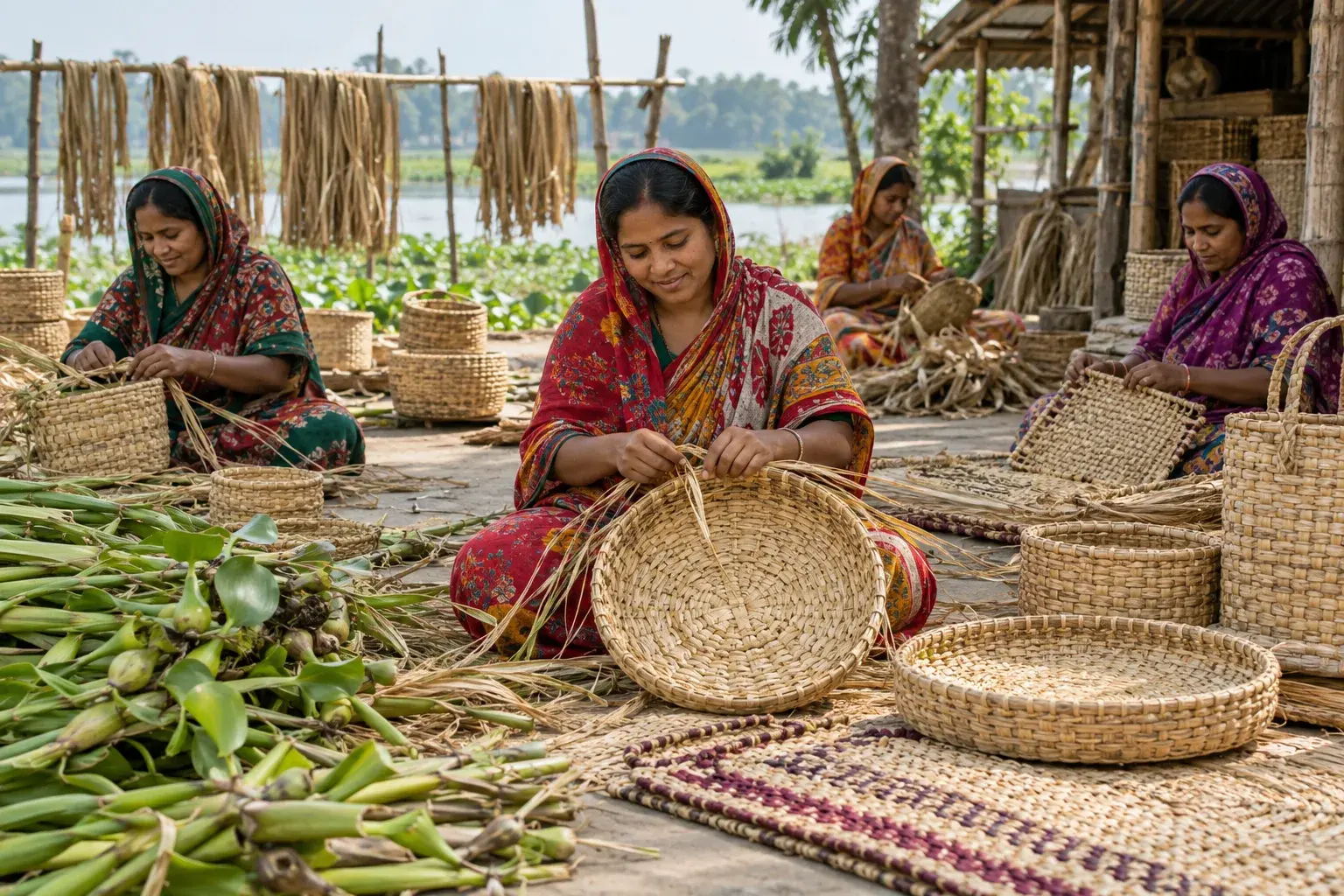
Drying water hyacinth and weaving it into trays, baskets and doormats. In Jhenaidah 800 women do this at home at Tk 20 a piece, 12-15 pieces a day, about Tk 3,000 a month, and the goods go to 82 countries.
- Capital
- ৳1k – ৳40k
- People
- 1 – 5
- First income
- 7 – 30 days
 Light manufacturing & workshop
Karchupi hand embroidery
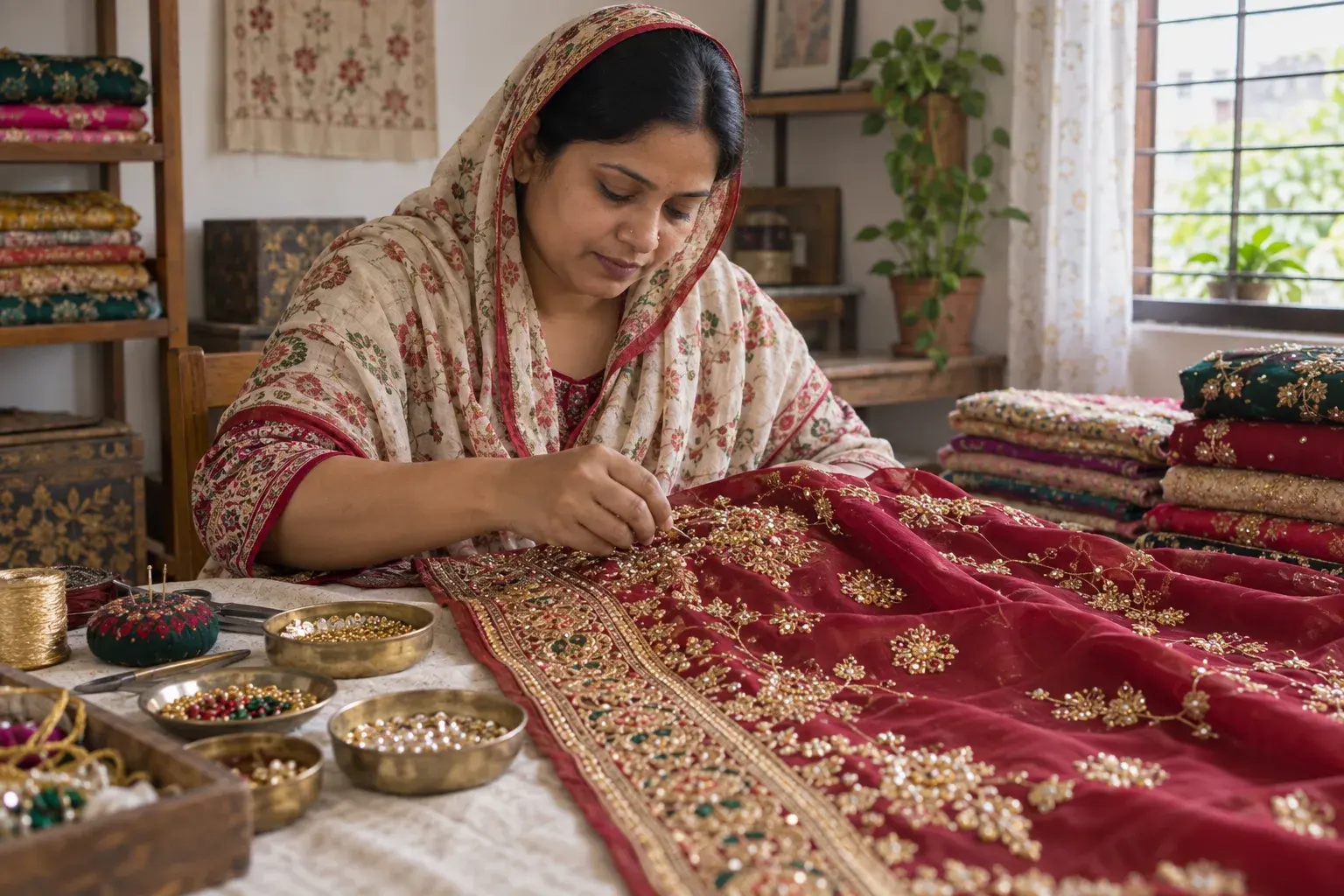
Sequin, bead and zari handwork on sarees and three-pieces, done at home. The mohajon supplies every material; the piece rate is Tk 700-800 a saree and one saree takes at least fifteen days.
- Capital
- ৳500 – ৳5k
- People
- 1 – 3
- First income
- 15 – 20 days
 Light manufacturing & workshop
Block, batik and tie-dye
Making batik and tie-dye sarees and three-pieces at home with wax and dye on cotton. Cumilla shops sell batik sarees from Tk 500 to Tk 1,700, and one karigar can finish about ten sarees a day.
- Capital
- ৳5k – ৳50k
- People
- 1 – 20
- First income
- 7 – 30 days
 Light manufacturing & workshop
Paper bag and packaging making
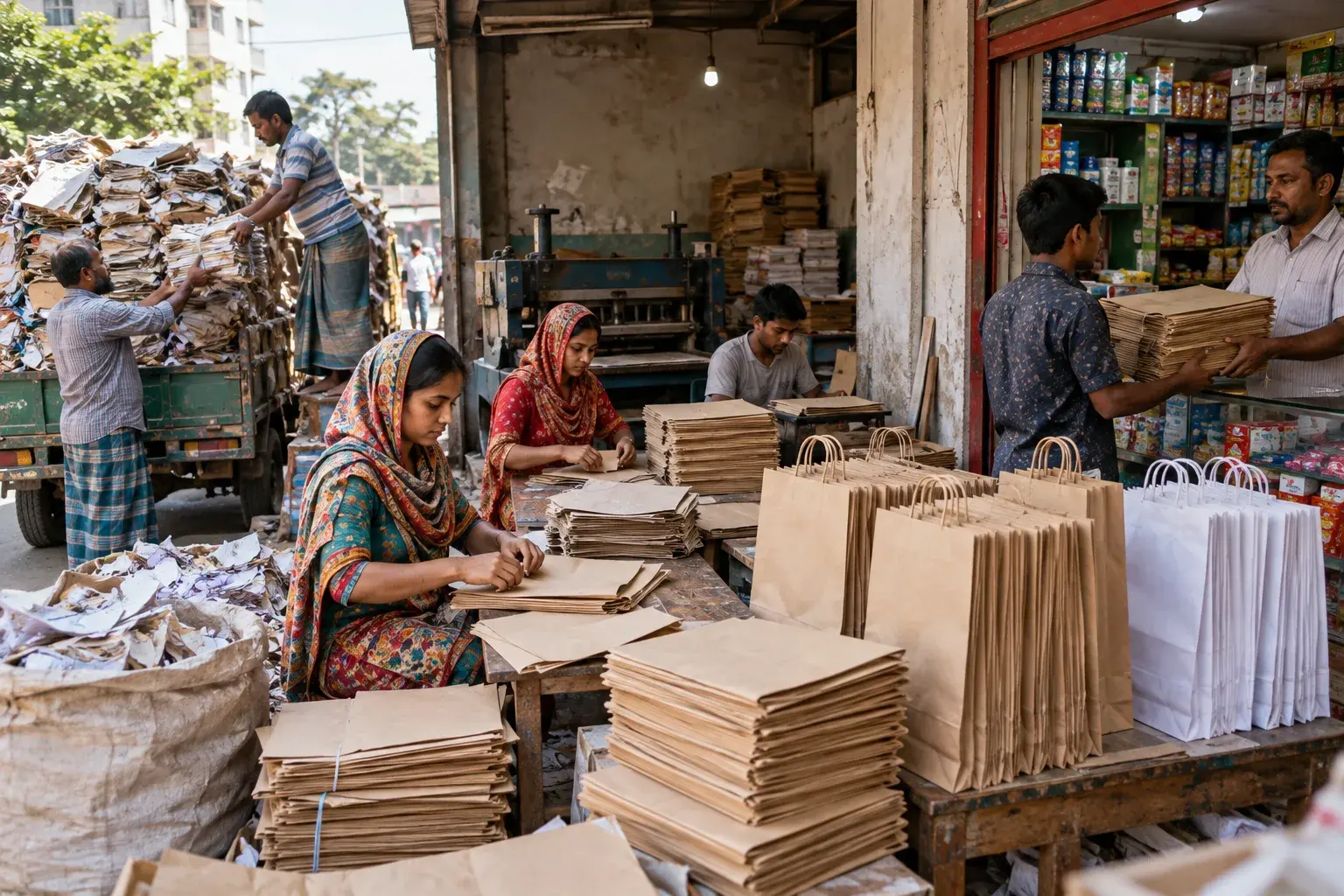
Buying waste paper, folding bags by hand and supplying shops. Khaki bags sell at Tk 135-140 a kg and white at Tk 80; 60 kg of paper costs Tk 7,500 and yields 70 kg of bags for Tk 2,300 profit.
- Capital
- ৳10k – ৳60k
- People
- 1 – 20
- First income
- 3 – 15 days