
Khoi and batasa making
Popping paddy into khoi and boiling sugar or gur into batasa and kadma. Wholesale sugar is Tk 102-103 a kg and batasa sells at Tk 190-300. Very low capital and no BSTI CM licence.
- Last reviewed: 19 September 2026
- Version 1
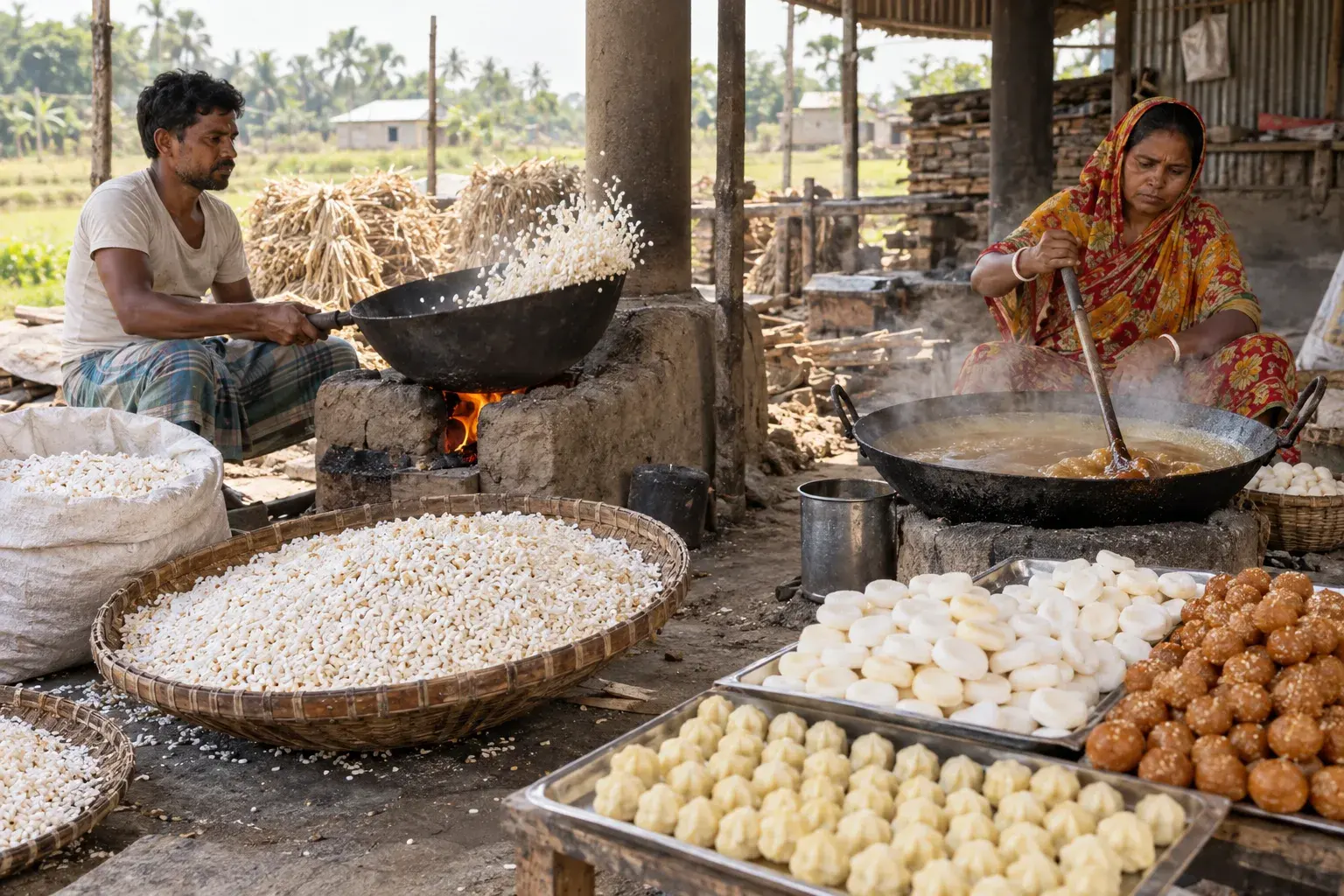
Khoi and batasa making
- Starting capital
- ৳15,000 – ৳1,50,000 Editorial estimate
- Manpower
- 2 – 6 people
- First sale
- 10 – 40 days Editorial estimate
- Break-even
- 2 – 6 months Editorial estimate
- Kind of work
- Home-based · Easy
About the business
Popping paddy in hot sand to make khoi, and boiling sugar or gur and dropping it into batasa and kadma - one of the oldest food trades in village Bengal. The capital is close to nothing: a large pan, sand, a stove, fuel and moulds. There is only one thing to learn, which is at what stage of the sugar syrup a batasa will puff up light. In Bhatara village in Saturia, Manikganj the craft is a hundred years old; when Pahela Baishakh comes the whole village works day and night on kadma and batasa for the fairs. Both sides of the price are known. On 15 September 2026 wholesale sugar in Dhaka was Tk 102-103 a kg and retail Tk 110-115. On 16 September 2026 Daraz listed batasa at Tk 106-150 for 500 g and Tk 190-240 for a kilo - roughly Tk 190 to Tk 300 a kilo. Khoi sells higher, Tk 140-210 for 500 g, or Tk 280-420 a kilo. The raw material is cheap. On 5 September 2026 Naogaon haats had Katari paddy at Tk 900-960 a maund and BRI-28 at Tk 800-820, about Tk 20-24 a kg. But khoi needs a particular paddy, not ordinary rice paddy, and that costs more - in Pabna in 2023 khoi paddy was Tk 120 a kg. The law is light here. Muri is on BSTI's mandatory list but khoi and batasa are not, so no CM licence is needed. Declaring a weight on a pack still requires the packaged-goods registration certificate, and making sweets requires food authority registration.
Unit economics
| Item | Range | Evidence | Suggest a correction |
|---|---|---|---|
| Monthly working capital | ৳20,000 – ৳1,20,000 | Editorial estimate | |
| Selling price | ৳190 – ৳300 / kg | Market quote | |
| Variable cost | ৳102 – ৳115 / kg | Official source | |
| Gross margin | 35% – 60% | Editorial estimate | |
| Time to first revenue | 10 – 40 days | Editorial estimate | |
| Break-even time | 2 – 6 months | Editorial estimate | |
| Cash cycle | 0 – 15 days | Editorial estimate | |
| Waste / loss | 3% – 8% | Editorial estimate | |
| Daily capacity | 10 – 60 | Editorial estimate |
What you need to start
- A large iron pan, a clay or brick stove, wood or straw fuel, moulds or tin sheets and cloth for dropping batasa, roasting sand and sieves for khoi, and wide trays and airtight tins for cooling and storage.Equipment
- Sugar (wholesale Tk 102-103 a kg on 15 September 2026), cane or date gur, and the right variety of paddy for khoi. Packets and labels too if you do not sell loose.Starting stock
- Bangladesh Food Safety Authority registration, compulsory for sweetmeat makers and packaged food producers under the Food Safety (Registration and Licensing) Regulations 2026: registration Tk 1,000, renewal Tk 500, valid three years.Licence
- Packaged-goods registration certificate from BSTI's metrology wing under the Weights and Measures Standards Act 2018. Needed only when selling in packs with a declared weight, not when selling loose. Selling packaged goods without it draws a mobile court case.Licence
- Trade licence from the city corporation, municipality or union parishad: form Tk 10, licence book Tk 50, standard tax Tk 30, stamp Tk 150-300, licence fee Tk 100-60,000 by trade type. Issued in 3-5 working days.Licence
- Reading the thread of the sugar syrup. This is the only real skill in the trade - under-boiled batasa is flat and sticky, over-boiled is hard and reddish. It is judged by eye and hand, not by a clock.Skill
- A sugar wholesale arot, a gur haat, and local growers or a paddy arot for khoi paddy. Plus standing orders with fair stallholders and sweet shops.Supplier
How the work is done
- 1Decide what you will make - only batasa and kadma, or khoi as well. Khoi needs roasting sand, a big pan and a separate skill.
- 2Fix a yard or a shed where a stove can sit and the smoke can get out. It must be dry, or the batasa goes soft.
- 3Take the trade licence from the city corporation, municipality or union parishad - form Tk 10, book Tk 50, standard tax Tk 30, stamp Tk 150-300.
- 4You are making sweets, so register with the Bangladesh Food Safety Authority: fee Tk 1,000, valid three years.
- 5Buy sugar by the sack from the wholesale market, not the retail counter. On 15 September 2026 wholesale was Tk 102-103 and retail Tk 110-115, and that Tk 8-13 a kilo is the profit.
- 6Boil sugar and water to the right thread, then drop it onto moulds or cloth to form batasa. Under-boil and it goes flat; over-boil and it turns hard and reddens.
- 7For khoi, soak the paddy, dry it, throw it into hot sand to pop, then sieve the sand out.
- 8Do not touch it before it cools, and the moment it cools put it into airtight tins. Damp air melts batasa and softens khoi.
- 9Produce ahead against the fair calendar. Pahela Baishakh, Chaitra Sankranti, Durga Puja and the village fairs are the year's big sales.
- 10Supply sweet shops, grocers, temple and mazar prasad suppliers and fair stallholders wholesale; selling loose avoids the packaging paperwork.
- 11If you want to sell in weighed packs under your own name, take the packaged-goods registration certificate from BSTI's metrology wing.
Seasons
- JanNormal
- FebNormal
- MarHigh
- AprHigh
- MayNormal
- JunNormal
- JulNormal
- AugNormal
- SepNormal
- OctHigh
- NovHigh
- DecNormal
Where it works well
- Strong fitManikganj · In Bhatara village, Saturia, making kadma and batasa is a century old, and the whole village works day and night on 'saj khabar' around Pahela Baishakh. The craftsmen, the moulds and the buyers are all already here.
- PossibleBogura · The northern trading centre, with many sweet shops and fairs and a sugar wholesale arot.
- PossibleDhaka · The biggest buyer and the online sales channel, though rent and dry storage cost more here.
- PossibleJashore · Date gur country, so the raw material for gur batasa is cheap here in winter.
- PossibleNaogaon · A major paddy market; on 5 September 2026 haat paddy was Tk 800-960 a maund, so khoi's raw material is cheapest here.
- PossiblePabna · Strong Durga Puja demand for naru, moa and khoi, a market whose ingredient prices are well documented, and khoi paddy available locally.
- PossibleTangail · A high density of village fairs, an old sweet-making tradition, and the Dhaka market close by.
Risks and cautions
- HighDemand: Sales are tied to fair and festival dates. Pahela Baishakh, Chaitra Sankranti, Durga Puja and the village fairs carry most of the year. If a fair is cancelled, rained off or moved, the stock stays on your hands, and batasa does not keep. In the other months the stove is nearly idle.
- HighSpoilage: Both batasa and khoi are enemies of damp air. In the monsoon or in fog, batasa melts and sticks together and khoi goes soft, and then nobody buys. Airtight tins and a dry room are not optional, and they are the most neglected cost in the trade.
- MediumWorking capital: A rise in the sugar price lands directly, because batasa is almost all sugar. Fair stallholders, meanwhile, expect the same price year after year, so passing the cost on is hard. One jump in sugar can wipe out a season's profit.
- MediumOther: The work is done with fire and boiling sugar syrup, usually in a home yard with the whole family involved. Splashed syrup burns deep, and the hot sand for khoi is dangerous too. In a trade this small there is no insurance and no medical cover.
Sources
Supports: Time to first revenue · বাংলাদেশ
- Collected: 16 Sept 2026
Supports: Starting capital · বাংলাদেশ
সিটি কর্পোরেশন থেকে ট্রেড লাইসেন্স প্রাপ্তির ধাপ সমূহ
Collected: 16 Sept 2026Supports: Starting capital · বাংলাদেশ
- Collected: 15 Sept 2026
Supports: Variable cost · ঢাকা মহানগর — সিপাহীবাগ, মিরপুর-৬, মোহাম্মদপুর টাউন হল, নিউমার্কেট, রামপুরা, মহাখালী বাজার
- Collected: 15 Sept 2026
Supports: Gross margin, Monthly working capital, Variable cost · ঢাকা মহানগর
All food businesses now need safety registration
Collected: 22 Jul 2026Supports: Starting capital · বাংলাদেশ
What changed
No corrections have been published yet.
Questions and answers
No questions yet. Be the first to ask.
Stories about this business
Batasa and kadma at 140 taka a kilo, and one seller's trade spread to a whole village
Wholesale rates run at 140 taka a kg for kadma, sugar figurines and batasa, 160 for nimki, 120 for jilapi and 90 for khoi. What began in the early 1980s with one man selling sweets at local fairs has turned a Bogura village into a confectionery quarter.
- Reasons
- Strong network, Weak demand
Similar businesses
 Food processing
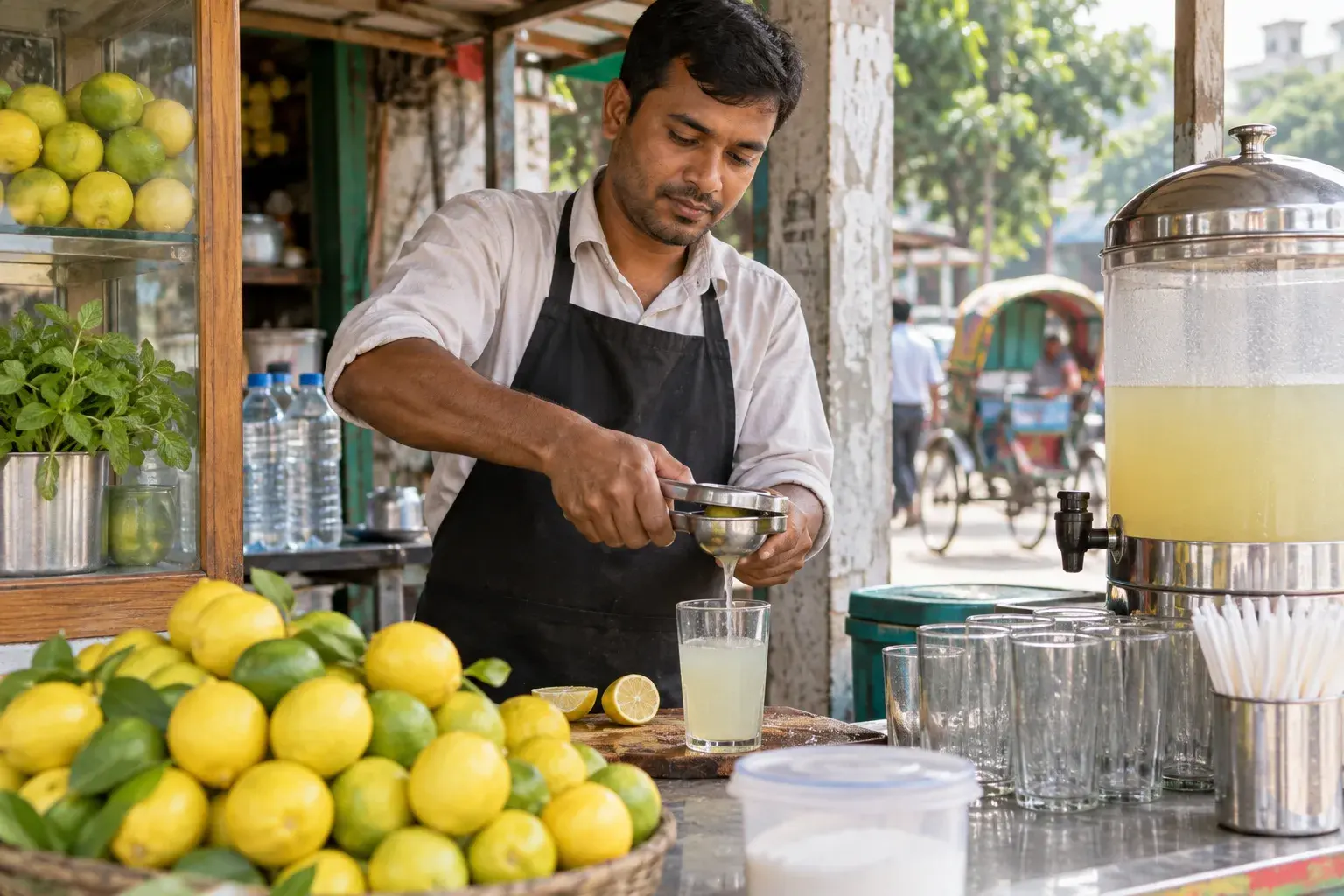
Juice and sharbat shop
Lemon, sugarcane and bael sharbat through the hot months at Tk 10-25 a glass, lassi at Tk 50. The trade stands on three things: ice, electricity and one hot season.
- Capital
- ৳15k – ৳3 lakh
- People
- 1 – 4
- First income
- 5 – 45 days
 Food processing
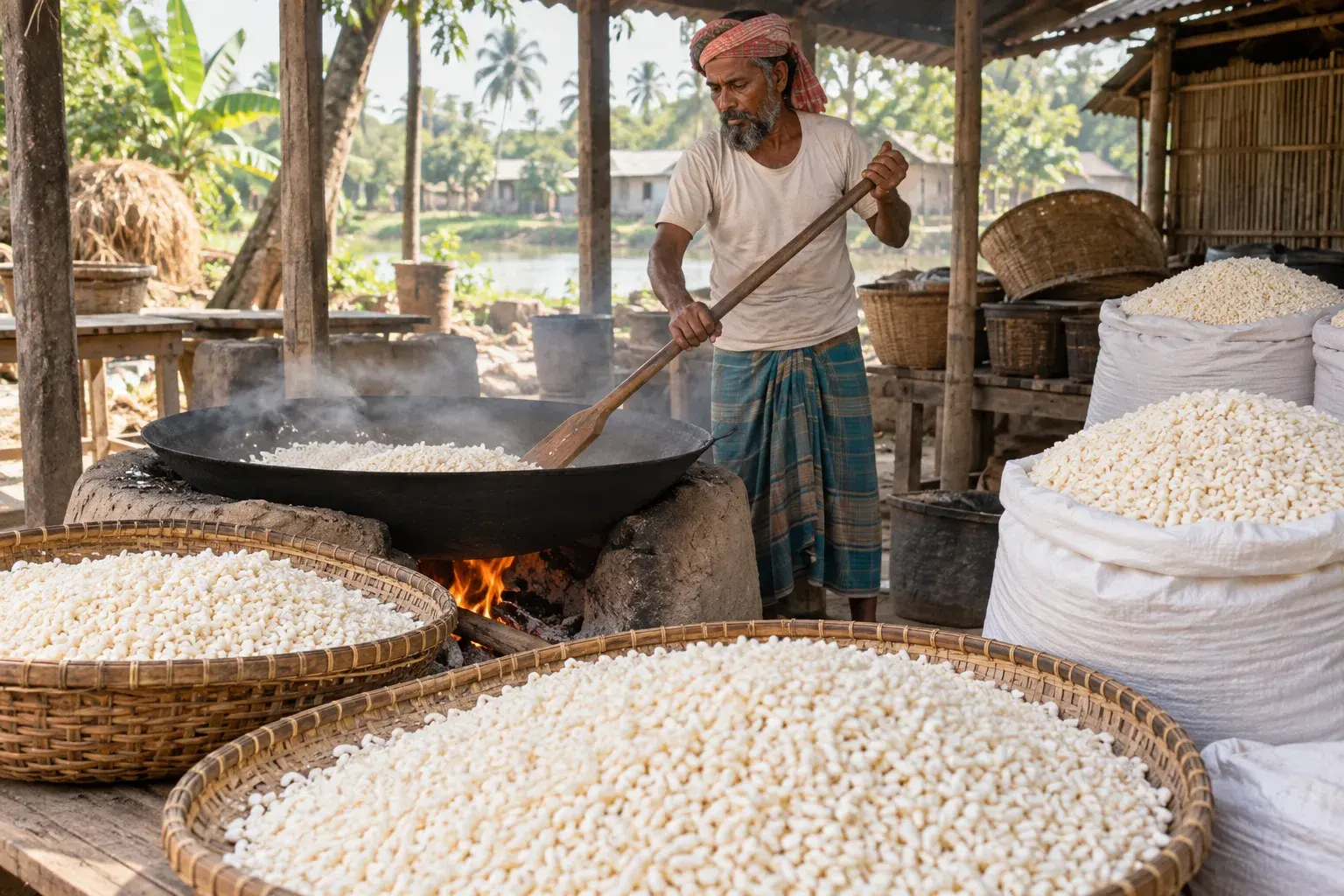
Puffed rice (muri) making
Frying rice into muri. One kilo of rice gives 900 grams of muri and coarse rice costs Tk 50-55/kg, so machine muri keeps only Tk 4-6 a kilo while hand-fried pure muri wholesales at Tk 90.
- Capital
- ৳20k – ৳2 lakh
- People
- 2 – 8
- First income
- 7 – 30 days
 Food processing
Pickle (achar) making
Making mango, olive and garlic pickle for jars. Branded pickle retails at Tk 375-525 a kilo, and selling packaged food means a Tk 1,000 food safety registration even from a home kitchen.
- Capital
- ৳20k – ৳90k
- People
- 1 – 4
- First income
- 14 – 28 days
 Food processing
Tea stall and small cafe
About 250 cups come out of a kilo of tea leaf, and a cup sells for Tk 5-30. Tk 20,000 buys a stove, a cylinder, cups and a week of stock - not a shop deposit and not a fridge.
- Capital
- ৳20k – ৳1.5 lakh
- People
- 1 – 3
- First income
- 7 – 30 days