
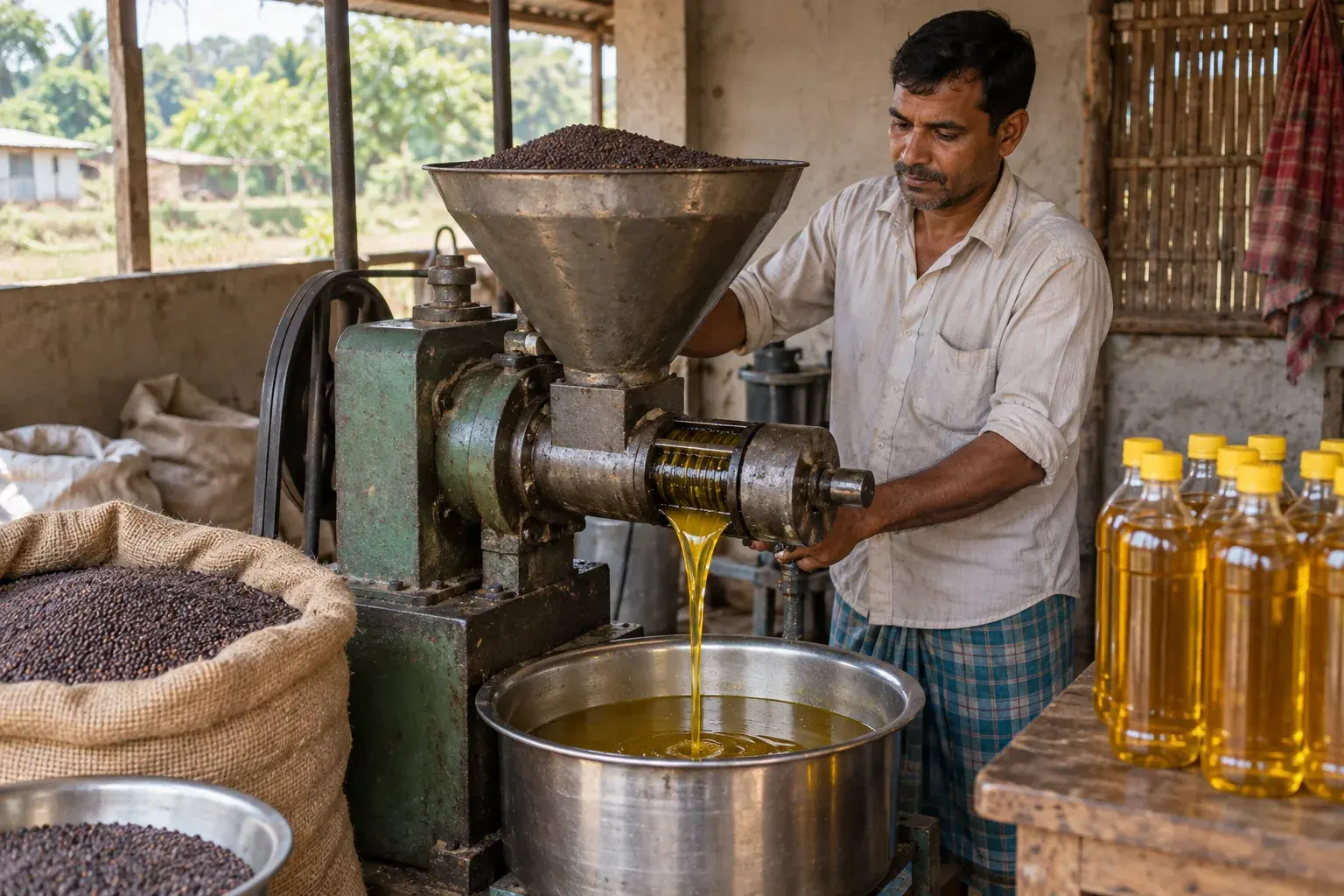
Mustard oil pressing (ghani)
Crushing mustard seed for oil and cake. A maund of seed gives 16-19 litres of oil and 25 kg of cake; net of the cake a litre costs Tk 96-114 to make and sells loose at Tk 200.
- Last reviewed: 19 September 2026
- Version 1
Mustard oil pressing (ghani)
- Starting capital
- ৳80,000 – ৳5,00,000 Editorial estimate
- Manpower
- 1 – 4 people
- First sale
- 30 – 90 days Editorial estimate
- Break-even
- 3 – 8 months Editorial estimate
- Kind of work
- Workshop · Medium difficulty
About the business
Crushing mustard seed into oil and selling it. Whether it is a wooden ghani or a small expeller, the arithmetic is the same: a maund of seed yields more than 16 litres of oil, up to 18-19 litres for a good variety, and leaves about 25 kg of oil cake. The cake is what keeps the business standing. A mill owner in Kushtia costed it out as follows: seed Tk 2,300-2,500 a maund, crushing Tk 340, and 25 kg of cake sold at Tk 45 returning Tk 1,125. Net of the cake, a litre of oil costs Tk 96 to at most Tk 114 to produce. That oil sells loose at Tk 200 a litre, Tk 220 under a local label, and Tk 350-360 in a national brand's bottle. Be careful with those figures: they are from February 2024 and are more than twelve months old. Seed prices swing through the season, and a rise takes the whole margin with it. Demand for pure mustard oil is rising in the cities as people move away from soybean, but this is also the market with the most complaints of adulteration and palm oil blending. Selling in your own bottle therefore needs a BSTI CM licence: mustard oil is item two on BSTI's compulsory certification list.
Unit economics
| Item | Range | Evidence | Suggest a correction |
|---|---|---|---|
| Monthly working capital | ৳70,000 – ৳4,00,000 | Editorial estimate | |
| Selling price | ৳200 – ৳360 / unit | Market quote | |
| Variable cost | ৳96 – ৳114 / unit | Market quote | |
| Gross margin | 43% – 52% | Editorial estimate | |
| Time to first revenue | 30 – 90 days | Editorial estimate | |
| Break-even time | 3 – 8 months | Editorial estimate | |
| Cash cycle | 10 – 60 days | Editorial estimate | |
| Waste / loss | 2% – 5% | Editorial estimate | |
| Daily capacity | 16 – 120 | Editorial estimate |
What you need to start
- A wooden ghani or a small expeller, means to clean and dry the seed, a filter, drums to hold the oil, scales, and bottles and labels. The machine price could not be verified.Equipment
- A stock of seed bought in season. At Tk 2,300-2,500 a maund, every maund stored is money locked up, and mustard comes only once a year.Starting stock
- BSTI CM (Certification Marks) licence. 'Mustard Oil' is item 2 in the agricultural and food products section of BSTI's compulsory list, standard BDS 25:2015 (Amendment-1:2020), and is required to sell under a name on a bottle or packet. The fee could not be verified.Licence
- Bangladesh Food Safety Authority registration: Tk 1,000 new, Tk 500 renewal, valid three years. For establishments including edible oil, licensing runs Tk 1,000-5,000 under the Food Safety (Registration and Licensing) Regulations, 2026.Licence
- Trade licence from the union parishad, municipality or city corporation: form Tk 10, licence book Tk 50, standard tax Tk 30, stamp Tk 150-300, licence fee Tk 100-60,000 by trade type.Licence
- A wholesale seed market or a direct link to growers, plus a regular buyer for the cake.Supplier
- A dry roofed space with room to store seed, crush, and keep the cake separately. An expeller needs electricity.Workspace
How the work is done
- 1Decide first where the seed will come from. In a growing area like Kushtia you can buy by the maund in the wholesale market, and the price is lowest at harvest.
- 2Choose between a wooden ghani and a small expeller. Ghani oil sells dearer as 'pure', but crushes far less in a day.
- 3Take the trade licence from the union parishad, municipality or city corporation.
- 4Register with the Bangladesh Food Safety Authority - Tk 1,000, renewal Tk 500, valid three years. Edible oil may also need a separate licence; ask at the office.
- 5Apply for the BSTI CM licence. Mustard Oil is item 2 on the compulsory list, standard BDS 25:2015 (Amendment-1:2020). No licence without passing the sample test.
- 6Buy seed in season, dry it and store it. Damp seed gives less oil and the cake picks up a smell.
- 7Record the litres of oil and kilos of cake from every maund. Below 16 litres, either the seed is poor or the machine needs work.
- 8Line up the cake buyer first - cattle and goat farmers, or fish feed traders. Without the cake money the oil does not add up.
- 9Sell loose oil to local shops and bottled oil to city buyers. A reputation for purity in the city nearly doubles the price.
- 10Do not blend in palm or any other oil. Section 25 of the Food Safety Act prohibits producing and selling adulterated food, and in this trade a ruined name does not come back.
Seasons
- JanHigh
- FebHigh
- MarHigh
- AprNormal
- MayNormal
- JunNormal
- JulNormal
- AugNormal
- SepNormal
- OctNormal
- NovHigh
- DecHigh
Where it works well
- Strong fitDhaka · The biggest buyers of pure mustard oil are here; national brands sell at Tk 350-360 a litre, leaving room for a small producer to get a price.
- Strong fitKushtia · Seed trades at Tk 2,300-2,500 a maund in the wholesale market and there is an old cluster of oil mills; the district agriculture extension office tracks the mustard crop here.
- PossibleChattogram · City purchasing power is high and supermarkets want pure oil, though the seed has to come from far away.
- PossibleFaridpur · A mustard growing area with old oil markets along the Padma.
- PossibleJashore · Mustard growing and an old edible oil trade, with many fish farms as cake buyers.
- PossibleMagura · A mustard growing area with the Kushtia wholesale market close by.
- PossibleManikganj · A mustard growing area within reach of the Dhaka market.
- PossibleRajbari · A mustard growing area with easy access to the Dhaka market.
- PossibleSirajganj · Mustard grows on the chars, and with many cattle farms nearby the cake sells locally.
- PossibleTangail · A mustard growing area, so seed is available close by in season and freight is low.
Risks and cautions
- HighWorking capital: Mustard comes once a year but oil sells all twelve months, so seed must be bought in bulk at harvest and the money sits there all year. A maund alone is Tk 2,300-2,500, so a hundred maunds parks a quarter of a million taka in the store. Without cash you buy out of season at a high price, and then there is no margin.
- HighDependency: Much of the profit is in the cake, not the oil. Twenty-five kilos of cake at Tk 45 returns Tk 1,125 a maund; take that away and the Tk 96-114 per litre cost rises sharply. If the cake price falls or the buyer disappears, the oil business goes into loss.
- HighCompliance: Mustard oil is a BSTI compulsory product (item 2, BDS 25:2015). Selling in your own bottle without a CM licence invites a mobile court. Blending in palm oil makes it adulterated food under section 25 of the Food Safety Act, an offence that is cognizable and non-bailable and cannot be settled with an administrative fine.
- MediumDemand: Loose mustard oil is Tk 200 a litre against loose soybean at Tk 186-195 on 15 September 2026. Customers have to be held at that narrow gap, and only trust in purity does it. Loose soybean rose 11.4 percent over the year - the dearer soybean gets, the better the opening for mustard oil.
- MediumOther: Nearly every money figure on this page is from February 2024 and is more than twelve months old. Seed, cake and retail oil prices can all have moved. Before putting money in, go to your own wholesale market and check all three yourself.
Sources
- Collected: 16 Sept 2026
Supports: Starting capital · বাংলাদেশ
সিটি কর্পোরেশন থেকে ট্রেড লাইসেন্স প্রাপ্তির ধাপ সমূহ
Collected: 16 Sept 2026Supports: Starting capital · বাংলাদেশ
- Collected: 15 Sept 2026
Supports: Selling price · ঢাকা মহানগর — সিপাহীবাগ, মিরপুর-৬, মোহাম্মদপুর টাউন হল, নিউমার্কেট, রামপুরা, মহাখালী বাজার
All food businesses now need safety registration
Collected: 22 Jul 2026Supports: Starting capital · বাংলাদেশ
What changed
No corrections have been published yet.
Questions and answers
No questions yet. Be the first to ask.
Stories about this business
Seed at 75-80 taka, oil at 300-350, and 30,000-40,000 a month
Mustard oil pressed on a horse-drawn wooden ghani: seed bought at 75-80 taka a kg, three to three and a half lakh taka of it a year, oil sold at 300-350 taka a kg, leaving 30,000-40,000 taka a month after costs.
- Reasons
- Good quality, Loyal customers
Similar businesses
 Food processing
Yogurt and chhana making
Buying raw milk at Tk 45-55 a litre and turning it into curd and chhana. Yield per litre and spoilage decide whether it makes money.
- Capital
- ৳80k – ৳4.5 lakh
- People
- 1 – 5
- First income
- 14 – 45 days
 Food processing
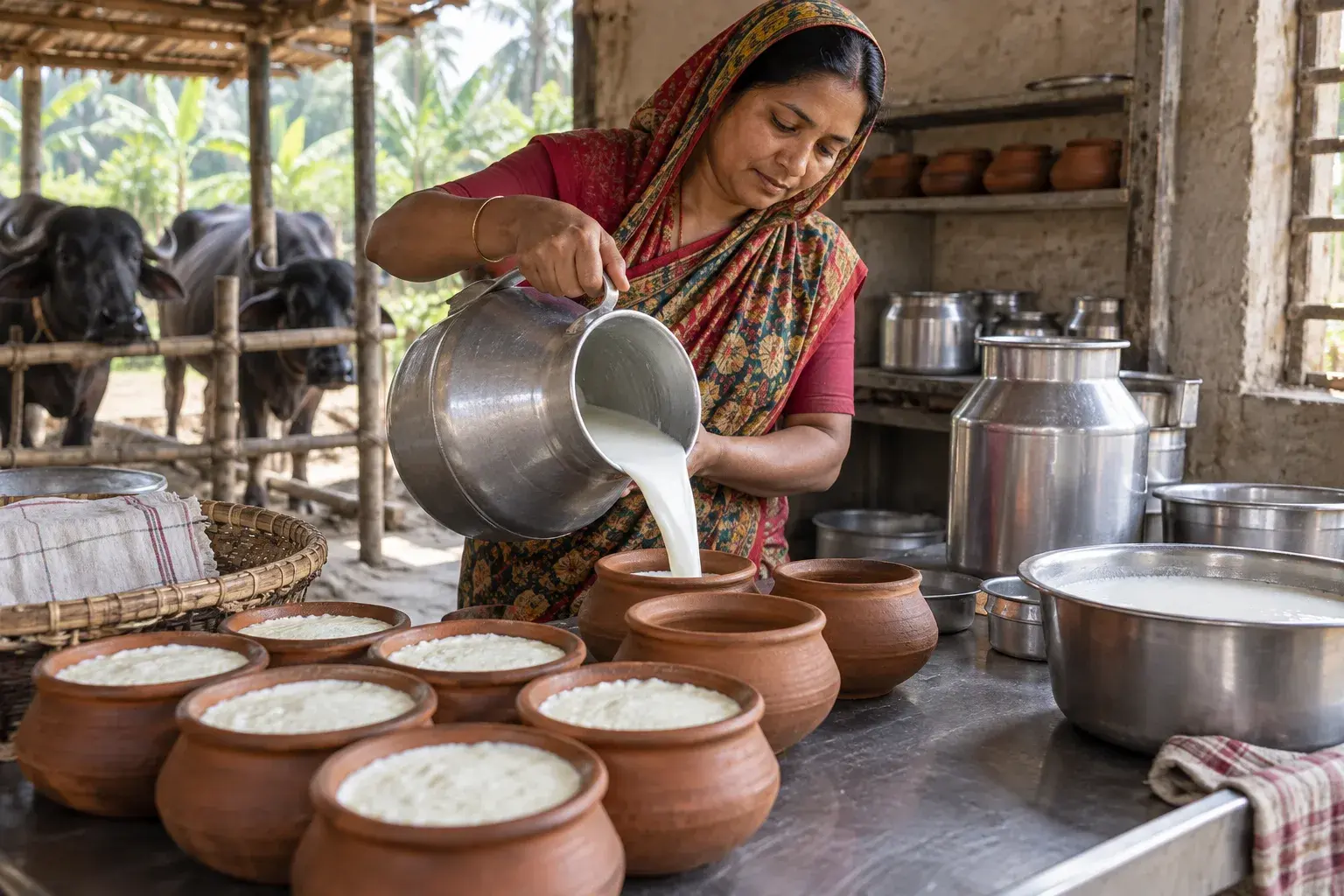
Buffalo curd and dairy
Raw buffalo milk set in clay pots. In Bhola milk costs Tk 150/kg and the curd sells at Tk 200/kg, so about Tk 50 a kg is left, and getting the milk at all is the hardest part.
- Capital
- ৳80k – ৳4 lakh
- People
- 1 – 5
- First income
- 7 – 30 days
 Food processing
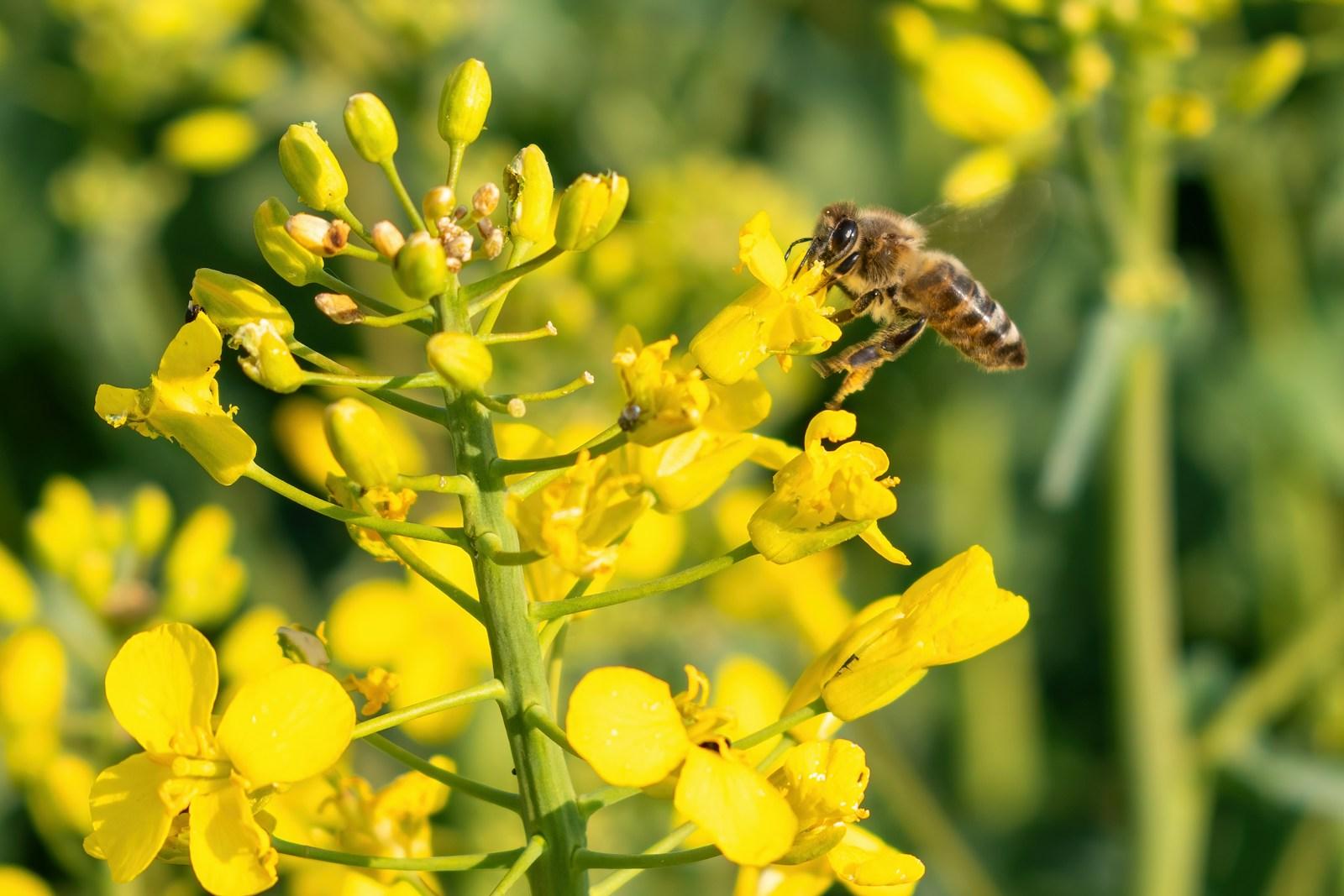
Mustard honey bottling
Place bee boxes in winter mustard fields, strain and bottle the honey, sell all year.
- Capital
- ৳1 lakh – ৳2.5 lakh
- People
- 2 – 3
- First income
- 60 – 90 days
 Food processing
Ghee and butter making
Separating milk into butter and ghee, with chhana or yogurt from the skim. One maund (40 kg) of milk gives 1.25 kg of ghee; cost about Tk 2,900 against Tk 3,040-3,260 of sales - a 5 to 11 percent margin.
- Capital
- ৳60k – ৳4 lakh
- People
- 2 – 6
- First income
- 15 – 60 days