
Ornamental fish farming
Breeding guppy, molly, goldfish and angelfish in concrete tanks or aquariums and selling the young. The country has one wholesale market that matters, Katabon in Dhaka, where a survey counted 40 shops.
- Last reviewed: 21 September 2026
- Version 1

Ornamental fish farming
- Starting capital
- ৳1,000 – ৳15,00,000 Editorial estimate
- Manpower
- 1 – 4 people
- First sale
- 90 – 120 days Editorial estimate
- Break-even
- 4 – 36 months Editorial estimate
- Kind of work
- Home-based · Medium difficulty
About the business
Keeping coloured fish in concrete tanks, cisterns or glass aquariums, breeding them and selling the young. In Bangladesh this comes in two quite different shapes. One is the import trade: fish brought in from Thailand, Singapore, Indonesia, India, Malaysia and Japan and released into Katabon in Dhaka. Katabon is the wholesale centre for the whole country; one survey found 40 aquarium shops there and recorded 270 varieties across 149 species from 38 families changing hands. The other is the small farmer's trade: concrete tanks in a household yard breeding guppy, molly and platy. These fish bear live young rather than laying eggs, so no hatchery is needed. Rakib of Dinajpur said in October 2025 that he started by buying six guppies for Tk 360 and now keeps 18 species in 45 tanks, earning Tk 40,000 to 45,000 a month, with fish and equipment worth Tk 13-15 lakh. On price the sources do not agree. The 2018-19 Katabon survey put guppy at Tk 40-80 a pair, molly Tk 60-300, platy Tk 60-180, angelfish Tk 50-850 and goldfish Tk 80-2,000. A 2020 report instead put good-strain guppy at Tk 400 a pair and upwards and fighter fish at Tk 1,500-2,500 a pair. Both are true: between a common strain and a named strain the price differs ten- or twentyfold.
Unit economics
| Item | Range | Evidence | Suggest a correction |
|---|---|---|---|
| Monthly working capital | ৳10,000 – ৳35,000 | Editorial estimate | |
| Selling price | ৳40 – ৳2,000 / unit | Disputed | |
| Variable cost | ৳15 – ৳40 / unit | Editorial estimate | |
| Gross margin | 50% – 90% | Editorial estimate | |
| Time to first revenue | 90 – 120 days | Editorial estimate | |
| Break-even time | 4 – 36 months | Editorial estimate | |
| Cash cycle | 60 – 120 days | Editorial estimate | |
| Waste / loss | 10% – 40% | Editorial estimate | |
| Daily capacity | 3 – 45 | Editorial estimate |
What you need to start
- Air pumps and air stones, a battery or IPS for power cuts, hand nets, small containers to separate fry, polythene bags and an oxygen cylinder. Prices could not be verified here.Equipment
- Breeding stock. The 2018-19 Katabon survey gives guppy Tk 40-80 a pair, molly Tk 60-300, platy Tk 60-180, angelfish Tk 50-850, goldfish Tk 80-2,000. A 2020 report puts good-strain guppy at Tk 400 to Tk 5,000 a pair. Both figures are old.Starting stock
- Trade licence from the city corporation, municipality or union parishad: form Tk 10, licence book Tk 50, standard tax Tk 30, stamp Tk 150-300, licence fee Tk 100-60,000, issued in 3-5 working days.Licence
- Knowing when a female will drop, separating fry, spotting fouled water and fungal disease, and packing live fish. The survey found 76 varieties across 23 species already being bred locally, so the knowledge exists to be learned.Skill
- The wholesale shops at Katabon, from which almost all imported fish in the country spread. A survey counted 40 shops, with imports from Thailand, Singapore, Indonesia, India, Malaysia and Japan.Supplier
- A backup for the power: a battery air pump or an IPS. This is not a convenience but a condition; with the pump off a crowded tank loses fish within hours.Supplier
- Cement tanks or cisterns in a shaded spot with a way to fill and drain. One Dinajpur farm runs 45 tanks. On 2020 figures, rented space cost Tk 5,000 a month with Tk 2,000 electricity and Tk 500 water.Workspace
How the work is done
- 1Start small, with a pair or two of guppy or molly. Rakib of Dinajpur began by buying six guppies for Tk 360.
- 2Take the livebearers first: guppy, molly, platy. They do not lay eggs but bear live young, so there is no hatchery and no egg-hatching to manage.
- 3Build cement tanks, not glass aquariums. Tanks are cheaper, do not break and hold more fish; a glass aquarium is for showing fish, not for raising them.
- 4Keep a way to separate the mother. Guppies and mollies eat their own young, so the mother has to go into a separate container when she drops.
- 5Settle what happens in a power cut before it happens: a battery air pump or an IPS. With the pump off, a crowded tank loses fish within hours.
- 6Plan for winter. Cold water kills the young and stops growth; without a heater the tanks have to be covered.
- 7Go to Katabon and see for yourself which fish are moving and what each shop pays. The country's wholesale price is set there; a survey counted 40 shops.
- 8Open a Facebook page and post photos and video of the fish regularly. Rakib's page has over 10,000 followers and he ships to Chapainawabganj and Thakurgaon.
- 9Learn to pack: one part water to two parts oxygen in the bag, and no feed for a day before shipping. Without that the fish die on the road and you refund the money.
- 10Never put new fish straight into the main tanks. Hold them separately for at least a week; one fish brought in from outside can take the whole farm.
- 11Keep a written record by strain of what dropped young when and what colour came from which pair. A valuable strain means holding a line, and that cannot be done without a book.
- 12Once you open a shop or start selling regularly, take a trade licence from the union parishad or municipality; it is issued in three to five working days.
Seasons
- JanLow
- FebLow
- MarHigh
- AprHigh
- MayHigh
- JunNormal
- JulNormal
- AugNormal
- SepNormal
- OctNormal
- NovNormal
- DecLow
Where it works well
- Strong fitDhaka · Katabon is the country's only wholesale market: a survey counted 40 aquarium shops handling 270 varieties across 149 species. Imports, wholesale price and buyers are all here.
- PossibleChattogram · A big city with hobby buyers and its own shops, though the wholesale price is still set at Katabon.
- PossibleDinajpur · A farmer here runs 18 species in 45 tanks, earns Tk 40,000-45,000 a month and sells direct through Facebook.
- PossibleGaibandha · Small-capital tank farms are appearing in the north, but the distance to Dhaka means more risk of losses on the way.
- PossibleGazipur · Close to Dhaka with relatively better power and cheap land, which suits putting up tanks.
- PossibleJashore · The country's biggest fish-seed centre, where the people, the vehicles and the habit of packing and shipping live fish already exist.
- PossibleMymensingh · An old fish-farming district with university training and hatchery experience behind it, and ornamental farms have spread from here.
- PossibleNarayanganj · Right beside Dhaka, so fish reach Katabon with little chance of dying on the road, and space is cheaper than in the city.
Risks and cautions
- HighDependency: There is effectively one wholesale market for the whole country, Katabon in Dhaka. A district farmer either takes the fish to Dhaka himself or accepts what the Katabon shopkeeper offers. There is almost no room to bargain, and if fish die in transit the loss is the farmer's.
- MediumDemand: This is a hobby purchase, not a necessity. When household costs rise, aquarium fish go first. And fashions move: the guppy line that pays well today is in everyone's tank two years later, and then the price falls.
- MediumDependency: The good breeding stock comes from outside: Thailand, Singapore, Indonesia, India, Malaysia and Japan. If imports stall or the dollar rises, new lines cannot be brought in, and an old line loses colour and size over a few generations.
- MediumOther: One fish brought in from outside can take the whole farm. Putting new stock straight into the main tanks instead of holding it apart for a few days is the commonest big mistake in this trade, and the damage only shows a week or two later.
- HighSpoilage: It is live stock, and when it dies nothing is left. A few hours without power and a crowded tank runs out of oxygen; cold water in winter kills the fry; and fish bagged for a long trip die on the way. In 2021, with the shops shut under lockdown, fish were dying at Katabon and the ministry had to arrange for shops to open two hours a day.
Sources
সিটি কর্পোরেশন থেকে ট্রেড লাইসেন্স প্রাপ্তির ধাপ সমূহ
Collected: 16 Sept 2026Supports: Starting capital · বাংলাদেশ
রাকিবের রঙিন মাছের খামার, মাসে আয় ৪৫ হাজার টাকা
Collected: 16 Oct 2025Supports: Starting capital, districts, Monthly working capital · দিনাজপুর সদর
কাটাবন মার্কেট: পশু-পাখি ও মাছের জীবন রক্ষার উদ্যোগ
Collected: 13 Jul 2021Supports: Waste / loss · ঢাকা — কাটাবন
Ornamental fish farming brimming with prospect
Collected: 10 Jul 2020Supports: Starting capital, Selling price, Time to first revenue, Variable cost · ঢাকা ও ময়মনসিংহ
- Collected: 28 Feb 2019
Supports: districts, Selling price · ঢাকা — কাটাবন বাজার
What changed
No corrections have been published yet.
Questions and answers
No questions yet. Be the first to ask.
Stories about this business
3,000 taka at the start, 1.5 lakh ornamental fish and 50,000 a month now
Started at home during COVID with 3,000 taka and some auto-breeding fish; a 45-shotok pond sold after five months at a large profit, and 3 ponds and 18 tanks now bring 45,000-50,000 taka a month.
- Capital
- ৳3k
- Ran for
- 5 months
- Reasons
- Weak demand, Working capital
Similar businesses
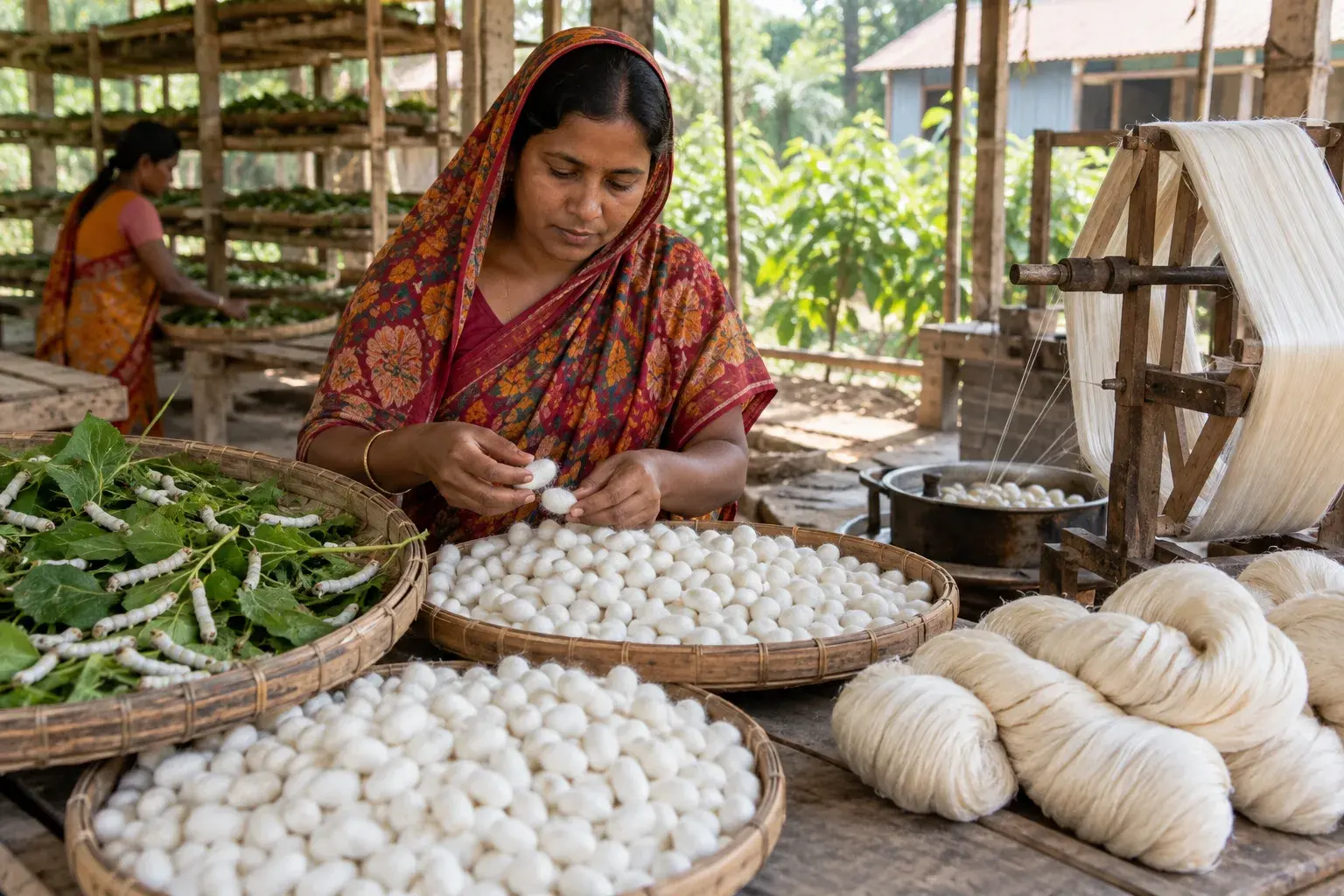 Agriculture & farming
Sericulture and silk yarn
Rearing silkworms on mulberry leaf for cocoons and silk yarn. The Sericulture Board supplies eggs, saplings, equipment and training free; its own rate for yarn is Tk 3,001-3,701 a kilo.
- Capital
- ৳3k – ৳20k
- People
- 1 – 4
- First income
- 30 – 180 days
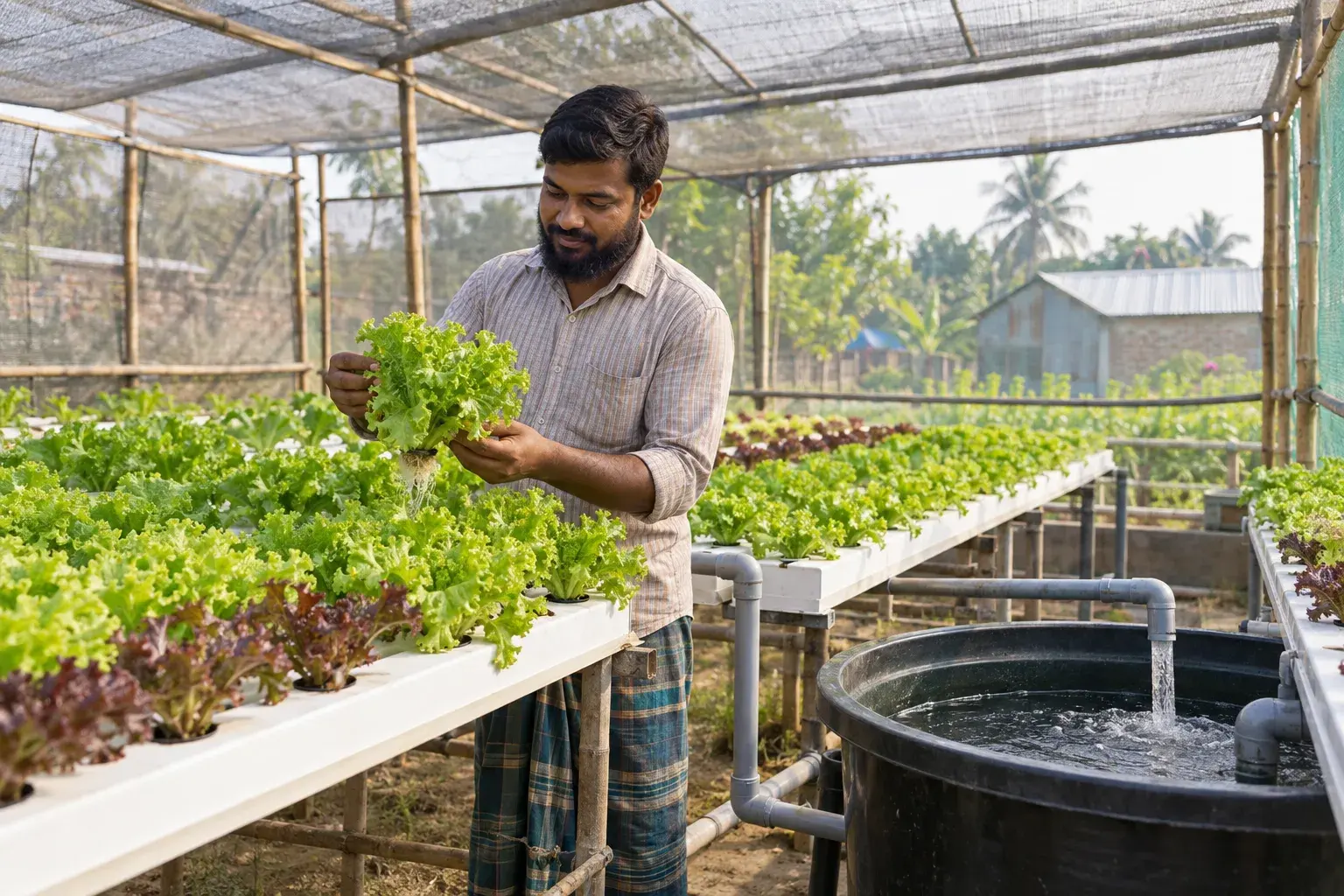 Agriculture & farming
Hydroponic farming
Growing vegetables in water without soil. One Dhaka rooftop setup cost about Tk 2,00,000, and outside Dhaka there is still almost no commercial buyer.
- Capital
- ৳4k – ৳2 lakh
- People
- 1 – 3
- First income
- 45 – 120 days
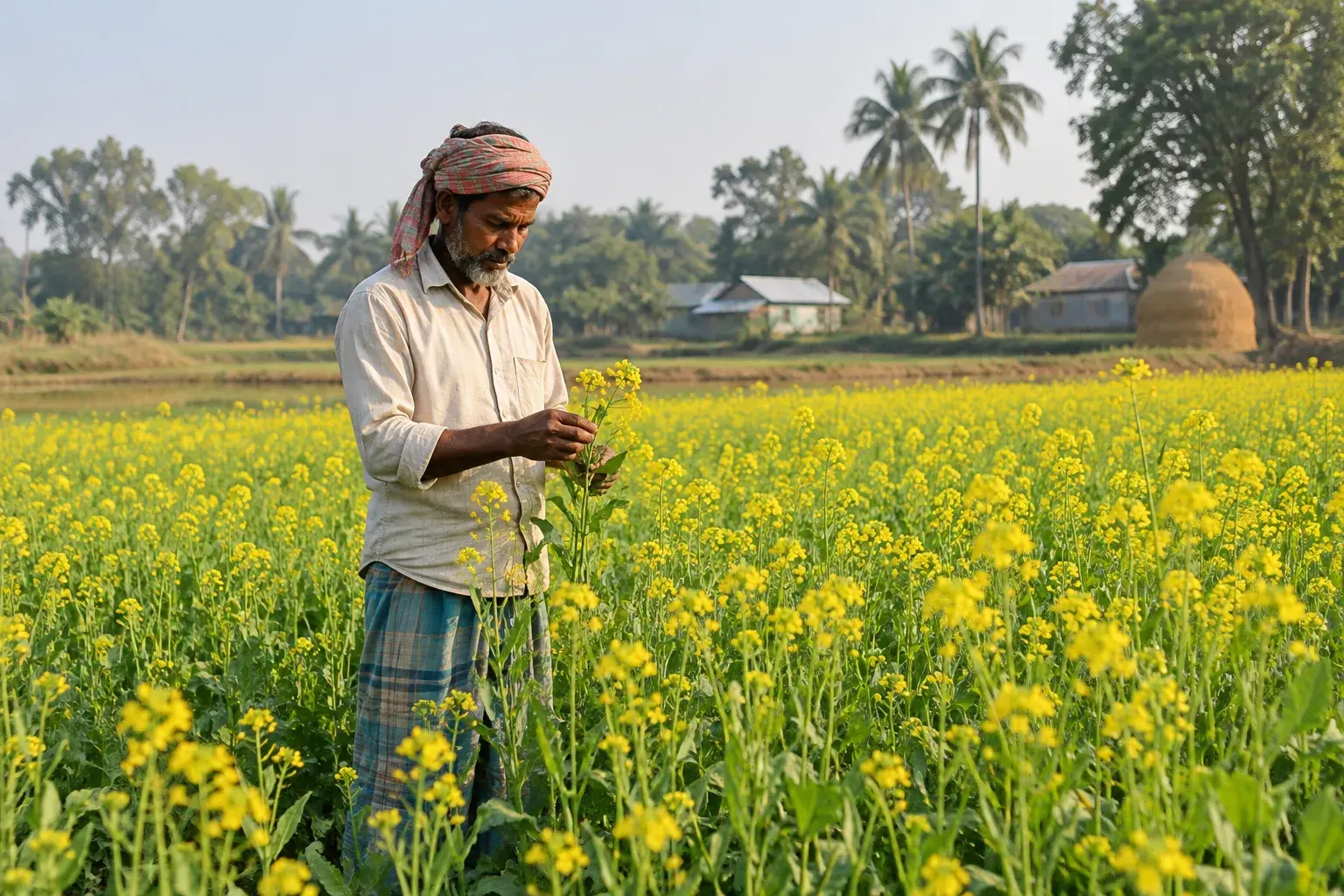 Agriculture & farming
Mustard farming
The 80-90 day crop that fits between the Aman harvest and Boro planting. Mustard seed averaged Tk 91.27 a kg wholesale nationally in August 2026, about Tk 3,651 a maund, and the government hands out Tk 550.50 worth of inputs per bigha.
- Capital
- ৳5k – ৳50k
- People
- 1 – 4
- First income
- 75 – 110 days
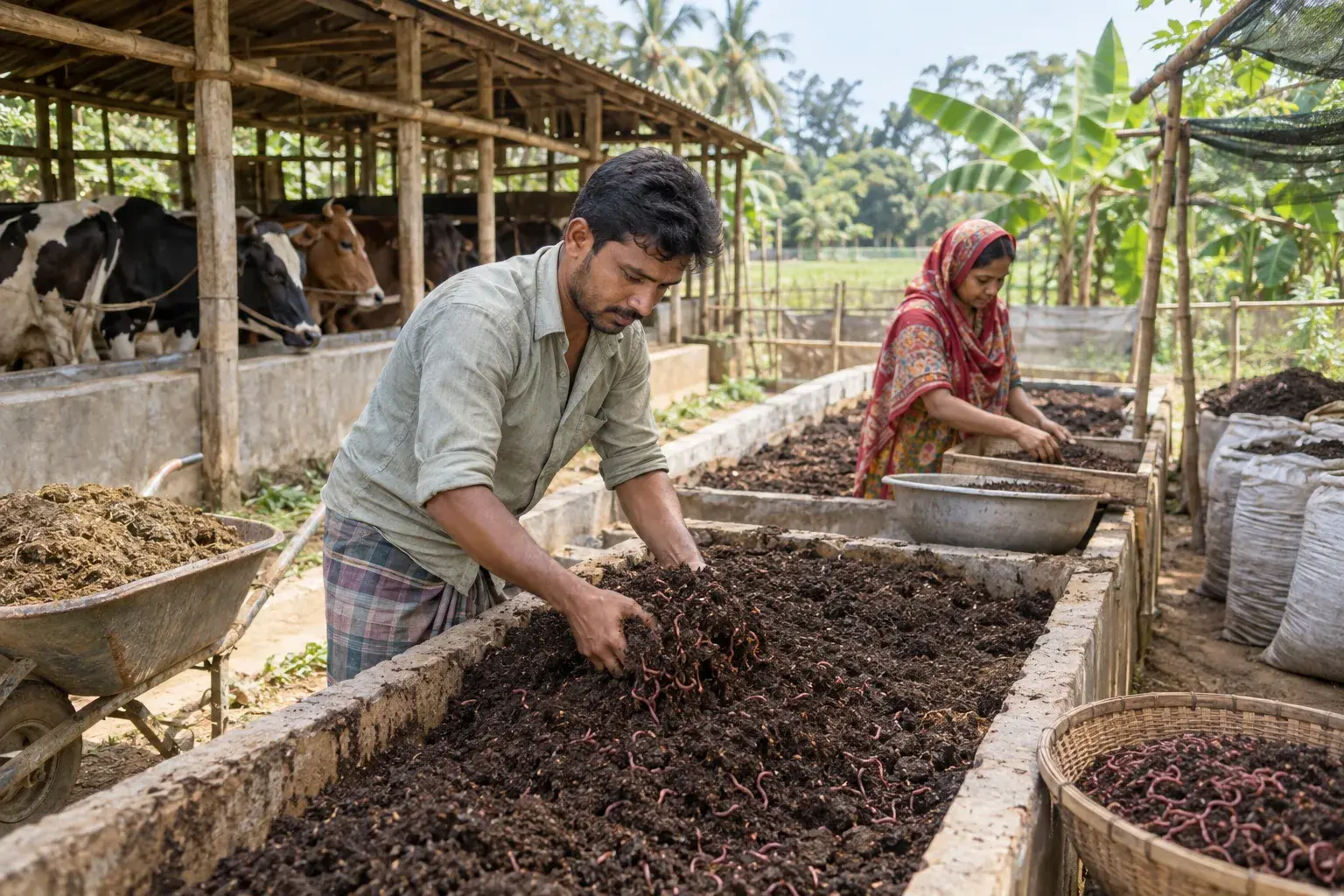 Agriculture & farming
Vermicompost production
Making compost from cow dung and earthworms beside the cattle shed. Compost sells at Tk 10-13/kg against a cost of Tk 6-7, but the real income is selling breeding worms at Tk 2,000/kg.
- Capital
- ৳5k – ৳60k
- People
- 1 – 2
- First income
- 30 – 50 days