
Beauty parlour
Hair, skin and makeover services. In Dhaka an at-home facial starts at Tk 820 and a party makeover runs Tk 2,350-2,950. Starting at home costs little; taking a shop costs a great deal more.
- Last reviewed: 19 September 2026
- Version 1
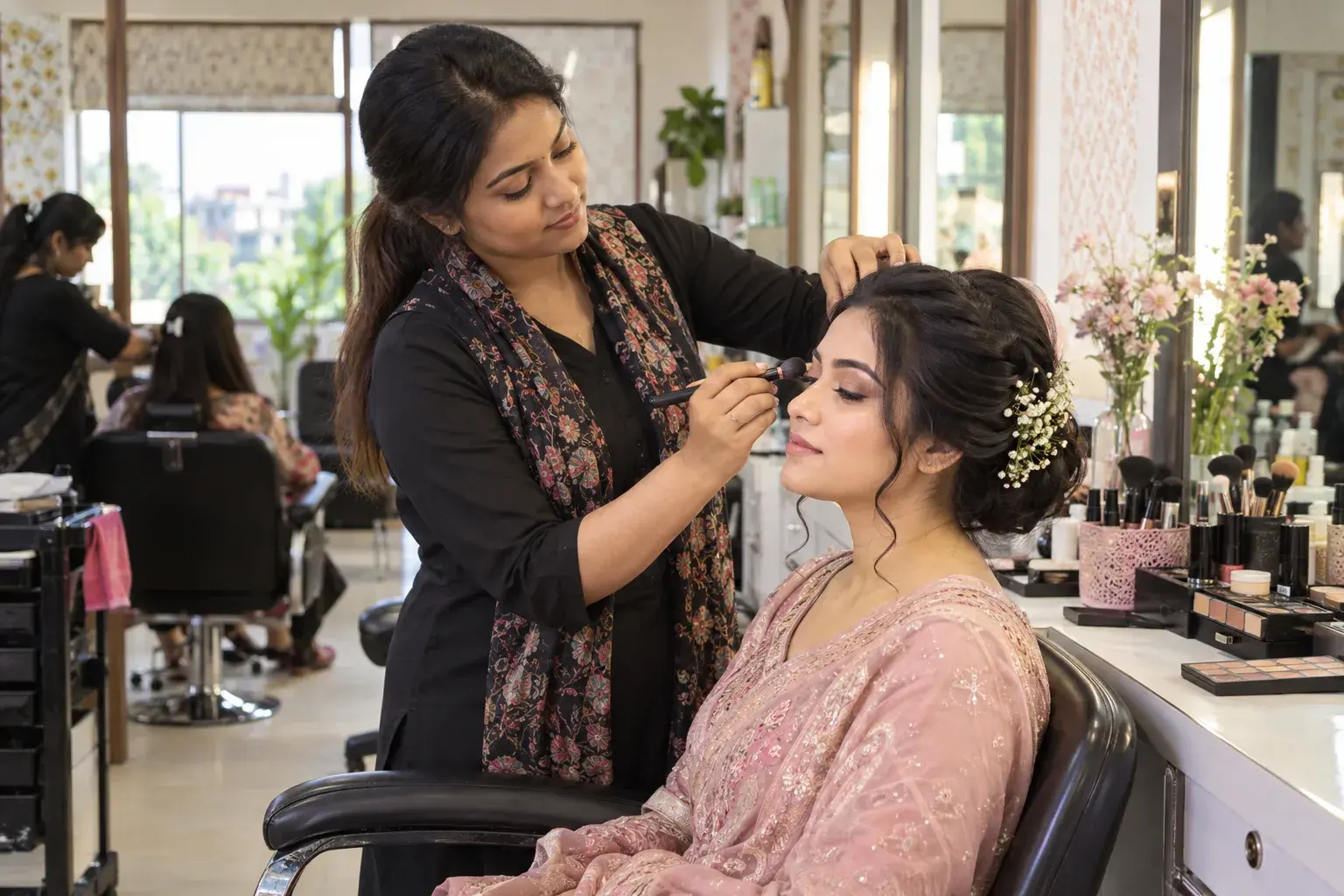
Beauty parlour — an illustrative AI-generated picture, not a real business
- Starting capital
- ৳20,000 – ৳5,00,000 Editorial estimate
- Manpower
- 1 – 6 people
- First sale
- 7 – 45 days Editorial estimate
- Break-even
- 1.5 – 6 months Editorial estimate
- Kind of work
- Shop · Medium difficulty
About the business
Haircuts, colour, facials, threading, waxing and bridal or party makeovers. This is the most asked-about women-run business in Bangladesh, and there are two quite different ways into it. One is to work out of a room at home, with no rent and no signboard, taking customers who come through people you know. The other is to rent a shop in the market, which means advance, deposit, fitout, staff and a trade licence. The capital needed is worlds apart, so that choice comes first. Prices vary by area. On the service platform Sheba.xyz in Dhaka on 16 September 2026, an at-home facial started at Tk 820, a casual party makeover ran Tk 2,350 to Tk 2,950, and a luxury makeover Tk 6,225. A neighbourhood parlour charges much less; a well-known salon charges far more for a bridal package. Training is not a legal requirement but there is no way around it: a Ministry of Women and Children Affairs project gives women six months of skills training with a Tk 150 daily allowance, with class eight as the minimum qualification. The thing to understand about this business is that the income does not arrive evenly. The big money comes on wedding season dates and in the days around Eid, and the chairs sit empty the rest of the time.
Unit economics
| Item | Range | Evidence | Suggest a correction |
|---|---|---|---|
| Monthly working capital | ৳8,000 – ৳1,10,000 | Editorial estimate | |
| Selling price | ৳820 – ৳6,225 / unit | Market quote | |
| Variable cost | ৳200 – ৳1,000 / unit | Editorial estimate | |
| Gross margin | 76% – 84% | Editorial estimate | |
| Time to first revenue | 7 – 45 days | Editorial estimate | |
| Break-even time | 1.5 – 6 months | Editorial estimate | |
| Cash cycle | 0 days | Editorial estimate | |
| Waste / loss | 3% – 8% | Editorial estimate | |
| Daily capacity | 6 – 30 | Editorial estimate |
What you need to start
- A large mirror and chair, a wash basin, hair dryer and straightener, steamer, cosmetics trolley, towels and aprons, and a way to sterilise tools. Prices could not be verified in this research.Equipment
- Cosmetics, hair colour, bleach, wax and facial materials, all bought up front and all with expiry dates. When they expire the money is simply gone.Starting stock
- VAT registration: beauty parlour services are taxed. On 20 March 2022 the NBR chairman publicly rejected a proposal to cut parlour VAT, saying that VAT is paid by the consumer and only passed on by the business. The rate itself could not be verified in this research.Licence
- Trade licence from the city corporation or municipality: form Tk 10, licence book Tk 50, standard tax Tk 30, stamp Tk 150-300, licence fee Tk 100-60,000 by trade type. Issued in 3-5 working days.Licence
- Training: a Ministry of Women and Children Affairs project gives women six months of skills training with a Tk 150 daily allowance and class eight as the minimum qualification. Private salon academies also run courses, but their fees could not be verified here.Skill
- Cosmetics wholesalers and brand distributors. Counterfeit and expired product is common in the market, so the source matters.Supplier
- Two paths: a room at home, with no rent or advance but few walk-ins, or a shop in the market with advance, monthly rent and fitout. Even in the government project, equipment is provided but the operator arranges the space.Workspace
How the work is done
- 1Learn the work first. It cannot be done without training, and word of a bad job takes less than a day to travel the neighbourhood.
- 2Ask about government training. A Ministry of Women and Children Affairs project runs six-month courses with a Tk 150 daily allowance and class eight as the minimum qualification.
- 3Decide between home and shop. At home there is no rent or advance but few new customers walk in; a shop brings walk-ins but the rent falls due every month.
- 4If you take a shop, get the trade licence from the city corporation or municipality with beauty parlour named as the service.
- 5Find a wholesale source for cosmetics and buy by the expiry date. Using out-of-date product damages skin and destroys your name.
- 6Put a written price list on the wall. Haggling over price eats working time and irritates regular customers.
- 7Keep a book of customer names and phone numbers. The income rests on repeat customers, and they are the ones to call first in the wedding season.
- 8Set separate bridal packages and an advance booking rule. When two weddings fall on the same date and there is no rule, both jobs go badly.
- 9Set aside part of the season's takings for the empty months. The big money comes on wedding dates and around Eid, and the chairs sit empty in between.
- 10If you hire, settle how the money is shared as well as teaching the work. A trained hand opening a parlour next door is a very ordinary event in this trade.
Seasons
- JanNormal
- FebNormal
- MarNormal
- AprNormal
- MayNormal
- JunNormal
- JulNormal
- AugNormal
- SepNormal
- OctNormal
- NovNormal
- DecNormal
Where it works well
- Strong fitChattogram · A large city with many households able to spend, and a strong habit of spending on wedding presentation.
- Strong fitDhaka · The densest population, the most working women and the most events, but also the sharpest competition and the heaviest pressure from online platforms.
- Strong fitSylhet · Remittance households can spend more and weddings are held on a bigger scale, so bridal work is easier to find.
- PossibleCumilla · Demand rises across the district town and nearby upazilas in the wedding season, and there are remittance households too.
- PossibleGazipur · Women factory workers have their own earnings, and at low prices the repeat trade is steady.
- PossibleKhulna · A divisional city where the urban middle class is the main customer.
- PossibleNarayanganj · Dense settlement next to Dhaka, with lower rent than the capital, so it is easier to start.
- PossibleRajshahi · University and college students are regular customers, though they spend in small amounts.
Risks and cautions
- HighDemand: The income does not arrive evenly. A single wedding date or one of the last days before Eid can bring in what a normal week does not, while rent, electricity and wages fall due the same every month. Without setting the season's money aside the shop closes in an empty month. How large that swing actually is could not be found in any source, and it is the biggest unknown in this business.
- HighDependency: The parlour is whoever does the work. Customers follow a particular pair of hands, not a signboard. When a trained worker opens her own parlour in the next lane a large share of the regulars goes with her, and building up a replacement takes months again.
- MediumWorking capital: Cosmetics, colour and wax must be bought in advance and all of it expires. Stocking up for a season that then goes badly means the money is lost outright when the dates pass. No source was found for what share is actually lost this way.
- MediumOther: Online service platforms now send workers straight to the customer's home: on Sheba.xyz you can book an at-home facial, a party makeover, even bridal mehendi. The customer who used to come to the parlour is now served in her own drawing room, and a small parlour's walk-in trade can shrink that way.
- MediumCompliance: Most home-run parlours have neither a trade licence nor VAT registration. Nobody notices while it stays small, but a signboard, an advertisement or an online page changes that. The NBR has refused to reduce parlour VAT, so scrutiny is more likely to increase than decrease.
Sources
সিটি কর্পোরেশন থেকে ট্রেড লাইসেন্স প্রাপ্তির ধাপ সমূহ
Collected: 16 Sept 2026Supports: Starting capital, Time to first revenue · বাংলাদেশ
What changed
No corrections have been published yet.
Questions and answers
No questions yet. Be the first to ask.
Stories about this business
20,000 taka of capital, 30,000 taka of training
She started on 20,000 taka borrowed from her brother, while a three-month course alone cost 30,000. Planned in 2006, registered and expanded in 2009.
- Capital
- ৳20k
- Reasons
- Skill gap, Working capital
A 60,000-taka loan took the parlour past 40,000 a month
Built from her own savings, then expanded with a 60,000-taka loan. The parlour now has five regular staff and brings in over 40,000 taka a month.
- Capital
- ৳60k
- Reasons
- Working capital, Strong network
Similar businesses
 Home & local services
Coaching centre
A room, benches and someone who can teach; the capital is close to nothing. But government orders close every coaching centre for two to three months a year around the public exams.
- Capital
- ৳20k – ৳2 lakh
- People
- 1 – 8
- First income
- 7 – 30 days
 Home & local services
Wedding planning and event management
Organising weddings, holud nights and receptions. Stage decoration budgets run from Tk 15,000 to over Tk 80,000, and the money comes 50 percent at booking and 50 percent on the day.
- Capital
- ৳16.3k – ৳5.1 lakh
- People
- 1 – 15
- First income
- 5 – 25 days
 Home & local services
Home tailoring
One machine, neighbourhood orders. Work triples in the two months before Eid.
- Capital
- ৳25k – ৳40k
- People
- 1
- First income
- 14 – 28 days
 Home & local services
Laundry and dry cleaning
A shop that washes, dries and irons clothes. In a mofussil town it is Tk 10 a garment and Tk 1,000 on a hundred-garment day, but load-shedding drops that to Tk 300-400.
- Capital
- ৳25k – ৳2.5 lakh
- People
- 1 – 4
- First income
- 7 – 30 days