
Easy-bike charging station
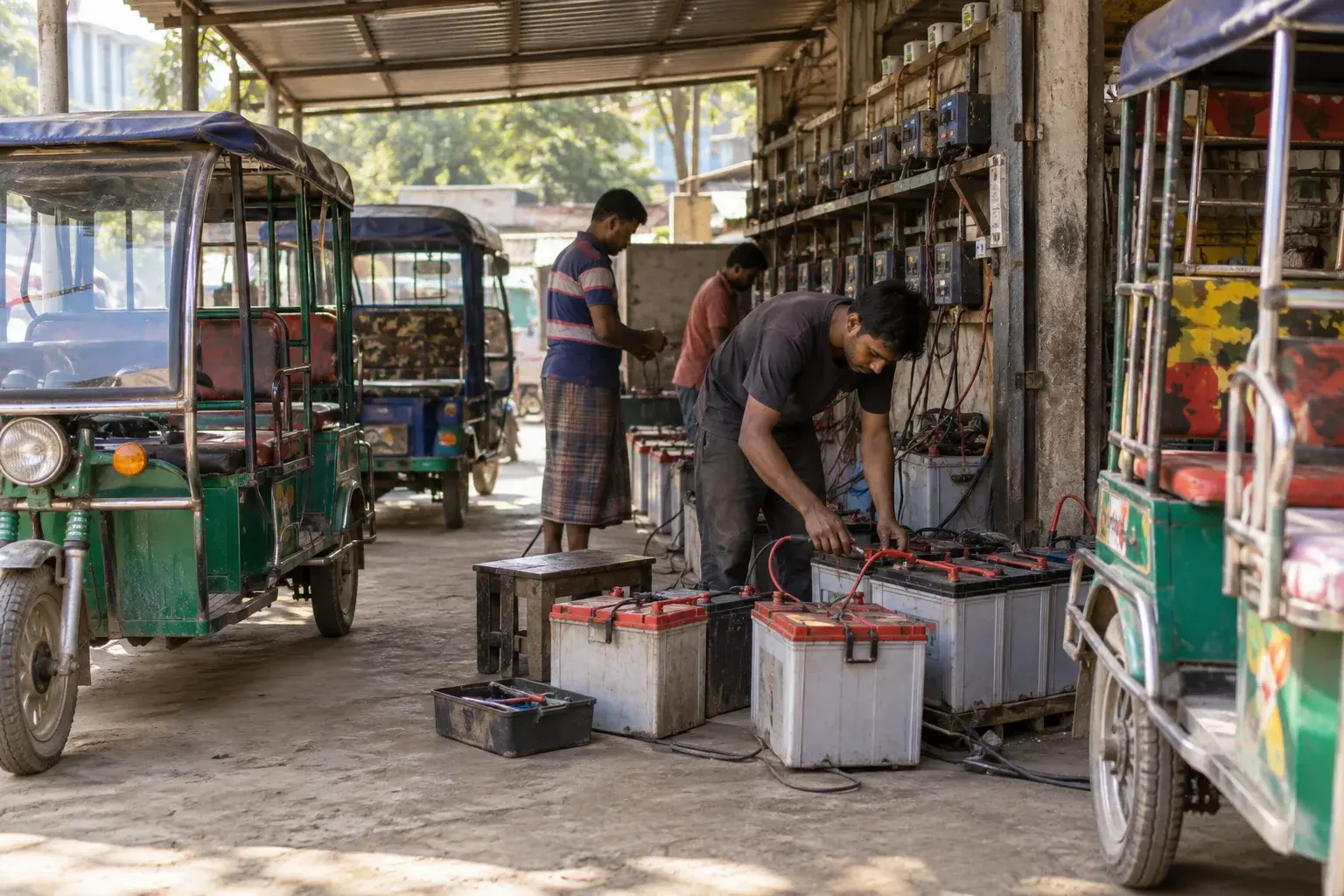
A garage charging the batteries of easy-bikes and battery rickshaws. Electricity in the LT-D3 class costs Tk 9.09-14.20 a unit, and commercial charging from a residential connection is prohibited.
- Last reviewed: 19 September 2026
- Version 1
Easy-bike charging station
- Starting capital
- ৳1,00,000 – ৳5,00,000 Editorial estimate
- Manpower
- 1 – 3 people
- First sale
- 30 – 90 days Editorial estimate
- Break-even
- 4 – 9 months Editorial estimate
- Kind of work
- Workshop · Medium difficulty
About the business
The whole business is the gap between two numbers: what the electricity costs and what you charge per charge. BERC's retail tariff of 3 June 2026 carries a separate class for electric vehicle and battery charging stations, LT-D3: Tk 11.36 a unit flat, Tk 10.22 off-peak, Tk 9.09 super off-peak and Tk 14.20 at peak, with a demand charge of Tk 90 per kW a month and a security deposit of Tk 960 per kW. For charging stations super off-peak runs 5 to 9 in the morning, off-peak 11 at night to 5 in the morning and 9 in the morning to 5 in the afternoon, and peak 5 to 11 at night. The problem sits in the same table: residential electricity is Tk 4.63 on the lifeline slab, Tk 5.26 on the first step and Tk 8.50 on the second - roughly half the legal charging rate. That is why so many garages charge off a household meter. BERC's order says plainly that battery charging may not be done commercially from a residential connection, and that charging at premises of any other class is billed at that class's rate. A larger risk is coming: on 17 August 2026 the state minister for local government said separate e-rickshaw rules are being drafted and that registration will not be granted or renewed where recharging is done by anything other than solar power.
Unit economics
| Item | Range | Evidence | Suggest a correction |
|---|---|---|---|
| Monthly working capital | ৳33,000 – ৳77,000 | Editorial estimate | |
| Selling price | ৳150 – ৳250 / unit | Editorial estimate | |
| Variable cost | ৳55 – ৳128 / unit | Editorial estimate | |
| Gross margin | 15% – 78% | Editorial estimate | |
| Time to first revenue | 30 – 90 days | Editorial estimate | |
| Break-even time | 4 – 9 months | Editorial estimate | |
| Cash cycle | 0 – 30 days | Editorial estimate | |
| Waste / loss | 15% – 25% | Editorial estimate | |
| Daily capacity | 10 – 40 | Editorial estimate |
What you need to start
- Chargers, a meter board, a breaker and earthing at every point, and a capacitor bank to hold the power factor. A 60V 150Ah five-battery charger was listed on Daraz at Tk 1,999 on 16 September 2026 (seller Rayan Tech).Equipment
- Trade licence from the city corporation or municipality: form Tk 10, licence book Tk 50, standard tax Tk 30, stamp Tk 150-300, licence fee Tk 100-60,000 by trade type.Licence
- An LT-D3 electricity connection from the distribution company: application fee Tk 120 single-phase, Tk 360 three-phase; security deposit Tk 960 per kW; demand charge Tk 90 per kW a month. Commercial charging from a residential connection is prohibited.Licence
- Load calculation, an understanding of power factor and safe wiring. The wiring must be done by a licensed electrician.Skill
- An approved contractor of the distribution company, plus suppliers of chargers and batteries. Many stations also sell and change batteries.Supplier
- An open or half-open garage with a solid floor, ventilation and fire extinguishers. Many batteries charging together build up gas, so a closed room will not do.Workspace
How the work is done
- 1Read the rule before you decide. BERC's order of 3 June 2026 says commercial EV or battery charging may not be done from a residential customer's connection. Running a charging business off a household line is a breach by definition.
- 2Apply to your distribution company (DESCO, DPDC, BPDB, Palli Bidyut, WZPDCL or NESCO) for a new connection in the LT-D3 class. The application fee is Tk 360 for three-phase and Tk 120 for single-phase.
- 3Work out your sanctioned load first: the security deposit is Tk 960 per kW and the demand charge Tk 90 per kW a month. Twenty kW means a deposit of Tk 19,200.
- 4Do not draw beyond your sanctioned load: the excess attracts double the demand charge. This happens easily in a charging garage because every charger switches on at once.
- 5Schedule charging by the rate. For charging stations, super off-peak is 5 to 9 am (Tk 9.09), off-peak 11 pm to 5 am and 9 am to 5 pm (Tk 10.22), peak 5 to 11 pm (Tk 14.20). Charging at peak costs about Tk 5 more a unit.
- 6Keep the power factor above 0.95. Every 0.01 below it adds a 0.75 percent surcharge on the energy charge, and three consecutive months below 0.75 means disconnection on 15 days' notice. Ordinary chargers have a poor power factor, so you will need a capacitor bank.
- 7Take a prepaid meter. It earns a 0.5 percent rebate on the net bill excluding VAT and avoids the shock of one big bill at month end.
- 8Build the garage with real ventilation. Lead-acid batteries give off gas while charging, and charging many at once in a closed room is a fire and explosion risk.
- 9Give every charger its own breaker and earthing, and have a licensed electrician do the wiring. Deaths by electrocution while charging these vehicles are reported regularly.
- 10Work out your cost per unit before you set the price of a charge. A full charge takes at least 6 to 9 units, Tk 55 to 128 of electricity. Add the demand charge, rent and wages before you fix the rate.
- 11Keep the solar decision in view. On 17 August 2026 the state minister for local government said e-rickshaws recharged by anything other than solar will not be registered or renewed, and that city corporations and municipalities will do the registering. Think twice before investing heavily until the rules are final.
Seasons
- JanNormal
- FebNormal
- MarNormal
- AprNormal
- MayNormal
- JunNormal
- JulNormal
- AugNormal
- SepNormal
- OctNormal
- NovNormal
- DecNormal
Where it works well
- Strong fitCumilla · On the link roads between upazila and municipal towns the easy-bike is the main vehicle.
- Strong fitDhaka · The country's largest market for battery vehicles - a Prothom Alo column of 4 September 2026 puts about 1.5 million people in Dhaka alone in this sector - but the zoning and ban risk is also highest here.
- Strong fitGazipur · Easy-bikes carry a lot of factory-worker traffic, and enforcement is somewhat looser than in Dhaka.
- Strong fitNarayanganj · Dense settlement and short trips suit easy-bikes, so garage demand is steady.
- PossibleBogura · A trading centre with heavy use of battery-driven goods vans.
- PossibleJashore · Heavy easy-bike use in the district and upazila towns, with room to keep off the highways.
- PossibleKushtia · Easy-bikes are the main link between the municipal area and the markets.
- PossibleMymensingh · Town and nearby upazila travel leans heavily on battery rickshaws.
- PossibleRangpur · Battery vans and rickshaws are numerous on the rural roads, but low incomes keep the charge fee down.
- Weak fitBandarban · Hill gradients and scattered settlement mean few easy-bikes, and the electricity supply does not reach everywhere.
Risks and cautions
- HighCompliance: The solar condition is the biggest risk. On 17 August 2026 the state minister for local government, rural development and cooperatives said separate rules are being drafted for battery rickshaws, that vehicles recharged by anything other than solar will not be registered or renewed, that city corporations and municipalities will do the registering, and that Dhaka will be split into eight geo-fenced zones. The rules are not final, but if they are made final, a garage running on grid power will find its customers can no longer be registered. Investing heavily now means carrying that rule change yourself.
- HighCompliance: The temptation of the household meter, and its cost. LT-D3 is Tk 11.36 a unit while residential power is Tk 4.63 on the lifeline slab, Tk 5.26 on the first step and Tk 8.50 on the second - roughly half. BERC's order says that except on irrigation, education-religious-charitable and hospital premises, charging done at any other premises is billed at that premises' class, and that commercial charging from a residential connection is barred. Getting caught means reclassification and arrears, and reconnection after a disconnection costs Tk 960 on an LT three-phase line.
- MediumWorking capital: The demand charge and the excess-load trap. Tk 90 per kW a month is payable whether vehicles come or not, and drawing beyond the sanctioned load attracts double the demand charge on the excess - which happens often, because every charger in a garage starts at once. A late bill adds another 5 percent.
- MediumCompliance: The power factor surcharge. Below 0.95 the energy charge carries a 0.75 percent surcharge for every 0.01 of drop, and three consecutive months below 0.75 brings disconnection on 15 days' notice. Cheap chargers have a poor power factor, and with many running together it shows up plainly on the bill.
- MediumDemand: The customers' vehicles are themselves still irregular. A Prothom Alo column of 4 September 2026 puts about 1.5 million people in Dhaka and about 5 million nationwide as directly involved in this sector, while a large share of the vehicles are unregistered. A sweep, a seizure drive or a route ban can empty a garage overnight, leaving the chargers and the connection deposit stranded.
Sources
সিটি কর্পোরেশন থেকে ট্রেড লাইসেন্স প্রাপ্তির ধাপ সমূহ
Collected: 16 Sept 2026Supports: Starting capital · বাংলাদেশ
- Collected: 3 Jun 2026
Supports: Starting capital, Cash cycle · বাংলাদেশ
Supports: Monthly working capital, Variable cost · বাংলাদেশ
What changed
No corrections have been published yet.
Questions and answers
No questions yet. Be the first to ask.
Stories about this business
A self-built rig charging easybikes for 110,000 taka, and still no income figure
After two unpaid years learning at an electricity office, he assembled a charge controller, DC motor, dynamo and circuits of his own to charge easybikes. Getting it working cost 110,000 taka.
- Capital
- ৳1.1 lakh
- Reasons
- Skill gap, Working capital
Similar businesses
 Home & local services
Sound and light rental
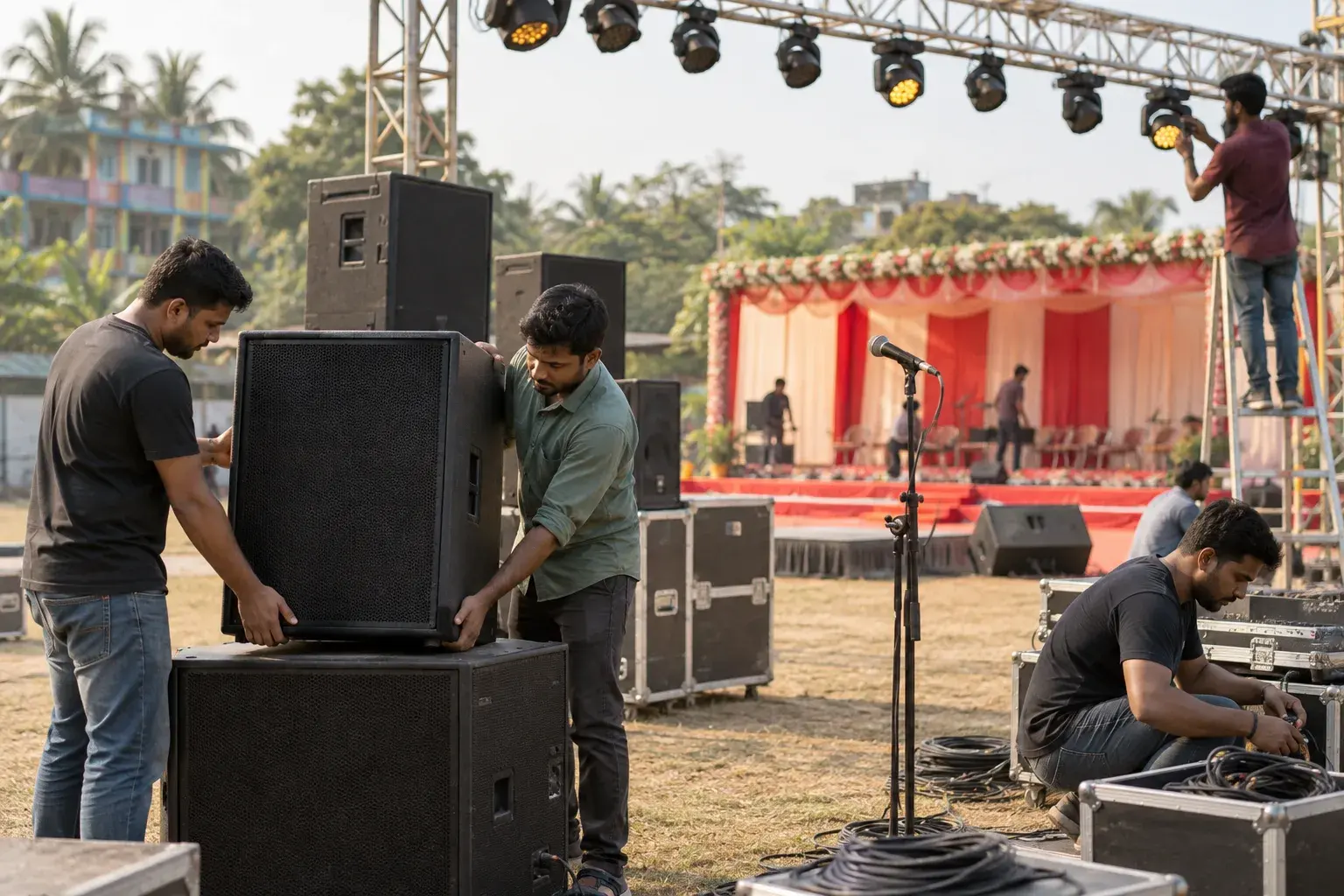
Buying mics, sound boxes and lights and hiring them out by the day. A one-day mic hire with vehicle was Tk 1,200 in Bhermara, of which Tk 500 is the equipment. Written permission is now required under the 2025 noise rules.
- Capital
- ৳1 lakh – ৳4.5 lakh
- People
- 1 – 4
- First income
- 7 – 30 days
 Home & local services
Photography and videography
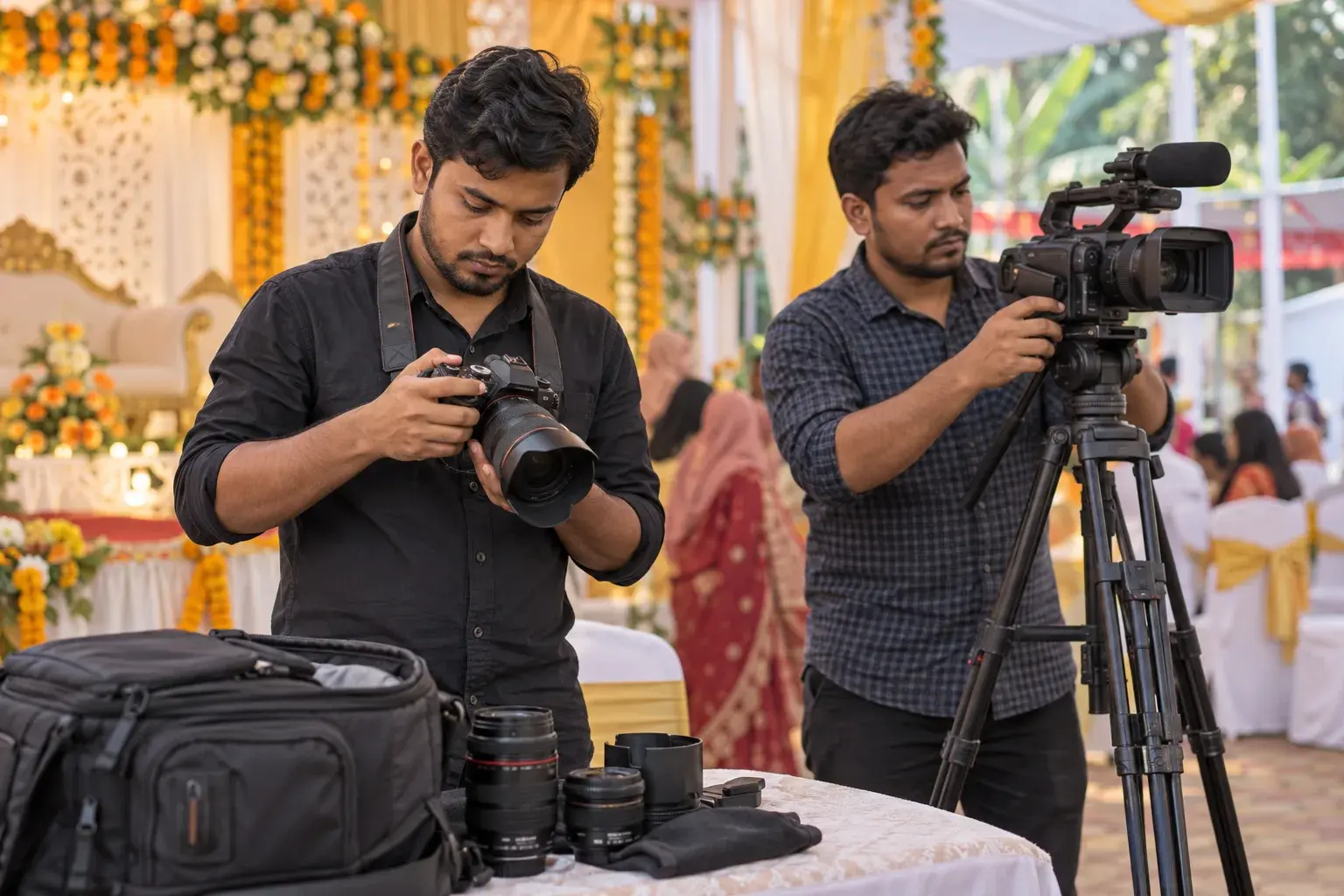
Shooting stills and video at events. Packages start at Tk 15,000, while a workable camera, lens and tripod cost about Tk 105,000.
- Capital
- ৳85k – ৳4 lakh
- People
- 1 – 6
- First income
- 7 – 30 days
 Home & local services
Laundry and ironing service
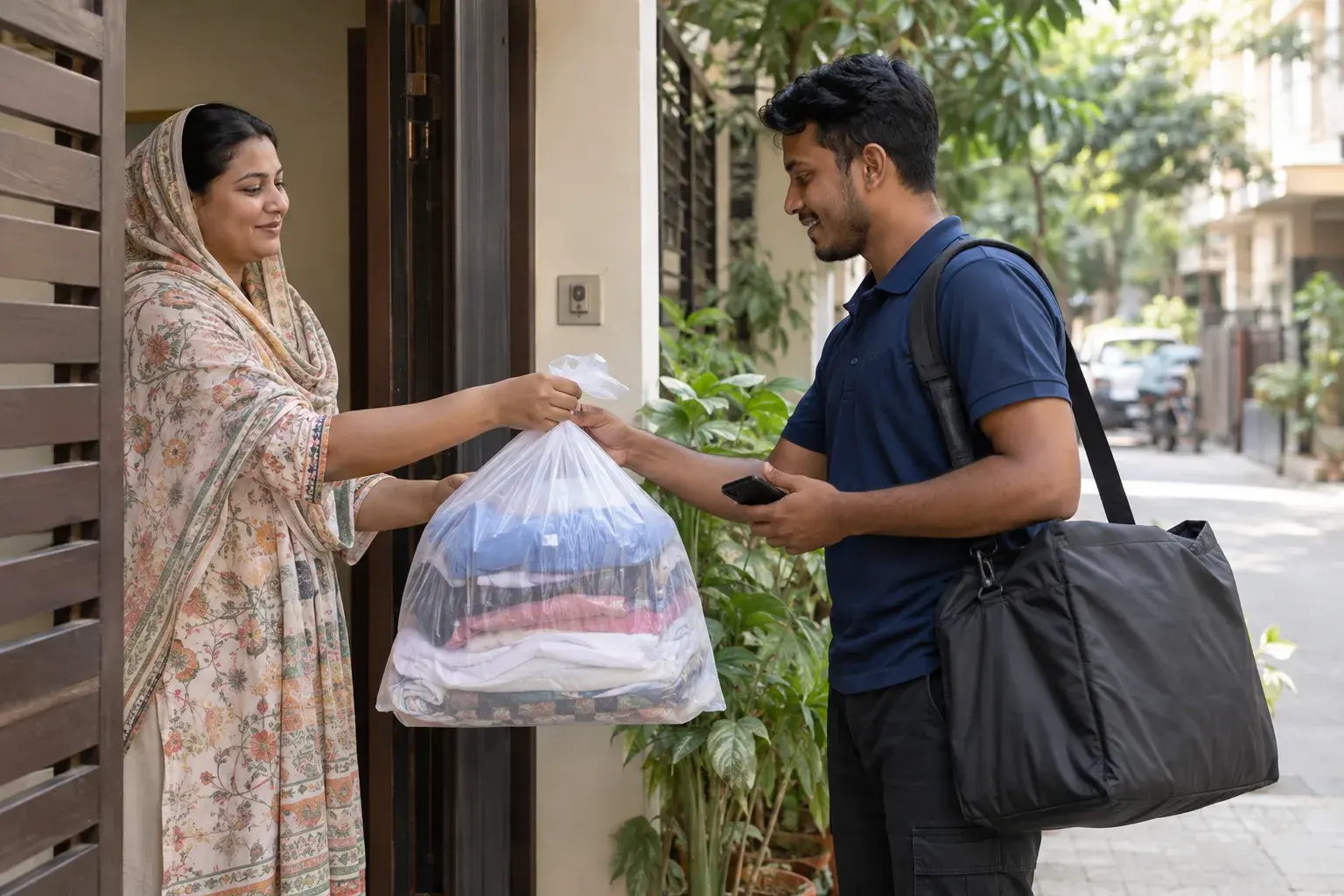
Washing, ironing and returning clothes, with pickup and delivery. In Dhaka one shirt washed and ironed runs Tk 60 to Tk 155, and ironing alone Tk 15.
- Capital
- ৳80k – ৳9 lakh
- People
- 2 – 10
- First income
- 3 – 10 days
 Home & local services
AC and refrigerator servicing
Servicing and repairing air conditioners and refrigerators at the customer's address. March to June is overloaded and winter is near dead, so annual maintenance contracts are what carry the year.
- Capital
- ৳60k – ৳4 lakh
- People
- 1 – 6
- First income
- 7 – 30 days