
Pond fish farming
The Department of Fisheries measures pond yield at a national average of 4.96 tonnes per hectare: 12.72 in Mymensingh, 2.01 in Rangamati. The district decides the income.
- Last reviewed: 19 September 2026
- Version 1
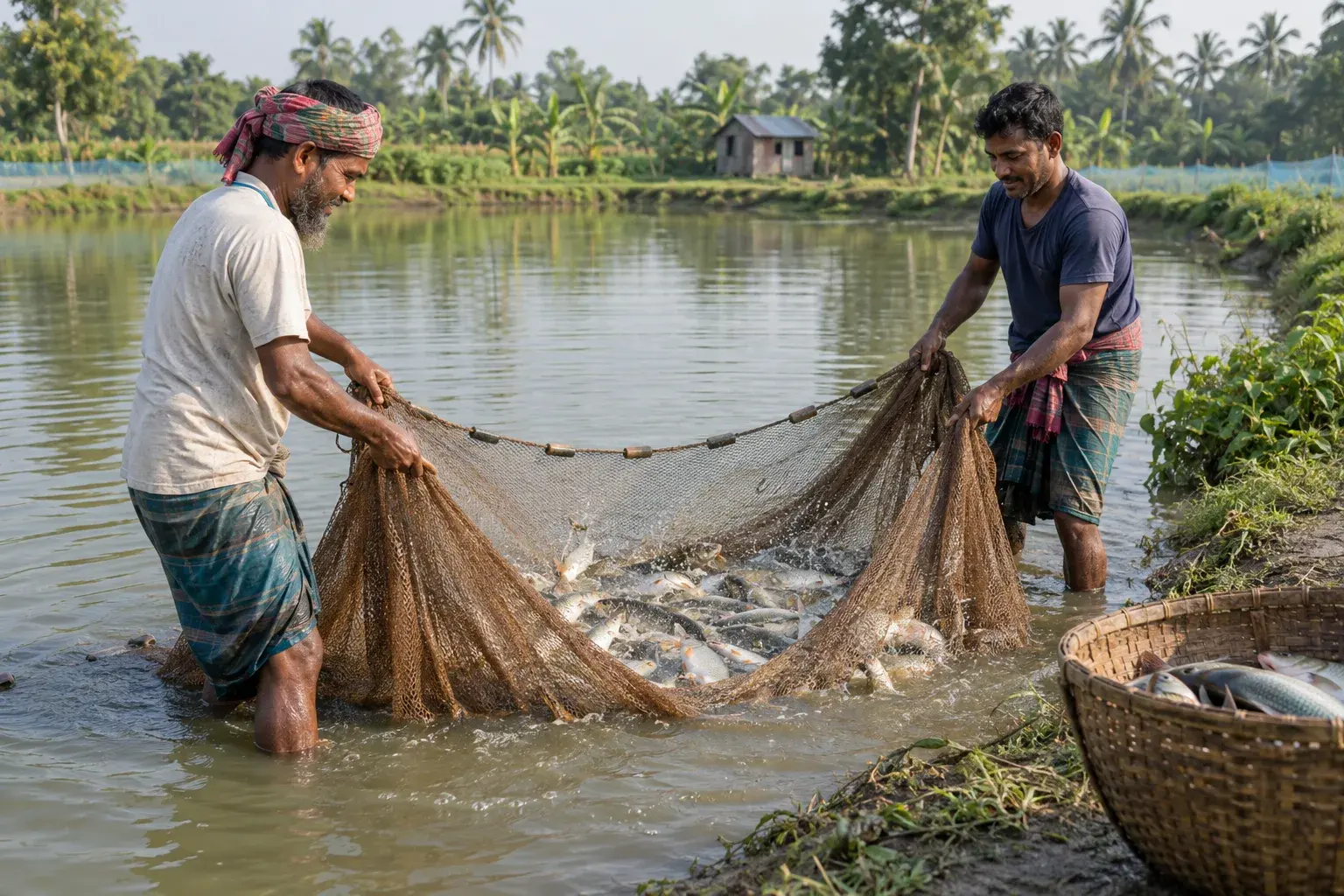
Pond fish farming
- Starting capital
- ৳1,00,000 – ৳6,00,000 Editorial estimate
- Manpower
- 1 – 4 people
- First sale
- 240 – 365 days Editorial estimate
- Break-even
- 12 – 24 months Editorial estimate
- Kind of work
- Farm · Medium difficulty
About the business
Stocking a pond with fingerlings, feeding them and selling the fish. Ponds are where most of the country's fish comes from: of 50.18 lakh tonnes produced in 2023-24, 29.78 lakh tonnes came from closed water bodies. This is the one business in Bangladesh where the government itself measures and publishes how much a pond in your district actually yields. The Department of Fisheries put the national average pond yield at 4.96 tonnes per hectare: 12.72 in Mymensingh, 8.28 in Narsingdi, 7.17 in Jashore, but only 2.01 in Rangamati. The same pond in one district produces six times what it produces in another. The department sorts ponds into four classes: extensive under 1.5 tonnes a hectare, semi-intensive 1.5 to 4, intensive over 4 to 10, and highly intensive above 10. Moving up a class means more fingerlings and much more feed, and more risk with the extra return. Over ninety percent of pond fish is a handful of species: pangas, tilapia, rui, silver carp and mrigal. The money arrives once or twice a year, on harvest day, while the feed bill arrives every day.
Unit economics
| Item | Range | Evidence | Suggest a correction |
|---|---|---|---|
| Monthly working capital | ৳6,000 – ৳13,000 | Editorial estimate | |
| Selling price | ৳300 – ৳450 / kg | Official source | |
| Variable cost | ৳150 – ৳300 / kg | Editorial estimate | |
| Gross margin | 33% – 50% | Editorial estimate | |
| Time to first revenue | 240 – 365 days | Editorial estimate | |
| Break-even time | 12 – 24 months | Editorial estimate | |
| Cash cycle | 240 – 370 days | Editorial estimate | |
| Waste / loss | 10% – 20% | Editorial estimate | |
| Daily capacity | 5 – 35 | Official source |
What you need to start
- Nets, lime and fertiliser, a way to check water depth, and for intensive culture an aerator or water pump.Equipment
- Fingerlings and fish feed, the two main costs of the year. The more intensive the pond, the more of both.Starting stock
- Trade licence from the union parishad, municipality or city corporation: form Tk 10, licence book Tk 50, standard tax Tk 30, stamp Tk 150-300, licence fee Tk 100-60,000 by trade type. Needed to sell commercially and to access government support.Licence
- Fish farmer registration and advisory service from the upazila fisheries office under the Department of Fisheries. Registered farmers appear on the lists for training, fingerlings and technical support. The fee and validity could not be verified here.Licence
- Reading oxygen from the colour and smell of the water, tracking weight gain, and knowing when to harvest.Skill
- A hatchery or government fish seed farm, a fish feed dealer, an ice plant, and an aratdar or wholesaler to take the fish.Supplier
- A pond, owned or leased, with banks solid enough that a flood does not carry the fish away, and preferably clear of heavy tree cover.Workspace
How the work is done
- 1Ask the upazila fisheries office what ponds in your district actually yield per hectare. What works in Mymensingh does not work in Rangamati, and you need to know that before you start.
- 2Fix the pond, owned or leased. If leased, put the term and the annual rent in writing; intensive culture does not fit a one-year lease.
- 3Dry out or net the pond to clear predatory fish, repair the banks and apply lime. Skip this and the money spent on fingerlings goes into the water.
- 4Choose the species. Pangas is the biggest share of pond fish, then tilapia and rui, because they grow fast and always have a market.
- 5Buy fingerlings from a government fish seed farm or a hatchery you trust. Cheap, weak fingerlings raise the whole year's feed bill and slow growth.
- 6Set a feeding routine: how many times a day and how many kilos. Feed is the largest cost in this business, and overfeeding fouls the water and kills fish.
- 7Watch the water colour and the fish every day. Fish gulping at the surface at dawn means oxygen has crashed, and that has to be dealt with then, not the next morning.
- 8Net a few fish now and then and weigh them. If weight is not going up, the feed or the water is wrong, and every week of delay costs money.
- 9Line up the buyer before you harvest: aratdar, wholesaler or market retailer. Looking for a buyer after the fish are out means taking whatever price is offered.
- 10Harvest in stages rather than all at once. Dumping the whole pond depresses the local price and spikes the ice and transport bill at the same time.
- 11At the end of each cycle work out total kilos against total cost. If cost per kilo is above the selling price, the next cycle needs a different species or stocking density.
Seasons
- JanHigh
- FebNormal
- MarNormal
- AprNormal
- MayNormal
- JunNormal
- JulNormal
- AugNormal
- SepNormal
- OctHigh
- NovHigh
- DecHigh
Where it works well
- Strong fitGazipur · 6.45 tonnes per hectare with the Dhaka market on the doorstep.
- Strong fitJashore · 7.17 tonnes per hectare, and an old hatchery belt so good fingerlings are close by.
- Strong fitMymensingh · The Department of Fisheries records 12.72 tonnes per hectare here, the highest in the country, with by far the largest area under highly intensive culture.
- Strong fitNarsingdi · 8.28 tonnes per hectare, and close enough to Dhaka for the fish to reach a big market quickly.
- PossibleBogura · 4.98 tonnes per hectare, just above the national average, and the north's biggest fish arats are here.
- PossibleCumilla · 4.91 tonnes per hectare, and on the Dhaka-Chattogram highway so fish can go either way.
- PossibleDinajpur · 4.84 tonnes per hectare over a large pond area, but the big markets are far.
- PossibleRajshahi · 4.76 tonnes per hectare with a relatively large share under intensive culture.
- PossibleTangail · 5.37 tonnes per hectare across a large area of ponds.
- Weak fitChattogram · Only 3.00 tonnes per hectare, with much of the pond area still under extensive methods.
- Weak fitCox's Bazar · 2.40 tonnes per hectare; freshwater ponds take second place here to shrimp and brackish-water culture.
- Weak fitRangamati · 2.01 tonnes per hectare, the lowest in the country, and hauling fingerlings and feed up the hills eats the margin.
Risks and cautions
- HighSpoilage: An overnight kill is the big fear. Heat that crashes the oxygen, overfeeding that fouls the water, or a disease outbreak can float most of the pond in one night, after a whole year's feed has already been paid for. And once the fish are out, without ice the price halves within hours.
- HighWorking capital: Money comes once or twice a year, on harvest day, while feed is a daily cost. Start without the whole cycle's feed money in hand and you end up cutting the ration mid-cycle; the fish then stop gaining weight and the money already spent does not come back.
- MediumDemand: On harvest day you take the price you are given. When many ponds in one area are drawn at the same time the local arat price falls, and there is no way to hold the stock. The most widely farmed species, pangas and tilapia, are also the cheapest.
- MediumDependency: On a leased pond everything depends on the owner's decision. Having to give up the pond before the term ends turns the bank repair and liming into a total loss.
- MediumOther: Floods and heavy rain that top the banks let the fish out, and none of it is insured. On low-lying land this happens every few years.
Sources
- Collected: 16 Sept 2026
Supports: Starting capital, Daily capacity · বাংলাদেশ
মাছ উৎপাদন / Fisheries Sector: Prospects and Potentials (২০২৩-২৪ অর্থবছরের উৎপাদন)
Collected: 16 Sept 2026Supports: Daily capacity · বাংলাদেশ
সিটি কর্পোরেশন থেকে ট্রেড লাইসেন্স প্রাপ্তির ধাপ সমূহ
Collected: 16 Sept 2026Supports: Starting capital · বাংলাদেশ
- Collected: 15 Sept 2026
Supports: Selling price · ঢাকা মহানগর — সিপাহীবাগ, মিরপুর-৬, মোহাম্মদপুর টাউন হল, নিউমার্কেট, রামপুরা, মহাখালী বাজার
What changed
No corrections have been published yet.
Questions and answers
No questions yet. Be the first to ask.
Stories about this business
An award-winning farm goes to auction, with 11 court cases behind it
This farmer, decorated with national awards in 2010 and 2011, ran over 50 bighas of fish ponds, 200 cattle and 5,000 chickens. Caught in bank loans from 2012, he now has 11 cases against him and his house and farm are up for auction.
- Reasons
- Working capital, Skill gap
Similar businesses
 Agriculture & farming
Turkey farming
About 5,000 farms sprang up in the 2015-2020 rush and a few hundred remain. Chick prices fell from Tk 600 to Tk 150 and the livestock department discourages the trade.
- Capital
- ৳1 lakh
- People
- 1 – 3
- First income
- 30 days
 Agriculture & farming
Betel leaf cultivation (boroj)
Growing betel vine inside a bamboo-and-thatch boroj. About Tk 1 lakh a bigha to run, and in Rajshahi a bira of 64 leaves has gone from Tk 100-120 to Tk 4.
- Capital
- ৳1 lakh
- People
- 1 – 4
- First income
- 120 – 180 days
 Agriculture & farming
Agar (agarwood) plantation
Growing agar trees, driving nails into them to force the resin, and selling the wood or the attar. The first money arrives 8 to 16 years after planting, and exporting needs a CITES no-objection certificate from the Forest Department.
- Capital
- ৳1 lakh – ৳10 lakh
- People
- 1 – 6
- First income
- 2,555 – 5,840 days
 Agriculture & farming
Plain-land tea growing
Growing tea on flat land, plucking green leaf and selling it to factories for cash. The fixed rate in March 2026 was Tk 28 a kg with the market at Tk 34-35, but up to 40 percent can be cut off the weight.
- Capital
- ৳1 lakh – ৳5 lakh
- People
- 1 – 6
- First income
- 730 – 1,095 days