
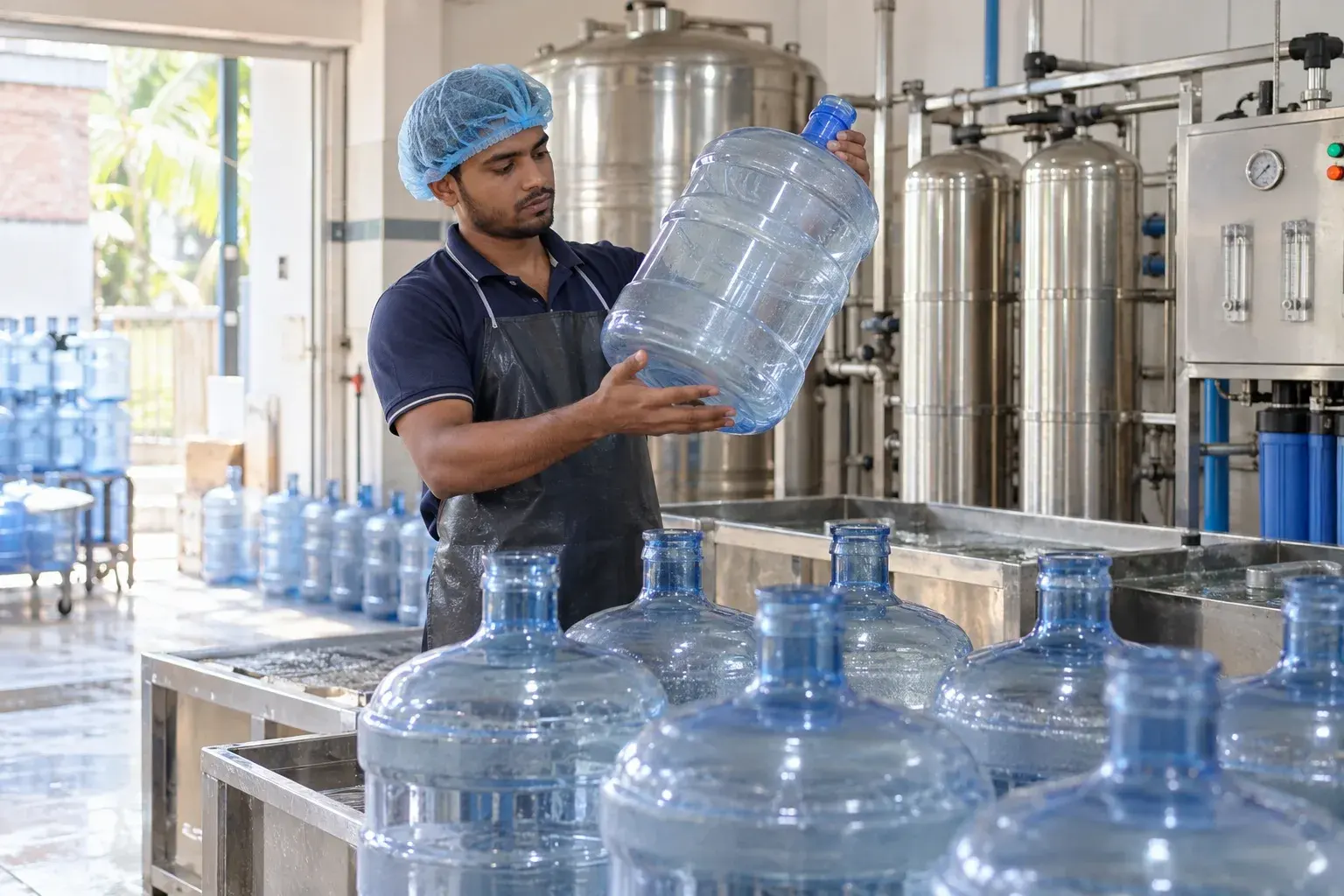
Jar water and drinking water plant
Treating water and selling it in jars and bottles. BSTI certification is compulsory, and most of the margin sits with the retailer and distributor rather than the plant.
- Last reviewed: 19 September 2026
- Version 1
Jar water and drinking water plant
- Starting capital
- ৳8,00,000 – ৳50,00,000 Editorial estimate
- Manpower
- 3 – 15 people
- First sale
- 45 – 100 days Official source
- Break-even
- 14 – 36 months Editorial estimate
- Kind of work
- Workshop · Hard
About the business
A plant that treats deep tube-well or piped water and sells it in 20-litre jars and bottles. Urban offices, shops, messes, hospitals and restaurants now run almost entirely on jar water. The first thing to know is that this cannot be done without a licence: BSTI's mandatory certification list covers both Packaged Drinking Water (BDS 1240:2021) and Natural Mineral Water (BDS 1414:2021), and the containers themselves are a listed product. Producing without a CM licence draws a mobile-court fine and the factory is sealed. The money is tighter than it looks. By Dhaka WASA's own accounts, a 500 ml bottle including the bottle costs about Tk 11 to make and is sold to traders at Tk 9 - a Tk 2 loss before it leaves the gate. WASA's MD says their cost is about Tk 1 per bottle higher than private companies', so a private producer's cost is close to Tk 10. The shopkeeper buys that half-litre for about Tk 11 and sells it for Tk 20, which means most of the margin sits with the retailer and the distributor, not the plant. A plant without its own vehicles and a daily delivery route sits on its stock - WASA's 'Shanti' still has no shelf presence after two decades. Two things decide this business: the BSTI certificate, and the van and the man who deliver every day.
Unit economics
| Item | Range | Evidence | Suggest a correction |
|---|---|---|---|
| Monthly working capital | ৳2,00,000 – ৳15,00,000 | Editorial estimate | |
| Selling price | ৳9 – ৳11 / unit | Market quote | |
| Variable cost | ৳10 – ৳11 / unit | Official source | |
| Gross margin | 0% – 9% | Editorial estimate | |
| Time to first revenue | 45 – 100 days | Official source | |
| Break-even time | 14 – 36 months | Editorial estimate | |
| Cash cycle | 0 – 30 days | Editorial estimate | |
| Waste / loss | 2% – 6% | Editorial estimate | |
| Daily capacity | 20,000 – 48,000 | Official source |
What you need to start
- A treatment set (filters, RO/UV or ozone), storage tanks, a separate bottle and jar washing area, a filling machine, sealing and labelling machines, and a delivery van or pickup. Local machinery prices could not be verified.Equipment
- Empty 20-litre jars: on Daraz a plain food-grade jar is Tk 369-450 and an RFL Sera jar with tap Tk 840-950 (16-09-2026). Even a small 300-jar fleet locks up Tk 110,000-135,000.Starting stock
- Bangladesh Food Safety Authority registration and the premises licence for food: Tk 1,000 new, Tk 500 renewal, valid three years. BSTI will not accept a CM application without the premises licence.Licence
- TIN and VAT registration from the National Board of Revenue; both certificates must go with the BSTI application.Licence
- Trade licence from the city corporation or municipality: form Tk 10, licence book Tk 50, standard tax Tk 30, non-judicial stamp Tk 150-300, licence fee Tk 100-60,000 by trade type, issued in 3-5 working days.Licence
- BSTI CM licence. Drinking water is on BSTI's mandatory certification list as Packaged Drinking Water BDS 1240:2021 and Natural Mineral Water BDS 1414:2021. Application Tk 1,000, renewal Tk 500, annual licence fee Tk 200, marking fee from Tk 1,875. Processing takes 19-42 working days.Licence
- Reading a water test report - TDS, pH and microbiological counts - and knowing when to change filters. Change them late and the laboratory test fails, and the licence stalls.Skill
- A steady supplier of bottles, caps, labels and shrink film, plus a source for jar repair and washing brushes and chemicals.Supplier
- A pucca floor with drainage, a separate filling room, and space for the source and storage tanks. The BSTI inspector judges the premises before taking samples.Workspace
How the work is done
- 1Fix the water source first - deep tube well or piped supply - and have it laboratory tested, because arsenic or salinity changes the whole treatment cost.
- 2Take the trade licence from the city corporation or municipality with 'bottled water production' named as the trade, then register for TIN and VAT with the NBR.
- 3Take the premises licence and Bangladesh Food Safety Authority registration for a food business: Tk 1,000 to register, Tk 500 to renew, valid three years.
- 4Apply online to BSTI for the CM licence: application fee Tk 1,000, annual licence fee Tk 200, renewal Tk 500 and a marking fee starting at Tk 1,875. Submit the trade licence, trademark, VAT and TIN, premises licence and a sample Bangla label.
- 5A BSTI inspector will visit, seal samples and send them to the laboratory. Have the floor, drainage, hand-washing point and a separate bottle-washing area ready before the visit.
- 6Print the label to rule: product name, brand, quantity, ingredients, manufacture and expiry dates, batch number, manufacturer's address, maximum retail price and the standard mark against the BDS number.
- 7Buy jars and bottles. On Daraz a plain food-grade 20-litre empty jar is Tk 369-450 and a branded jar with a tap Tk 840-950. A bigger jar fleet means more rotation but more capital locked up.
- 8Build the delivery system before scaling production: a van on a fixed route every day, and a fresh consignment when a shop telephones. Without it the stock stays in the factory.
- 9Decide what the shopkeeper earns. If another brand pays double on the same shelf space, your water will not be stocked - that is exactly why WASA's 'Shanti' is missing from shops.
- 10Sign monthly contracts with offices, hospitals, messes and construction sites. Keep a written record of empty jars returned, or the fleet quietly shrinks every month.
- 11Keep a sample of every batch and have the water tested at your own cost from time to time. When the mobile court comes, those test reports are your defence.
Seasons
- JanLow
- FebNormal
- MarHigh
- AprHigh
- MayHigh
- JunHigh
- JulHigh
- AugHigh
- SepHigh
- OctHigh
- NovNormal
- DecLow
Where it works well
- Strong fitChattogram · Port, factories and commercial offices, with salinity problems in the piped supply during the dry season.
- Strong fitDhaka · The densest concentration of offices, messes, hospitals and restaurants, and low trust in piped supply keeps jar demand permanent.
- Strong fitGazipur · Garment factory workforces and worker messes need jars in bulk every day.
- Strong fitKhulna · Coastal salinity in tube-well water makes treated water a permanent need, though it also makes treatment more expensive.
- Strong fitNarayanganj · Dense factories and commercial premises, and transport costs are low because Dhaka is next door.
- PossibleBogura · The commercial hub of the north, from which surrounding districts can be supplied.
- PossibleCox's Bazar · Hotel and restaurant demand spikes in the tourist season and falls away out of it.
- PossibleCumilla · Highway hotels, the industrial belt and educational institutions give a steady supply route.
- PossibleSatkhira · Salinity makes safe water scarce, but purchasing power is low and substandard plants crowd the market.
- PossibleSylhet · Offices, chambers and restaurants are growing in the city, and remittance households can pay.
- Weak fitRangpur · There is demand, but purchasing power is low and distances eat the margin in transport.
Risks and cautions
- HighCompliance: Producing without a CM licence brings a mobile-court fine and the factory is sealed. These drives run continuously under the BSTI Act 2018 - on 15 September 2026 a firm in Dhaka's Tejgaon industrial area was fined Tk 30,000 for producing without one. For drinking water the rule is stricter still because it is a mandatory-certification product. Not one bottle may be sold before the licence is in hand.
- HighWorking capital: The profit per bottle is tiny, so survival depends on volume. Dhaka WASA loses Tk 2 a bottle at its own plant and about Tk 15 crore over two decades. If a state agency is in that position, a small plant must count harder still: machinery, the jar fleet, a vehicle and the daily bill for bottles, caps and labels all fall due together.
- HighDependency: Making water is easy; selling it is not. Private companies run vans on fixed routes every day and send a fresh consignment on a phone call. WASA's 'Shanti' never built that in twenty years, and a sweep of shops in Mirpur, Mohammadpur, Jatrabari, Shahbagh, Malibagh, Gulshan, Banani and Karwan Bazar found none of it. Without distributors and vehicles the plant runs and the stock does not move.
- HighOther: Jar water has a long record of quality scandals, and one bad name kills sales across a whole area. Three mistakes end the business: filling jars that were not properly washed, leaving filters in past their life, and never testing the source. Regular testing at your own cost is the only way to hold this down.
- MediumDemand: Sales rise in the heat, fall in winter and stall on rainy delivery days, while rent, the power bill and the driver's wage stay the same all twelve months. Work out in advance whether the lean three or four months of winter still cover the fixed costs.
Sources
- Collected: 16 Sept 2026
Supports: Starting capital · বাংলাদেশ
সিটি কর্পোরেশন থেকে ট্রেড লাইসেন্স প্রাপ্তির ধাপ সমূহ
Collected: 16 Sept 2026Supports: Starting capital · বাংলাদেশ
All food businesses now need safety registration
Collected: 22 Jul 2026Supports: Starting capital · বাংলাদেশ
What changed
No corrections have been published yet.
Questions and answers
No questions yet. Be the first to ask.
Similar businesses
 Food processing
Poultry feed mill
Mixing maize, soybean meal and bran into poultry feed sold in 50 kg sacks. Sacks run Tk 3,000-3,669, and both a Department of Livestock Services licence and a BSTI CM licence are compulsory.
- Capital
- ৳8 lakh – ৳60 lakh
- People
- 4 – 20
- First income
- 45 – 150 days
 Food processing
Tea packaging and branding
Buying loose tea at auction, blending and packing it under your own brand. The 2026-27 Chattogram auction averages Tk 280.88 a kg while packet tea sells at Tk 428-650.
- Capital
- ৳5 lakh – ৳50 lakh
- People
- 2 – 15
- First income
- 45 – 100 days
 Food processing
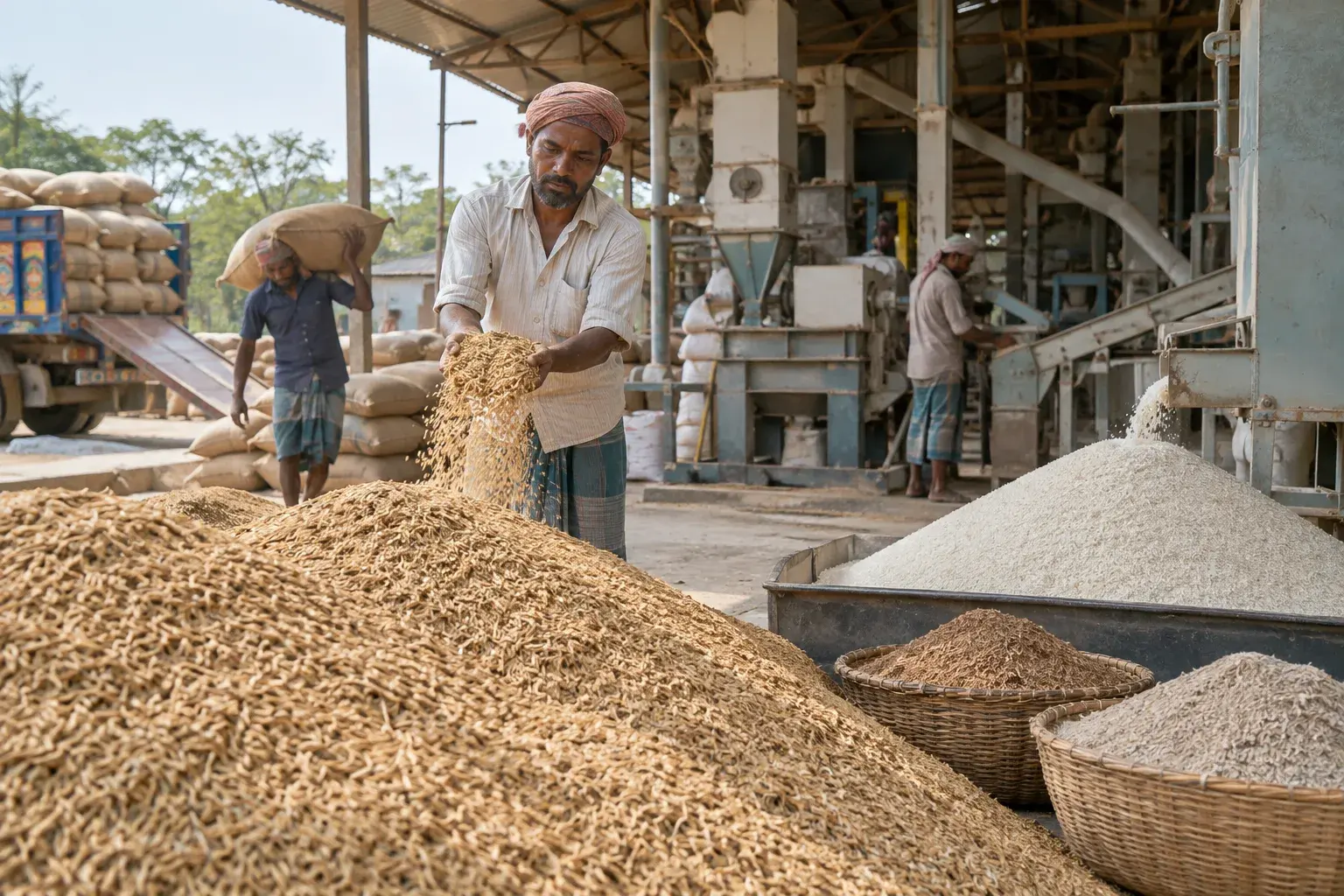
Rice mill
Buying paddy, parboiling and hulling it, and selling the rice. 24,000 kg of paddy gives 15,000 kg of rice, and the husk, bran and broken grain return another Tk 6.45 on every kilo sold.
- Capital
- ৳5 lakh – ৳50 lakh
- People
- 4 – 20
- First income
- 30 – 120 days
 Food processing
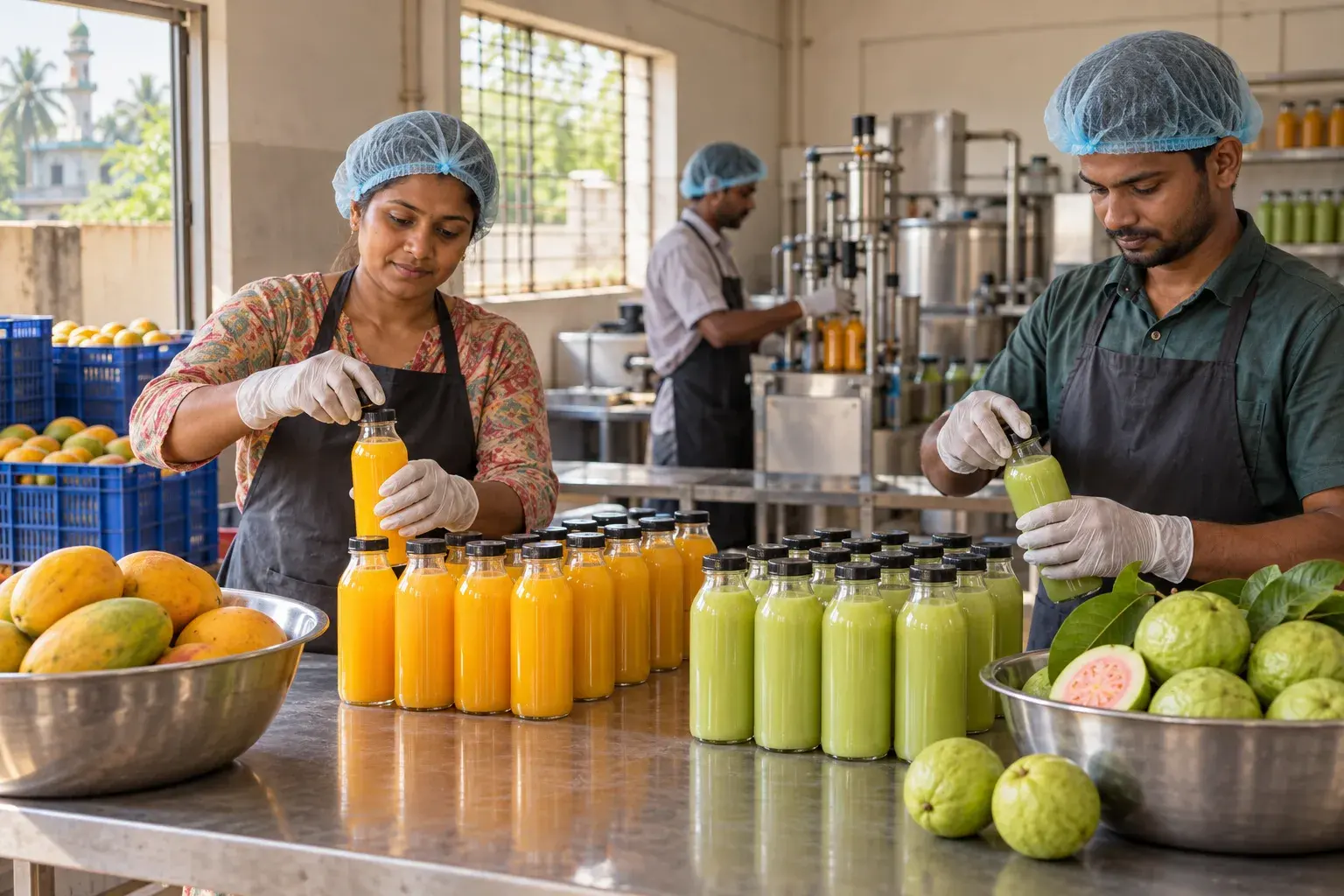
Fruit juice and drinks
Making and bottling fruit juice and fruit drinks. A litre retails at Tk 80-90. Selling without a BSTI CM licence draws fines - recently Tk 30,000 to Tk 1,00,000.
- Capital
- ৳5 lakh – ৳30 lakh
- People
- 4 – 20
- First income
- 90 – 180 days