
Juice and sharbat shop
Lemon, sugarcane and bael sharbat through the hot months at Tk 10-25 a glass, lassi at Tk 50. The trade stands on three things: ice, electricity and one hot season.
- Last reviewed: 21 September 2026
- Version 1
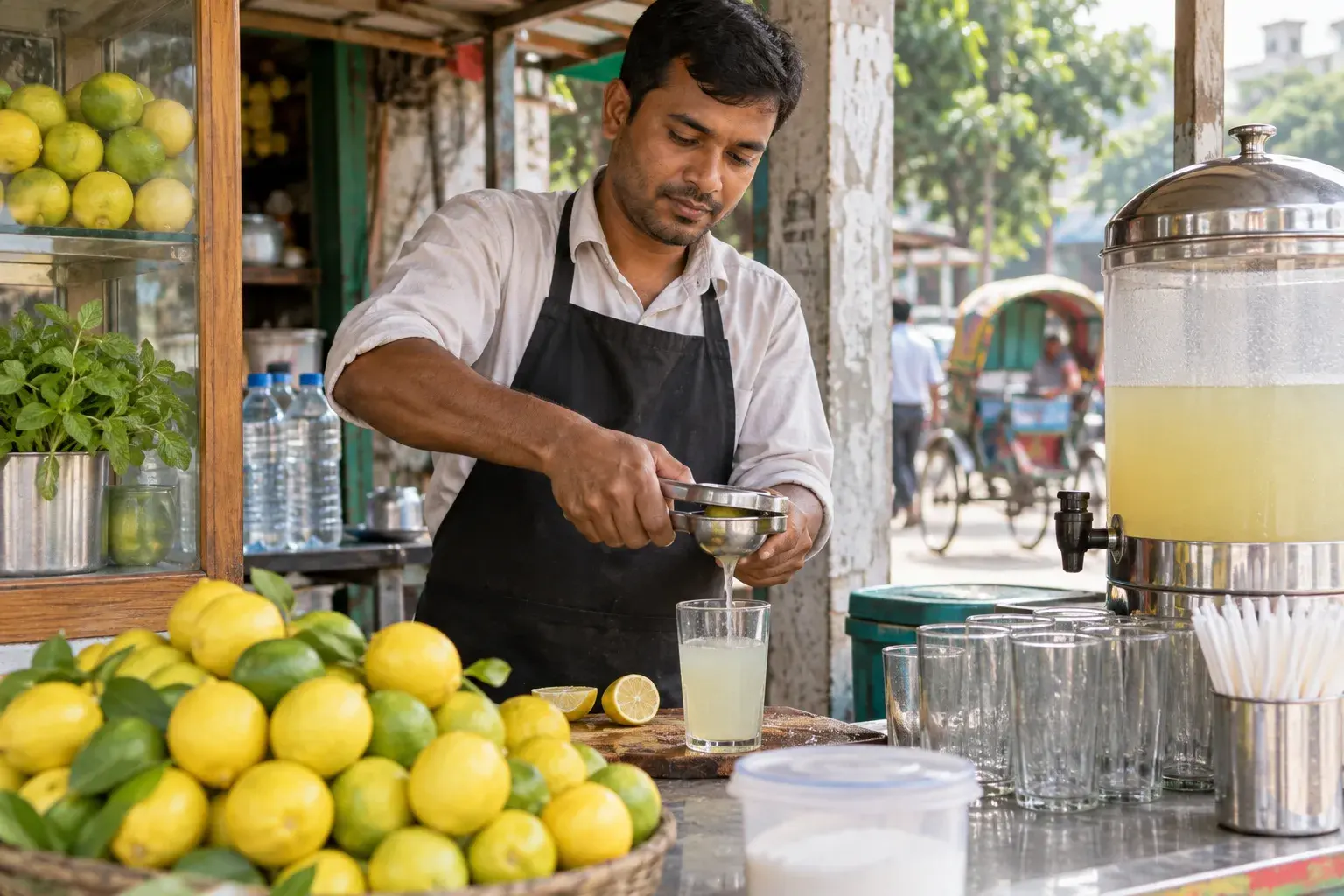
Juice and sharbat shop
- Starting capital
- ৳15,000 – ৳3,00,000 Editorial estimate
- Manpower
- 1 – 4 people
- First sale
- 5 – 45 days Editorial estimate
- Break-even
- 2 – 17 months Editorial estimate
- Kind of work
- Shop · Easy
About the business
When the heat comes the sharbat stalls go up on the roadside. Around New Market in Dhaka on 10 April 2025 lemon sharbat was Tk 10 a glass, sugarcane juice Tk 20, bael sharbat Tk 20 and a mixed-fruit sharbat with basil seed Tk 25. The prices are small and so is the margin per glass, so the money comes from the count. But the three costs that decide this business are not on the menu board. The first is ice. In the same report a New Market sharbat seller named Motin said plainly: 'This ice is usually brought in for fish, we take it from there. One sack does a whole day's trade.' Fish ice is not food grade, and a Food Safety Authority inspection can mean a fine and a closed shop; food-grade ice costs more. The second is electricity - the blender, the chiller and the freezer run all day, and when the power goes the ice melts and the cut fruit spoils. The third is the season. What sells between March and July has to carry the rest of the year; nobody buys a cold sharbat in winter. The 2026 regulations bring juice shops under registration - the Authority's draft named 'fruit juice, beverages' outright in schedule 1 - so Food Safety Authority registration is compulsory. Selling loose by the glass needs no BSTI certification; the moment it goes into a bottle, fruit juice falls under mandatory certification and the sample test alone is Tk 11,300.
Unit economics
| Item | Range | Evidence | Suggest a correction |
|---|---|---|---|
| Monthly working capital | ৳20,000 – ৳90,000 | Editorial estimate | |
| Selling price | ৳10 – ৳50 / unit | Market quote | |
| Variable cost | ৳5 – ৳30 / unit | Editorial estimate | |
| Gross margin | 40% – 65% | Editorial estimate | |
| Time to first revenue | 5 – 45 days | Editorial estimate | |
| Break-even time | 2 – 17 months | Editorial estimate | |
| Cash cycle | 0 – 1 days | Editorial estimate | |
| Waste / loss | 10% – 25% | Editorial estimate | |
| Daily capacity | 100 – 250 | Practitioner verified |
What you need to start
- A commercial electricity connection. On DPDC's rates effective from the June 2026 bill month, LT-E commercial and office is Tk 15.36 per kWh flat, Tk 13.82 off-peak and Tk 18.43 at peak, plus a demand charge of Tk 90 per kW per month. The residential 76-200 unit step is Tk 8.50 by comparison, so the same electricity costs roughly twice as much on the commercial rate - and the freezer and blender run most of the day.Equipment
- Hand lemon press Tk 451-900, electric juicer Tk 3,599-8,390, 2200W two-litre commercial double-jar blender Tk 9,900-10,200, chest freezer 150L Tk 27,900 / 200L Tk 43,900-51,400 / 250L Tk 37,890, portable ice maker Tk 17,000 (Daraz Bangladesh, 21-09-2026). Plus strainers, glasses or disposable cups and a cold jar.Equipment
- Sugar (Tk 108-112 a kg retail in Dhaka, Tk 102.40-103.00 wholesale, Department of Agricultural Marketing 17-09-2026), lemons, sugarcane, bael, basil seed, fruit, salt and black salt. Lemon, cane and bael are not on the Dhaka daily price sheet and could not be verified here.Starting stock
- In a pourashava, registration of the food premises - clause 18 of the Model Tax Schedule, under section 21 of the Pure Food Ordinance 1959 - is an annual fee on top of the trade licence: Tk 300 for a fast food, snacks bar, coffee house, ice cream, juice or cold drinks shop, and Tk 500 for a fruit juice or mineral water factory. The 2016 city corporation schedule has no equivalent.Licence
- Fire safety certificate under section 4(1) of the Fire Prevention and Extinguishing Act 2003; there is no size exemption. Keeping sugar and paper puts it in group 1: Tk 900 up to 150 sq ft, Tk 1,000 for 151-300, Tk 2,000 for 301-500. An LPG cylinder or cooking oil puts it in group 3 or 4: Tk 2,000 up to 150 sq ft, Tk 2,400 for 151-500, Tk 4,000 for 501-1,000. Application form Tk 100 by treasury challan. It expires on 30 June of the financial year; a 5 percent monthly late fee runs for six months, then it is cancelled. Operating without one carries a minimum of three years in prison plus a fine under section 17.Licence
- Trade licence. The pourashava schedule has a line of its own for a juice bar - serial 11(5), 'coffee house / snacks bar / fast food / juice bar': air-conditioned Tk 2,000 (class A pourashava) or Tk 1,700 (class B and C), ordinary Tk 500 or Tk 400; application fee Tk 50; signboard tax Tk 100 per square foot. The 2016 city corporation schedule has no juice line - manufacturing falls under serial 19, 'beverage', at Tk 4,000 (Dhaka North, Dhaka South and Chattogram) or Tk 2,000, otherwise serial 295 residual at Tk 1,000 or Tk 500. It runs on the fiscal year, and missing the 30 September renewal costs Tk 100 a month or 10 percent of the fee a month, whichever is higher, in a city corporation.Licence
- Food business registration with the Food Safety Authority; schedule 1, item 1 of the Authority's draft names 'fruit juice, beverages' outright, and The Daily Star's report on the final gazette lists juice shops under registration. Valid three years, renewal application at least 90 days before expiry. Two sources give two fees: the Authority's draft schedule 10 makes new registration free with Tk 100 renewal, while press reporting says Tk 1,000 and Tk 500.Licence
- BSTI CM licence: not needed for loose glasses, needed the moment it goes into a bottle or packet. On the mandatory list: Fruits and Vegetables Juices (item 16, BDS 513:2013), Fruit Squashes (13, BDS 506:2002), Concentrated Fruit Juice (20, BDS 527:2015), Fruit Drinks (58, BDS 1581:2015) and Packaged Drinking Water (47, BDS 1240:2021). Sample test fees: juice Tk 11,300, squash Tk 6,800, fruit drinks Tk 17,000, packaged water Tk 35,850 - all plus 15 percent VAT. New CM application Tk 1,000, annual CM fee 0.07 percent of production value for fruit products with a Tk 3,000 floor. Time 19-94 working days.Licence
- Environmental clearance: not needed for a small shop selling by the glass, needed once bottling begins. Under the note to schedule 1 of the Environment Conservation Rules 2023, a cottage industry run by family members with investment up to Tk 5 lakh - service activities included - is outside the requirement. But 'juice and soft drink manufacture' is serial 96 of the Orange class in schedule 1, which needs a location clearance and an Initial Environmental Examination first, takes up to 21 working days to approve, costs a Tk 5,000 processing fee plus a clearance fee running from Tk 3,000 (investment Tk 1-5 lakh) to Tk 20,000 (Tk 50 lakh to 1 crore), and is valid only one year, renewed at half the fee. Packaged drinking water, by contrast, is Green serial 6: 7 working days, valid five years.Licence
- Keeping the sugar, lemon and salt in the same proportion so the taste does not change, working fast in the rush, and the habit of keeping glasses and machines clean. The recipe is easy; cleanliness is what keeps the shop alive.Skill
- A reliable ice factory supplying food-grade ice, with a daily delivery. Ice brought in for fish is widely used in this trade (a New Market seller's own words, 10-04-2025) but is not fit for food. The price of ice is itself volatile: at Pathorghata in Barguna on 22-08-2026 a can or bar that used to sell at Tk 120 had gone to Tk 200-250, and the ice mill owners' association blamed frequent load-shedding and the rise in the per-unit electricity price. An ice factory carries its own trade licence too - serial 20, 'ice mill / ice cream factory', at Tk 2,000 in a city corporation.Supplier
- A small shop on a roadside or at a bazar mouth, a commercial power connection, running water and drainage for washing glasses, and room for the freezer. Rent varies by area and could not be verified here.Workspace
How the work is done
- 1Choose the spot by the sun. The mouth of a bazar, a bus stand, a hospital or college gate - wherever people walk in the afternoon. The crowd standing in unshaded heat is this shop's customer.
- 2Take the trade licence: form Tk 10, book Tk 50, standard tax Tk 30, stamp Tk 150-300, licence fee Tk 100-60,000, issued in 3-5 working days.
- 3Register the food business with the Food Safety Authority. Schedule 1, item 1 of the Authority's draft names 'fruit juice, beverages' outright, and reporting on the final gazette names juice shops too. The registration runs three years.
- 4Settle the ice before the machines. Find an ice factory that supplies food-grade ice and fix a daily delivery. Fish ice is cheap, but being caught with it risks a fine and a closed shop.
- 5Take the power connection at the commercial rate and work out the load: knowing how many units the blender, juicer, freezer and lights draw together means the monthly bill is no surprise. The commercial per-unit tariff could not be verified here and has to be asked at the distribution company's office.
- 6Decide in advance what happens when the power goes. With the freezer off the ice melts and the cut fruit spoils. IPS, battery or generator, whichever it is, put the cost into the monthly accounts.
- 7Buy the equipment in the order of the work: hand lemon press Tk 451-900, electric juicer Tk 3,599-8,390, 2200W two-litre commercial blender Tk 9,900-10,200, 150-litre chest freezer from Tk 27,900 (Daraz, 21-09-2026). A sugarcane crusher is a separate machine and its price could not be verified here.
- 8Set up proper glass washing - running water and soap, not two basins. The same unwashed glass carries infection from one customer to the next, and that is the commonest charge made against this trade.
- 9Keep the menu short and set how much fruit to cut by what is selling. Cut fruit changes within hours, so on a cloudy day cutting less is what pays.
- 10Plan separately for Ramadan: the two hours before iftar are the heaviest demand of the year, and ice and lemon are dearest at exactly that time.
- 11Think hard before bottling. Loose glasses need no BSTI, but bottled fruit juice is on the mandatory list (BDS 513:2013): the sample test alone is Tk 11,300, or Tk 17,000 as a fruit drink, plus 15 percent VAT, and the licence takes 19-94 working days.
- 12Plan the four cold months in advance - tea and coffee, lassi, or something else. A cold sharbat counter sits empty in winter while the rent keeps running.
Seasons
- JanLow
- FebNormal
- MarHigh
- AprHigh
- MayHigh
- JunHigh
- JulNormal
- AugNormal
- SepNormal
- OctLow
- NovLow
- DecLow
Where it works well
- Strong fitDhaka · The centre of the capital's sharbat trade; there is direct reporting on the prices and the ice supply of the New Market stalls (10-04-2025). Dense population, a long hot season and the largest number of people on foot all come together here.
- PossibleChapai Nawabganj · The mango district: raw material is cheapest from May to July, which is also the peak of the heat. When the fruit season ends, so does the advantage.
- PossibleChattogram · The port city has the same street crowds and the same long heat, though prices or sales figures for sharbat stalls in this district were not separately verified here.
- PossibleCumilla · Crowds around bus stands and roadside hotels on the Dhaka-Chattogram highway, where long-distance passengers get down looking for something cold in the heat. Figures were not verified here.
- PossibleKhulna · Bazar and ghat crowds in the city and a long hot season; separate figures for sharbat stalls were not verified here.
- PossibleNilphamari · Local reporting notes sharbat demand rising in the heat in this northern district too; separate price or sales figures were not verified here.
- PossibleRajshahi · One of the hottest parts of the country in summer, with cheap fruit in the mango season. Sales figures were not verified here.
- PossibleSylhet · The town has the crowds and the spending power of migrant families, but heavier rain means fewer clear hot days. Figures were not verified here.
Risks and cautions
- HighCompliance: The ice is the biggest risk. The New Market sharbat seller Motin said himself on 10-04-2025: 'This ice is usually brought in for fish, we take it from there.' Fish ice is not food grade. Dr Mohammad Rafikul Islam of Shaheed Suhrawardy Medical College says this water and ice spread typhoid, jaundice and hepatitis, and that unwashed glasses carry infection from one customer to the next. A mobile court means a fine and a closed shop, and one person falling ill ruins the name locally - in the hot season that costs the whole year.
- HighDemand: One hot season a year. What sells between March and July has to carry the rest, because nobody buys a cold sharbat in winter. A run of cloudy or rainy days inside that window means the fruit is already bought and the customers are not there. Rent and the power bill run all twelve months.
- HighDependency: When the power goes the business stops, and you pay for it twice. First on your own bill: on DPDC's rates effective from June 2026, commercial power is Tk 15.36 a unit flat and Tk 18.43 at peak, plus Tk 90 per kW a month in demand charge on the approved load, not the measured one - roughly double the residential rate. Second in the price of ice: at Pathorghata in Barguna on 22-08-2026 a can of ice had gone from Tk 120 to Tk 200-250, and the ice mill owners blamed load-shedding and the power price directly. So load-shedding does not merely stop your blender, it doubles the price of your main raw material - in exactly the heat that brings the customers. And the scale changed: at the same season and the same demand, load shedding ran 96-175 MW in April 2025 and 940-2,086 MW in April 2026. On 19-09-2026 the evening shortfall was 1,686 MW; on the worst day, 11 August 2026, it was 3,142 MW. A generator is no answer at these prices: diesel went to Tk 135 a litre on 21 September 2026, and at about 0.4 litre per unit that is roughly Tk 54 a unit against Tk 15.36 from the grid. A Tk 4-9 margin per glass does not carry it, which is why small businesses simply go dark.
- HighWorking capital: Lemon prices go out of hand exactly in season. The national retail average for kagzi lemon is Tk 19 a hali (August 2026) and TCB puts Dhaka at Tk 20-30 a hali (20-09-2026) - but at the start of Ramadan, at the Subhanighat wholesale market in Sylhet, small kagzi lemons went from Tk 20 a hali to Tk 70-80, medium to Tk 120-150 and large to Tk 175-200. And the two hours before iftar are the biggest selling of the year. The glass stays at Tk 10 or Tk 15, so when lemons quadruple there is no profit left on those days.
- MediumSpoilage: Cut fruit turns within hours and made-up sharbat will not do the next day. Cut too much expecting a crowd and it goes in the bin at dusk; cut too little and you run out in the rush. The decision comes every single day and getting it wrong costs that day's profit.
- MediumWorking capital: The margin is locked into round numbers. A glass is Tk 10 or Tk 20; nobody wants the change for Tk 12 or Tk 22. So when sugar or lemons go up the only moves are a smaller glass or a thinner sharbat, and the customer notices both. Sugar was Tk 108-112 a kg retail in Dhaka on 17-09-2026 against Tk 102-105 on the same date a year before.
- MediumCompliance: Running without registration breaches section 38 of the Safe Food Act 2013: a first offence brings six months to a year in prison or a fine of Tk 1,00,000 to Tk 2,00,000 or both. And starting to sell in bottles without a CM licence brings it under section 21 of the BSTI Act 2018, where section 29 carries up to four years or a fine of Tk 50,000 to Tk 2,00,000.
Sources
Supports: Starting capital · মিরপুর (রূপনগর), ঢাকা
Supports: Starting capital · মিরপুর, ঢাকা
Supports: Starting capital · বাংলাদেশ (অনলাইন)
- Collected: 21 Sept 2026
Supports: Starting capital · বাংলাদেশ (অনলাইন)
- Collected: 21 Sept 2026
Supports: Starting capital, Starting capital · বাংলাদেশ (অনলাইন)
Supports: Starting capital · বাংলাদেশ (অনলাইন)
- Collected: 21 Sept 2026
Supports: Starting capital, requirements · বাংলাদেশ
- Collected: 21 Sept 2026
Supports: requirements · বাংলাদেশ
ডিপিডিসি ট্যারিফ হার — জুন ২০২৬ বিল মাস হতে কার্যকর খুচরা বিদ্যুৎ হার
Collected: 21 Sept 2026Supports: requirements · ঢাকার ডিপিডিসি এলাকা
নিরাপদ খাদ্য আইন, ২০১৩ (২০১৩ সনের ৪৩ নং আইন) — তফসিল, ধারা ৩১ ও ৩৮ এর দণ্ড
Collected: 21 Sept 2026Supports: risks · বাংলাদেশ
- Collected: 21 Sept 2026
Supports: requirements · বাংলাদেশ
- Collected: 21 Sept 2026
Supports: Starting capital, requirements · বাংলাদেশের সকল পৌরসভা
- Collected: 21 Sept 2026
Supports: requirements · বাংলাদেশ
- Collected: 21 Sept 2026
Supports: risks · বাংলাদেশ
- Collected: 21 Sept 2026
Supports: requirements · বাংলাদেশ
- Collected: 21 Sept 2026
Supports: Starting capital, requirements · বাংলাদেশ
সারণী-২: পণ্যের পরীক্ষণ ফি'র তালিকা, রসায়ন পরীক্ষণ উইং — ফুড ডিভিশন
Collected: 21 Sept 2026Supports: requirements · বাংলাদেশ
সিএম লাইসেন্স প্রসেস ম্যাপ (বাধ্যতামূলক পণ্য) — সেবা প্রোফাইল, প্রয়োজনীয় সময় ১৯–৯৪ কর্মদিবস
Collected: 21 Sept 2026Supports: requirements · বাংলাদেশ
সি এম লাইসেন্স ফি শিডিউল — সিএম উইং
Collected: 21 Sept 2026Supports: requirements · বাংলাদেশ
- Collected: 21 Sept 2026
Supports: Starting capital, requirements · ঢাকা উত্তর, ঢাকা দক্ষিণ, চট্টগ্রাম ও অন্যান্য সিটি কর্পোরেশন
- Collected: 21 Sept 2026
Supports: risks · সিলেট — সুবহানীঘাট পাইকারি বাজার
- Collected: 20 Sept 2026
Supports: risks · বাংলাদেশ
- Collected: 20 Sept 2026
Supports: Variable cost · ঢাকা মহানগর — সিপাহীবাগ, মিরপুর-৬, মোহাম্মদপুর টাউন হল, নিউমার্কেট, রামপুরা, মহাখালী বাজার
- Collected: 19 Sept 2026
Supports: risks · বাংলাদেশ — ঢাকা, চট্টগ্রাম, ময়মনসিংহ, সিলেট, খুলনা, রাজশাহী ও কুমিল্লা জোন
- Collected: 17 Sept 2026
Supports: Variable cost, risks · ঢাকা মহানগর
- Collected: 17 Sept 2026
Supports: Variable cost · ঢাকা মহানগর — কারওয়ান বাজার, যাত্রাবাড়ী, তেজগাঁও, রহমতগঞ্জ ও মৌলভী বাজার, কাপ্তান বাজার, বাদামতলী ও বাবুবাজার, শ্যামবাজার, মিরপুর-১ ও ২
সিটি কর্পোরেশন থেকে ট্রেড লাইসেন্স প্রাপ্তির ধাপ সমূহ
Collected: 16 Sept 2026Supports: requirements · বাংলাদেশ
পণ্যভিত্তিক মাসিক পাইকারী ও খুচরা জাতীয় গড় বাজারদর, আগস্ট ২০২৬ — ২৭১টি কৃষিপণ্যের বুলেটিন
Collected: 31 Aug 2026Supports: Variable cost · বাংলাদেশ (জাতীয় গড়)
লোডশেডিং ও বিদ্যুতের দাম বৃদ্ধিতে পাথরঘাটায় বরফের দাম বেড়ে দ্বিগুণ
Collected: 22 Aug 2026Supports: risks · বরগুনা — পাথরঘাটা বিএফডিসি মৎস্য অবতরণ কেন্দ্র
Frequent power cuts put small businesses under pressure
Collected: 13 Aug 2026Supports: risks · বাংলাদেশ — পাবনা, বরিশাল ও পল্লী বিদ্যুৎ এলাকা
ভ্যাপসা গরমে হাঁসফাঁস জনজীবন, তৃষ্ণা মেটাতে ভরসা লেবুর শরবত
Collected: 2 Jun 2026Supports: Selling price · বগুড়া — দুপচাঁচিয়া
ঢাকার বিয়ের টেবিল থেকে বাজারের গলি: রাজত্ব তিন পানীয়ের
Collected: 19 Aug 2025Supports: Selling price · ঢাকা — বিউটি লাচ্ছি, নাজিরা বাজার
- Collected: 27 Apr 2025
Supports: Daily capacity · ঢাকা — ফার্মগেট
ক্ষণিকের তৃপ্তি মেটাতে সস্তা আখ-লেবুর শরবত, স্বাস্থ্যঝুঁকিতে নগরবাসী
Collected: 10 Apr 2025Supports: districts, Daily capacity, Selling price, risks · ঢাকা — নিউমার্কেট
ফুটপাথের ইফতার দামে কম হলেও রয়েছে স্বাস্থ্যঝুঁকি
Collected: 6 Mar 2025Supports: Selling price · ঢাকা — গুলিস্তান, পল্টন, শাহবাগ, নিউমার্কেট, বাংলামোটর, কারওয়ান বাজার
What changed
No corrections have been published yet.
Questions and answers
No questions yet. Be the first to ask.
Stories about this business
From 2 taka a glass to 10, and still only 600-700 taka a day
A glass of sugarcane juice has gone from 2 taka to 10 over ten years, but the cane has risen with it. The stall turns over 3,000-4,000 taka a day and keeps 600-700 of it.
- Reasons
- Other, Working capital
Paddy out, sugarcane in: four lakh taka a year from a roadside juice shop
The same 2.5 acres returned about 30,000 taka a year under paddy against 18,000 taka of production cost. Crushed and sold as juice at the roadside, the cane from that land now takes about 2,000 taka a day and leaves about 400,000 taka of profit over a nine-month season.
- Reasons
- Good location, Strong network
Similar businesses
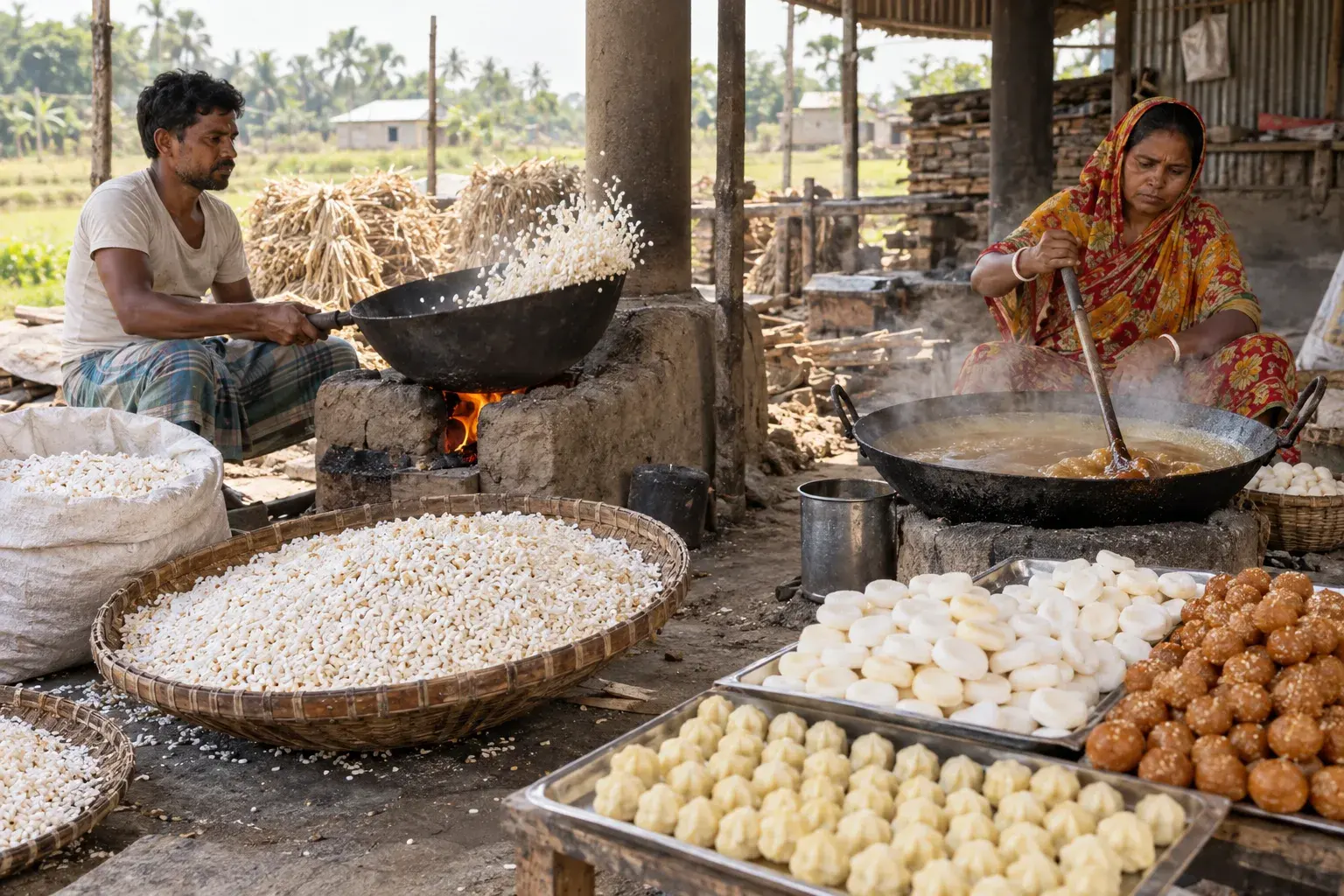 Food processing
Khoi and batasa making
Popping paddy into khoi and boiling sugar or gur into batasa and kadma. Wholesale sugar is Tk 102-103 a kg and batasa sells at Tk 190-300. Very low capital and no BSTI CM licence.
- Capital
- ৳15k – ৳1.5 lakh
- People
- 2 – 6
- First income
- 10 – 40 days
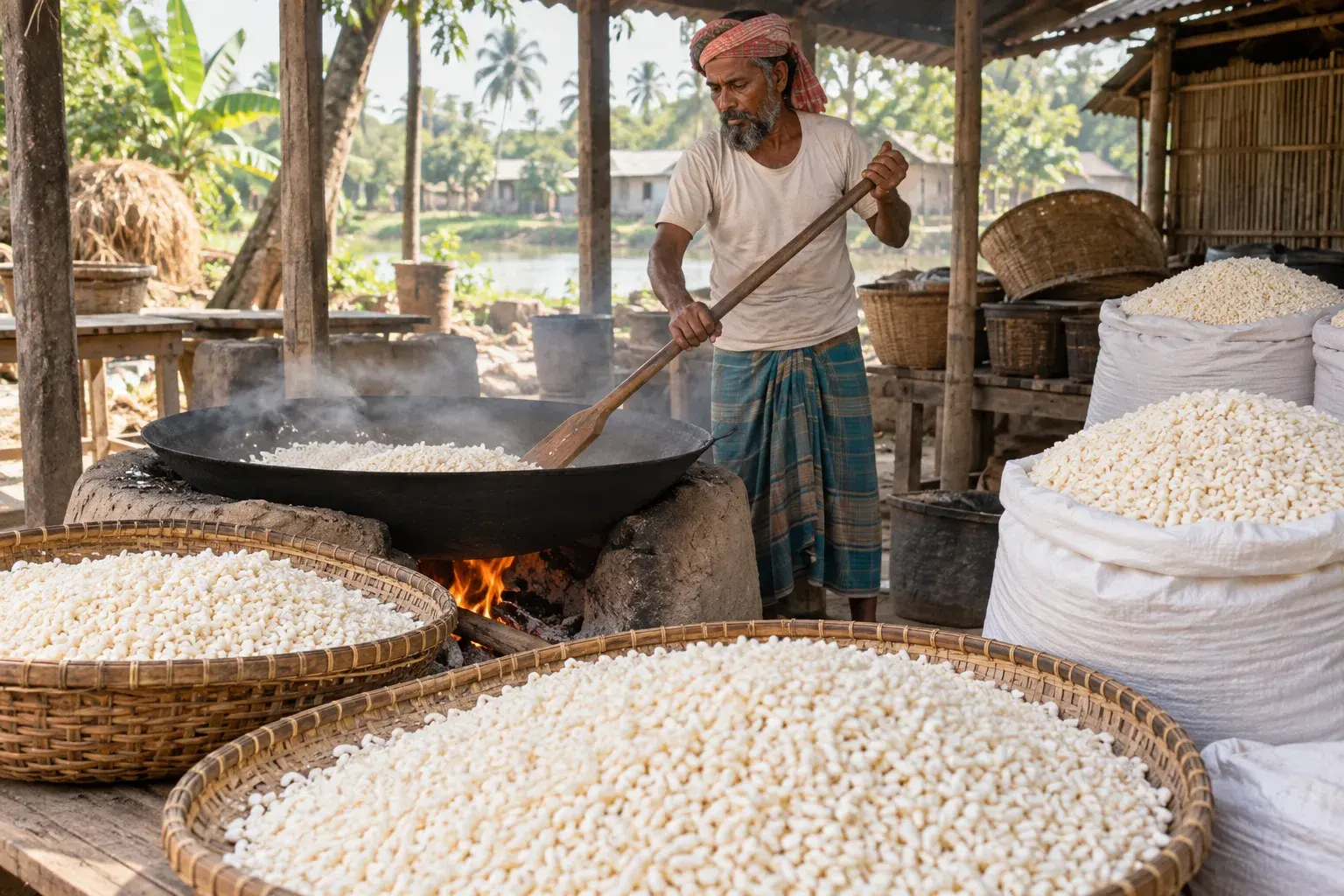 Food processing
Puffed rice (muri) making
Frying rice into muri. One kilo of rice gives 900 grams of muri and coarse rice costs Tk 50-55/kg, so machine muri keeps only Tk 4-6 a kilo while hand-fried pure muri wholesales at Tk 90.
- Capital
- ৳20k – ৳2 lakh
- People
- 2 – 8
- First income
- 7 – 30 days
 Food processing
Pickle (achar) making
Making mango, olive and garlic pickle for jars. Branded pickle retails at Tk 375-525 a kilo, and selling packaged food means a Tk 1,000 food safety registration even from a home kitchen.
- Capital
- ৳20k – ৳90k
- People
- 1 – 4
- First income
- 14 – 28 days
 Food processing
Tea stall and small cafe
About 250 cups come out of a kilo of tea leaf, and a cup sells for Tk 5-30. Tk 20,000 buys a stove, a cylinder, cups and a week of stock - not a shop deposit and not a fridge.
- Capital
- ৳20k – ৳1.5 lakh
- People
- 1 – 3
- First income
- 7 – 30 days