
Onion and garlic storage trading
Buying cheap at harvest, storing, and selling when prices rise. But 25-30 percent of the country's onion rots for want of storage, and local onion fell 30 percent in twelve months.
- Last reviewed: 19 September 2026
- Version 1
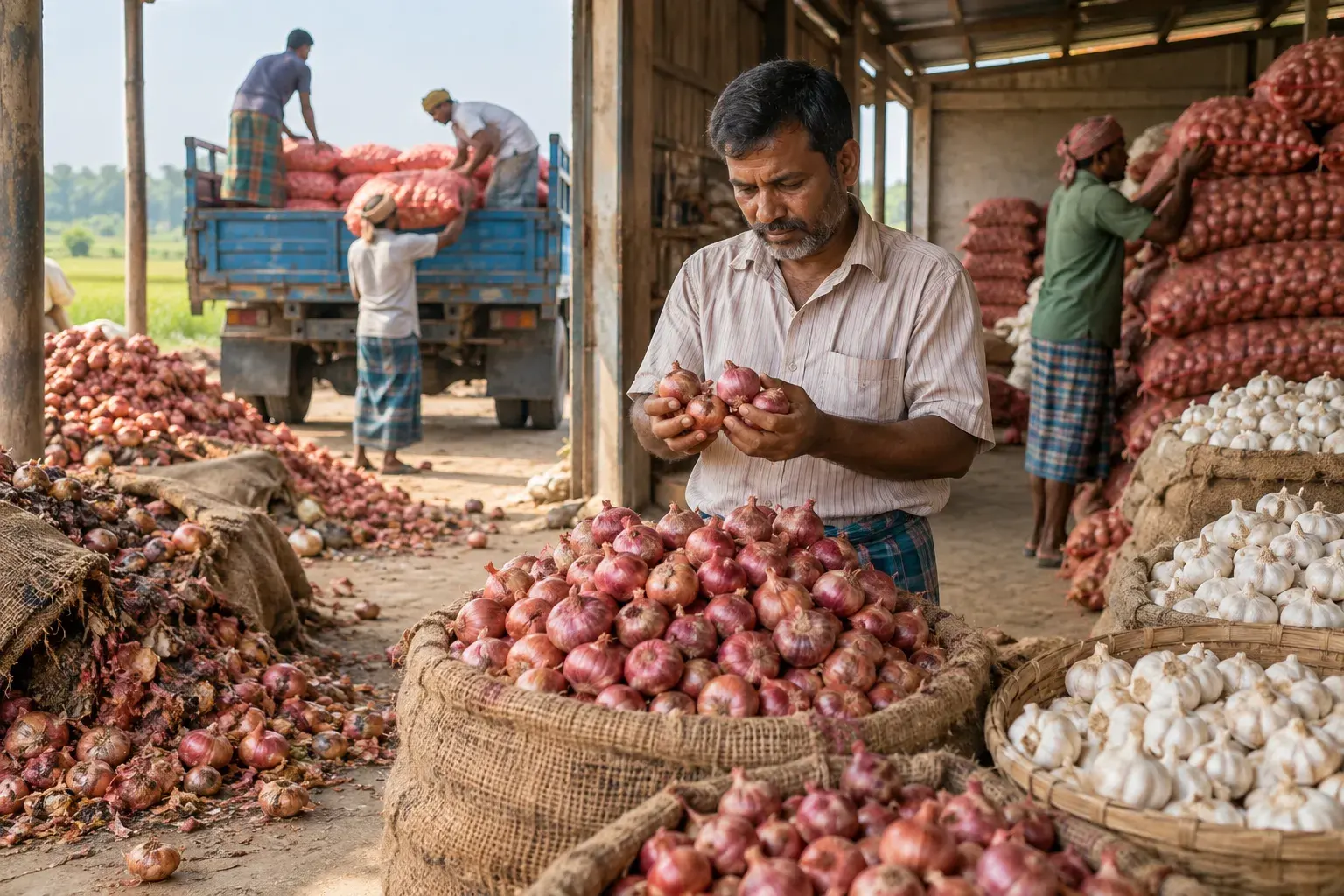
Onion and garlic storage trading
- Starting capital
- ৳70,000 – ৳4,72,500 Editorial estimate
- Manpower
- 1 – 4 people
- First sale
- 90 – 250 days Editorial estimate
- Break-even
- 22 – 48 months Editorial estimate
- Kind of work
- Shop · Hard
About the business
Buying onion and garlic cheap at harvest, holding it in store, and selling when the price climbs. There is no production and no processing here - only the gap between the buying price and the selling price. On 26 May 2026 onion in the Rajbari-Faridpur-Pabna-Kushtia belt was selling at Tk 700-1,050 a maund against Tk 1,800-2,000 a year earlier, while it cost Tk 28-30 a kilo to grow on one's own land and Tk 38-40 on leased land - so whoever was holding stock that season lost money. On 15 September 2026 Dhaka retail was Tk 50-55 for local onion, Tk 100-120 for local garlic and Tk 160-200 for imported garlic, and local onion was 30 percent cheaper than a year before. The real enemy is rot: 25-30 percent of the country's onion is lost purely for want of storage, six to seven lakh tonnes a year. Air-flow machines hold onion for eight to nine months with only 2-4 percent loss, but not everyone has one. And while stock sits, the import door from India can open and take the price down overnight. The law bites too: under the Agricultural Marketing Act 2018, running a warehouse without a licence, creating an artificial shortage, or taking profit above the government-fixed rate carries up to a year in jail or a Tk 1 lakh fine, doubled on a second offence. Money is made fast here, and one season is enough to lose everything.
Unit economics
| Item | Range | Evidence | Suggest a correction |
|---|---|---|---|
| Monthly working capital | ৳60,000 – ৳4,50,000 | Editorial estimate | |
| Selling price | ৳50 – ৳55 / kg | Official source | |
| Variable cost | ৳17 – ৳26 / kg | Market quote | |
| Gross margin | 52.7% – 66% | Editorial estimate | |
| Time to first revenue | 90 – 250 days | Editorial estimate | |
| Break-even time | 22 – 48 months | Editorial estimate | |
| Cash cycle | 90 – 240 days | Editorial estimate | |
| Waste / loss | 20% – 30% | Editorial estimate | |
| Daily capacity | 50 – 350 | Editorial estimate |
What you need to start
- Scales, sacks and netting, bamboo or steel racks, and an air-flow machine where possible. The government has a programme to install 8,000 air-flow machines in the onion and garlic districts.Equipment
- Onion or garlic bought at harvest. On 26 May 2026 onion was Tk 700-1,050 a maund: 100 maunds costs Tk 70,000-1,05,000 and 450 maunds Tk 3,15,000-4,72,500.Starting stock
- Agricultural marketing licence from the Director General, Department of Agricultural Marketing. Section 6 of the Agricultural Marketing Act 2018 bars running a warehouse or cold store commercially without one; section 5 bars acting as a market trader in a notified market without one. Section 8 leaves term, renewal and fee to the rules, and the fee could not be verified here. The licence may not be transferred (section 9).Licence
- Trade licence from the city corporation or municipality: form Tk 10, licence book Tk 50, standard tax Tk 30, stamp Tk 150-300, licence fee Tk 100-60,000 by trade type, usually issued in 3-5 working days.Licence
- Recognising dry, firm bulbs when buying, turning the stock and picking out rot, and above all judging when to sell. Holding without watching the market rate is the biggest mistake in this trade.Skill
- Markets and farmers or middlemen in Pabna, Faridpur, Rajbari, Kushtia and Meherpur, and on the selling side buyers in wholesale markets such as Shyambazar.Supplier
- A dry, ventilated godown with racks off the floor and a roof that does not leak. With an air-flow machine installed, onion and garlic keep eight to nine months and loss falls to 2-4 percent.Workspace
How the work is done
- 1Decide which season you are buying for. Local onion comes in at the end of winter and that is when it is cheapest. Do not buy without knowing that season's rate.
- 2Arrange the store: a dry room with air movement and racks off the floor. Onion heaped on the ground rots from the bottom and takes the whole pile with it.
- 3Take the licence from the Department of Agricultural Marketing. Section 6 of the Agricultural Marketing Act 2018 bars running a warehouse commercially without one, and section 5 bars trading in a notified market without one.
- 4Take the trade licence from the city corporation or municipality and a TIN from the NBR.
- 5Before buying, spend a few days at the markets writing down the rate. In the Pabna, Faridpur, Rajbari and Kushtia markets the per-maund rate moves daily, and the difference between the start and end of the season is large.
- 6Buy dry, firm onion with a closed neck. Wet bulbs and hybrid varieties hold more moisture and rot faster - do not buy those to store.
- 7Cure the crop properly before it goes in, then stack in thin layers. Turn it over every fortnight and pull out the rotten ones - one rotten bulb takes many with it.
- 8Watch the daily rate. The Department of Agricultural Marketing publishes separate wholesale and retail rates for onion and potato, and TCB publishes a daily sheet. Do not hold on guesswork.
- 9Keep an eye on import news from India. An import permission or a duty cut sends the price down fast, so when the news comes it is safer to sell than to hold.
- 10Sell in instalments, not all at once. If you release the whole stock at one price and that price turns out to be the worst one, there is no way back.
- 11Stay away from creating an artificial shortage or taking profit above the government-fixed rate. Refusing to sell from the warehouse while there is demand is itself an offence, and mobile courts can impose the penalty.
Seasons
- JanNormal
- FebNormal
- MarHigh
- AprHigh
- MayHigh
- JunNormal
- JulNormal
- AugNormal
- SepHigh
- OctHigh
- NovHigh
- DecHigh
Where it works well
- Strong fitDhaka · The selling end. The national rate is set in wholesale markets like Shyambazar, and the daily TCB and DAM sheets are based on Dhaka markets.
- Strong fitFaridpur · A major onion-growing area; the 2026 season's price crash and rot were reported most heavily from here.
- Strong fitKushtia · Grows both onion and garlic, with easy road links to Dhaka and Khulna.
- Strong fitPabna · One of the country's main onion districts; at harvest the markets are full and the rate is at its lowest.
- Strong fitRajbari · An onion district where the government's air-flow storage machine programme has gone furthest.
- PossibleChapai Nawabganj · Imports come through the Sona Masjid land port, so import news moves this market immediately.
- PossibleDinajpur · Hili land port is here, so when Indian onion comes in this market's price falls first.
- PossibleMeherpur · A border onion area where prices are low, but Indian onion hits here first.
- PossibleNatore · A garlic and spice-crop district, convenient for buying garlic in season.
- PossibleSatkhira · Indian onion arrives through the Bhomra land port - both an opportunity and a risk for a storage trader.
Risks and cautions
- HighSpoilage: Rot is the main enemy. As of 15 April 2026, 25-30 percent of the country's onion is lost for want of storage - six to seven lakh tonnes a year. This is normal, not rare: a report of 26 May 2026 describes one farmer who stored 450 maunds and lost 405 of them, ninety percent. Hybrid varieties hold more water and rot faster still.
- HighDemand: The bet on rising prices is not one-way. On 15 September 2026 Dhaka retail for local onion was Tk 50-55, down 30 percent in twelve months. On 26 May 2026 the field rate was Tk 700-1,050 a maund against Tk 1,800-2,000 a year earlier. A trader who bought this year on last year's price got less than half of it back.
- HighDependency: One announcement of imports from India can take the value of the whole stock down. Roughly 86,000 tonnes of onion were imported in FY2025-26 even though production exceeded demand. If the import door opens while stock is sitting, there is no way out - everyone tries to sell at once.
- HighCompliance: Under section 19 of the Agricultural Marketing Act 2018, running a warehouse without a licence, creating an artificial market shortage, refusing to sell from the warehouse while there is demand, and taking profit above the government-fixed rate are all offences, punishable with up to a year in jail or a fine of up to Tk 1 lakh or both, doubled on repetition. Mobile courts can impose these penalties, so raids increase exactly when prices rise.
- HighWorking capital: The money leaves in one go at harvest and then sits in the godown for months, with no room to buy again. Buying stock on credit means the interest keeps running while the price falls. Three to eight months of locked-up money is normal here.
Sources
কৃষি বিপণন আইন, ২০১৮ (২০১৮ সনের ৪৪ নং আইন) — ধারা ৫, ৬, ৮, ৯, ১৬, ১৯, ২৬
Collected: 16 Sept 2026Supports: Starting capital · বাংলাদেশ
সিটি কর্পোরেশন থেকে ট্রেড লাইসেন্স প্রাপ্তির ধাপ সমূহ
Collected: 16 Sept 2026Supports: Starting capital · বাংলাদেশ
- Collected: 15 Sept 2026
Supports: Selling price · ঢাকা মহানগর — সিপাহীবাগ, মিরপুর-৬, মোহাম্মদপুর টাউন হল, নিউমার্কেট, রামপুরা, মহাখালী বাজার
What changed
No corrections have been published yet.
Questions and answers
No questions yet. Be the first to ask.
Stories about this business
Price past 5,000 taka a maund, and not an onion in the arot
Onion prices at Santhia rose from 3,200-3,400 to 5,000-5,400 taka a maund in ten days, but supply dried up: a hat day that normally brings ten trucks brought half of one.
- Reasons
- Supplier problem, Dependency
Similar businesses
 Retail & wholesale
Grocery shop
The neighbourhood everyday-goods shop. A few taka a kilo, so income depends on volume - and the shop usually dies when customer credit locks up the cash.
- Capital
- ৳80k – ৳5 lakh
- People
- 1 – 3
- First income
- 10 – 30 days
 Retail & wholesale
Fresh fish from landing sites to town
Bought at dawn from the landing site, iced and in town shops before noon.
- Capital
- ৳80k – ৳1.5 lakh
- People
- 2 – 3
- First income
- 3 – 7 days
 Retail & wholesale
Bale (gait) clothing trade
Buying imported used clothing by the sealed bale and selling it by the piece. A jacket bale is about Tk 15,000 and pieces retail at Tk 20-2,000, but the bale is bought without seeing inside.
- Capital
- ৳50k – ৳4 lakh
- People
- 1 – 5
- First income
- 7 – 30 days
 Retail & wholesale
Selling clothes on a Facebook page
Buy three-pieces and saris wholesale, sell on Facebook Live, deliver by courier.
- Capital
- ৳50k – ৳1.5 lakh
- People
- 1 – 3
- First income
- 7 – 21 days