
Sand filling and earthwork
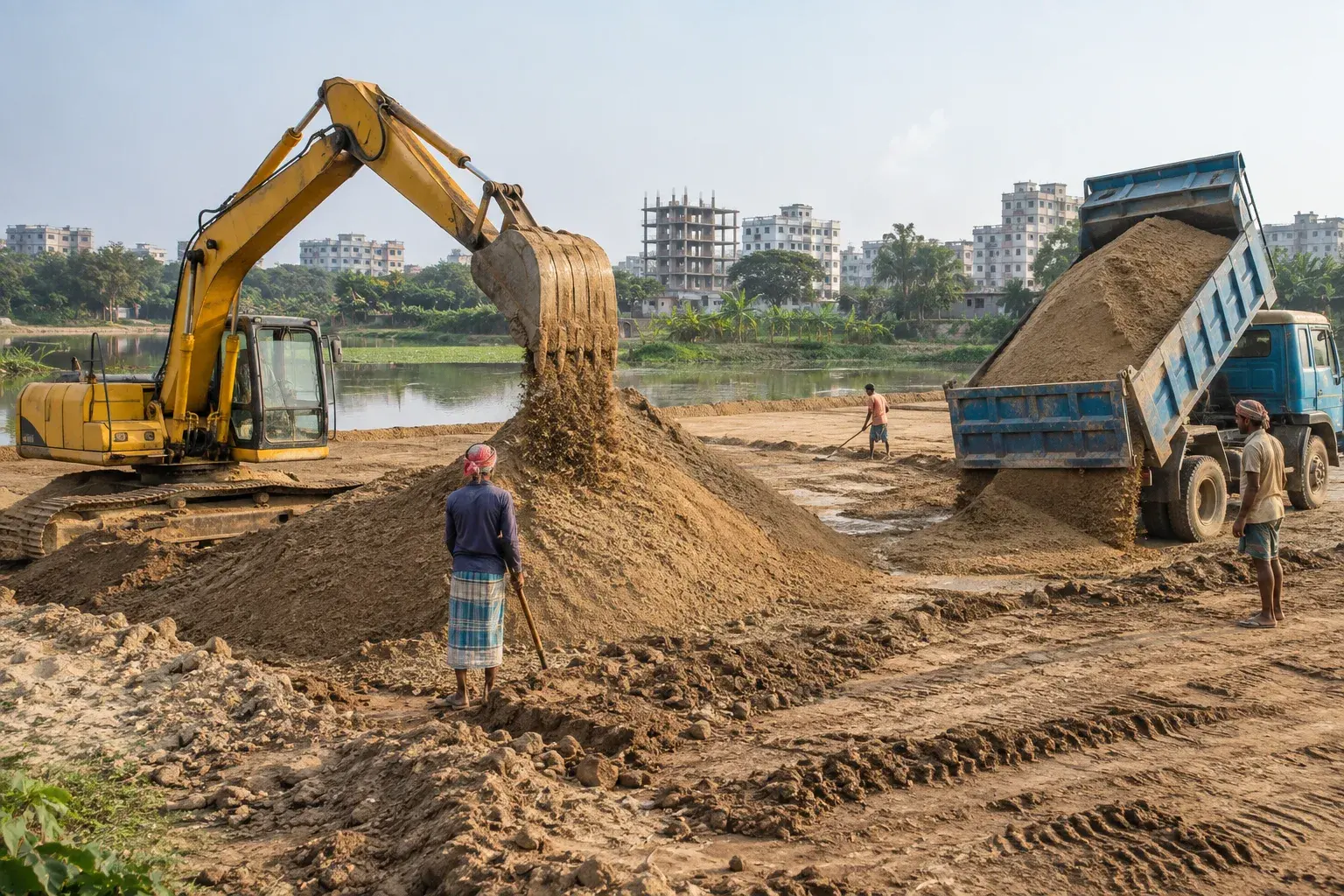
Contracting land filling, pond filling and earth cutting. Fill sand is Tk 8-12 a cubic foot in Dhaka, and lifting soil without permission means a fine up to Tk 10,00,000 and the excavator confiscated.
- Last reviewed: 19 September 2026
- Version 1
Sand filling and earthwork
- Starting capital
- ৳1,50,000 – ৳15,00,000 Editorial estimate
- Manpower
- 3 – 20 people
- First sale
- 30 – 365 days Official source
- Break-even
- 3 – 8 months Editorial estimate
- Kind of work
- Mobile service · Hard
About the business
Filling land and cutting earth. Raising a low plot with sand before a house goes up, filling a pond or ditch, digging out a foundation, dumping soil beside a road -- all of it is this business. The money comes from two places: selling sand, and hiring out the machine. In the Dhaka market on 28 June 2026 fill sand was Tk 8-12 a cubic foot, selection or local sand Tk 17-27 and Sylhet red sand Tk 37-45; a ten-wheel truck of medium selection sand for roof casting, roughly 950-1,000 cubic feet, went for Tk 24,000-25,000. Freight is the big cost line: Prothom Alo's costing shows a 180-foot cart of sand at Tk 1,200 while the truck fare alone is Tk 2,300-2,400, so carrying the sand costs more than the sand. The law here is hard and not knowing it is ruinous. Under the Sand Quarry and Soil Management Act 2010, sand and soil may not be lifted within one kilometre of a bridge, dam, embankment, road, railway line or residential area. Even on private land, topsoil from fertile farmland and any extraction for commercial purposes are barred. The penalty is up to two years' jail or a fine of Tk 50,000 to Tk 10,00,000, or both, and the excavator, dredger and carrying vehicles are confiscated.
Unit economics
| Item | Range | Evidence | Suggest a correction |
|---|---|---|---|
| Monthly working capital | ৳91,000 – ৳2,81,000 | Editorial estimate | |
| Selling price | ৳8 – ৳45 / unit | Market quote | |
| Variable cost | ৳6 – ৳38 / unit | Editorial estimate | |
| Gross margin | 15% – 25% | Editorial estimate | |
| Time to first revenue | 30 – 365 days | Official source | |
| Break-even time | 3 – 8 months | Editorial estimate | |
| Cash cycle | 15 – 60 days | Editorial estimate | |
| Waste / loss | 3% – 10% | Editorial estimate | |
| Daily capacity | 1,500 – 30,000 | Editorial estimate |
What you need to start
- Excavator, dredger and pipes, trucks or tractors to carry soil, spades and baskets and a water pump. The big machines are normally hired; no published hire rate could be found.Equipment
- Trade licence from the city corporation or municipality: form Tk 10, licence book Tk 50, standard tax Tk 30, stamp Tk 150-300, licence fee Tk 100-60,000 by trade type, in 3-5 working days.Licence
- Sand quarry lease from the deputy commissioner's office by open tender under section 10 of the Sand Quarry and Soil Management Act 2010. Only enlisted persons or firms may bid and blacklisted lessees are excluded. The term is one year, 1 Baishakh to 30 Chaitra (section 13). The lease value differs by quarry and is not published.Licence
- Permission of the upazila nirbahi officer, required under section 7A to lift soil in a limited way from one's own land for building a house or for personal need. The exemption does not extend to commercial purposes.Licence
- Measuring a plot and calculating cubic feet, judging sand grade by eye -- fill, selection or red sand -- and knowing where the law bars extraction.Skill
- A quarry lessee or a sand depot, plus the truck and tractor owners' association. Since carriage costs more than the sand, the real bargaining in this business is with the vehicle owners.Supplier
How the work is done
- 1Decide which side you are on: leasing a sand quarry and lifting sand, or simply buying sand and contracting to fill land. The second needs less capital and carries less risk.
- 2Read sections 4 and 7A of the Sand Quarry and Soil Management Act 2010. Extraction is barred within one kilometre of a bridge, dam, road, railway line or residential area, and commercial extraction from fertile farmland is barred outright.
- 3To take a lease, get enlisted at the deputy commissioner's office. The Act bars anyone not on the list from bidding in the open tender.
- 4Take the trade licence from the city corporation or municipality, and register for TIN and VAT to take company work.
- 5Arrange the machines: an excavator, a dredger with pipes, and trucks or tractors to carry the soil. Hire rather than buy at first, because instalments on a bought machine do not stop when the work does.
- 6Fix the source of the sand and how far it has to travel. Prothom Alo's costing shows the truck fare exceeding the price of the sand itself, so distance decides your profit.
- 7Measure the plot before starting and work out the cubic feet needed: length by breadth by the depth of fill. Get this wrong and a lump-sum job loses money.
- 8Do not stack the lifted sand on roads, playing fields or parks. Section 7B bars it specifically, and most raids start from a public nuisance complaint.
- 9Put it in writing: how many cubic feet, which grade of sand, in how many days, and money at which stage. Take a filling job on a verbal understanding and the measurement becomes a dispute.
- 10Get most of the work done in the dry season. In the monsoon the rivers are full, quarries are closed and fill does not hold on wet ground.
Seasons
- JanHigh
- FebHigh
- MarHigh
- AprHigh
- MayNormal
- JunLow
- JulLow
- AugLow
- SepLow
- OctNormal
- NovHigh
- DecHigh
Where it works well
- Strong fitDhaka · The most plot and housing project filling work, and the highest sand prices.
- Strong fitGazipur · Land filling for factories and worker housing goes on all year.
- Strong fitMunshiganj · The Padma and Meghna quarries are close, and the big housing projects south of Dhaka are filled from here.
- Strong fitNarayanganj · Low land next to Dhaka needs filling, and sand comes easily by river.
- Strong fitSylhet · Sylhet red sand fetches the highest rate, Tk 37-45 a cubic foot, but quarry disputes and raids are also most frequent here.
- PossibleBrahmanbaria · Sand from the Titas and Meghna, with easy supply because of the Dhaka-Chattogram highway.
- PossibleChattogram · Strong demand from industrial and housing project filling, though hill cutting is separately prohibited.
- PossiblePanchagarh · A major source of river sand and stone, though the truck fare to Dhaka is the largest cost.
- PossibleRajbari · Padma quarries and ferry-based supply, with more going out of the district than is used in it.
- PossibleSunamganj · Quarries on the Jadukata and other rivers, with leases and raids both regularly in the news.
Risks and cautions
- HighCompliance: Section 15 of the Sand Quarry and Soil Management Act 2010 provides up to two years' imprisonment or a fine of Tk 50,000 to Tk 10,00,000, or both, for lifting sand or soil without permission, and the dredger, excavator and carrying vehicles are confiscated. Trial is by mobile court under an executive magistrate, on the spot. If a hired excavator is confiscated, its owner has to be paid for it too.
- HighCompliance: Section 4 bars extraction within at least one kilometre of a bridge, culvert, dam, barrage, embankment, road, highway, forest, railway line or other important installation, or a residential area, and bars it altogether in ecologically critical areas. Section 7A bars taking topsoil from fertile farmland or lifting soil for commercial purposes even on private land. Many contractors take jobs without knowing these sections, assuming the landowner's consent is enough. It is not.
- HighDependency: The biggest cost is freight, and it is not in the contractor's control. Prothom Alo's costing shows a 180-foot cart of sand at Tk 1,200 against a truck fare of Tk 2,300-2,400. A fuel rise or a transport association rate increase wipes out the margin on a lump-sum job, and sand brought from a distant district is riskier still.
- MediumDemand: The work is entirely seasonal. In the monsoon the rivers are full, the quarries are shut and fill does not hold on wet ground. Four months of the year are nearly dead, while excavator instalments and worker advances carry on.
- MediumLate payment: Housing companies and plot traders give large jobs but release bills in stages and haggle over the measurement, while truck fare and wages are paid in cash every day. On a big filling job that gap runs into lakhs.
Sources
- Collected: 16 Sept 2026
Supports: Starting capital, Time to first revenue · বাংলাদেশ
সিটি কর্পোরেশন থেকে ট্রেড লাইসেন্স প্রাপ্তির ধাপ সমূহ
Collected: 16 Sept 2026Supports: Starting capital · বাংলাদেশ
What changed
No corrections have been published yet.
Questions and answers
No questions yet. Be the first to ask.
Similar businesses
 Light manufacturing & workshop
Small shoe making unit
A small unit making sandals and shoes for wholesalers. Sandals sell at Tk 250-700 and leather shoes at Tk 1,200. Bhairab alone has 3,500-5,000 units employing about 25,000 people.
- Capital
- ৳1.5 lakh – ৳10 lakh
- People
- 4 – 20
- First income
- 30 – 90 days
 Light manufacturing & workshop
Thai glass and aluminium fitting
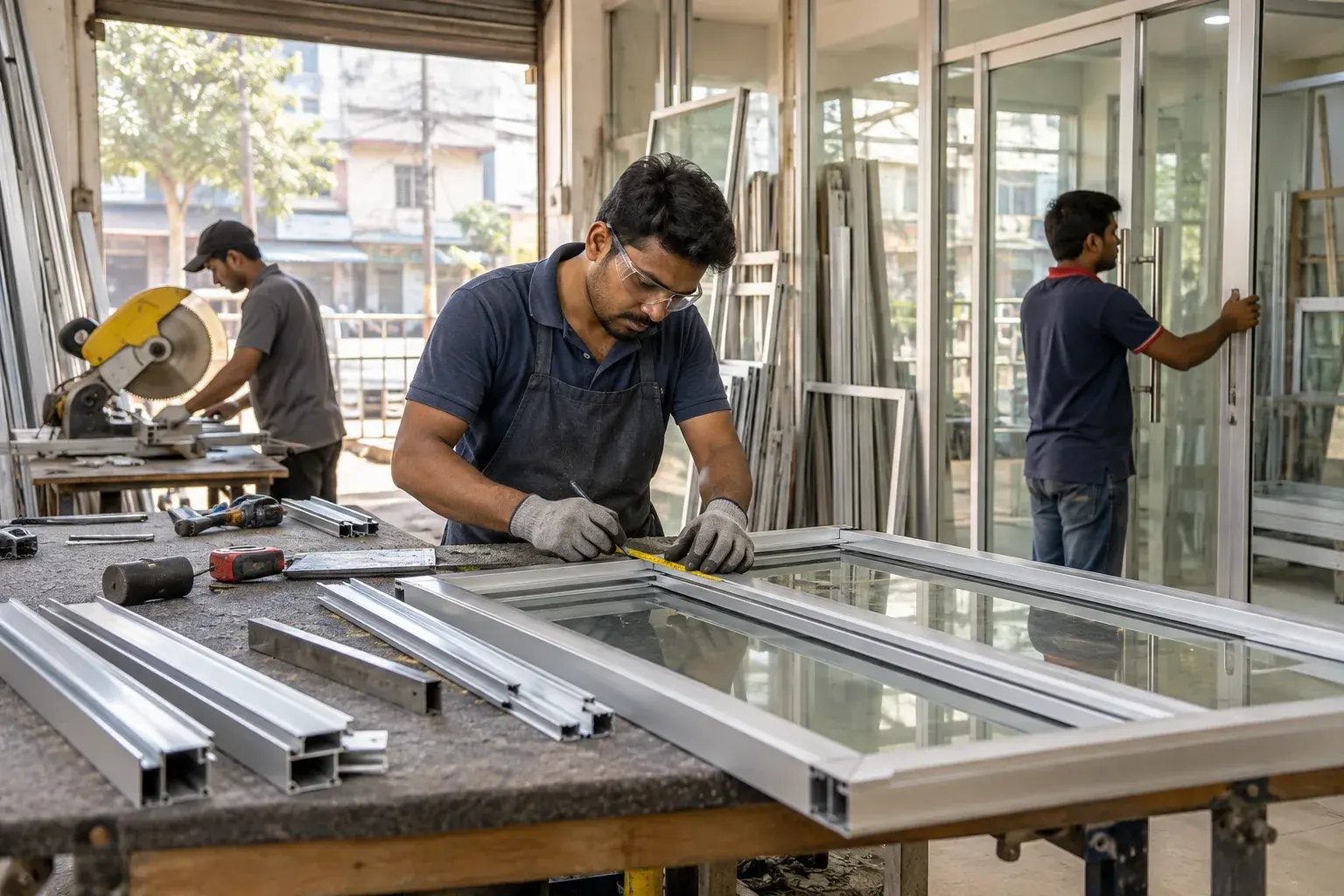
Cutting and fitting aluminium profile and glass into doors, windows and partitions. Ordinary work is about Tk 470-750 per square foot, and a wrong measurement cannot be returned.
- Capital
- ৳1.5 lakh – ৳6 lakh
- People
- 2 – 6
- First income
- 20 – 60 days
 Light manufacturing & workshop
Notebook making
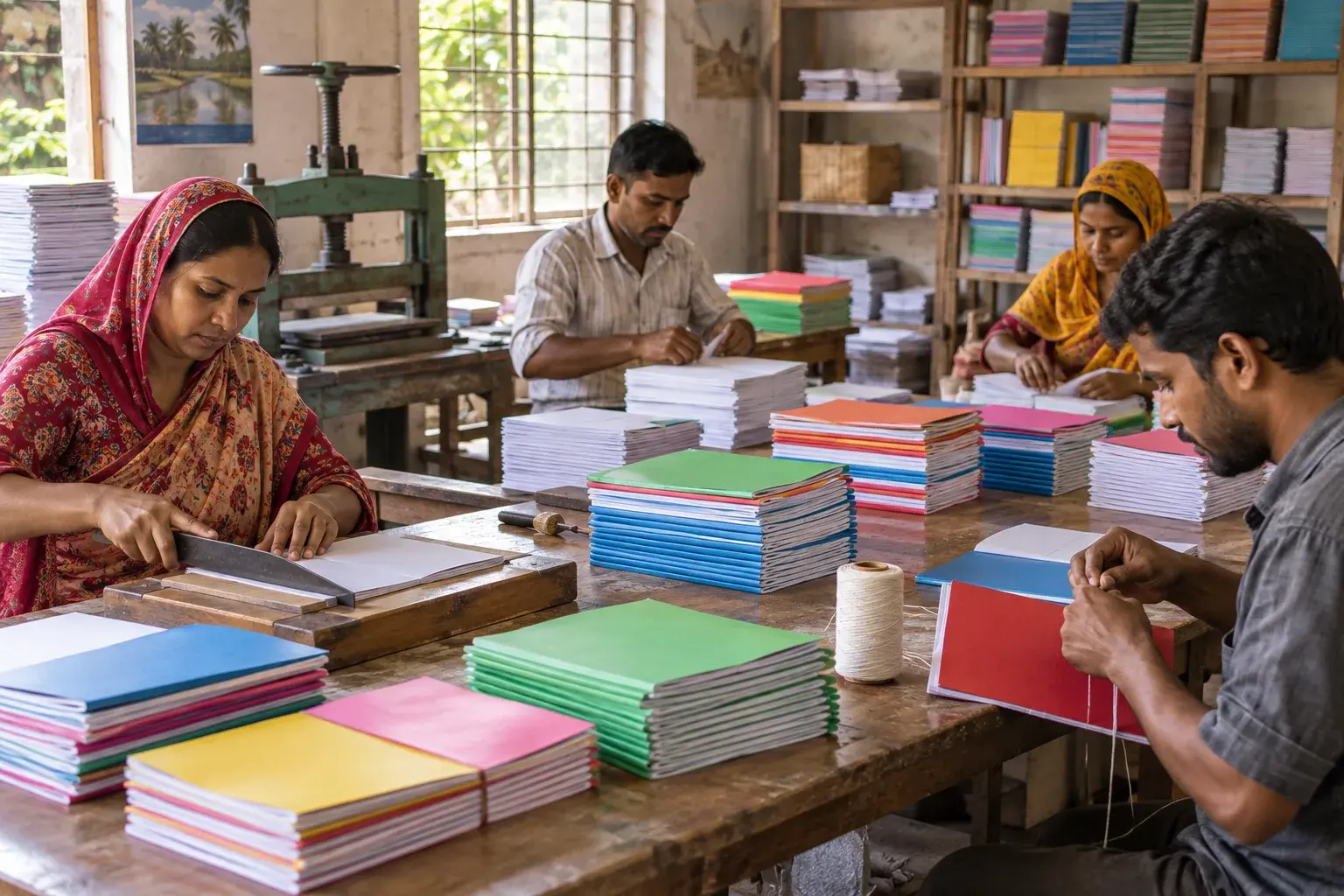
Cutting, folding and binding paper into exercise books. A 300-page khata sells online at Tk 169 and a 120-page one at Tk 75, while a packet of paper costs Tk 100-150 more than a year ago.
- Capital
- ৳1.5 lakh – ৳7 lakh
- People
- 3 – 15
- First income
- 15 – 45 days
 Light manufacturing & workshop
Agarwood attar distilling
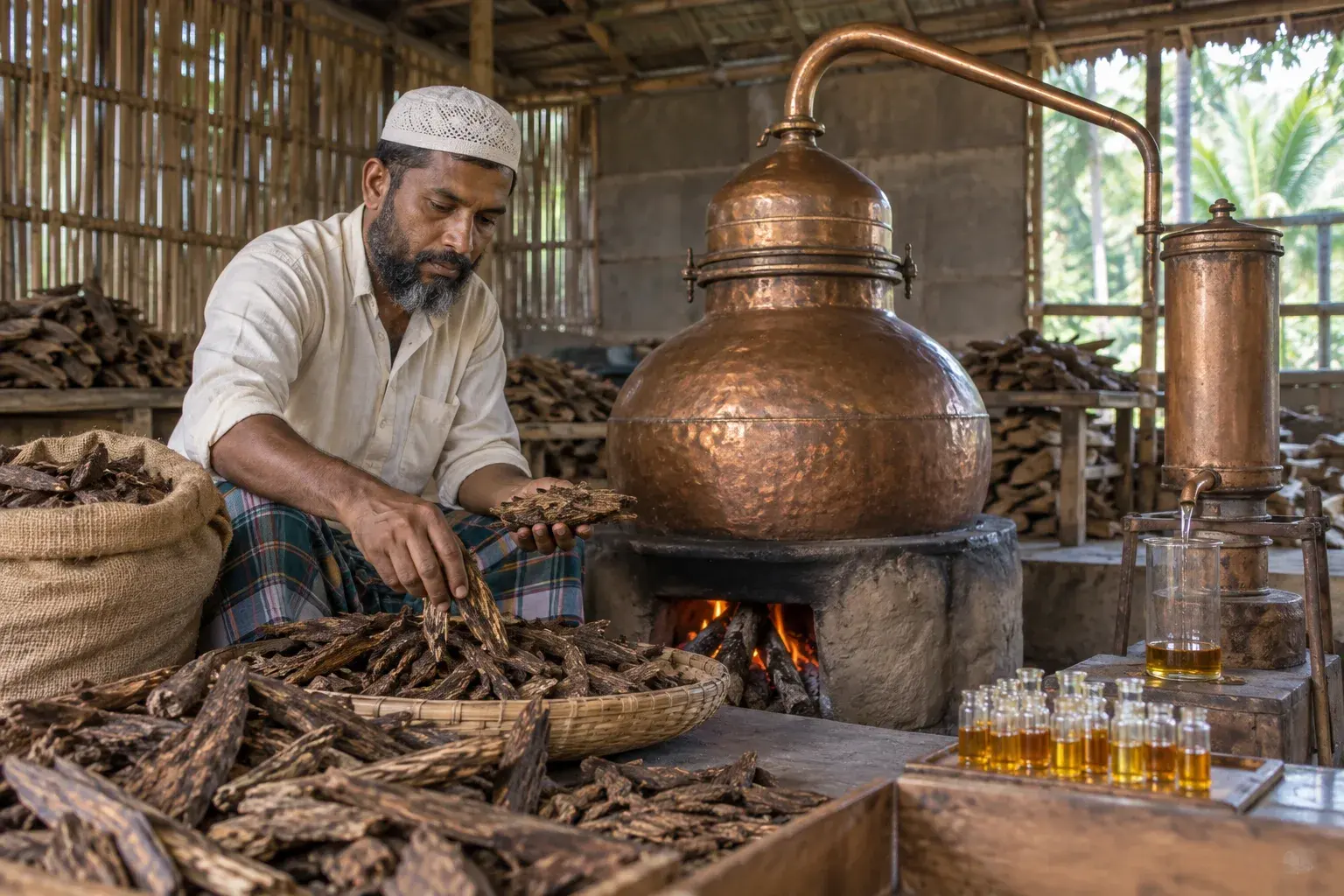
Soaking and boiling agarwood to draw off fragrant attar. Barlekha's Sujanagar has about 250 units, attar sells at Tk 6,000-10,000 a tola by grade, and nearly all of it is exported.
- Capital
- ৳1.5 lakh – ৳10 lakh
- People
- 3 – 15
- First income
- 2,555 – 10,950 days