
Wheat farming
A single winter crop, sown mid-November and cut in March. The government bought wheat from farmers at Tk 36 a kg in the 2025 procurement, against a reported Tk 6,000-7,000 to grow one bigha.
- Last reviewed: 21 September 2026
- Version 1

Wheat farming
- Starting capital
- ৳6,000 – ৳35,000 Editorial estimate
- Manpower
- 1 – 4 people
- First sale
- 108 – 180 days Editorial estimate
- Break-even
- 4 – 6 months Editorial estimate
- Kind of work
- Farm · Medium difficulty
About the business
Wheat is a one-season winter crop. BWMRI puts the best sowing window at 15-30 November, stretching to 10 December for the early, heat-tolerant varieties. BWMRI Gom 5 runs 112-117 days and BARI Gom 33 108-112 days, so the crop is in the house about four months after the seed goes down. Seed rate is 120-130 kg a hectare, roughly 16-17 kg a bigha; BADC's 2026-27 schedule prices certified wheat seed at Tk 66 a kg to a farmer and foundation seed at Tk 69. The money arrives once, after harvest. In the 2025 internal procurement the government paid Tk 36 a kg, bought between 24 April and 31 July, and bought only from farmers on the Department of Agricultural Extension's list, first come first served. A farmer not on that list cannot deliver to a government godown and sells to the local arat instead. That is wheat's real problem: maize or potato on the same land pays more, so the area keeps shrinking year after year. After the 2016 wheat blast outbreak farmers in the southwest dropped the crop out of fear. Blast-resistant varieties exist now, but when the disease arrives the heads go white and the grain dies, and a whole bigha goes with it.
Unit economics
| Item | Range | Evidence | Suggest a correction |
|---|---|---|---|
| Monthly working capital | ৳1,500 – ৳7,000 | Editorial estimate | |
| Selling price | ৳32 – ৳36 / kg | Official source | |
| Variable cost | ৳12 – ৳23 / kg | Editorial estimate | |
| Gross margin | 27% – 68% | Editorial estimate | |
| Time to first revenue | 108 – 180 days | Editorial estimate | |
| Break-even time | 4 – 6 months | Editorial estimate | |
| Cash cycle | 120 – 200 days | Editorial estimate | |
| Waste / loss | 5% – 20% | Editorial estimate | |
| Daily capacity | 3 – 24 | Editorial estimate |
What you need to start
- A power tiller or plough for land preparation, ideally a seed drill that ploughs, sows and levels in one pass, access to irrigation (usually water bought from a shallow or deep tubewell) and a thresher after cutting. Most farmers hire these; hire rates could not be verified.Equipment
- Seed: 16-17 kg a bigha (120-130 kg a hectare). BADC's 2026-27 rate to a farmer is Tk 66 a kg certified and Tk 69 foundation; to a dealer Tk 58 and Tk 61.Starting stock
- Fertiliser: per hectare 150-175 kg urea (plus 75-90 kg as top dressing), 135-150 kg TSP, 100-110 kg MOP, 110-125 kg gypsum and 6.25-7.50 kg boric acid. Where zinc is short, 12.5 kg a hectare of zinc sulphate.Starting stock
- Registration on the Department of Agricultural Extension's farmer list. No licence is needed to grow the crop, but being on this list is compulsory to sell to a government godown, as the 2025 procurement order states as a condition. No fee.Licence
- A trade licence, only if you start buying and reselling wheat or contract to supply a mill. Issued by the city corporation, municipality or union parishad: form Tk 10, standard tax Tk 30, licence book Tk 50, non-judicial stamp Tk 150-300 where required, in 3-5 working days. Trading without one draws Tk 5,000 the first time and Tk 500 a day after. Not needed to sell your own crop.Licence
- Recognising wheat blast and leaf spot, and knowing the timing of irrigation and top dressing. BWMRI runs an early warning system for wheat blast that can be checked.Skill
- High, well-drained land, plus an open paved yard for threshing and drying. A godown will not take damp wheat, so without drying space the trouble starts the day the crop is cut.Workspace
How the work is done
- 1Pick the land. Wheat will not stand water, so it needs high, well-drained ground. If the previous crop was aman paddy the land falls free right after it is cut, and that is wheat's best slot.
- 2Go to the upazila office of the Department of Agricultural Extension and get your name on the farmer list. It is compulsory for selling to a government godown: the 2025 procurement order says in plain words that wheat will be bought from farmers listed by the Department of Agricultural Extension.
- 3Choose the variety. In blast country take BARI Gom 33, the first blast-resistant variety, yielding 4.8-5.5 t/ha over 108-112 days. If you must sow late take BWMRI Gom 4 or 5, which are heat-tolerant.
- 4Buy the seed by the numbers: 16-17 kg a bigha (120-130 kg a hectare where germination is over 80 percent). BADC's 2026-27 rate to a farmer is Tk 66 a kg certified and Tk 69 foundation. Grain kept back from your own crop germinates worse.
- 5Treat the seed. Three grams of Provax-200 to a kg of seed cuts seed-borne disease and, by BWMRI's figure, raises yield by 10-12 percent.
- 6Sow between 15 and 30 November, in rows 20 cm apart and 4-5 cm deep. Late sowing costs yield, and past 10 December only the early varieties give anything worth having.
- 7Before the last ploughing put in two-thirds of 150-175 kg urea a hectare, plus 135-150 kg TSP, 100-110 kg MOP and 110-125 kg gypsum. The rest of the urea goes on as a top dressing 17-21 days after sowing.
- 8Keep birds off for 10-12 days after sowing, and weed at 25-30 days when the soil has the right moisture. BWMRI puts the gain from timely weeding at 15 percent of yield.
- 9Give the first irrigation at the three-leaf stage, then top-dress 75-90 kg of urea a hectare while the soil is still wet. Wheat will grow without irrigation, but the yield is far lower.
- 10If leaf spot shows, spray 5 ml of Tilt 250 EC in 10 litres of water over 5 decimals at heading. Blast turns the heads white overnight and there is nothing to be done then, so in blast country the resistant variety has to be chosen up front.
- 11Cut when the grain is hard, thresh and dry it properly. A godown will not take damp wheat, and an arat docks the price for it.
- 12If you are on the list, go to the upazila food godown. In 2025 procurement ran from 24 April to 31 July at Tk 36 a kg on a first-come-first-served basis. Once the target is filled the godown stops buying, so there is no room for delay.
Seasons
- JanNormal
- FebNormal
- MarHigh
- AprHigh
- MayNormal
- JunNormal
- JulNormal
- AugLow
- SepLow
- OctLow
- NovHigh
- DecHigh
Where it works well
- Strong fitDinajpur · The northern wheat heartland, with dense BWMRI regional work and seed supply and BADC seed sale centres close by.
- Strong fitNilphamari · Land falls free after aman and tubewells are dense, so irrigated wheat is workable.
- Strong fitPanchagarh · The country's northernmost district and its coldest, where early-sown wheat fills well.
- Strong fitRangpur · Greater Rangpur is where field-level prices are reported, Tk 1,200-1,300 a maund in 2022, and also where maize has cut the wheat area fastest.
- Strong fitThakurgaon · Thakurgaon and Panchagarh get a longer winter with less heat at grain filling, so yields hold up better.
- PossibleChapai Nawabganj · The dry climate suits wheat, but spreading mango orchards keep taking cropland.
- PossibleJoypurhat · Wheat competes with potato and maize for the same land and survives where the potato cold stores are far.
- PossibleKurigram · Wheat grows on the high sandy loam of the chars, but irrigation costs push many towards maize.
- PossibleNaogaon · Wheat works on the high Barind land, but limited irrigation water makes yields vary sharply from place to place.
- Weak fitJashore · Wheat blast was first confirmed in fields in Jashore in 2016; wheat here is risky since, and unwise without a resistant variety.
- Weak fitKushtia · The same blast belt, and tobacco and maize have taken over the land.
- Weak fitMeherpur · Inside the blast-prone southwestern belt, where the area has fallen away.
Risks and cautions
- MediumWorking capital: Nearly all the spending falls in November on seed, ploughing and basal fertiliser, and the money returns in March or April. The four or five months in between run on borrowing, and the lender is usually the same arat that will buy the crop, which leaves no room to argue over price.
- HighDemand: Maize and potato pay more on the same land, so the wheat area keeps falling. The country sowed 880,000 hectares of wheat in 1998-99 and is now near a quarter of that. A farmer who keeps wheat usually keeps it on part of the land, not all of it.
- HighOther: Wheat blast. After the 2016 outbreak farmers across the southwest dropped the crop. Once it takes, the heads go white and the grain shrivels, and a whole field can go in a few days; no spray brings it back, and the only defences are a resistant variety like BARI Gom 33 and crop rotation.
- HighOther: The winter is getting shorter. Heat during grain filling leaves the grain shrivelled and light. On late-sown fields this costs something almost every year, which is why BWMRI keeps releasing early and heat-tolerant varieties.
- MediumLate payment: Selling to a government godown is not open to everyone, nor always. Without your name on the list you cannot enter, and once the target is filled buying stops. In 2025 the window ran from 24 April to 31 July. Otherwise it is the arat, which pays less and pays late.
Sources
- Collected: 21 Sept 2026
Supports: Starting capital, Starting capital · বাংলাদেশ
২০২৬ সনের সম্ভাব্য গম উৎপাদনের তথ্যাদি প্রেরণ — স্মারক ১৩.০১.০০০০.০৯১.৪৫.২৯.২৬, তারিখ ২৯/০৩/২০২৬
Collected: 21 Sept 2026Supports: Cash cycle · বাংলাদেশ
ইউরিয়া, ডিএপি, টিএসপি ও এমওপি সারের দাম কেজিতে ৫ টাকা বাড়ান হয়েছে (প্রকাশ ১১-০৪-২০২৩)
Collected: 21 Sept 2026Supports: Starting capital · বাংলাদেশ
বারি গম ৩৩ — ব্লাস্ট রোগ প্রতিরোধী জিংক সমৃদ্ধ জাত, ফলন ৪.৮-৫.৫ টন/হে., জীবনকাল ১০৮-১১২ দিন
Collected: 21 Sept 2026Supports: Time to first revenue · বাংলাদেশ
- Collected: 21 Sept 2026
Supports: Starting capital, Monthly working capital · বাংলাদেশ
বিডাব্লিউএমআরআই গম ৫ — জাতের বৈশিষ্ট্য, বপনের সময়, বীজের পরিমাণ ও সারের মাত্রা
Collected: 21 Sept 2026Supports: Time to first revenue · বাংলাদেশ
সিটি কর্পোরেশন থেকে ট্রেড লাইসেন্স প্রাপ্তির ধাপ সমূহ — ফি, কাগজপত্র, সময় ও জরিমানা
Collected: 21 Sept 2026Supports: requirements · বাংলাদেশ
Farmers in Thakurgaon count losses as potato prices fall
Collected: 28 Feb 2026Supports: Starting capital · ঠাকুরগাঁও
- Collected: 22 Apr 2025
Supports: Cash cycle, Selling price · বাংলাদেশ
What changed
No corrections have been published yet.
Questions and answers
No questions yet. Be the first to ask.
Stories about this business
6,000 taka of profit on 40 shotok of wheat, and more land this season
This Fatikchhari farmer cleared about 6,000 taka from wheat on 40 shotok last year and is taking more land this season; the upazila's wheat area is going from 25 hectares to 40.
- Reasons
- Weak demand, Other
Similar businesses
 Agriculture & farming
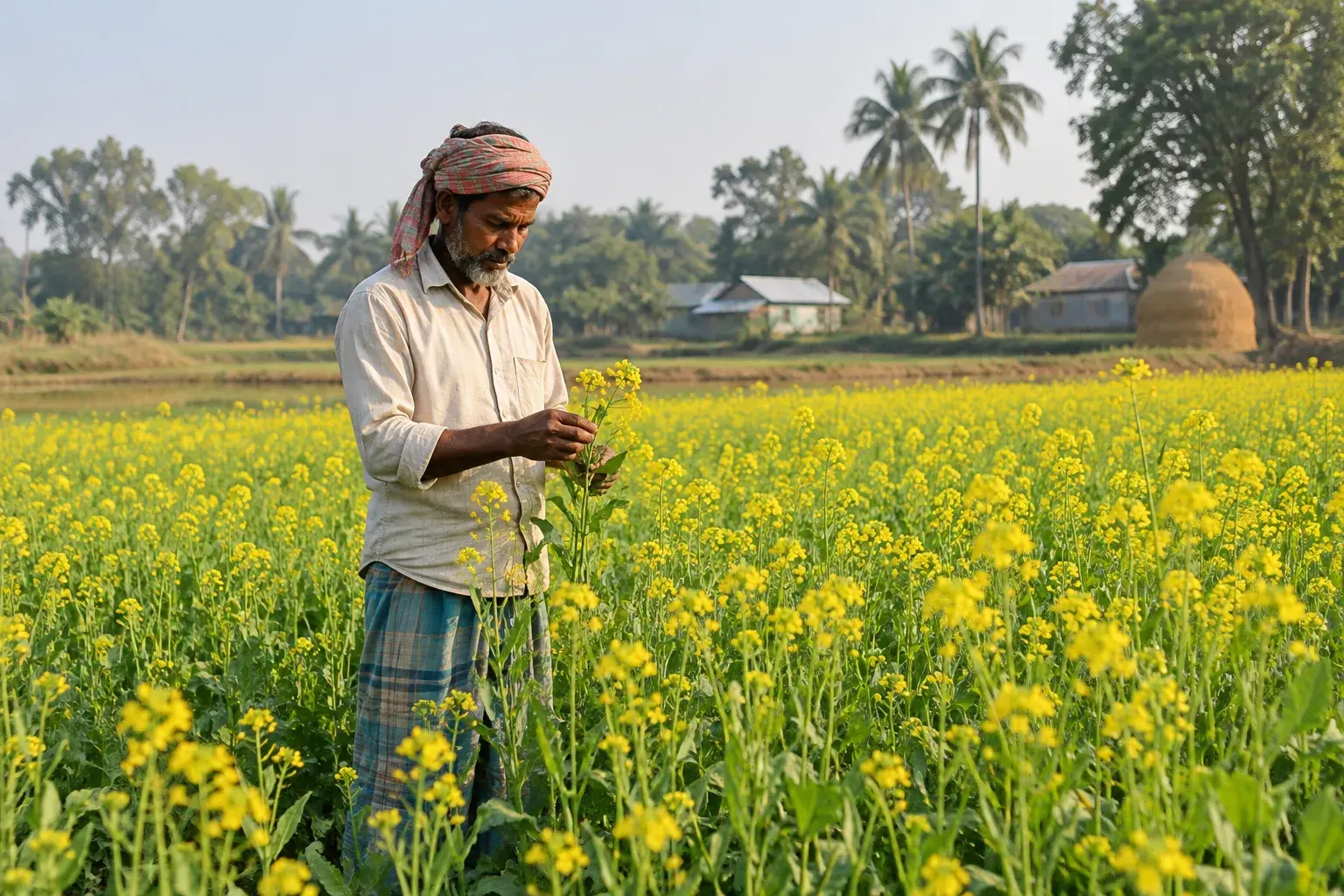
Mustard farming
The 80-90 day crop that fits between the Aman harvest and Boro planting. Mustard seed averaged Tk 91.27 a kg wholesale nationally in August 2026, about Tk 3,651 a maund, and the government hands out Tk 550.50 worth of inputs per bigha.
- Capital
- ৳5k – ৳50k
- People
- 1 – 4
- First income
- 75 – 110 days
 Agriculture & farming
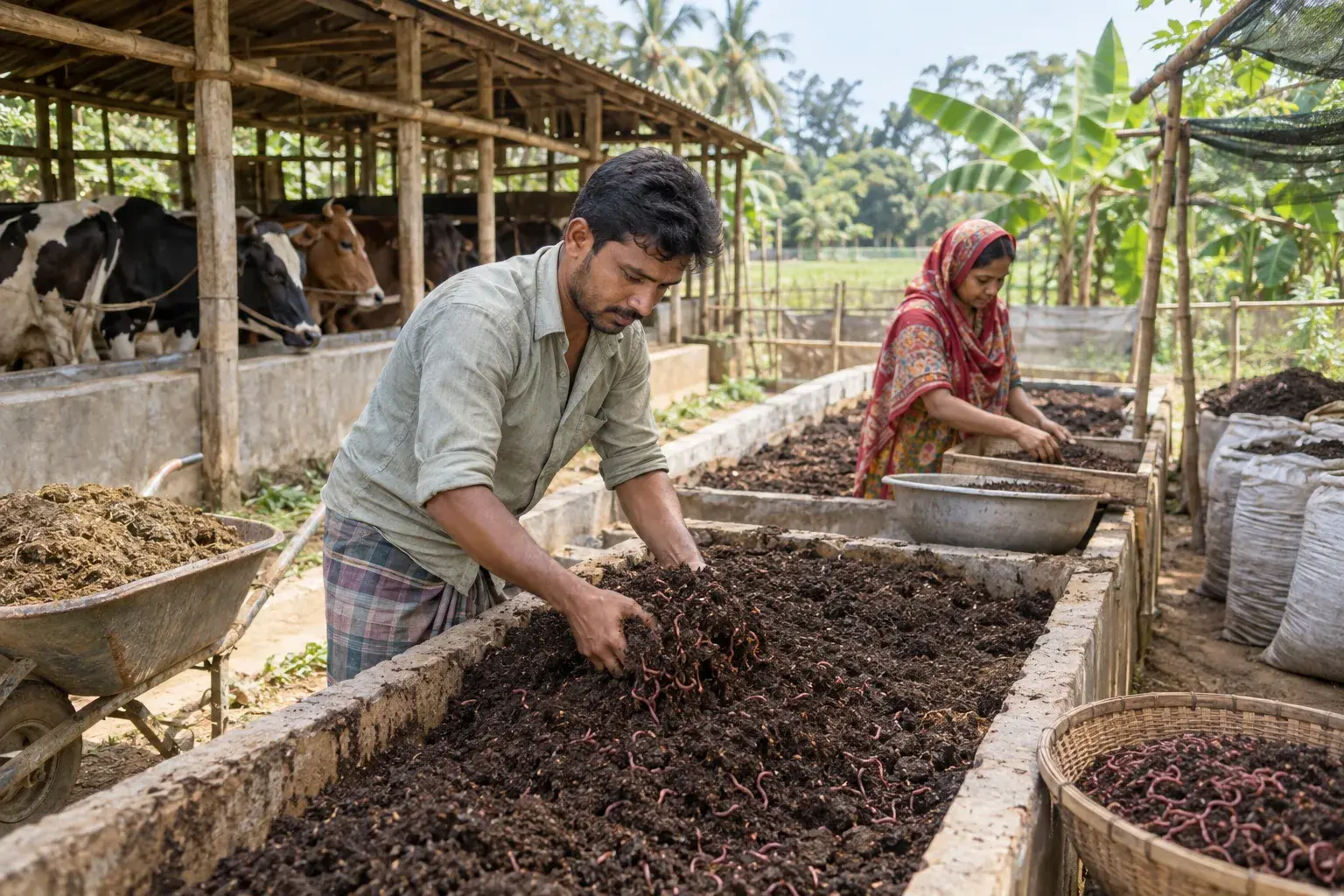
Vermicompost production
Making compost from cow dung and earthworms beside the cattle shed. Compost sells at Tk 10-13/kg against a cost of Tk 6-7, but the real income is selling breeding worms at Tk 2,000/kg.
- Capital
- ৳5k – ৳60k
- People
- 1 – 2
- First income
- 30 – 50 days
 Agriculture & farming
Rooftop farming and nursery
Growing plants in pots on the roof and selling seedlings. A small plant is Tk 50 while cactus and ferns reach Tk 1,200-5,000, and the pot, soil and fertiliser carry more money than the plant itself.
- Capital
- ৳5k – ৳80k
- People
- 1 – 2
- First income
- 60 – 180 days
 Agriculture & farming
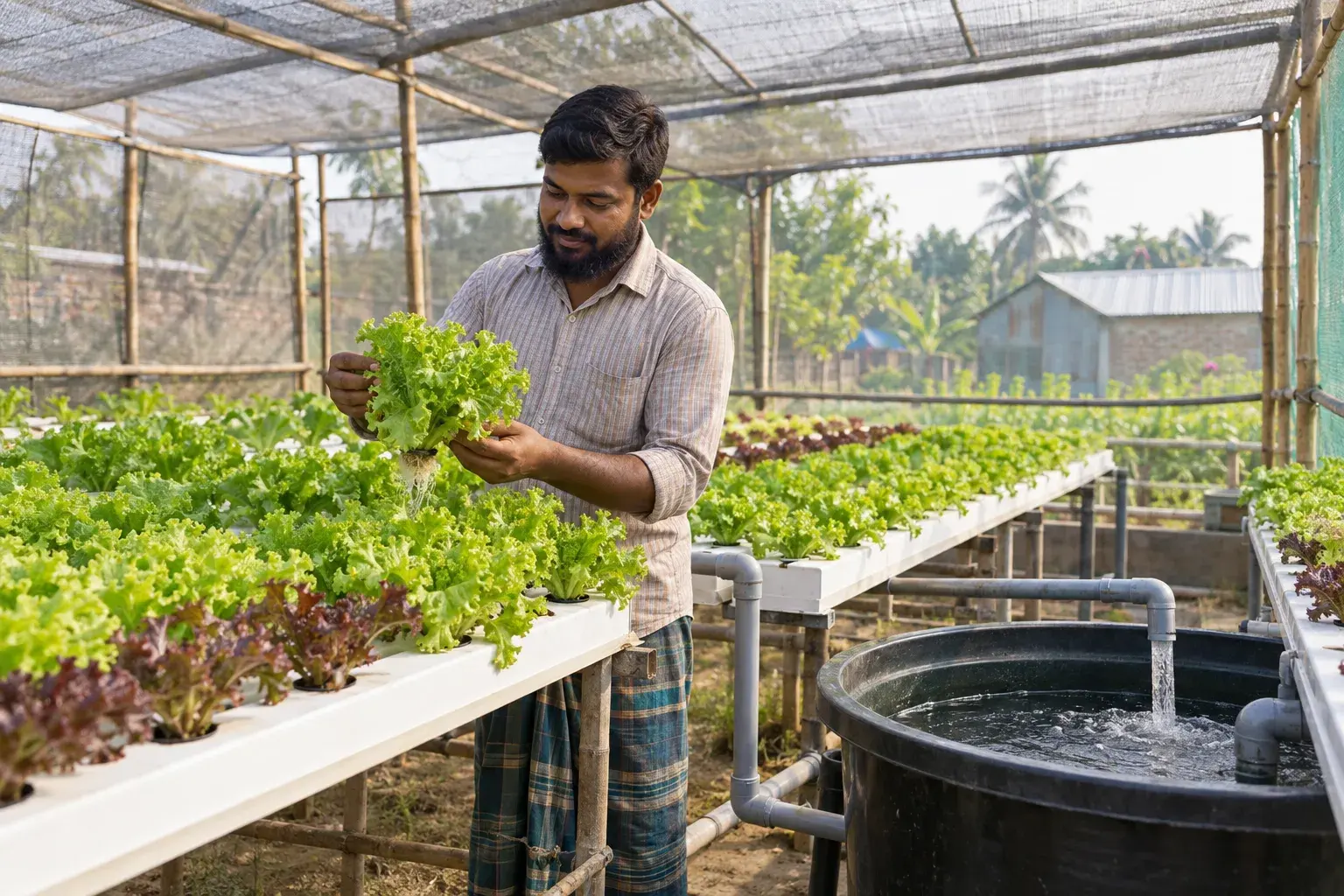
Hydroponic farming
Growing vegetables in water without soil. One Dhaka rooftop setup cost about Tk 2,00,000, and outside Dhaka there is still almost no commercial buyer.
- Capital
- ৳4k – ৳2 lakh
- People
- 1 – 3
- First income
- 45 – 120 days