
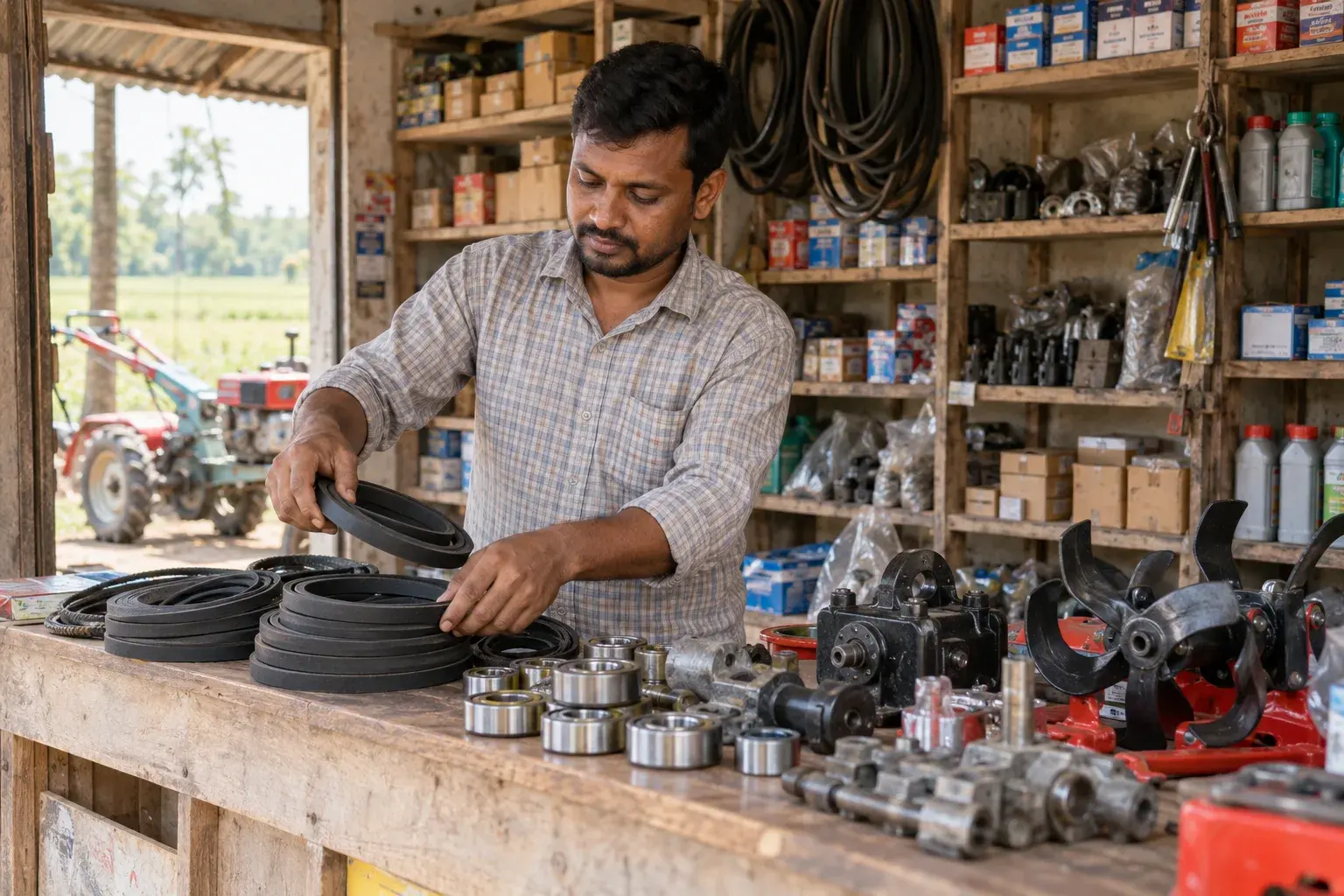
Agricultural machinery parts shop
Spare parts for power tillers, shallow engines and sprayers. Machine sales fell 80-90 per cent when the subsidy was suspended in June 2024, but the machines already in the fields still need parts.
- Last reviewed: 19 September 2026
- Version 1
Agricultural machinery parts shop
- Starting capital
- ৳3,00,000 – ৳15,00,000 Editorial estimate
- Manpower
- 1 – 4 people
- First sale
- 30 – 75 days Editorial estimate
- Break-even
- 9 – 15 months Editorial estimate
- Kind of work
- Shop · Medium difficulty
About the business
A shop selling spare parts for power tillers, shallow engines, threshers, sprayers and irrigation pumps. The money in this trade is in the parts, not the machines. A power tiller is sold once, but its blades, belts, pistons, rings, nozzles, bearings and gaskets have to be replaced every season, and that customer comes back four or five times a year. The machine market itself is in a bad state. The Tk 3,000 crore agricultural mechanisation project begun in 2020 paid subsidies of up to 50 per cent on the plains and 70 per cent in the haor. On corruption allegations the subsidy has been suspended since June 2024, and sales of agricultural machinery have fallen by 80 to 90 per cent as a result. Metal used to sell 500-700 combine harvesters a year and now sells 100-150. Without the subsidy nobody can buy a Tk 32 lakh machine, so the companies now take Tk 5-7 lakh down and let the rest run on credit. But 40,000 machines have already gone into the fields, and about 95 per cent of paddy land preparation is now done by tractor. Those machines are running, and they are breaking. That is exactly why a parts shop still works.
Unit economics
| Item | Range | Evidence | Suggest a correction |
|---|---|---|---|
| Monthly working capital | ৳2,00,000 – ৳9,00,000 | Editorial estimate | |
| Selling price | ৳1,265 – ৳5,290 / unit | Market quote | |
| Variable cost | ৳1,010 – ৳4,500 / unit | Editorial estimate | |
| Gross margin | 15% – 20% | Editorial estimate | |
| Time to first revenue | 30 – 75 days | Editorial estimate | |
| Break-even time | 9 – 15 months | Editorial estimate | |
| Cash cycle | 0 – 90 days | Editorial estimate | |
| Waste / loss | 3% – 7% | Editorial estimate | |
| Daily capacity | 3 – 15 | Editorial estimate |
What you need to start
- Wrench and socket sets, a vice, slide callipers, a bearing puller, a grease gun, and an electric drill and grinder for small repairs.Equipment
- Power tiller blades and belts, engine pistons, rings and liners, bearings and gaskets, fuel filters and injectors, shallow pump impellers and seals, sprayer nozzles, washers and pumps, engine oil and grease, and a few complete sprayers.Starting stock
- Trade licence from the municipality, city corporation or union parishad: form Tk 10, licence book Tk 50, standard tax Tk 30, non-judicial stamp Tk 150-300, licence fee Tk 100-60,000 by trade type, plus VAT and signboard fee. Issued in 3-5 working days.Licence
- Being able to say which part has gone from looking at the engine or hearing it run, and matching the right replacement against an old part when the model number is unknown. That is the real skill in this shop.Skill
- Dholaikhal in Dhaka, the Bogura machinery market, Chattogram importers, and the dealer networks of ACI, Metal, Alim Industries, Abedin and Bangla Mark.Supplier
- A 200-500 square foot shop in an upazila bazaar or beside a highway, with wall racks and floor space for heavy parts. Room to park one machine in front allows repair work as well.Workspace
How the work is done
- 1Look for a shop in an upazila bazaar in a big paddy, maize or vegetable growing area. When a machine breaks the farmer cannot travel far, so being close is the whole advantage.
- 2Take the trade licence from the municipality or union parishad and pay the signboard fee.
- 3List exactly which machines run in your area: which brand of power tiller, which horsepower of shallow engine, which company's thresher. Buying stock without this list is wasted money.
- 4Take prices at Dholaikhal in Dhaka, the Bogura machinery market or a Chattogram importer. Also ask the dealership terms of ACI, Metal, Alim Industries, Abedin and Bangla Mark.
- 5Fill the first consignment with fast-wearing items: tiller blades, belts, pistons and rings, bearings, gaskets, nozzles, filters and engine oil. Do not put money into whole machines and wait.
- 6Build a relationship with the local mechanics. The farmer calls the mechanic, and it is the mechanic who says which shop to get the part from.
- 7Offer small repairs and fitting at the shop. Fitting the part rather than just selling it brings the customer back and earns a labour charge as well.
- 8Stock shallow engine and pump parts by December, at least a month before the Boro irrigation season starts. Once the season begins the wholesale market runs out too.
- 9Do not take a consignment of new machines while the subsidy is suspended. Until the Department of Agricultural Extension restarts it, keep the whole capital in parts.
- 10Collect the credit after the harvest, at the end of Boishakh and Ogrohayon. The farmer can only pay once the paddy is sold; pressing before that achieves nothing.
Seasons
- JanHigh
- FebNormal
- MarNormal
- AprHigh
- MayHigh
- JunLow
- JulNormal
- AugNormal
- SepLow
- OctNormal
- NovHigh
- DecHigh
Where it works well
- Strong fitBogura · The northern agricultural machinery market and its lathe and foundry industry are here; some parts are even made locally.
- Strong fitDinajpur · A major paddy and maize area with a high density of power tillers and threshers.
- Strong fitKishoreganj · A haor district where Boro paddy is largely cut and threshed by machine.
- Strong fitRangpur · A big maize and potato area where mechanised cultivation is widespread.
- Strong fitSunamganj · Combine harvesters are used most heavily for Boro paddy in the haor, so repair and parts demand is intense.
- PossibleCumilla · Triple-cropped land with easy supply along the highway.
- PossibleFaridpur · An onion and jute area with heavy use of sprayers and power tillers.
- PossibleJashore · Vegetable and paddy cultivation give steady demand for sprayers and pumps.
- PossibleMymensingh · A paddy and fisheries area with high demand for irrigation pump parts.
- PossibleNaogaon · A major paddy district with a large number of shallow irrigation engines.
Risks and cautions
- HighDemand: The new machine market has nearly stopped. On corruption allegations the mechanisation project's subsidy has been suspended since June 2024, and machinery sales have fallen 80-90 per cent. Metal's combine harvester sales went from 500-700 a year to 100-150; ACI's sales fell about 90 per cent and it has stopped importing. A shop that put its capital into machines will sit on that stock for years.
- HighWorking capital: A parts shop has to hold many variants of the same item, because there is no telling which engine's part will be asked for, so a large share of the capital sleeps on the shelf. The customer who asks for a part you do not have does not come back next time, so holding less is also dangerous.
- MediumLate payment: When a machine stops mid-season the farmer or driver has no cash, so the part goes on credit and is paid for after the paddy is sold. If the crop fails or the paddy price falls, that receivable rolls into the next season, and sometimes never comes back at all.
- MediumDependency: Most parts are imported from China and India. A rise in the dollar or an LC delay lifts wholesale prices in one step. And once a model stops being imported, parts for the machines already in the field simply become unavailable.
- LowCompliance: Beyond the trade licence no separate licence is needed to sell parts. But keeping diesel, engine oil or other flammable goods in the shop brings Fire Service rules into play, and many shopkeepers overlook that.
Sources
সিটি কর্পোরেশন থেকে ট্রেড লাইসেন্স প্রাপ্তির ধাপ সমূহ
Collected: 16 Sept 2026Supports: Starting capital · বাংলাদেশ
What changed
No corrections have been published yet.
Questions and answers
No questions yet. Be the first to ask.
Similar businesses
 Retail & wholesale
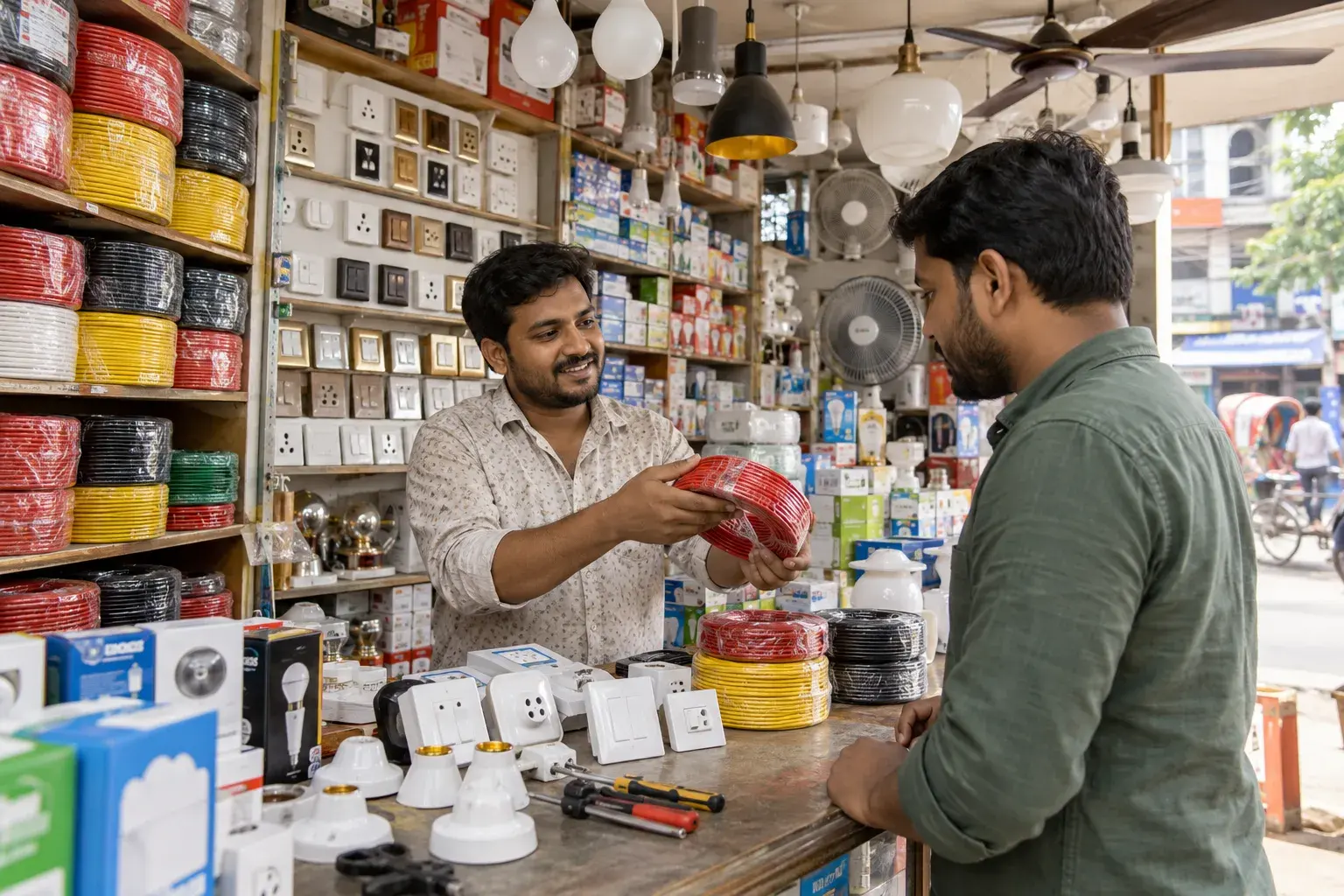
Electrical goods shop
A retail shop selling cable, switches, sockets, holders, lamps and fans. Fifty of the 315 products on BSTI's mandatory certification list are electrical, and selling uncertified cable brings a fine and a sealed shop.
- Capital
- ৳2.5 lakh – ৳15 lakh
- People
- 1 – 5
- First income
- 15 – 60 days
 Retail & wholesale
Rice wholesale trading
Buying rice by the sack at the mokam and selling it to retail shops. Dhaka wholesale coarse rice is Tk 43-45 against Tk 50-55 retail, but the wholesaler keeps only 50 paisa to one taka a kilo.
- Capital
- ৳2.5 lakh – ৳15 lakh
- People
- 2 – 8
- First income
- 15 – 45 days
 Retail & wholesale
Second-hand book shop
Buying used books and selling them on. In the Purana Paltan market in Dhaka used books went at roughly Tk 20-30 a book in May 2024. In Nilkhet shop rents ran from Tk 12,000 to Tk 50,000 a month on advances of Tk 2 lakh to Tk 8 lakh.
- Capital
- ৳2.5 lakh – ৳9.5 lakh
- People
- 1 – 4
- First income
- 3 – 45 days
 Retail & wholesale
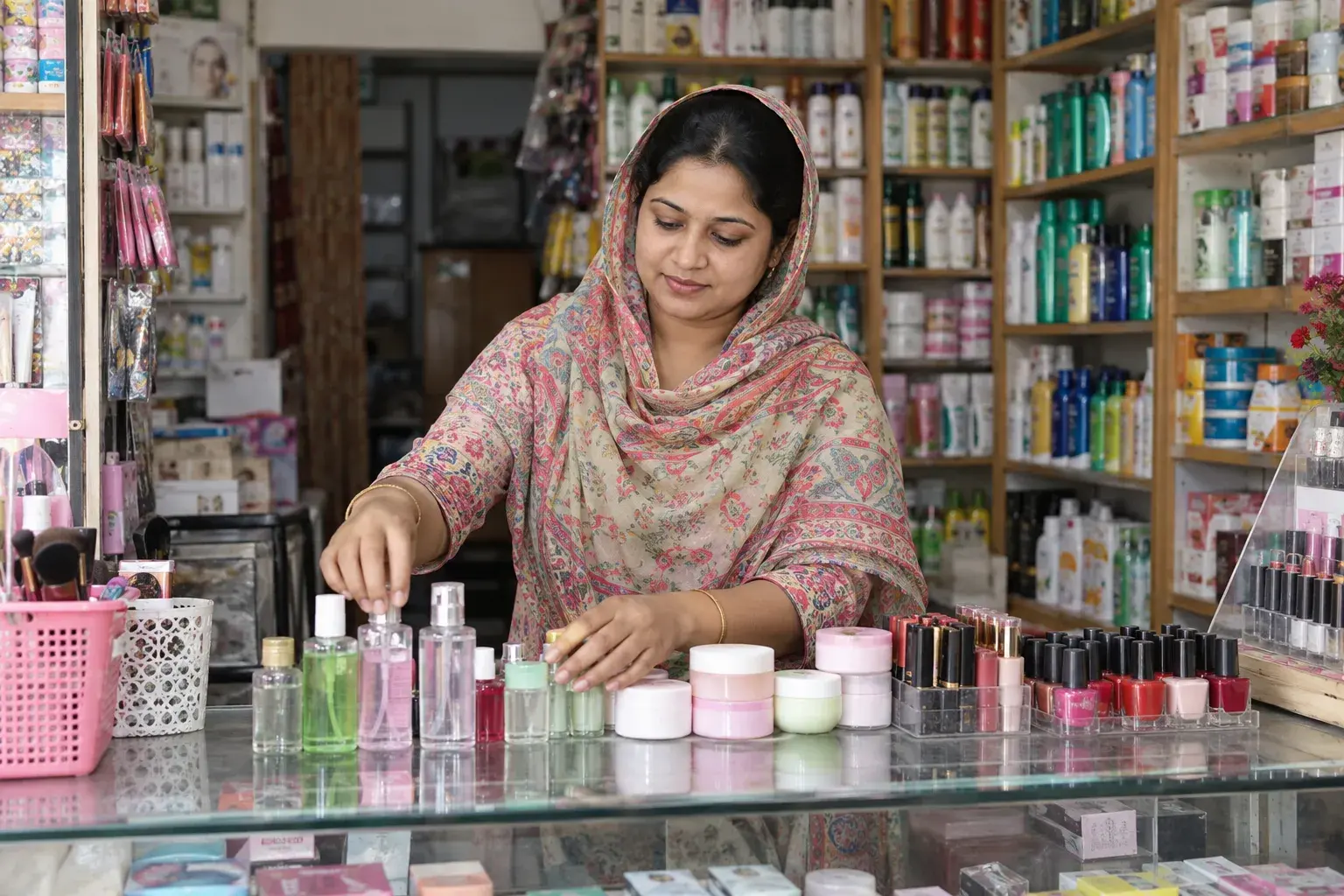
Cosmetics shop
A retail shop for creams, shampoo, face wash and make-up. At least 18 cosmetic categories are on BSTI's mandatory list, and uncertified or undocumented imported stock is the shopkeeper's liability.
- Capital
- ৳2 lakh – ৳15 lakh
- People
- 1 – 5
- First income
- 15 – 45 days