
Aloe vera farming
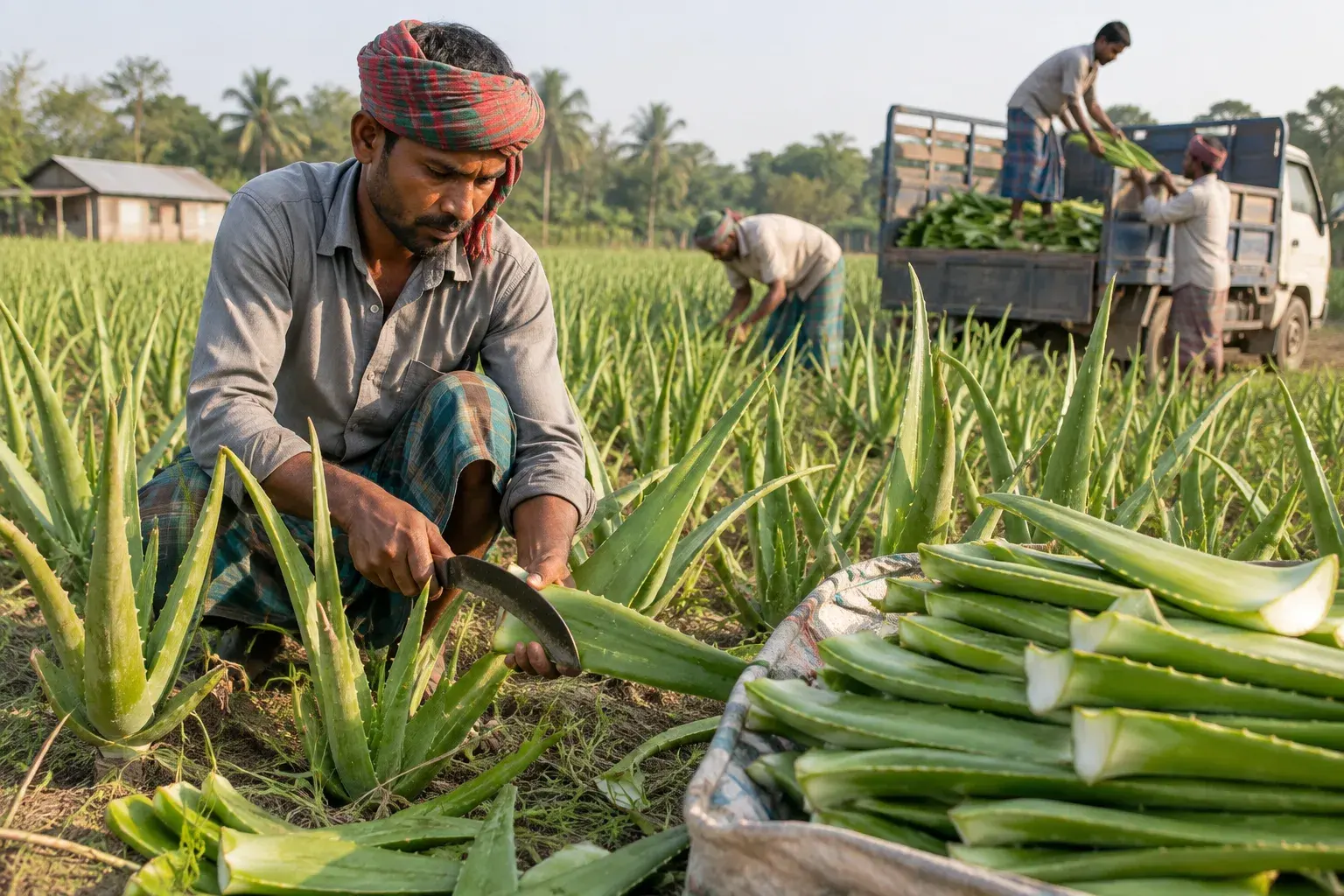
Cutting aloe leaves and selling them to companies. About Tk 50,000 a bigha to grow and Tk 1.5-2.5 lakh of leaves, but the only buyers are a few pharmaceutical and juice companies.
- Last reviewed: 19 September 2026
- Version 1
Aloe vera farming
- Starting capital
- ৳50,000 – ৳2,00,000 Practitioner verified
- Manpower
- 1 – 6 people
- First sale
- 90 – 120 days Practitioner verified
- Break-even
- 12 – 24 months Editorial estimate
- Kind of work
- Farm · Medium difficulty
About the business
Planting aloe vera and cutting the leaves for sale. One thing has to be said at the start: this crop has no retail market. Aloe leaves are not sold in a bazar, not cooked at home and not carried home by anyone. They are bought by pharmaceutical and cosmetics companies and by juice factories, and that is the whole list. Without a buyer in hand the crop stays in the field. The country's only medicinal village is Lakshmipur-Khalabaria union in Natore Sadar, fifteen villages in all, where 70 of the 155 hectares under herbs are aloe vera and annual output is about 15,000 tonnes. Grower Abul Hossain puts the cost at about Tk 50,000 a bigha against leaves selling for Tk 1.5 to 2.5 lakh. Ten to twelve thousand plants go in per bigha between November and February, cutting starts three months later, and the same land yields for the next two years. But there is no processing anywhere in the area, so cut leaves have to be moved fast. Hamdard and one or two pharmaceutical companies buy, and the biggest buyer is Taiwan Sin Lin Enterprise, an export juice maker in Bhaluka, Mymensingh. If even one of that handful stops buying, the price across the whole area collapses. Before starting this outside Natore, find your buyer first.
Unit economics
| Item | Range | Evidence | Suggest a correction |
|---|---|---|---|
| Monthly working capital | ৳4,000 – ৳5,000 | Editorial estimate | |
| Selling price | ৳1,50,000 – ৳2,50,000 / unit | Practitioner verified | |
| Variable cost | ৳50,000 / unit | Practitioner verified | |
| Gross margin | 53% – 80% | Editorial estimate | |
| Time to first revenue | 90 – 120 days | Practitioner verified | |
| Break-even time | 12 – 24 months | Editorial estimate | |
| Cash cycle | 30 – 150 days | Editorial estimate | |
| Waste / loss | 5% – 15% | Editorial estimate | |
| Daily capacity | 0 | Editorial estimate |
What you need to start
- An irrigation pump and pipe, and a way to move the leaves. Several truckloads of aloe leave for Dhaka and elsewhere every day, so transport has to be planned in truckloads.Equipment
- Plants, at 10,000 to 12,000 a bigha. No source gives the unit price, and a Natore grower said plants were dearer in 2025 than before.Starting stock
- Trade licence from the union parishad, municipality or city corporation: form Tk 10, licence book Tk 50, standard tax Tk 30, stamp Tk 150-300, licence fee Tk 100-60,000 by trade type. Supplying a company regularly normally means having a named firm and a licence.Licence
- Keeping rot off the crop and knowing when to cut. A long monsoon brings rot that destroys the leaves, and that is the main technical risk in the crop.Skill
- The buyer, which matters more here than the land. Pharmaceutical companies (Hamdard and one or two others in Natore), cosmetics firms, and the export juice maker Taiwan Sin Lin Enterprise in Bhaluka, Mymensingh. Planting without an arrangement is a gamble.Supplier
- High land with drainage, measured in bighas and held for at least two or three years. In the Natore medicinal village, 70 of the 155 hectares under herbs are aloe.Workspace
How the work is done
- 1Fix the buyer before the land. Aloe leaf does not sell in a bazar. Which company or factory will take your leaves, how many kilos, at what rate and how often - do not plant a single decimal before you know that.
- 2Go and see Lakshmipur-Khalabaria union in Natore. It is the country's only medicinal village, fifteen villages with about a hundred herb trading businesses at four locations. Whatever there is to learn about rates and buyers is there.
- 3Plant between November and February, after the rains have ended. Ten to twelve thousand plants go in per bigha, set in rows.
- 4Put in irrigation. Without it the leaves in the rows do not thicken, and a thin leaf has no value.
- 5Alongside organic manure, apply measured urea, TSP, MOP, gypsum, zinc and boric acid. Lime is used to stop black spotting on the leaves.
- 6Use Trichoderma and sex pheromone against the leaf-boring pests; that is the way the agriculture department and growers in Natore are moving.
- 7Watch the monsoon. Md Harish of Natore says a long monsoon brought rot disease and destroyed many leaves, leaving growers out of pocket. High land and drainage channels reduce that loss.
- 8Start cutting three months after planting and move the leaves immediately. There is no processing anywhere in the area, so there is no holding them either.
- 9Take leaf off the same land for the next two years. The first year covers the cost and the second is the profit, so arrange the land for two or three years, not one.
- 10Do not depend on one buyer. In Natore, Hamdard and one or two pharmaceutical companies buy, and the largest buyer is Taiwan Sin Lin Enterprise in Bhaluka. That list is short, and the whole risk sits in its shortness.
Seasons
- JanNormal
- FebNormal
- MarHigh
- AprHigh
- MayHigh
- JunLow
- JulLow
- AugLow
- SepNormal
- OctNormal
- NovNormal
- DecNormal
Where it works well
- Strong fitMymensingh · Not a growing district but the buyer's district. Taiwan Sin Lin Enterprise in Bhaluka, a foreign-owned export juice maker, is the largest buyer of aloe.
- Strong fitNatore · The country's only medicinal village: fifteen villages of Lakshmipur-Khalabaria union in the sadar upazila. Seventy of the 155 hectares under herbs are aloe, output is about 15,000 tonnes a year, and two thousand farmers in the union grow herbs.
- PossibleBogura · The trading centre of the north, with easy truck dispatch along the highway.
- PossibleGazipur · Pharmaceutical and cosmetics plants are close by, so raw leaf reaches them quickly, and distance is the biggest cost in this crop.
- PossibleNaogaon · High Barind land with good drainage, so less risk of rot.
- PossiblePabna · Adjoining Natore, in the same agricultural region and within easy reach of the same market.
- PossibleRajshahi · Next to Natore with the same Barind soil and the same herb trading network; Natore traders also draw from neighbouring districts.
- PossibleSirajganj · One of the districts that buys herb saplings from Natore, with good road links to Dhaka.
Risks and cautions
- HighDependency: The buyers can be counted on one hand, and without them the crop has no market. In Natore, Hamdard and one or two pharmaceutical companies buy, and the biggest buyer is Taiwan Sin Lin Enterprise in Bhaluka. Aloe leaf does not sell retail, is not used at home, and has no alternative outlet. If one of that handful cuts back, the rate across the area collapses and the grower can do nothing about it.
- HighSpoilage: There is no way to process the leaf locally - the report says so outright. Cut leaves have to be sent on immediately. There is no cold store; farmer and cooperative leader Md Zainal Abedin has himself asked for one to be built. If the buyer does not take a day's cutting, that day's cutting is lost.
- HighOther: Rot disease in a long monsoon. Md Harish of Natore says a long monsoon brought rot that destroyed many leaves and left growers out of pocket, in a year when plants were also dearer - loss and cost rising together. No source gives a percentage.
- MediumWorking capital: The money for 10,000-12,000 plants a bigha goes in at planting, three months before the first cutting, and irrigation, fertiliser and labour run through those months. Natore needs about 100 workers year-round for cultivation, care and irrigation, so labour is not a small cost here.
- MediumDemand: The value is added somewhere else, not in the grower's hands. Natore leaf is processed into medicine, cosmetics and juice and exported, but the factory is not in the area. Cooperative leaders are still asking for an entrepreneur to build a soap and shampoo plant, so as of 2025 it had not happened. Whatever raw leaf fetches is the ceiling of this business.
Sources
সিটি কর্পোরেশন থেকে ট্রেড লাইসেন্স প্রাপ্তির ধাপ সমূহ
Collected: 16 Sept 2026Supports: Starting capital · বাংলাদেশ
What changed
No corrections have been published yet.
Questions and answers
No questions yet. Be the first to ask.
Stories about this business
One and a half to two lakh a bigha, but no one to sell it to
Aloe vera started on 12 shotok in Shajahanpur took about three years to come into production. A bigha now gives 250 maund at 5-25 taka a kg, worth 1.5-2 lakh a year, but no factory in the country buys from the growers directly.
- Ran for
- 36 months
- Reasons
- Weak demand, Working capital
Similar businesses
 Agriculture & farming
Poultry and duck hatchery
Setting eggs in an incubator and selling day-old chicks to farmers. Ducklings cost Tk 30-35 and sell at Tk 72-75, but chicken chick prices swing from Tk 25 to Tk 85 and back to Tk 5 within months.
- Capital
- ৳50k – ৳8 lakh
- People
- 2 – 15
- First income
- 28 – 60 days
 Agriculture & farming
Milk collection and supply
Buying milk from farmers and delivering it to chilling centres and shops. Farmers get Tk 35-50 a litre and plants pay Tk 48-58; that gap is the business.
- Capital
- ৳50k – ৳4 lakh
- People
- 1 – 4
- First income
- 7 – 21 days
 Agriculture & farming
Cashew and coffee farming
Cashew and coffee orchards on hill land. Farmers get Tk 180-200 a kg for raw cashew and Tk 350-400 for raw coffee, but the first crop comes three to four years after planting for coffee and four to five for cashew.
- Capital
- ৳50k – ৳5 lakh
- People
- 1 – 6
- First income
- 1,095 – 1,825 days
 Agriculture & farming
Oyster mushroom growing
Grown indoors in straw packs. First harvest in 21 days, with rising city demand.
- Capital
- ৳50k – ৳1.2 lakh
- People
- 1 – 2
- First income
- 21 – 35 days