
Cashew and coffee farming
Cashew and coffee orchards on hill land. Farmers get Tk 180-200 a kg for raw cashew and Tk 350-400 for raw coffee, but the first crop comes three to four years after planting for coffee and four to five for cashew.
- Last reviewed: 19 September 2026
- Version 1

Cashew and coffee farming
- Starting capital
- ৳50,000 – ৳5,00,000 Editorial estimate
- Manpower
- 1 – 6 people
- First sale
- 1,095 – 1,825 days Practitioner verified
- Break-even
- 48 – 84 months Editorial estimate
- Kind of work
- Farm · Medium difficulty
About the business
Planting cashew and coffee on hill slopes. The government is pushing both: the Department of Agricultural Extension's cashew and coffee project began in June 2021 and now runs in 66 upazilas across 19 districts, handing out saplings and training free. Cashew area has gone from 2,200 hectares to about 4,500 and coffee from 65 hectares to roughly 2,000. But one thing has to be understood before anything else, or the household will not eat: these trees take years to pay. Cashew gives its first flower and fruit four to five years after the sapling goes in, coffee three to four. Mongsui Marma of Ruma planted 50 trees three years ago and got a little over ten kilos this year. Mangpong Mro of Mrolong Para put 600 coffee saplings into half his mango orchard three years ago; the first year made him Tk 2,500 and he now earns about Tk 40,000 a year. Through those years the land is occupied and earns nothing. The prices are good: a farmer gets Tk 180-200 a kg for raw cashew nut and Tk 350-400 for raw coffee, against Tk 40 a kg for a hill mango. Five kilos of raw nut make one kilo of processed cashew, and that kilo sells in Dhaka at Tk 1,600-1,750, so most of the value stays in the processing shed rather than the farmer's house. Weather is the sharpest risk: unseasonal rain or drought at flowering takes the whole year's crop.
Unit economics
| Item | Range | Evidence | Suggest a correction |
|---|---|---|---|
| Monthly working capital | ৳3,000 – ৳20,000 | Editorial estimate | |
| Selling price | ৳180 – ৳400 / kg | Practitioner verified | |
| Variable cost | ৳80 – ৳150 / kg | Editorial estimate | |
| Gross margin | 55% – 77% | Editorial estimate | |
| Time to first revenue | 1,095 – 1,825 days | Practitioner verified | |
| Break-even time | 48 – 84 months | Editorial estimate | |
| Cash cycle | 90 – 270 days | Editorial estimate | |
| Waste / loss | 25% – 50% | Editorial estimate | |
| Daily capacity | 1 – 6 | Editorial estimate |
What you need to start
- A paved drying floor or tarpaulin, sacks and a dry store. Cashew keeps for months indoors, which is one real advantage of this crop.Equipment
- Saplings, free from the Cashew and Coffee Research, Development and Extension Project, which runs in 66 upazilas across 19 districts. For coffee the released varieties are BARI Coffee-1 (robusta) and BARI Coffee-2 (arabica).Starting stock
- Trade licence from the union parishad, municipality or city corporation, needed to sell or supply commercially: form Tk 10, licence book Tk 50, standard tax Tk 30, stamp Tk 150-300, licence fee Tk 100-60,000 by trade type.Licence
- Bangladesh Food Safety Authority registration is not needed to sell raw nut or coffee, but processing and packing makes you a packaged food producer and registration applies: Tk 1,000 new, Tk 500 renewal, valid three years.Licence
- Planting and nursing through the first few years, fertiliser use, and harvesting and drying at the right time. The project gives training free; without it the nuts come small and buyers walk away.Skill
- A buyer for the raw crop: a local processor or a roastery. Twenty-two nut processing plants have been built of which fifteen run regularly; for coffee, North End Coffee Roasters, Abul Khair Group and PRAN-RFL buy directly.Supplier
- Hill slope land that does not waterlog. The Department of Agricultural Extension reckons about 98 percent of hill land is still uncultivated and most of it could carry these two crops.Workspace
How the work is done
- 1Look at the land first. A hill slope that does not hold water is needed, and arabica coffee does best at 18-22 degrees Celsius; the tree suffers in more heat.
- 2Go to the upazila agriculture office and ask for saplings and training under the cashew and coffee project. It gives both free: in Bandarban alone about 2,000 farmers were given coffee saplings between 2021 and 2026.
- 3Choose the variety. BARI Coffee-1 (robusta) was released in 2023 and BARI Coffee-2 (arabica) in 2025, both from the Hill Agricultural Research Centre at Khagrachhari.
- 4Settle how you will eat for four or five years before anything else. Do not plant the whole plot at once: the farmers of Mrolong Para put coffee into half the mango orchard and kept living off the other half.
- 5Plant, and manage watering and weeds for the first two or three years. Cashew needs little care, but without fertiliser the nuts come small and the processing plants then refuse to buy them.
- 6Watch the flowering window. Cashew flowers from November to January and the nuts are collected from May to July; unseasonal rain or drought in that window takes the whole year's crop.
- 7Sort out drying. Drying in an open field costs quality, and without quick processing in the remote hills coffee loses grade too. The agriculture department talks of union-level drying and processing centres; find out whether yours has one.
- 8Do not shell cashew bare-handed: the shell carries urushiol, which blisters and itches the skin.
- 9Line up the buyer before harvest. Middlemen take raw nut cheap and ship it to Dhaka and Chattogram; talking directly to a processing plant or a roastery gets a better price.
- 10If you think of processing yourself, do the arithmetic first. Five kilos of raw nut give one kilo of cashew, which sells in Dhaka at Tk 1,600-1,750. But a plant in Bandarban has already closed for want of capital, and bank credit is not available in this sector.
Seasons
- JanNormal
- FebNormal
- MarNormal
- AprNormal
- MayHigh
- JunHigh
- JulHigh
- AugNormal
- SepNormal
- OctNormal
- NovHigh
- DecHigh
Where it works well
- Strong fitBandarban · The main centre. In 2025-26 seven upazilas carried 2,800 hectares of cashew with over 700,000 bearing trees, heaviest in Ruma, Thanchi, Roangchhari and Sadar, and about 2,000 farmers were given coffee saplings between 2021 and 2026.
- Strong fitKhagrachhari · Home of the Hill Agricultural Research Centre, where BARI Coffee-1 and BARI Coffee-2 were released and coffee work has run since 2001.
- Strong fitRangamati · One of the three hill districts, where much of the growth in cashew and coffee area has happened.
- PossibleChattogram · Grown in the hill areas, and the country's first cashew processing plant opened here in 2016, so the buyer is close.
- PossibleCox's Bazar · The hill slopes and climate suit it and the Chattogram plants are close by.
- PossibleNilphamari · One of the plains districts whose soil has been shown to suit coffee.
- PossibleRangpur · One of the plains districts whose soil has been shown to suit coffee.
- PossibleSherpur · Coffee planting has started on the Garo hill slopes and the soil has been shown to suit it.
- PossibleSylhet · Coffee has been grown commercially in Golapganj and Beanibazar since 2021.
- PossibleTangail · The soil of the Madhupur tract has been shown to suit coffee.
Risks and cautions
- HighDemand: Weather can take the whole year. In 2025-26 rain during the March-April flowering rotted and stripped the blossom in the Ruma orchards and the agriculture department in Bandarban had to cut its target. Arabica does best at 18-22 degrees Celsius and rising heat is hurting both yield and grade.
- HighDependency: Without processing nearby the price is out of your hands. The Kishanghar cashew processing plant in Bandarban has closed for want of capital and bank credit is unavailable in this sector, so middlemen buy the raw nut cheap and ship it to Dhaka and Chattogram. In May 2026 Ruma farmers said the price had fallen from the year before and they were not getting a fair rate.
- LowCompliance: Growing needs no special licence, but processing and packing for sale brings you under Bangladesh Food Safety Authority registration: Tk 1,000 new, Tk 500 renewal, valid three years. A small risk, but one people miss.
- MediumWorking capital: The saplings and training come free from the project, but fertiliser, watering, weeding and watching come out of your own pocket for four or five years while the plot returns nothing. With no bank credit available, a grower without another income tends to abandon the orchard halfway.
- HighOther: The four to five year wait is the biggest risk here. Coffee first crops at three to four years and cashew at four to five, and that first crop is tiny: ten kilos off 50 trees, twenty kilos off 700. The land is tied up throughout with no income while the care costs keep running. Agricultural reporting itself admits this stretch is hard for a marginal farmer. Planting the whole plot at once leaves the household with nothing to live on.
Sources
সিটি কর্পোরেশন থেকে ট্রেড লাইসেন্স প্রাপ্তির ধাপ সমূহ
Collected: 16 Sept 2026Supports: Starting capital · বাংলাদেশ
All food businesses now need safety registration
Collected: 22 Jul 2026Supports: Starting capital · বাংলাদেশ
What changed
No corrections have been published yet.
Questions and answers
No questions yet. Be the first to ask.
Stories about this business
Cashew that fetched 3,200-3,700 taka a maund sold at 1,700
About 2,000 cashew trees gave this Thanchi grower 20 maunds this season, sold at 1,700 taka a maund against 3,200-3,700 the year before.
- Reasons
- Price drop, Weak demand
Similar businesses
 Agriculture & farming
Poultry and duck hatchery
Setting eggs in an incubator and selling day-old chicks to farmers. Ducklings cost Tk 30-35 and sell at Tk 72-75, but chicken chick prices swing from Tk 25 to Tk 85 and back to Tk 5 within months.
- Capital
- ৳50k – ৳8 lakh
- People
- 2 – 15
- First income
- 28 – 60 days
 Agriculture & farming
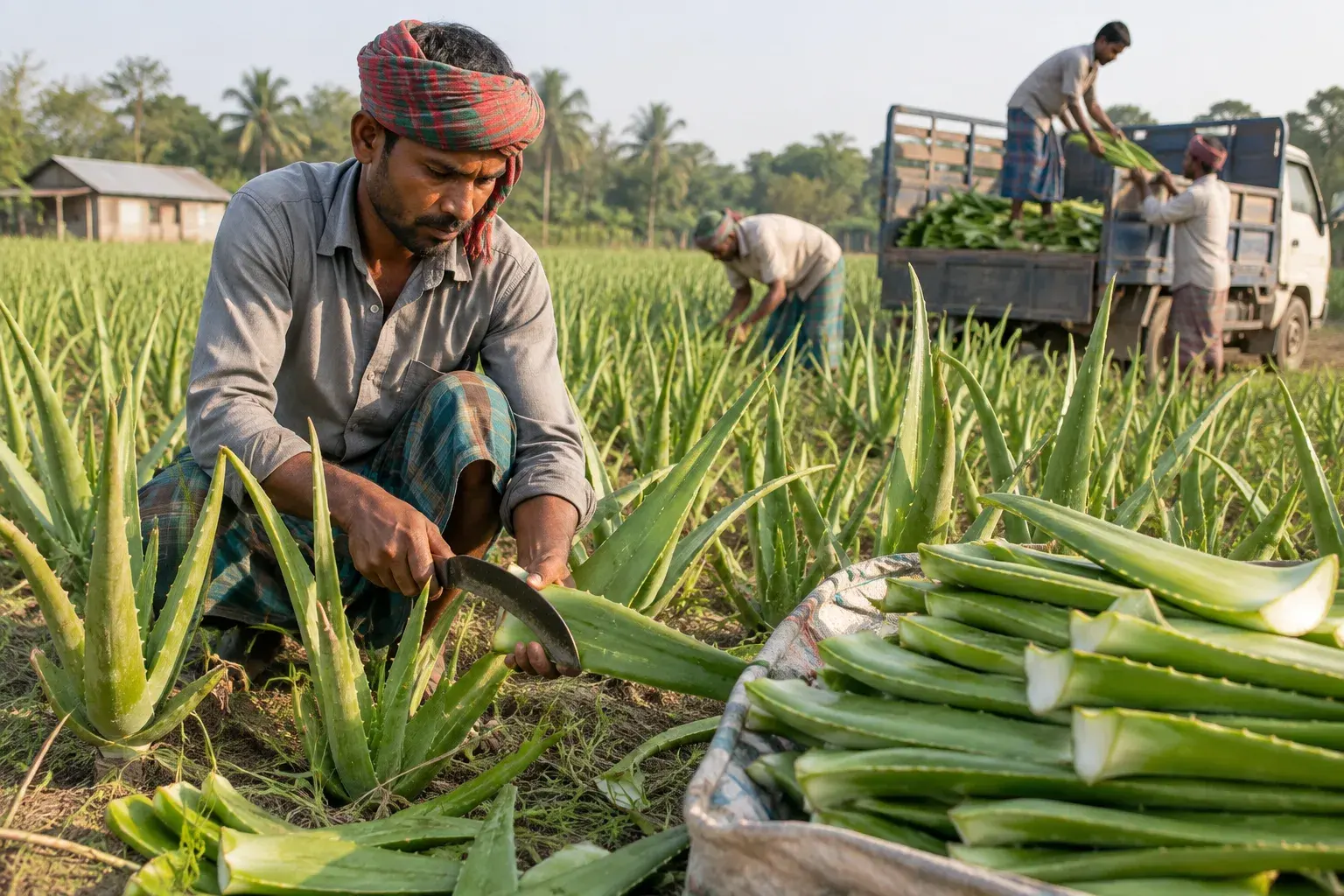
Aloe vera farming
Cutting aloe leaves and selling them to companies. About Tk 50,000 a bigha to grow and Tk 1.5-2.5 lakh of leaves, but the only buyers are a few pharmaceutical and juice companies.
- Capital
- ৳50k – ৳2 lakh
- People
- 1 – 6
- First income
- 90 – 120 days
 Agriculture & farming
Milk collection and supply
Buying milk from farmers and delivering it to chilling centres and shops. Farmers get Tk 35-50 a litre and plants pay Tk 48-58; that gap is the business.
- Capital
- ৳50k – ৳4 lakh
- People
- 1 – 4
- First income
- 7 – 21 days
 Agriculture & farming
Oyster mushroom growing
Grown indoors in straw packs. First harvest in 21 days, with rising city demand.
- Capital
- ৳50k – ৳1.2 lakh
- People
- 1 – 2
- First income
- 21 – 35 days