
Ice cream and popsicle making
Making ice cream, kulfi and popsicles from milk, milk powder and sugar. BSTI certification is compulsory, and one break in the minus-20-degree cold chain ruins the stock.
- Last reviewed: 19 September 2026
- Version 1
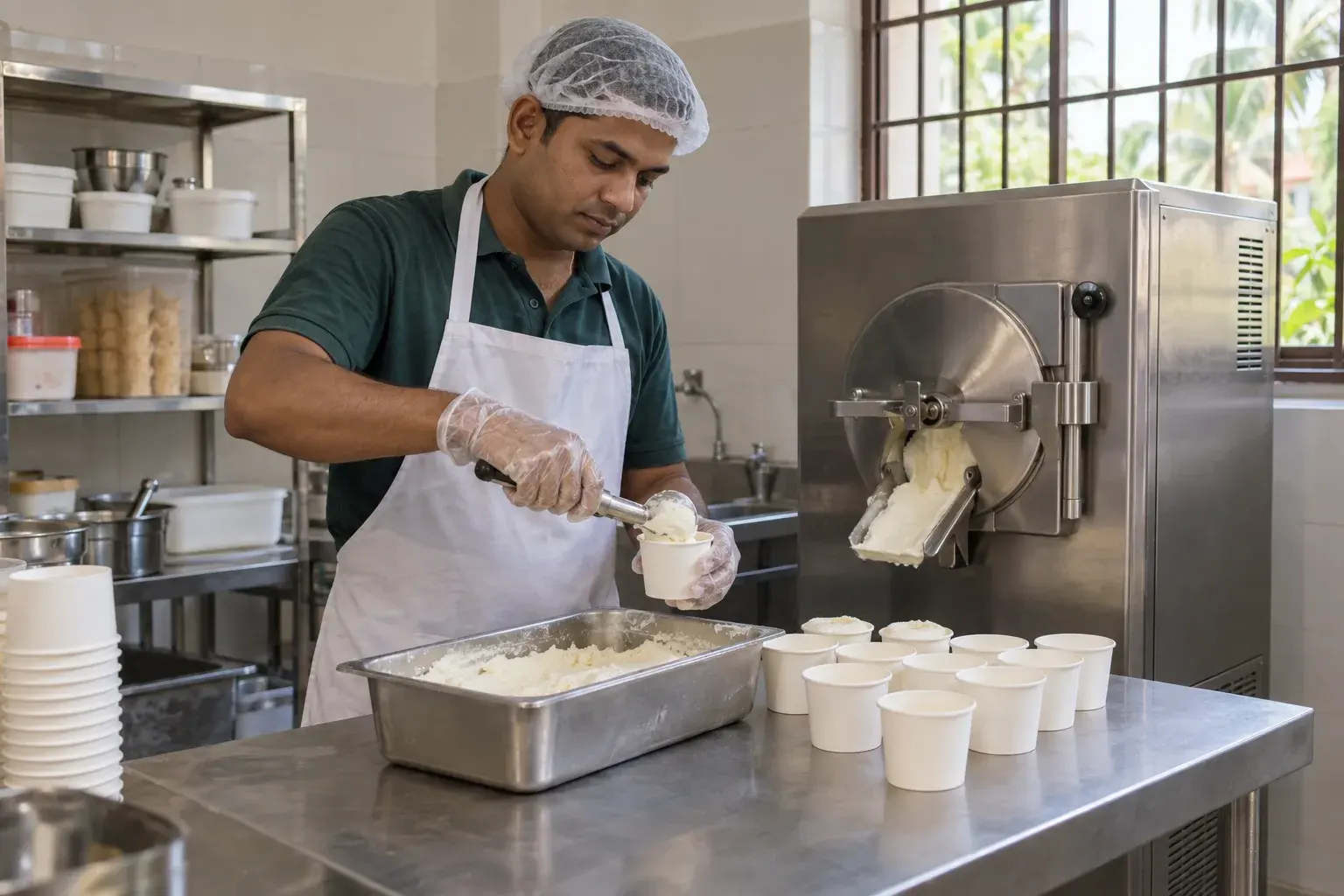
Ice cream and popsicle making
- Starting capital
- ৳2,50,000 – ৳30,00,000 Editorial estimate
- Manpower
- 2 – 12 people
- First sale
- 45 – 100 days Official source
- Break-even
- 6 – 18 months Editorial estimate
- Kind of work
- Workshop · Hard
About the business
Making and selling ice cream, kulfi and popsicles from milk, milk powder, sugar and flavours. The market is growing fast: it was Tk 1,500-2,000 crore in 2021 and reached about Tk 3,500 crore in 2026, growing 15 to 20 percent a year. The season used to run March to June; heat now stretches to September and October, so the selling window is longer. Two things make it hard. First, raw materials: skimmed milk powder, butter fat, cocoa and flavours are almost all imported because domestic milk supply falls short of demand, so duty changes and a rising dollar feed straight into cost. Second, the cold chain: ice cream must stay at minus 20 degrees from factory to customer, and load shedding in upazila and rural areas breaks that chain and spoils the stock. Igloo's chief executive says fuel price rises have added about 10 percent to costs in this sector. Ice cream is also a BSTI mandatory product (BDS 1083), as is ice lolly (BDS 1847), so making it without a CM licence brings a mobile-court fine and a sealed factory.
Unit economics
| Item | Range | Evidence | Suggest a correction |
|---|---|---|---|
| Monthly working capital | ৳1,50,000 – ৳18,00,000 | Editorial estimate | |
| Selling price | ৳280 – ৳500 / unit | Market quote | |
| Variable cost | ৳150 – ৳230 / unit | Editorial estimate | |
| Gross margin | 18% – 70% | Editorial estimate | |
| Time to first revenue | 45 – 100 days | Official source | |
| Break-even time | 6 – 18 months | Editorial estimate | |
| Cash cycle | 7 – 30 days | Editorial estimate | |
| Waste / loss | 5% – 25% | Editorial estimate | |
| Daily capacity | 100 – 1,200 | Editorial estimate |
What you need to start
- A batch freezer or ice cream machine, mixing tanks, popsicle moulds, a hardening deep freeze and freezers to place in shops. A 300-litre chest freezer is Tk 43,857-53,590 on Daraz (16-09-2026). Batch freezer prices in Bangladesh could not be verified.Equipment
- Powdered milk Tk 830-960 a kg, sugar Tk 110-115 retail and Tk 102-103 wholesale (TCB and DAM 15-09-2026), Milk Vita liquid milk Tk 110 a litre. Skimmed milk powder, butter fat, cocoa and flavours are imported.Starting stock
- Bangladesh Food Safety Authority registration and premises licence: Tk 1,000 new, Tk 500 renewal, valid three years, compulsory for packaged food producers.Licence
- Trade licence from the city corporation or municipality: form Tk 10, licence book Tk 50, standard tax Tk 30, stamp Tk 150-300, licence fee Tk 100-60,000, in 3-5 working days.Licence
- BSTI CM licence. Ice Cream (BDS 1083:2006) and Ice Lolly (BDS 1847:2011, Amendment-1:2021) are both on the mandatory certification list. Application Tk 1,000, renewal Tk 500, annual licence fee Tk 200, marking fee from Tk 1,875.Licence
- Holding the mix ratio and the overrun right, and holding temperature. Too much air makes it light, too little makes it hard, and customers notice both.Skill
- An importer or distributor for milk powder and butter fat, an approved supplier for flavours and colours, a source for cups, sticks and wrappers, and refrigerated transport.Supplier
- A separate production room with pucca floor and drainage, a cold store and a strong power connection - freezers and the hardening room draw the most electricity.Workspace
How the work is done
- 1Decide the product first - cheap popsicles and kulfi, or milk-based ice cream. The machines, the raw materials and the licence conditions differ.
- 2Take the trade licence from the city corporation or municipality and register for TIN and VAT with the NBR.
- 3Take Bangladesh Food Safety Authority registration and the food premises licence - Tk 1,000 new, Tk 500 renewal, valid three years. BSTI will not accept an application without the premises licence.
- 4Apply to BSTI for the CM licence. Ice Cream (BDS 1083) and Ice Lolly (BDS 1847) are both on the mandatory list. Application Tk 1,000, annual licence fee Tk 200, marking fee from Tk 1,875.
- 5Build the cold side first - a hardening room or deep freeze, plus freezers to place in shops. On Daraz a 300-litre chest freezer is Tk 43,857-53,590 and a 200-litre Tk 42,990-48,990 (16-09-2026).
- 6Line up raw material suppliers. Powdered milk is Tk 830-960 a kg in Dhaka retail (TCB 15-09-2026), sugar Tk 110-115 retail and Tk 102-103 wholesale, and Milk Vita liquid milk Tk 110 a litre. Skimmed milk powder and butter fat are imported, so a rising dollar raises cost.
- 7Make trial batches, have them tested at the BSTI laboratory, then print the label with name, brand, weight, ingredients, manufacture and expiry dates, batch number, address, retail price and the standard mark against the BDS number.
- 8Decide the route to market - hawkers and van sellers, or freezers placed in shops. A placed freezer is your capital while the power bill is the shopkeeper's; put that split in writing first.
- 9Start building stock in February, because demand now runs from March to October. Sales collapse for three winter months, so set that money aside in advance.
- 10Plan for load shedding - a generator or IPS and a thermometer in every freezer. Ice cream that melts and refreezes tastes wrong, and that customer does not come back.
Seasons
- JanLow
- FebLow
- MarNormal
- AprHigh
- MayHigh
- JunHigh
- JulHigh
- AugHigh
- SepHigh
- OctNormal
- NovLow
- DecLow
Where it works well
- Strong fitChattogram · A large city, and imported raw material arrives fast because the port is next door.
- Strong fitDhaka · The biggest market, with relatively steady power and dense retail, so the cold chain is easier to hold.
- Strong fitGazipur · An industrial belt with dense settlement; like Savar and Ashulia it already hosts large plants, so supply lines exist.
- Strong fitMymensingh · Fully automated ice cream plants have been set up at Bhaluka; milk supply is nearby and the road to Dhaka is good.
- Strong fitNarayanganj · Dense settlement and factory workforces, and the Dhaka market is a short run away.
- PossibleBogura · The commercial hub of the north, usable as a distribution base for the surrounding districts.
- PossibleCox's Bazar · Hotel, restaurant and beach-seller demand rises sharply in the tourist season.
- PossibleSirajganj · The Baghabari area is one of the country's main milk collection zones, so liquid milk is close at hand.
- PossibleSylhet · Restaurants and supermarkets are multiplying in the city, and remittance households can pay.
- Weak fitRangpur · There is demand, but load shedding is heavier and distance makes holding the cold chain expensive.
Risks and cautions
- HighSpoilage: Ice cream must stay at minus 20 degrees from factory to customer. Upazila and rural areas have no continuous power and heavy load shedding, and that is where the chain breaks. Igloo's CEO says load shedding is heaviest in summer when demand peaks, raising retailers' freezer costs and the risk of spoilage, so reaching villages stays expensive even as the suburban market grows fast.
- HighDependency: The core inputs - skimmed milk powder, butter fat, cocoa and specialist flavours - are almost entirely imported. The Bangladesh Dairy Farmers Association and the Ice Cream Manufacturers Forum say domestic milk falls far short of demand. A budget duty rise or a weaker taka feeds straight into cost, while the shelf price is printed on the wrapper and cannot move.
- HighCompliance: Ice cream is a BSTI mandatory product. Producing without a CM licence brings a mobile-court fine and a sealed factory under the BSTI Act 2018 - on 15 September 2026 a Tejgaon food factory was fined Tk 30,000 for exactly that. Separately the Food Safety Authority inspects the production and storage environment, and unhygienic premises draw fines in the lakhs.
- HighDemand: Sales depend wholly on the weather. The season used to be March to June and now stretches to September and October, which helps. But from November to February sales nearly stop, and a week of heavy rain kills them too - while the freezer power bill, the rent and the wages still fall due.
- MediumWorking capital: Freezers placed in shops are bought with your own money, and one 300-litre chest freezer is Tk 43,857-53,590. Ten shops lock up four and a half to five lakh taka in freezers alone, and that money comes back only slowly through sales.
Sources
- Collected: 16 Sept 2026
Supports: Starting capital · বাংলাদেশ
সিটি কর্পোরেশন থেকে ট্রেড লাইসেন্স প্রাপ্তির ধাপ সমূহ
Collected: 16 Sept 2026Supports: Starting capital · বাংলাদেশ
- Collected: 15 Sept 2026
Supports: Starting capital · ঢাকা মহানগর — সিপাহীবাগ, মিরপুর-৬, মোহাম্মদপুর টাউন হল, নিউমার্কেট, রামপুরা, মহাখালী বাজার
All food businesses now need safety registration
Collected: 22 Jul 2026Supports: Starting capital · বাংলাদেশ
What changed
No corrections have been published yet.
Questions and answers
No questions yet. Be the first to ask.
Stories about this business
Ice cream in a big brand's likeness, and a one-lakh-taka fine
A small factory ran for years under a name close to a well-known brand, with an unearned BSTI mark and no ingredient list, until a mobile court fined it 100,000 taka.
- Reasons
- Compliance
Similar businesses
 Food processing
Tomato sauce and ketchup making
Buying winter tomatoes and cooking them into bottled sauce and ketchup. Sauce sells at Tk 320-430 a kg, and the BSTI sample test alone is Tk 11,100 for ketchup and Tk 12,200 for sauce.
- Capital
- ৳2.5 lakh – ৳15 lakh
- People
- 3 – 12
- First income
- 60 – 180 days
 Food processing
Small bakery
Making bread, biscuits and cake and supplying local shops. A sack of flour went from Tk 2,300 to Tk 3,100 in a year, and BFSA registration at Tk 1,000 is compulsory.
- Capital
- ৳2.5 lakh – ৳20 lakh
- People
- 3 – 20
- First income
- 30 – 90 days
 Food processing
Fast food and burger shop
A small shop selling burgers, sandwiches, rolls and fries. Lower capital than a restaurant, but exactly the same licence stack - trade, food safety, fire, environment and VAT.
- Capital
- ৳2.5 lakh – ৳15 lakh
- People
- 2 – 8
- First income
- 30 – 90 days
 Food processing
Coffee shop
An espresso machine and imported beans. A cup sells from Tk 50 to Tk 400, but a shop moves 70-100 cups a day - customers sit for hours over a single cup.
- Capital
- ৳2.3 lakh – ৳25 lakh
- People
- 2 – 8
- First income
- 30 – 90 days