
Ice factory
A plant making ice for fish preservation. A can sells for Tk 120-300, but a 125 kg can needs eight straight hours of power, which makes load-shedding the whole risk.
- Last reviewed: 19 September 2026
- Version 1

Ice factory
- Starting capital
- ৳15,00,000 – ৳1,00,00,000 Editorial estimate
- Manpower
- 5 – 25 people
- First sale
- 90 – 240 days Editorial estimate
- Break-even
- 9 – 32 months Editorial estimate
- Kind of work
- Workshop · Hard
About the business
A factory that freezes ice for fish. Cans of water are sunk in a chilled brine tank and, with the compressor running hour after hour, the water inside sets into a block. The whole cost of this business is electricity. Selim Chowdhury, general secretary of the Pathorghata Ice Mill Owners' Association, says a 125 kg can needs at least eight hours of uninterrupted power. Kabir Hossain, who owns Jononi Ice Plant at Mohipur, says chilling the water alone takes eight hours and a full block needs twelve to sixteen. Load-shedding here is not an inconvenience, it is the loss itself. In August 2026 power was going out five to seven times in 24 hours at Pathorghata and seven to eight times at Mohipur-Alipur, each time for more than two hours, and cans that should hold 125 kg were coming out at 60 kg. The 24 mills at Pathorghata used to make 28,800 cans in eight hours and were down to 10,000. Prices then jump: a can that had been Tk 120 was costing Tk 200-250, and at Alipur-Mohipur in Patuakhali a Tk 150 can went to Tk 300. The buyers are the fish landing centre, the aratdars and the deep-sea trawlers, one of which loads 250 to 300 cans before it sails. Power itself also got dearer: on 3 June 2026 BERC raised the average retail tariff from Tk 9.11 to Tk 10.63 a unit.
Unit economics
| Item | Range | Evidence | Suggest a correction |
|---|---|---|---|
| Monthly working capital | ৳9,50,000 – ৳35,00,000 | Editorial estimate | |
| Selling price | ৳120 – ৳300 / unit | Market quote | |
| Variable cost | ৳75 – ৳105 / unit | Editorial estimate | |
| Gross margin | 12% – 75% | Editorial estimate | |
| Time to first revenue | 90 – 240 days | Editorial estimate | |
| Break-even time | 9 – 32 months | Editorial estimate | |
| Cash cycle | 0 – 15 days | Editorial estimate | |
| Waste / loss | 0% – 52% | Practitioner verified | |
| Daily capacity | 417 – 1,200 | Editorial estimate |
What you need to start
- Compressor, brine tank, ice cans or moulds, a hoist to lift the cans, a deep tube well and pump, and a generator for the outages.Equipment
- An industrial or commercial electricity connection from the local Palli Bidyut Samity, BPDB, DPDC, DESCO, NESCO or OZOPADICO. BERC announced new rates on 3 June 2026: wholesale from Tk 7.00 to Tk 8.39 a unit and average retail from Tk 9.11 to Tk 10.63. Get the industrial slab rate itself in writing from the distribution office.Licence
- Ask the district office of the Department of Environment whether environmental clearance is required. Ice plants use ammonia and may fall into an industrial category, but this could not be verified from an official source, so ask before applying.Licence
- Trade licence from the municipality, union parishad or city corporation: form Tk 10, licence book Tk 50, standard tax Tk 30, non-judicial stamp Tk 150-300, licence fee Tk 100-60,000 by trade type.Licence
- Running and doing minor repairs on the compressor and brine tank. Every hour the plant is down is a loss, so waiting for a mechanic is not an option.Skill
- Steady power and clean water are the raw materials. Add a diesel supply and a mechanic who can repair the compressor.Supplier
- A site next to the fish landing centre or ghat, with a hard floor and drainage, plus roof height and space for the hoist that lifts the cans.Workspace
How the work is done
- 1Electricity first, location second. Go to the rural electrification or distribution office for the area and ask how much power is demanded, how much is supplied and how many times a day the feeder is shed. That one answer decides whether the business works.
- 2Take land right beside the fish landing centre or the ghat. Ice is heavy and it melts, so distance is loss.
- 3Count the buyers: how many deep-sea trawlers berth at this ghat, how many arats there are, how many cans a trawler takes per trip. In Barguna a trawler loads 250-300 cans before heading to deep sea.
- 4Apply for an industrial or commercial connection and get the per-unit rate and demand charge in writing. From 3 June 2026 the average retail tariff is Tk 10.63 a unit.
- 5Fix the water source, a deep tube well or a supply line. The quality of the ice rests on the water.
- 6Install the plant: compressor, brine tank, cans or moulds, and a hoist to lift the cans. Before deciding how many moulds, do the sum: one can needs eight straight hours, so in 24 hours a mould empties three times at best.
- 7Arrange a generator and keep its fuel cost in a separate ledger. Work out in the first month whether making ice on the generator pays at all.
- 8Tie down supply with the aratdars and trawler owners and put the credit terms in writing. Agreeing to be paid after the fish sells sends your money to sea with them.
- 9Plan around the season. Demand peaks in the hilsa season and that is exactly when load-shedding bites hardest; the two arrive together.
- 10Keep in touch with the local ice mill owners' association. Pathorghata and Cox's Bazar both have one, and price negotiation runs through them.
Seasons
- JanLow
- FebLow
- MarNormal
- AprHigh
- MayHigh
- JunHigh
- JulHigh
- AugHigh
- SepHigh
- OctHigh
- NovNormal
- DecLow
Where it works well
- Strong fitBarguna · The BFDC landing centre at Pathorghata is the country's second largest fish mokam, the upazila has 24 ice mills, and the district trawler owners' association covers 1,350 deep-sea trawlers within about 3,500 vessels in all.
- Strong fitChattogram · Chattogram's deep-sea trawlers travel as far as Pathorghata to sell fish and take ice, which says local supply does not meet local demand.
- Strong fitCox's Bazar · The district's biggest fish mokam is the landing centre, which has its own ice mill owners' association and has seen trading shut down over ice prices before.
- Strong fitPatuakhali · Twenty-seven ice mills at Mohipur-Alipur port in Kalapara, with 36 small and large across the Alipur-Mohipur area; one trawler takes 200-300 cans for a deep-sea trip.
- PossibleBagerhat · Shrimp farms and fish depots around Mongla and Rampal keep ice demand running most of the year.
- PossibleBhola · Many hilsa ghats and fish arats on the Meghna and Tetulia, though the power supply has to be checked before building.
- PossibleChandpur · A major hilsa mokam that needs a lot of ice to send fish to Dhaka, though many of its ice mills have closed before.
- PossibleKhulna · Shrimp and white fish processing plants and export depots mean more industrial-scale buyers here.
- PossiblePirojpur · A river district with many fish ghats, though its small mills have struggled with power costs before.
- PossibleSatkhira · Steady demand from moving fish out of the shrimp farms of Shyamnagar and Assasuni.
Risks and cautions
- HighDependency: Electricity is the whole business. A 125 kg can needs at least eight uninterrupted hours, and by Mohipur mill owner Kabir Hossain's count twelve to sixteen for a full block. In August 2026 Pathorghata was drawing 7-8 MW against a 13 MW demand and Mohipur-Alipur-Kuakata 5-6 MW against 10. Cans came out at 60 kg and the 24 Pathorghata mills fell from 28,800 cans to 10,000.
- HighWorking capital: The wage bill does not stop when the power does. Khaja Ice Mill at Pathorghata employs 20-25 workers, and owner Mihir Kumar says he is paying them to sit idle and has lost a great deal over several months. Carried on, the only option is to lay workers off and shut the plant.
- HighDemand: Demand rises and falls with the fishing season, and the season is a few weeks. In the hilsa peak the Barguna trawler owners' association alone has 1,350 deep-sea trawlers and about 3,500 vessels in all looking for ice; when the season ends that demand is gone, while the plant carries a full year of costs.
- MediumOther: Whenever supply tightens, a row over price follows and mill owners get accused of forming a syndicate. Pathorghata fish trader Zakir Hossain says outright that a syndicate has grown up in the ice trade as output fell. When that happens the fish traders stop buying and selling and the BFDC landing centre shuts down, and then nobody sells anything.
- MediumSpoilage: Ice cannot be held: the longer it sits after freezing the more of it melts. The day's ice has to sell the same day, and if the trawlers do not berth or the weather turns, that ice never becomes money.
Sources
নতুন ট্যারিফ রেট — Retail Tariff Rate Correction: Effect from June 2026
Collected: 16 Sept 2026Supports: Starting capital · বাংলাদেশ
সিটি কর্পোরেশন থেকে ট্রেড লাইসেন্স প্রাপ্তির ধাপ সমূহ
Collected: 16 Sept 2026Supports: Starting capital · বাংলাদেশ
What changed
No corrections have been published yet.
Questions and answers
No questions yet. Be the first to ask.
Stories about this business
Two of 33 ice mills still running, and five winter months of straight loss
Chandpur once had 33 ice mills running; at the time of the report only two were. Ice goes wholesale at 160 taka a can, and demand disappears for five straight winter months.
- Reasons
- Dependency, Working capital
Similar businesses
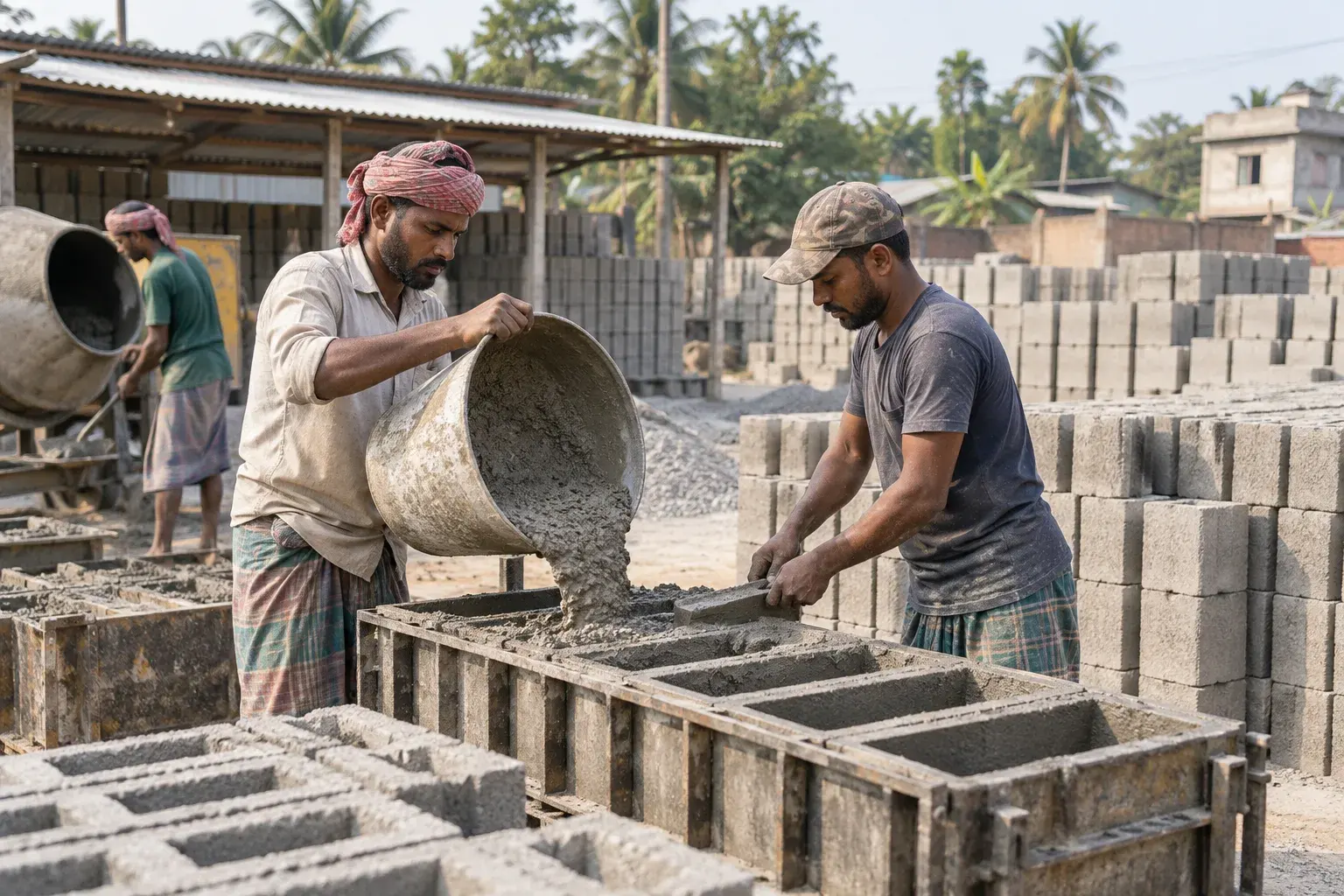 Light manufacturing & workshop
Concrete block making
Making and selling cement-sand-chip blocks. A hollow block sells for Tk 32-50 and replaces five bricks. The deadline for 100 percent block use in government work expired in June 2025 and was missed.
- Capital
- ৳12 lakh – ৳45 lakh
- People
- 3 – 12
- First income
- 30 – 90 days
 Light manufacturing & workshop
E-waste recycling
Recovering metals from discarded phones, televisions, fridges and computers. The Hazardous Waste (E-waste) Management Rules 2021 make Department of Environment registration and clearance compulsory; operating without it carries up to two years in prison or a Tk 200,000 fine or both.
- Capital
- ৳10 lakh – ৳3 crore
- People
- 5 – 40
- First income
- 120 – 540 days
 Light manufacturing & workshop
Household plastic goods moulding
Moulding buckets, mugs and chairs from melted plastic. The market is worth about Tk 50,000 crore, but RFL's own store sells a 30-litre bucket at Tk 193, which virgin resin cannot match.
- Capital
- ৳6 lakh – ৳50 lakh
- People
- 4 – 30
- First income
- 90 – 240 days
 Light manufacturing & workshop
Mosquito coil manufacturing
A unit pressing mosquito coils from sawdust and insecticide. BSTI certification is compulsory and the Department of Environment will not clear a site in a residential area.
- Capital
- ৳4 lakh – ৳40 lakh
- People
- 5 – 40
- First income
- 90 – 270 days