
Masonry and building contracting
Contracting the labour of brickwork, casting and finishing. Dhaka construction runs Tk 1,800-3,000 per square foot of plinth area, and the statutory minimum for a mason is Tk 940 a day in town.
- Last reviewed: 19 September 2026
- Version 1
Masonry and building contracting
- Starting capital
- ৳50,000 – ৳5,00,000 Editorial estimate
- Manpower
- 3 – 25 people
- First sale
- 15 – 60 days Editorial estimate
- Break-even
- 3 – 8 months Editorial estimate
- Kind of work
- Mobile service · Medium difficulty
About the business
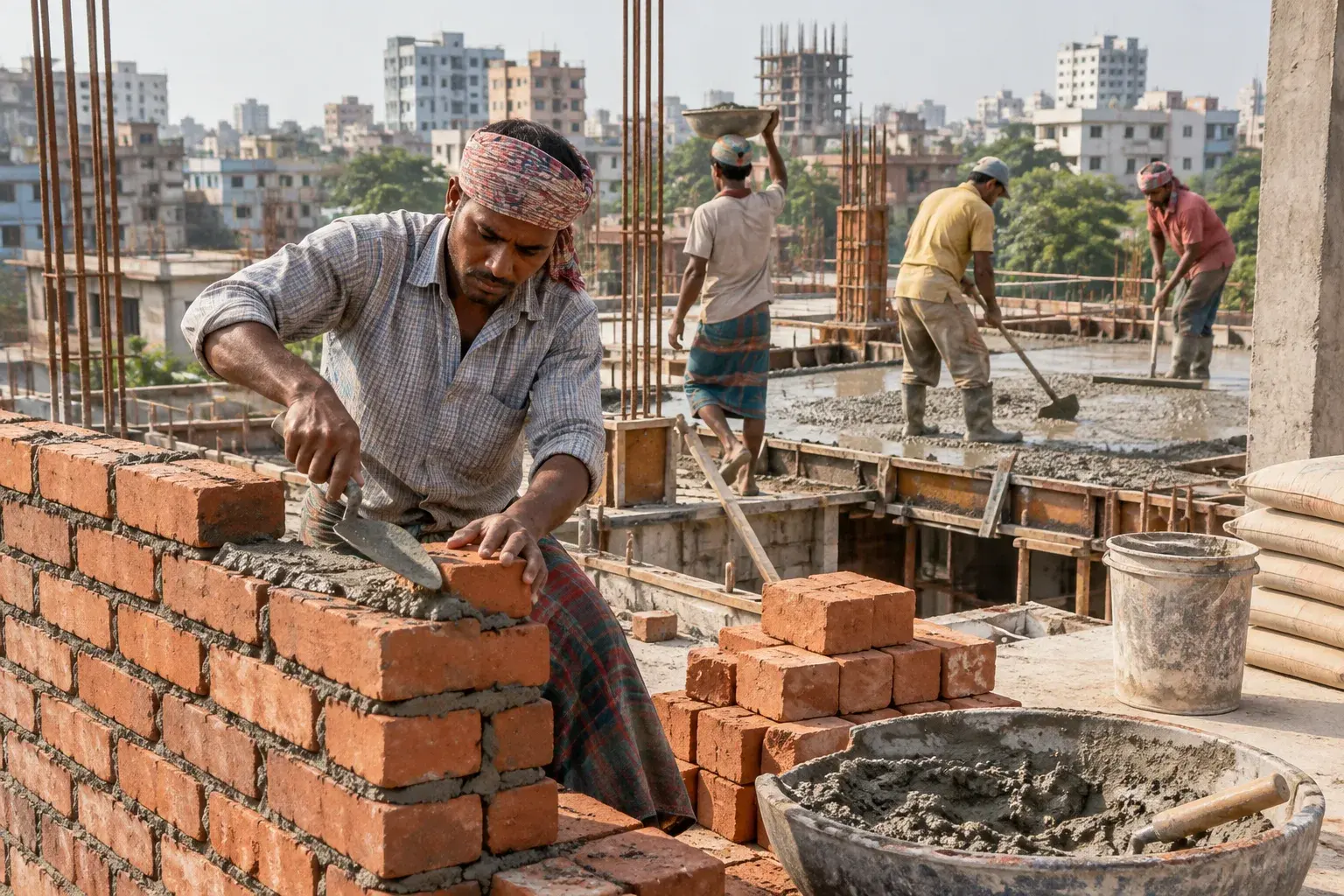
Masonry contracting is the labour side of building: brickwork, casting, plaster and finishing. The owner brings the land and the drawing, the contract fixes who buys the materials, and the mason's team does the work. Two kinds of contract run side by side: a labour-only deal priced per square foot or per man-day, and a lump-sum deal in which rod, cement, sand and brick are all the contractor's problem. A Prothom Alo costing of 27 July 2025 puts construction at Tk 1,800-2,000 per square foot of plinth area on a shallow foundation and Tk 2,500-3,000 where piling is needed, excluding VAT, income tax and the contractor's own profit. There is also a statutory wage floor: the construction and wood sector minimum wage gazette sets a mason's day at Tk 940 in town and Tk 870 in the village, a helper at Tk 680 and Tk 620, and a tiles or mosaic man at Tk 1,105 and Tk 1,020. Those are 2021 rates and the market now pays more. The real danger here is cash: the owner pays in instalments but the crew must be paid weekly, and the contractor funds the gap himself. Rod has risen about 10 percent for 60-grade and 17 percent for 40-grade in a year, so a lump-sum contract signed at an old rate turns into a loss.
Unit economics
| Item | Range | Evidence | Suggest a correction |
|---|---|---|---|
| Monthly working capital | ৳1,90,000 – ৳3,00,000 | Editorial estimate | |
| Selling price | ৳1,800 – ৳3,000 / unit | Market quote | |
| Variable cost | ৳1,530 – ৳2,760 / unit | Editorial estimate | |
| Gross margin | 8% – 15% | Editorial estimate | |
| Time to first revenue | 15 – 60 days | Editorial estimate | |
| Break-even time | 3 – 8 months | Editorial estimate | |
| Cash cycle | 30 – 90 days | Editorial estimate | |
| Waste / loss | 3% – 8% | Editorial estimate | |
| Daily capacity | 5 – 35 | Editorial estimate |
What you need to start
- Trowel, plumb bob, water level, measuring tape, vibrator, mixer machine, bamboo and timber shuttering, safety belts and helmets. Mixer and vibrator can be hired instead of bought.Equipment
- Trade licence from the city corporation or municipality: form Tk 10, licence book Tk 50, standard tax Tk 30, stamp Tk 150-300, licence fee Tk 100-60,000 by trade type, plus VAT and signboard fee. Issued in 3-5 working days with papers ready.Licence
- TIN and VAT registration from the National Board of Revenue. Tax and VAT are deducted at source from bills, so both are unavoidable for company or government work.Licence
- Crew management. The construction and wood sector wage structure has six grades, from helper up to tiles and mosaic man. Knowing which grade a job needs keeps the cost in line.Skill
- Reading a drawing and estimating quantities: how much brick, cement and rod a job will take. This single skill is the difference between profit and loss on a lump-sum contract.Skill
- Separate suppliers for rod, cement, sand and stone, and brick. On a lump-sum contract, credit from them does the work of capital.Supplier
- No premises are needed since the work happens on site, but a shed or godown is needed for tools and shuttering.Workspace
How the work is done
- 1First decide what you are selling: labour only, or a lump-sum job including materials. The risks are completely different.
- 2Build your crew: a head mason, several masons and helpers. Knowing each man's grade matters when you fix wages.
- 3Take the trade licence from the city corporation or municipality, and if you want government work, find out the enlistment conditions.
- 4Before taking a job, work the quantities off the drawing: how many bricks, bags of cement, tonnes of rod, cubic feet of sand. Get this wrong and a lump-sum contract eats the whole margin.
- 5Quote on today's market rates, not last month's. Rod and cement move week to week.
- 6Put the contract in writing: total value, instalment dates, how much at each stage, who supplies materials, and what happens on delay.
- 7Take an advance before starting. Without one, the first week's wages come out of your own pocket.
- 8Line up separate suppliers for rod, cement, sand and brick, and negotiate credit terms before you need them.
- 9Keep a daily attendance book: who came, how many days, how much he was paid. That is what stops disputes at month end.
- 10Show each completed stage to the owner and collect that instalment. Do not start the next stage before the last one is paid.
- 11Plan ahead for the three or four monsoon months, when casting and plaster work drops off and holding the crew together gets hard.
Seasons
- JanHigh
- FebHigh
- MarHigh
- AprHigh
- MayNormal
- JunLow
- JulLow
- AugLow
- SepLow
- OctNormal
- NovHigh
- DecHigh
Where it works well
- Strong fitChattogram · Steady residential and commercial building in the port city, plus separate foundation and retaining wall work on the hill slopes.
- Strong fitDhaka · The country's biggest construction market, with both developer companies and private houses, and the highest wages.
- Strong fitGazipur · Factories, worker housing and warehouses give work all year.
- Strong fitNarayanganj · An industrial belt next to Dhaka with many small developers and factory extensions.
- Strong fitSylhet · More remittance-funded house building than anywhere else, and payment tends to come on time.
- PossibleBogura · The northern trading centre, where the number of developer companies is rising.
- PossibleCox's Bazar · Hotel and resort work, but seasonal, with pressure to finish before the tourist season.
- PossibleCumilla · Remittance-funded houses and commercial buildings along the Dhaka-Chattogram highway.
- PossibleKhulna · City and industrial work, with extra care needed on foundations and casting in saline areas.
- PossibleRajshahi · A growing city with more multi-storey work, and wages below Dhaka.
Risks and cautions
- HighLate payment: The owner pays by instalment, usually after a stage is finished, but the crew must be paid weekly or it moves to another site. One week for a twelve-man crew is Tk 50,000-60,000 and the contractor funds it himself. One stuck instalment stops the work the following week.
- HighWorking capital: On a lump-sum contract the rod, cement, sand and brick are the contractor's purchase. On 15 September 2026 60-grade MS rod was Tk 92,500-94,500 a metric tonne, up about 10 percent in a year, and 40-grade Tk 89,000-91,000, up about 17 percent. One roof slab's rod runs into lakhs, paid out before any bill is raised.
- MediumDependency: Once a lump-sum price is quoted, any rise in material cost is the contractor's loss. Prothom Alo's market report of 28 June 2026 put 60-grade rod at Tk 88,000-92,000 a tonne; by September it was Tk 92,500-94,500. A few thousand taka a tonne in three months is the whole margin on a large job, and without a price-escalation clause it is never recovered.
- MediumDemand: Casting and plaster work thins out over the three or four monsoon months, and around Eid the workers go home to their villages. With no work coming in, the head mason still has to be held with an advance, or the crew is gone by the next season.
- MediumOther: Site accidents happen: falls from height, collapsing walls or shuttering, electric shock. If a worker dies or is crippled, the medical bill and compensation land on the contractor and the job stops. Helmets and safety belts cost almost nothing against that.
Sources
সিটি কর্পোরেশন থেকে ট্রেড লাইসেন্স প্রাপ্তির ধাপ সমূহ
Collected: 16 Sept 2026Supports: Starting capital · বাংলাদেশ
- Collected: 15 Sept 2026
Supports: Starting capital · ঢাকা মহানগর — সিপাহীবাগ, মিরপুর-৬, মোহাম্মদপুর টাউন হল, নিউমার্কেট, রামপুরা, মহাখালী বাজার
What changed
No corrections have been published yet.
Questions and answers
No questions yet. Be the first to ask.
Stories about this business
Twelve years on the tools, and 1.5 lakh taka of wages never paid
A mason who worked twelve years in Dhaka was never paid about 1.5 lakh taka of his wages; another lost 90,000 over ten years, and one contractor left 30 workers stranded together.
- Reasons
- Late payment, Dependency
Similar businesses
 Light manufacturing & workshop
Battery reconditioning
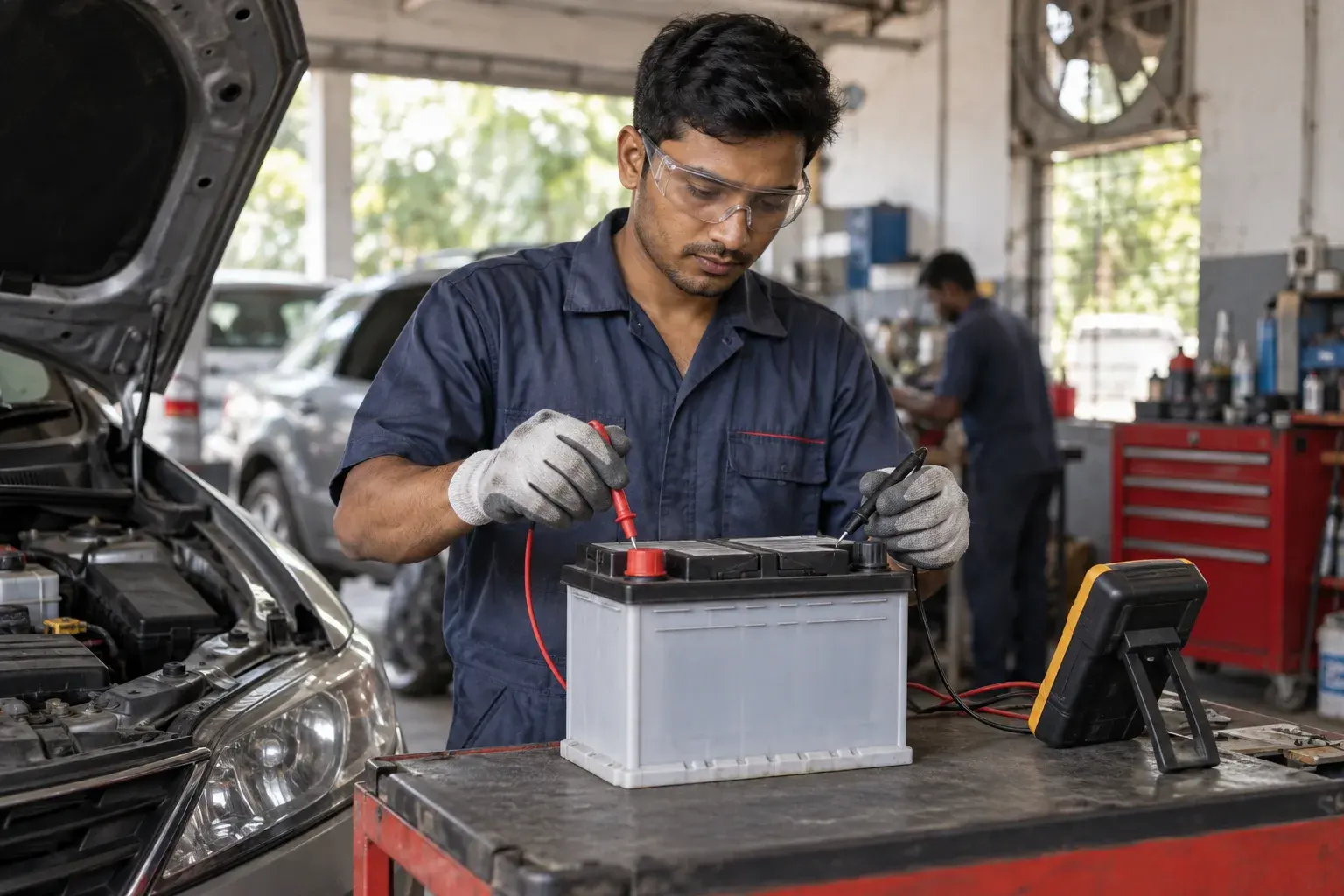
Bringing weak lead-acid batteries back with electrolyte correction and slow charging. Breaking batteries open and smelting the lead is a completely different trade - an offence without Department of Environment clearance, and only 7 of about 1,100 such operations in the country hold one.
- Capital
- ৳50k – ৳4 lakh
- People
- 1 – 5
- First income
- 15 – 60 days
 Light manufacturing & workshop
Screen printing and t-shirt
Printing designs on cloth. Low capital, but every design and every colour needs its own screen, so the per-piece cost climbs steeply as the order gets smaller.
- Capital
- ৳50k – ৳4 lakh
- People
- 1 – 6
- First income
- 15 – 45 days
 Light manufacturing & workshop
Handloom and jamdani weaving
Hand-woven sarees on a wooden loom. Sarees sell from Tk 1,500 to Tk 300,000 while a weaver earns about Tk 4,590 a month, because the margin stays with the mahajan.
- Capital
- ৳60k – ৳4 lakh
- People
- 2 – 10
- First income
- 7 – 180 days
 Light manufacturing & workshop
Tailoring and small garment unit
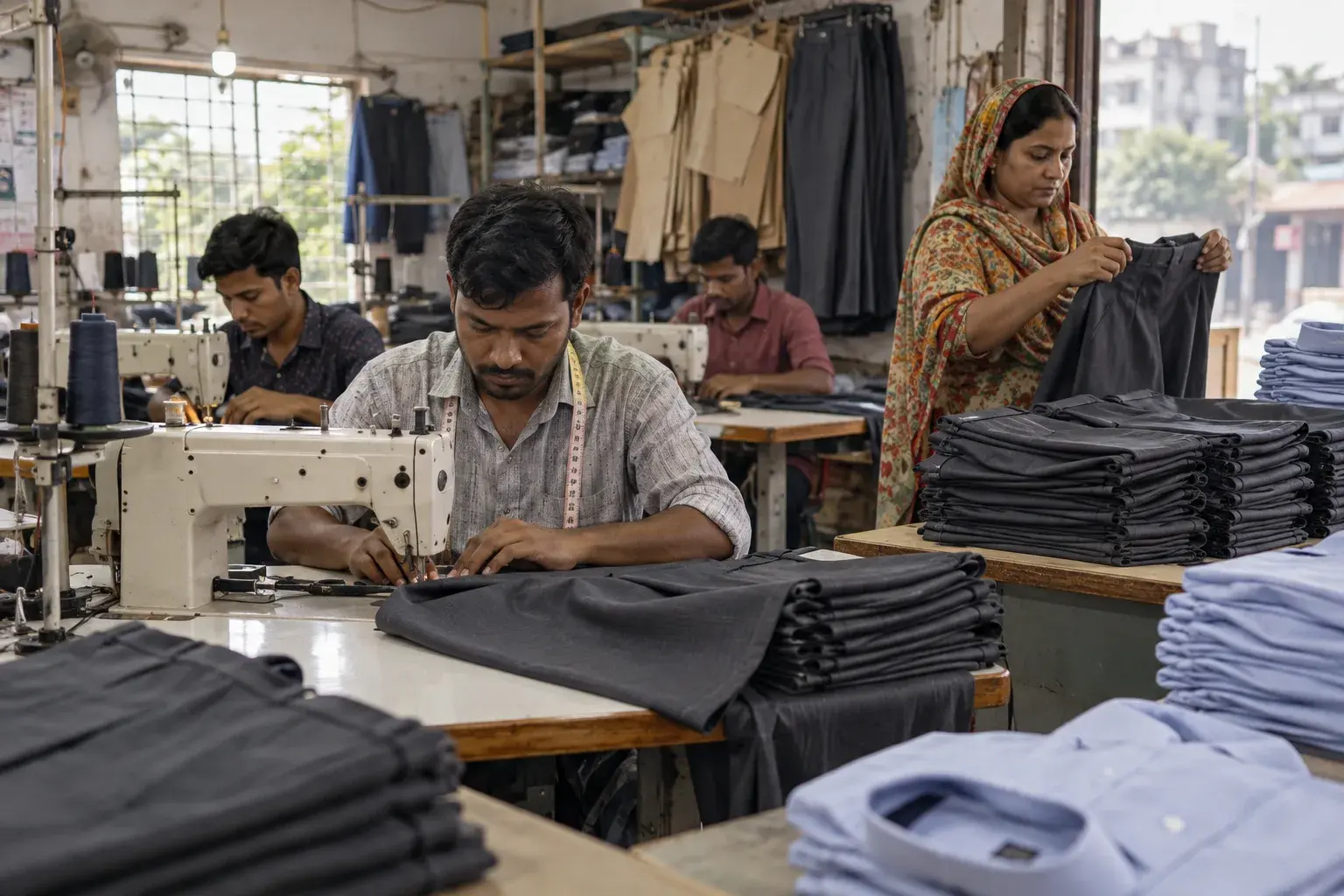
Trousers stitch for Tk 600: Tk 220 to the karigor, Tk 90 other costs, Tk 290 to the shop. One karigor does five trousers or ten shirts a day. The real money is sub-contract work, and its rules just tightened.
- Capital
- ৳60k – ৳8 lakh
- People
- 1 – 30
- First income
- 15 – 45 days