
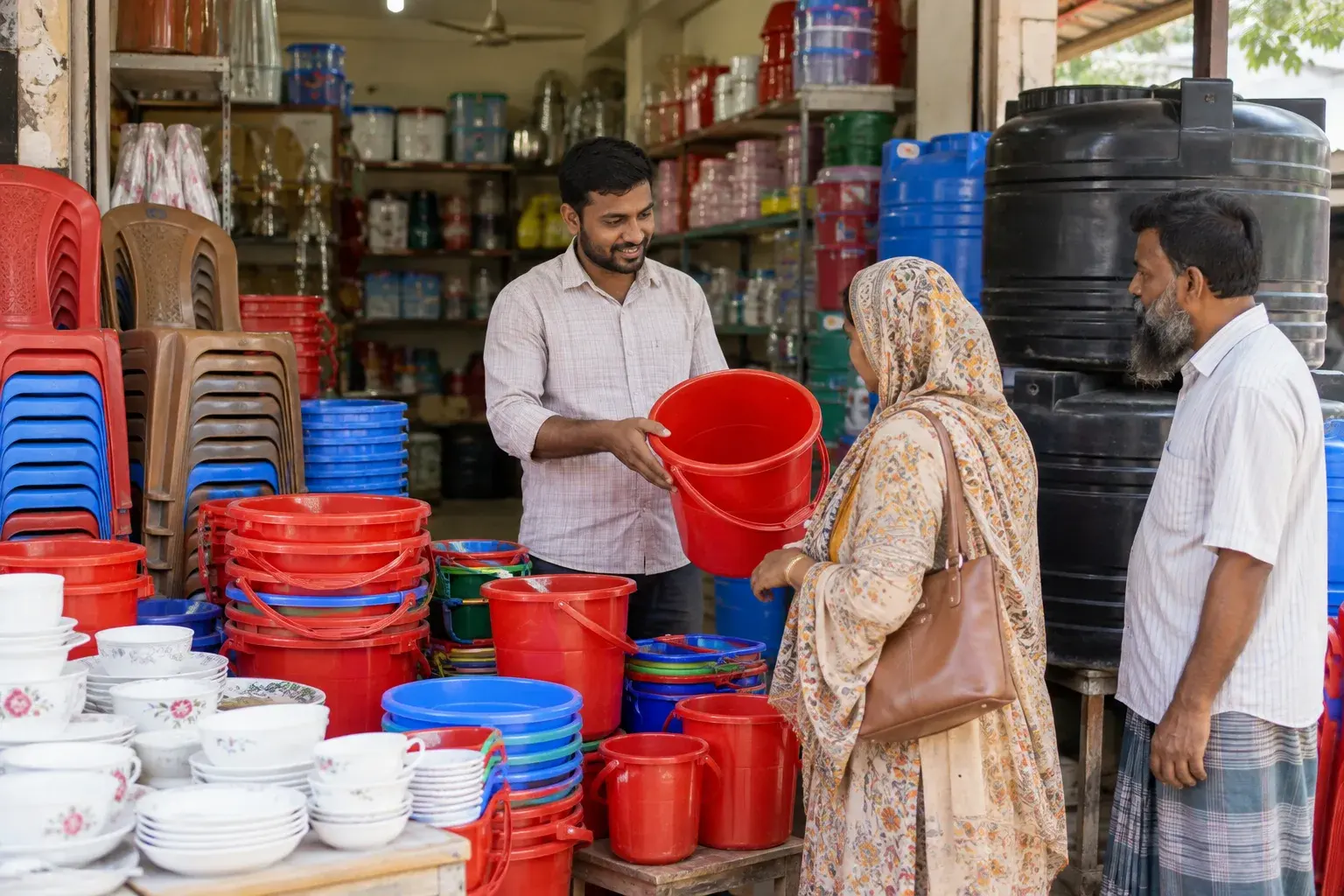
Plastic and household goods shop
A retail shop for buckets, mugs, chairs, dinner sets and water tanks. The factory prints the selling price, but nobody publishes the dealer's commission.
- Last reviewed: 19 September 2026
- Version 1
Plastic and household goods shop
- Starting capital
- ৳2,00,000 – ৳9,00,000 Editorial estimate
- Manpower
- 1 – 4 people
- First sale
- 15 – 45 days Editorial estimate
- Break-even
- 7 – 13 months Editorial estimate
- Kind of work
- Shop · Easy
About the business
Buckets, mugs, jugs, chairs, tables, bowls, dinner sets, water tanks, tiffin boxes and the small things a kitchen runs on. Stock comes from domestic factories - RFL, Bengal, and the many brands of the PRAN-RFL group. The selling price is printed by the factory: every item carries a maximum retail price and that is what the customer reads. On 16 September 2026, on PRAN-RFL's own online store, a 36-piece opal dinner set listed at Tk 4,190 and sold at Tk 3,855; a Sera 500-litre water tank listed at Tk 5,400 and sold at Tk 5,130; a 25-litre thermal ice box was Tk 1,880 and a six-compartment fridge storage box Tk 176. One thing needs saying plainly. Dealership terms and the commission rate are set by the manufacturer, but neither RFL nor Bengal nor PRAN publishes that rate anywhere. So before opening the shop you cannot know what you keep on each sale; you find out sitting with a company sales representative, and unless it is in writing it can change later. On top of that the manufacturer sells through its own online store and its own showrooms at 5 to 8 percent below the printed price, which makes your supplier your competitor.
Unit economics
| Item | Range | Evidence | Suggest a correction |
|---|---|---|---|
| Monthly working capital | ৳1,00,000 – ৳5,00,000 | Editorial estimate | |
| Selling price | ৳176 – ৳5,400 / unit | Market quote | |
| Variable cost | ৳145 – ৳4,700 / unit | Editorial estimate | |
| Gross margin | 13% – 18% | Editorial estimate | |
| Time to first revenue | 15 – 45 days | Editorial estimate | |
| Break-even time | 7 – 13 months | Editorial estimate | |
| Cash cycle | 0 – 15 days | Editorial estimate | |
| Waste / loss | 2% – 5% | Editorial estimate | |
| Daily capacity | 25 – 120 | Editorial estimate |
What you need to start
- From cheap everyday items (buckets, mugs, jugs, bowls, tiffin boxes, hangers) up to costly ones (36-piece dinner set Tk 3,855-4,190, 500-litre water tank Tk 5,130-5,400, 25-litre ice box Tk 1,880). Every size and colour of an item has to be on the shelf.Starting stock
- Trade licence from the city corporation or municipality: form Tk 10, licence book Tk 50, standard tax Tk 30, non-judicial stamp Tk 150-300, licence fee Tk 100-60,000 by trade type, plus VAT and signboard fee. Issued in 3-5 working days, renewed yearly.Licence
- A Tax Identification Number (TIN) from the National Board of Revenue, needed for a dealership or any factory agreement. VAT registration may also apply by size of business, but the VAT rate applicable to retail of these goods could not be verified here.Licence
- Tracking how fast each item turns. There is nothing to do about price here - the factory prints it - so profit comes from picking the fast movers and not taking in dead stock.Skill
- Domestic factories or their distributors: RFL (PRAN-RFL Group), Bengal Plastics and PRAN. RFL runs its own household, kitchenware, furniture and home decor and toy ranges, and its own Best Buy and exclusive franchise outlets.Supplier
- A market-facing shop with tall shelving and hanging hooks inside. The goods are light but bulky, so height matters more than floor area.Workspace
How the work is done
- 1Take a shop inside the market or on the road leading to it. These goods are light but bulky - chairs, tanks and buckets need height to hang and stack.
- 2Take the trade licence from the city corporation or municipality and a TIN from NBR. A factory will ask for both before giving a dealership.
- 3Decide whether to become a dealer or simply buy from a local distributor. A dealership gets the factory rate but usually carries a minimum monthly offtake condition.
- 4Sit with the company's sales representative and get four things in writing: your buying price, the list price, the credit period and the territory. No manufacturer publishes these rates, so do not open on a verbal promise.
- 5Before taking stock, check whether that factory already has its own showroom or exclusive outlet in your area. If it does, your supplier is your competitor.
- 6Start the first stock with cheap everyday items - buckets, mugs, jugs, bowls, tiffin boxes. They turn fast and cover the shop's running cost.
- 7Keep only a few of the big, costly items - water tanks, dinner sets, plastic wardrobes - and order them in when someone asks. One tank alone locks up more than Tk 5,000.
- 8Sell against the maximum retail price printed on the item. The customer already knows that number, so there is less haggling - but you also cannot go above it.
- 9Write down how long each item takes to sell. Ask at the dealership stage whether stock that has not moved in three months can be returned or exchanged.
- 10In the wedding and function season, set out dinner sets, cookware and gift packs separately: that is where the year's big sales happen.
- 11Line up regular supply to nearby small hotels, tea stalls, schools and offices, but put the credit terms in writing.
Seasons
- JanHigh
- FebHigh
- MarNormal
- AprNormal
- MayNormal
- JunNormal
- JulNormal
- AugNormal
- SepNormal
- OctNormal
- NovHigh
- DecHigh
Where it works well
- Strong fitBogura · The wholesale centre of the north, where small shopkeepers from surrounding districts come to buy.
- Strong fitChattogram · A large city and port with both retail and wholesale buyers.
- Strong fitDhaka · The densest population, the most new households and tenants, with the factories and distributors close by.
- Strong fitGazipur · New settlement keeps growing around the factories, and every new tenant is a new buyer of buckets, mugs and utensils.
- Strong fitNarayanganj · Large numbers of factory worker families and mess tenants, with steady demand for cheap everyday items.
- PossibleCumilla · Highway markets and the spending power of families with members abroad; dinner set demand rises in the wedding season.
- PossibleJashore · A regional trading centre with scope to supply the upazila markets around it.
- PossibleMymensingh · A divisional city with large rural markets and steady sales of cheap everyday items.
- PossibleRangpur · Rural market hawkers stock up here, though demand for costly items is limited.
- PossibleSylhet · Gift buying and new-household purchases by families with members abroad keep demand for costlier sets higher.
Risks and cautions
- HighDependency: Your margin is set by the manufacturer and nobody publishes it. Neither RFL nor Bengal nor PRAN prints a dealer commission or buying price anywhere. So there is no way to know what you keep on a sale before you open the shop, and if a verbal term changes later there is nothing to fall back on. What is not written down cannot be argued in court.
- HighDependency: Your supplier is your competitor. PRAN-RFL runs its own online store and sells below the printed price there: on 16-09-2026 the 36-piece dinner set was Tk 3,855 against a list of Tk 4,190 and the 500-litre tank Tk 5,130 against Tk 5,400, 5 to 8 percent off. It also runs its own Best Buy and exclusive franchise outlets. Customers check the price on a phone and then ask you for it.
- HighWorking capital: The capital sits on the shelf. A customer wants three colours and four sizes of a bucket and goes next door if they are not there, but stocking them all leaves much of it unsold for months. One 500-litre tank locks up Tk 5,130, and a dealership with a minimum monthly offtake has to be taken whether it sells or not.
- MediumOther: Glass, ceramic and opal ware breaks in transit and in the shop, and the loss usually falls on the shopkeeper. If a few pieces of a 36-piece set break, it is no longer a set at all - and the set alone is Tk 3,855-4,190.
- MediumLate payment: Small hotels, tea stalls and market hawkers buy regularly but on credit. Several outstanding balances at once leave nothing to take the next consignment with, and the dealership's monthly condition is broken as well.
Sources
সিটি কর্পোরেশন থেকে ট্রেড লাইসেন্স প্রাপ্তির ধাপ সমূহ
Collected: 16 Sept 2026Supports: Starting capital · বাংলাদেশ
What changed
No corrections have been published yet.
Questions and answers
No questions yet. Be the first to ask.
Similar businesses
 Retail & wholesale
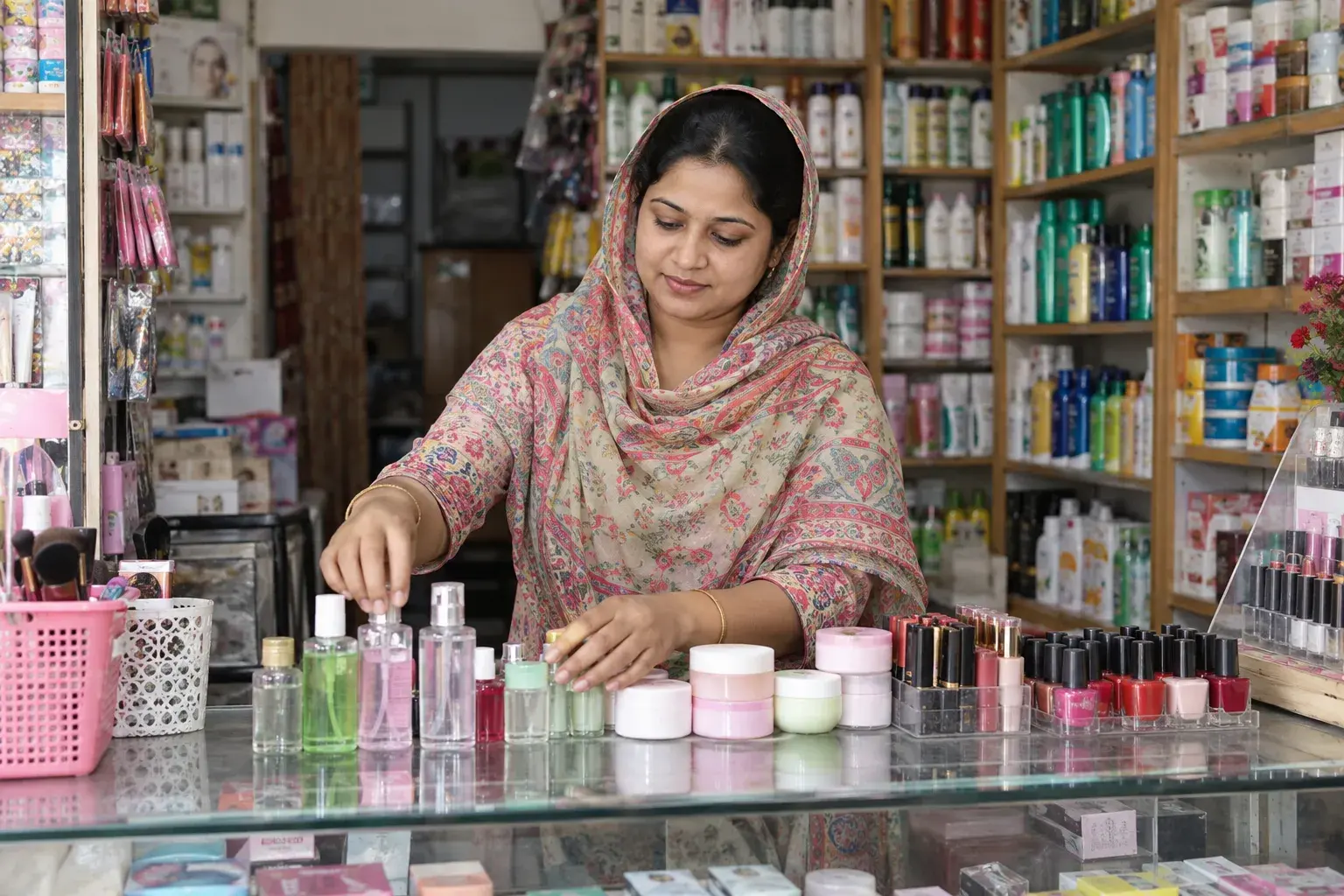
Cosmetics shop
A retail shop for creams, shampoo, face wash and make-up. At least 18 cosmetic categories are on BSTI's mandatory list, and uncertified or undocumented imported stock is the shopkeeper's liability.
- Capital
- ৳2 lakh – ৳15 lakh
- People
- 1 – 5
- First income
- 15 – 45 days
 Retail & wholesale
Optical shop (spectacles)
Buying frames and lenses and assembling spectacles over the counter. A complete ordinary pair retails at Tk 649 to Tk 5,400 (online prices, 21 Sep 2026). No BSTI certificate is needed; the trade licence is the only paper.
- Capital
- ৳2 lakh – ৳15 lakh
- People
- 1 – 4
- First income
- 15 – 60 days
 Retail & wholesale
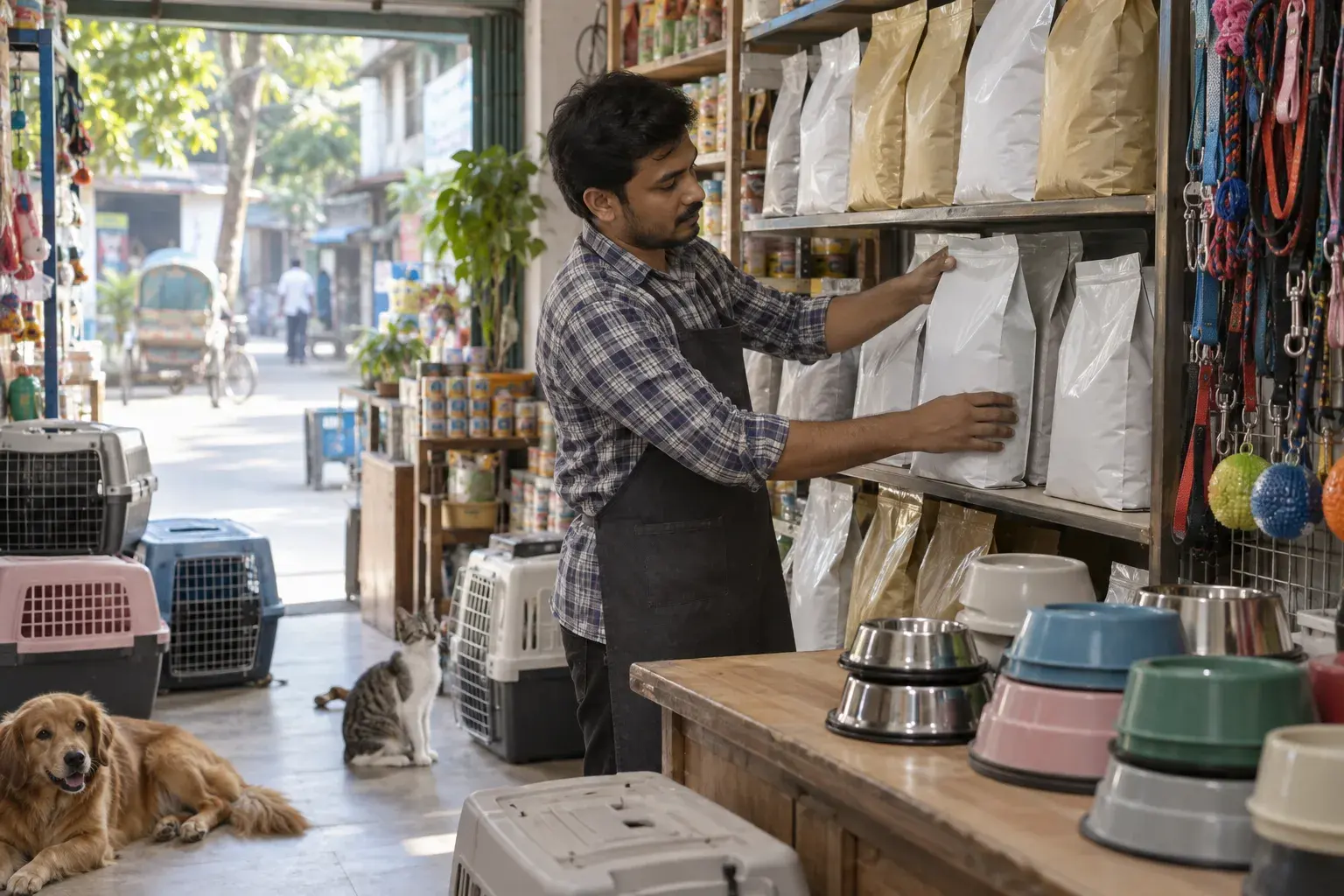
Pet food and supplies shop
A shop selling imported cat and dog food, litter and accessories. Dry food runs Tk 487 to Tk 1,900 a kg (21-09-2026). Customs duty on pet food is 25%, and demand is still mostly confined to Dhaka.
- Capital
- ৳2 lakh – ৳10 lakh
- People
- 1 – 4
- First income
- 15 – 60 days
 Retail & wholesale
Fish wholesale arot
Auctioning farmers' fish on commission. The rate is about 3 per cent, and holding suppliers means giving interest-free advances - the money is in volume, not margin.
- Capital
- ৳2 lakh – ৳15 lakh
- People
- 3 – 12
- First income
- 15 – 60 days