
Fish wholesale arot
Auctioning farmers' fish on commission. The rate is about 3 per cent, and holding suppliers means giving interest-free advances - the money is in volume, not margin.
- Last reviewed: 19 September 2026
- Version 1
Fish wholesale arot
- Starting capital
- ৳2,00,000 – ৳15,00,000 Editorial estimate
- Manpower
- 3 – 12 people
- First sale
- 15 – 60 days Editorial estimate
- Break-even
- 4 – 8 months Editorial estimate
- Kind of work
- Shop · Hard
About the business
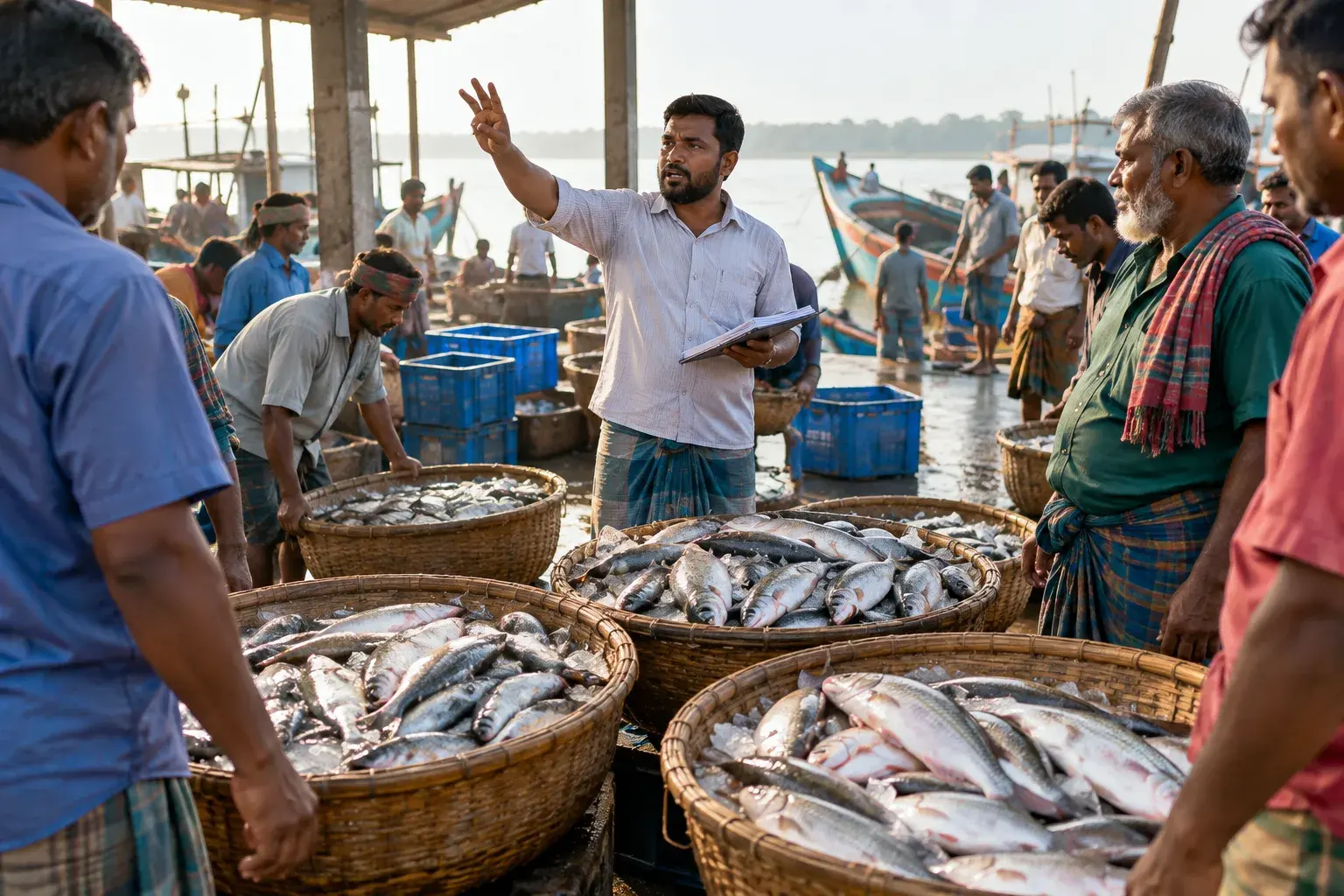
A fish arot auctions the fish that farmers and fishermen bring in and keeps a commission on the sale value. The arotdar does not buy the fish, so a price crash or a spoiled lot is the farmer's loss, not his. But holding on to suppliers costs money in advance, and that advance is dadon - which is what makes an arot a lending business wearing a trading coat. A statistically representative survey of 229 wholesalers across 31 markets in seven southern districts found that 95 per cent of auctioneers give dadon to regular suppliers, that farmers pay no interest on it, and that in exchange they are obliged to sell through that arot for the year. The commission was 2.9 per cent from farmers who had taken dadon and 3.1 per cent from those who had not - so the advance does not buy a worse rate, it buys supply. Money moves fast: 97 per cent of wholesalers are paid with a delay of two to four days on about 89 per cent of the sale value, and they pass the same delay up to their suppliers. On 15 September 2026 Dhaka wholesale prices were farmed rui Tk 290-400, katla Tk 260-380, pangas Tk 130-190 and tilapia Tk 120-200 per kg, against a retail rui price of Tk 300-450 the same day. The gap is thin because the lot clears the same day. Income is commission, and commission is volume.
Unit economics
| Item | Range | Evidence | Suggest a correction |
|---|---|---|---|
| Monthly working capital | ৳1,00,000 – ৳8,00,000 | Editorial estimate | |
| Selling price | ৳120 – ৳400 / kg | Official source | |
| Variable cost | ৳116 – ৳390 / kg | Editorial estimate | |
| Gross margin | 2% – 4% | Practitioner verified | |
| Time to first revenue | 15 – 60 days | Editorial estimate | |
| Break-even time | 4 – 8 months | Editorial estimate | |
| Cash cycle | 2 – 4 days | Practitioner verified | |
| Waste / loss | 0% – 1% | Practitioner verified | |
| Daily capacity | 500 – 4,000 | Editorial estimate |
What you need to start
- Heavy scales, plastic tubs and crates, ice-breaking tools, a stainless steel table and a ledger. In the survey 96 per cent of depots and 28 per cent of auctioneers used stainless steel tables.Equipment
- Cash held for dadon. It is not stock, but it is the arot's real capital - 95 per cent of auctioneers in the survey gave dadon to regular suppliers.Starting stock
- Trade licence from the city corporation or municipality: form Tk 10, licence book Tk 50, standard tax Tk 30, stamp Tk 150-300, licence fee Tk 100-60,000 by trade type. Issued in three to five working days.Licence
- Agricultural marketing licence from the Department of Agricultural Marketing. Form-1 is the prescribed application and renewal form for arotdars and wholesalers under the agricultural marketing law. The fee is paid online; the rate could not be verified here.Licence
- Calling an auction, judging fish size and grade by eye, and knowing which farmer's dadon will come back.Skill
- Farmers or fishermen who supply regularly. In the survey 89 per cent of farmers' fish was sold through auctioneers, so the supply line is the real asset.Supplier
- A stall inside the market with water, drainage, space for ice and truck access. Rent and the up-front premium vary by market.Workspace
How the work is done
- 1Find a stall in a market where fish actually lands. Water, ice and truck access - without all three an arot does not work.
- 2Take the trade licence from the city corporation or municipality, with 'fish arot' written as the trade.
- 3Apply for the agricultural marketing licence from the Department of Agricultural Marketing on Form-1; it is renewed periodically.
- 4Line up farmers. Decide which ponds and farms will supply you regularly - no fish landing means no commission.
- 5Decide the dadon. Who gets how much advance, when it is recovered, and what happens if it is not - write it down, because this trade runs on verbal agreement alone.
- 6Hire your auction caller and weighing hands. Salaries are an auctioneer's biggest cost - 60 per cent of total costs in the survey.
- 7Fix a reliable ice and water supply. Fish delivered alive fetches a 5-10 per cent premium over fish delivered dead.
- 8Run the auction at dawn, let the open bidding set the price, and enter every lot's weight and price in the book.
- 9Deduct the commission from the sale proceeds, pay the farmer the rest, and recover the dadon in instalments out of the same payments.
- 10Collect the buyers' balance within two to four days. You owe your suppliers the same delay, so if the two do not match the squeeze comes from both sides.
- 11At year end, see whose dadon did not come back. What does not is rolled over to the next year - that happened in 28 per cent of cases in the survey.
Seasons
- JanNormal
- FebNormal
- MarNormal
- AprNormal
- MayNormal
- JunNormal
- JulHigh
- AugHigh
- SepHigh
- OctLow
- NovHigh
- DecHigh
Where it works well
- Strong fitBarishal · A river-fish and hilsa hub, where volumes jump sharply in season.
- Strong fitChandpur · A major hilsa landing centre - packed in season, close to shut during the ban.
- Strong fitDhaka · The Jatrabari fish arot is one of the eleven markets the Department of Agricultural Marketing samples for its Dhaka wholesale price sheet; fish from the whole country breaks bulk here.
- Strong fitJashore · A large fish and fingerling centre, and one of the seven southern districts covered by the survey.
- Strong fitKhulna · A shrimp and fish farming district; the survey found depots channel product from here to processing factories.
- Strong fitMymensingh · A major pond-aquaculture belt, so landings at the arot do not stop through the year.
- PossibleBagerhat · Both shrimp and white fish land here, though much of it goes straight on to Khulna.
- PossibleChattogram · Big-city demand and processing factories are both close; the survey names this district as a main destination for depots.
- PossibleCox's Bazar · A marine fish arot is a different animal - here the dadon runs to fishermen and trawler owners, not farmers.
- PossiblePatuakhali · Both coastal catch and farmed fish come in, but transport costs are higher.
- PossibleSatkhira · Enclosure farming country, where shrimp depots and fish arots sit side by side.
Risks and cautions
- MediumLate payment: Buyers pay about 89 per cent of the value two to four days later. This happened to 97 per cent of surveyed wholesalers, so it is the rule, not the exception. If one large buyer holds back, you hold back the farmer, and the farmer takes his next consignment elsewhere.
- MediumDemand: Across the whole chain the price of fish rises only about 10 per cent from farm to retail, per the CPD study released on 30 July 2026. There is very little room to cut in the middle. Try to take more and the buyer walks, because the open auction sets the price in front of everybody.
- LowSpoilage: Spoilage is the smallest risk here, because lots clear the same day and the arotdar never owns the fish. Still, without ice or power live fish die, and dead fish fetch 5-10 per cent less - the farmer takes the loss, but the arotdar's commission shrinks with it.
- HighWorking capital: Dadon is interest-free and undocumented - purely verbal, resting on an old relationship. The survey found 64 per cent of advances were fully repaid within the year, but 28 per cent were left outstanding and rolled into the next. If disease hits the farmer's pond, or he takes his fish to another arot, there is no legal route to that money.
- HighDependency: Income is all commission and commission is all volume. At 2.9-3.1 per cent, a fall in landings cuts income immediately while salaries - 60 per cent of an auctioneer's costs - do not fall. A new arot opening nearby can take the farmers, because these markets are far more competitive than they used to be.
Sources
কৃষি বিপণন লাইসেন্স — ফরম-১ (লাইসেন্স গ্রহণ ও নবায়নের জন্য আবেদন)
Collected: 16 Sept 2026Supports: Starting capital · বাংলাদেশ
সিটি কর্পোরেশন থেকে ট্রেড লাইসেন্স প্রাপ্তির ধাপ সমূহ
Collected: 16 Sept 2026Supports: Starting capital · বাংলাদেশ
- Collected: 15 Sept 2026
Supports: Selling price · ঢাকা মহানগর — সিপাহীবাগ, মিরপুর-৬, মোহাম্মদপুর টাউন হল, নিউমার্কেট, রামপুরা, মহাখালী বাজার
ঢাকা মহানগরীর বাজারসমূহের নিত্য প্রয়োজনীয় কৃষিপণ্যের পাইকারী বাজারদর, ১৫-০৯-২০২৬
Collected: 15 Sept 2026Supports: Selling price · ঢাকা মহানগরী (১১টি বাজার)
What changed
No corrections have been published yet.
Questions and answers
No questions yet. Be the first to ask.
Stories about this business
Two and a half crore taka of fish in a three-hour market
The Dipnagar market, started in 2009, turns over 2 to 2.5 crore taka between 6 and 9 a.m. each day, including around 40,000 kg of pangash.
- Reasons
- Good location, Weak demand
Similar businesses
 Retail & wholesale
Cosmetics shop
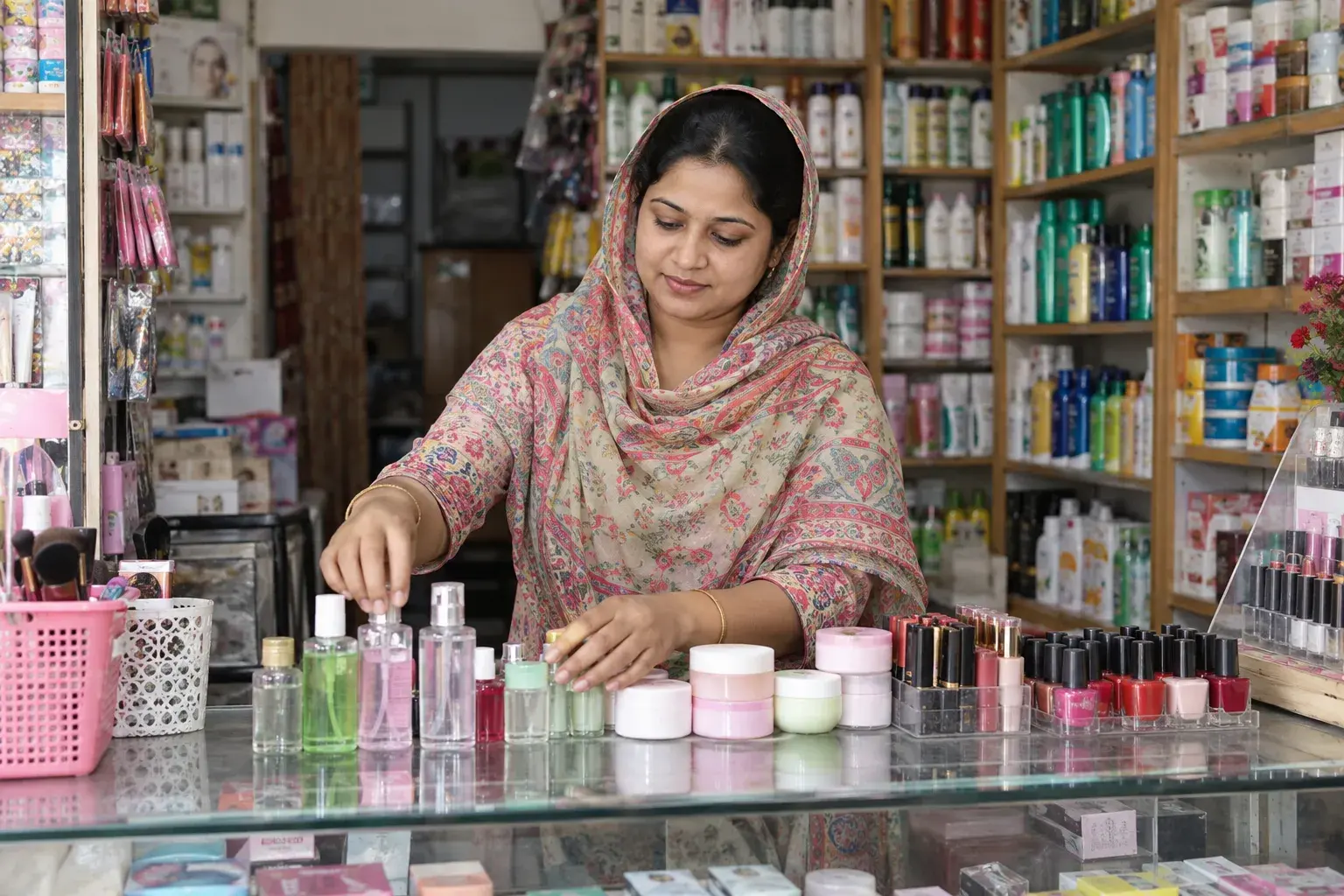
A retail shop for creams, shampoo, face wash and make-up. At least 18 cosmetic categories are on BSTI's mandatory list, and uncertified or undocumented imported stock is the shopkeeper's liability.
- Capital
- ৳2 lakh – ৳15 lakh
- People
- 1 – 5
- First income
- 15 – 45 days
 Retail & wholesale
Optical shop (spectacles)
Buying frames and lenses and assembling spectacles over the counter. A complete ordinary pair retails at Tk 649 to Tk 5,400 (online prices, 21 Sep 2026). No BSTI certificate is needed; the trade licence is the only paper.
- Capital
- ৳2 lakh – ৳15 lakh
- People
- 1 – 4
- First income
- 15 – 60 days
 Retail & wholesale
Pet food and supplies shop
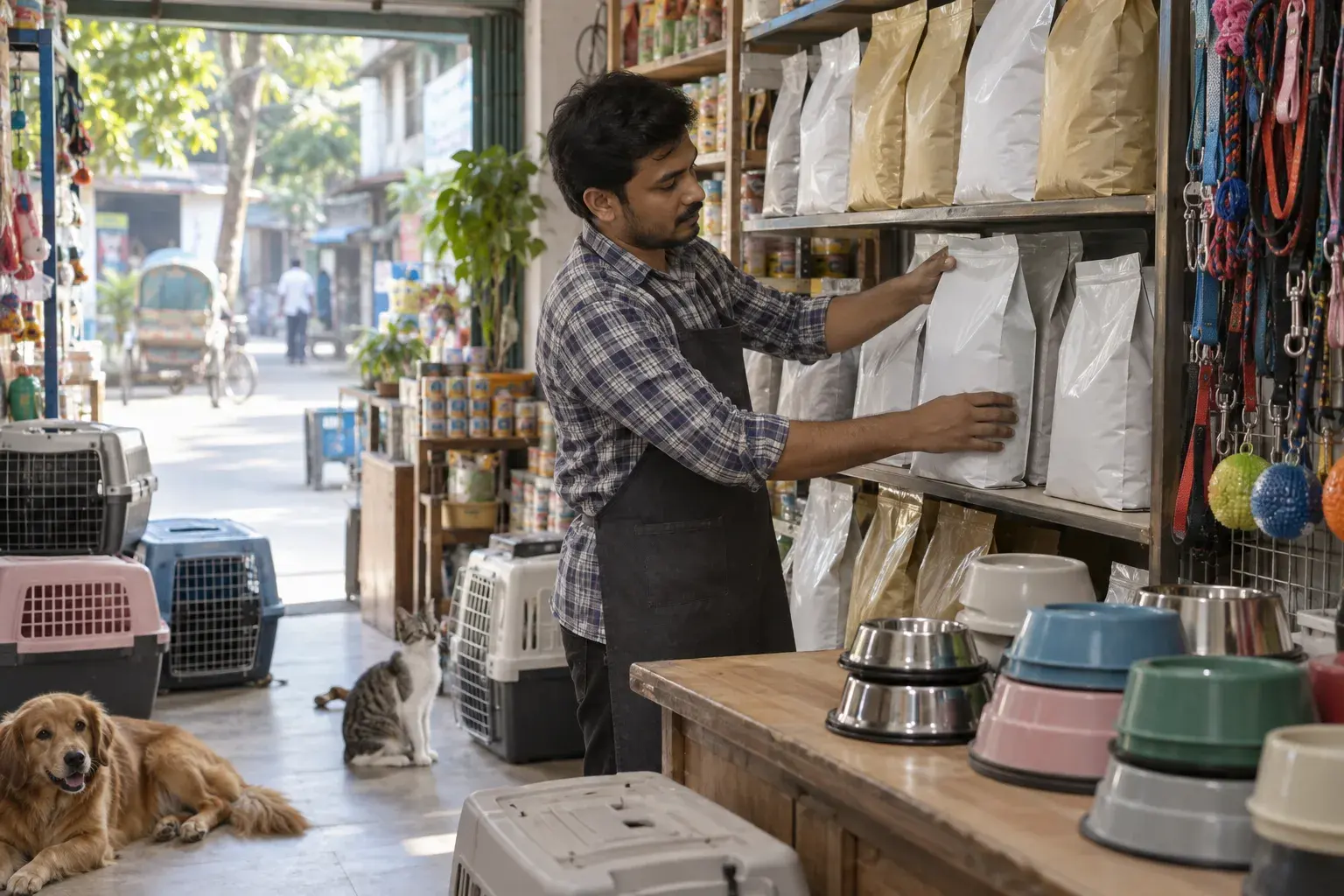
A shop selling imported cat and dog food, litter and accessories. Dry food runs Tk 487 to Tk 1,900 a kg (21-09-2026). Customs duty on pet food is 25%, and demand is still mostly confined to Dhaka.
- Capital
- ৳2 lakh – ৳10 lakh
- People
- 1 – 4
- First income
- 15 – 60 days
 Retail & wholesale
Paint and hardware shop
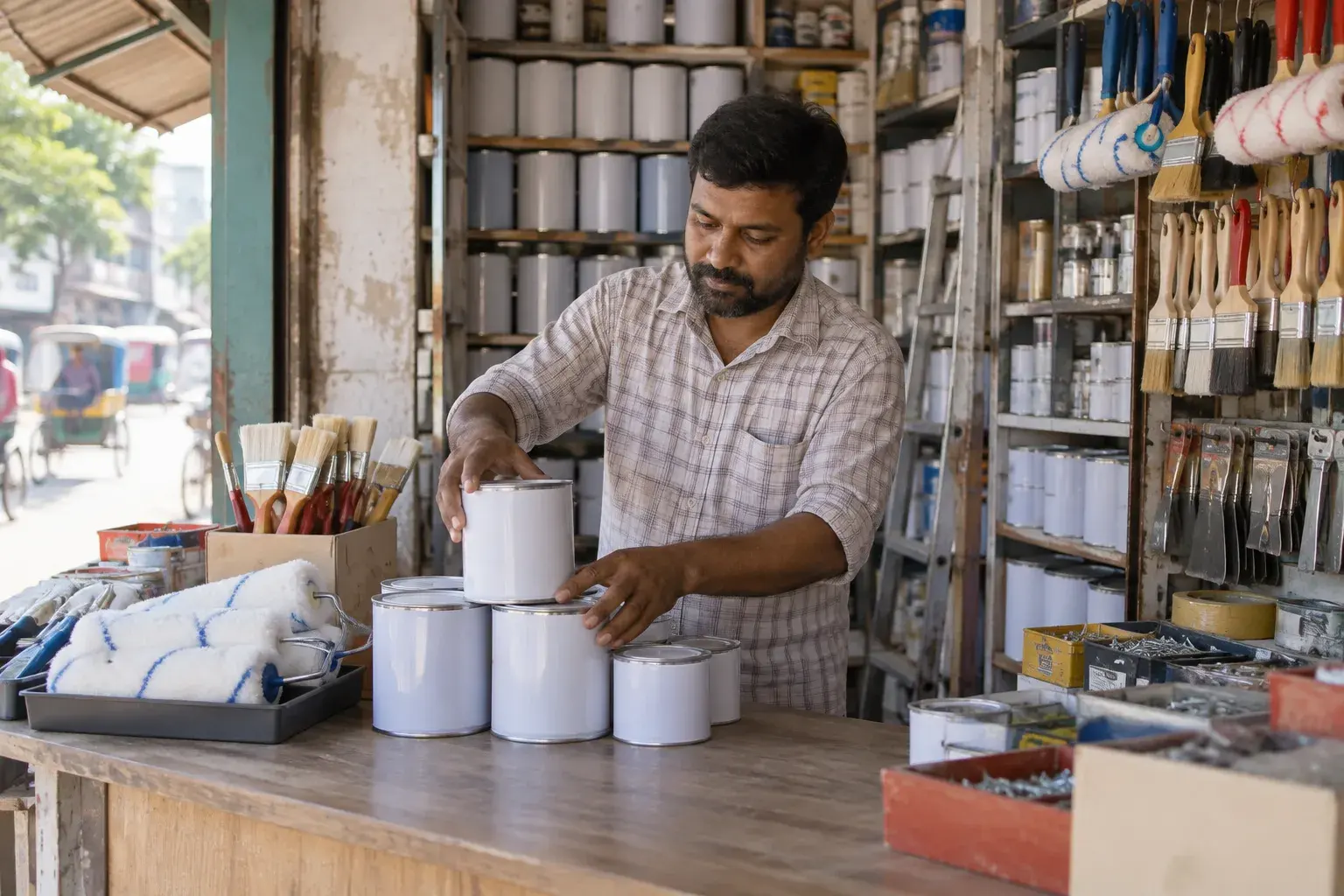
A retail shop selling paint, cement, rod, pipe, sanitary ware and tools. On 12-03-2026 a 50 kg bag of cement was Tk 475-520 and 60-grade rod Tk 87,000-88,500 a tonne, and these prices move week to week.
- Capital
- ৳2 lakh – ৳20 lakh
- People
- 1 – 6
- First income
- 15 – 60 days