
Agar (agarwood) plantation
Growing agar trees, driving nails into them to force the resin, and selling the wood or the attar. The first money arrives 8 to 16 years after planting, and exporting needs a CITES no-objection certificate from the Forest Department.
- Last reviewed: 21 September 2026
- Version 1

Agar (agarwood) plantation
- Starting capital
- ৳1,00,000 – ৳10,00,000 Editorial estimate
- Manpower
- 1 – 6 people
- First sale
- 2,555 – 5,840 days Disputed
- Break-even
- 96 – 192 months Editorial estimate
- Kind of work
- Farm · Hard
About the business
Agar is a tree, and agarwood is the blackened part of it. In nature a stem borer makes a hole, fungus gets in, and the tree's defence lays a brown-black layer around the wound. That layer is the agar. Left to nature it takes 25 to 30 years, sometimes 50. So growers force it: rows of nails are driven into the trunk to make wounds deliberately. The Agriculture Information Service puts nailing at 5-6 years of age and harvest at 15-16 years, with 2.0 to 2.5 kg of agarwood from a mature tree. Bonik Barta (31 August 2023) says nailing at 5-6 years and harvest at 7-8 years from planting. That is at least a seven-year disagreement between two credible sources, and that gap is the single biggest risk a grower carries. Through all of it the land is committed: vegetables or pulses can be intercropped for the first 3 to 5 years, then a few years of shade-tolerant crops like ginger, turmeric or sarpagandha, and after that nothing. The prices are what pull people in. Ordinary agarwood runs Tk 200 to Tk 1,000 a kg by grade, while wood from a naturally matured tree reaches Tk 80,000 to Tk 100,000 a kg, and raw attar sells locally at Tk 6,000 to Tk 12,000 a tola of 11.66 grams. Bangladeshi agar goes to Saudi Arabia, Qatar, Kuwait, Bahrain, Oman, Dubai and Malaysia. But the tree is CITES-listed: export needs a no-objection certificate from the Forest Department, and the difficulty of getting one is the traders' loudest complaint.
Unit economics
| Item | Range | Evidence | Suggest a correction |
|---|---|---|---|
| Monthly working capital | ৳2,000 – ৳30,000 | Editorial estimate | |
| Selling price | ৳5,000 – ৳1,00,000 / kg | Disputed | |
| Variable cost | ৳400 – ৳1,250 / kg | Editorial estimate | |
| Gross margin | 75% – 99% | Editorial estimate | |
| Time to first revenue | 2,555 – 5,840 days | Disputed | |
| Break-even time | 96 – 192 months | Editorial estimate | |
| Cash cycle | 15 – 120 days | Editorial estimate | |
| Waste / loss | 20% – 50% | Editorial estimate | |
| Daily capacity | 1 – 20 | Editorial estimate |
What you need to start
- Nails, 1.5 to 2 inches, driven in rows 1-2 inches apart from the base of the trunk upward. An acre takes several lakh nails. The price of nails and the number needed per tree could not be verified here.Starting stock
- Forest produce transit pass. Under the Forest Produce Transit (Control) Rules 2011, and the 1973 rules in the hill tracts, agarwood moved from one district to another needs a pass. The fee and validity could not be verified.Licence
- Trade licence from the city corporation, municipality or union parishad: form Tk 10, licence book Tk 50, standard tax Tk 30, stamp Tk 150-300, licence fee Tk 100-60,000, issued in 3-5 working days, renewed yearly.Licence
- VAT registration and an export registration certificate, needed to export attar. By bdnews24's count only about 70 of roughly 200 factories in Moulvibazar have tax and VAT registration, so most of the trade is off the books. The fees and process could not be verified here.Licence
- CITES export no-objection certificate from the Forest Department. Agar (Aquilaria) is a CITES-listed plant, so agarwood or attar leaving the country needs the Department's no objection; the Department publishes the list of issued NOCs on its own site, last updated 27 July 2026. The fee, validity and processing time could not be verified here and must be checked with the Wildlife and Nature Conservation Circle.Licence
- A 'dourhal', as the men who can read agarwood are called locally. Whether a tree is ready is judged from its sickness, not its age, and splitting the logs so the black stays whole is entirely hand skill. Without it even good wood sells cheap.Skill
- A relationship with the agar-attar factories of Sujanagar union in Barlekha: Bonik Barta counts about 250 there and another 50 elsewhere in the district, of which 176 are registered. They are essentially the only buyers of raw wood.Supplier
- A hillock or high ground, or a homestead yard or waste plot. In a pure stand rows go 5-6 ft apart and plants 3-4 ft, about 1,800-2,900 trees to an acre. The land is out of other use for fifteen years, apart from an intercrop in the first few.Workspace
How the work is done
- 1Take this decision with your eyes open: it is a wait of 8 to 16 years. The land you plant will not give you a rice or vegetable income for all of that time. If you have no other income across those years, do not do this.
- 2Pick the land. Agar does best on hillocks and slopes, but it also grows in a homestead yard, along a road or on waste ground. The species grown in Bangladesh are Aquilaria agallocha and Aquilaria malaccensis.
- 3Get the planting stock. It can be raised from seed, but the seed stays viable only 7 to 10 days, so it must go into a sand bed as soon as the capsule is picked and be moved to polybags after 20-25 days. Saplings are normally 1-2 years old when they go into the field.
- 4Plant in the monsoon, June to September. Dig 50x50x50 cm pits and put rotted cow dung and fertiliser in them first. In a pure stand keep 5-6 ft between rows and 3-4 ft between plants; a little wider in a mixed planting.
- 5For the first 3 to 5 years crop the gaps with vegetables and pulses, then a few years of shade-tolerant sarpagandha, ginger or turmeric. That intercrop is your only income through the waiting years.
- 6Water in drought, keep it weeded, and fertilise twice a year, before and after the monsoon. A new planting needs no chemical fertiliser; it can be added as the trees age.
- 7Decide when to nail. The Agriculture Information Service's field observation records 1.5-2 inch nails driven in rows 1-2 inches apart into 4-5 year old trees, half the nail left in the wood and set slightly at an angle. On 10-12 year old trees of 10-12 inch girth the nails go in 4-5 inches apart.
- 8Then wait. The black layer around each wound takes 4 to 6 years to fill. You fell not by age but by signs: growth stopped, visible wounds on the trunk, distorted wood, leaves gone small, and dieback on the trunk and branches.
- 9Fell between January and April. The tree is dormant then, so the wood carries more oil and a better grade. It can be cut year round, but the price differs.
- 10Grade the wood. Cut it into logs and split them two ways: dense black, light black and coppery in one lot, grey and near-white in the other. The light black and coppery logs are ripped lengthwise into slivers called dhum, and the nails are picked out carefully so the black stays whole.
- 11Decide whether to sell the wood or distil it yourself. Raw wood to a factory fetches Tk 200-1,000 a kg at ordinary grade. Distilling earns far more but needs a still, tanks, fuel and labour; a small unit cost Tk 350,000 to set up in 2016.
- 12If you mean to export, get the paperwork first. The tree is CITES-listed, so a CITES export no-objection certificate from the Forest Department is required, along with the trade licence, VAT registration and an export registration certificate. Traders have complained for years that this paperwork is the industry's biggest obstacle.
Seasons
- JanHigh
- FebHigh
- MarHigh
- AprHigh
- MayNormal
- JunNormal
- JulLow
- AugLow
- SepNormal
- OctNormal
- NovNormal
- DecNormal
Where it works well
- Strong fitMoulvibazar · The country's agar-attar centre. Sujanagar union in Barlekha alone has some 250-300 factories large and small, with another 50 elsewhere in the district and 176 registered with the Forest Department. It is also the only real market for raw wood.
- Strong fitSylhet · The Agriculture Information Service names the Sylhet region as suitable for agar: the hillock land and the rainfall both suit it, and the Barlekha factories are close.
- PossibleBandarban · The hill land suits it, but the separate hill tracts transit rules apply and the wood has to travel all the way to Barlekha.
- PossibleChattogram · The Agriculture Information Service names Chattogram and the hill tracts as suitable; it grows well on the slopes and the port is near.
- PossibleCox's Bazar · Possible on the hill slopes, though salt air and sandy ground must be avoided.
- PossibleHabiganj · Hillock and tea-slope land is available and the Moulvibazar factories are not far, but there is no local buyer.
- PossibleKhagrachhari · Agar can be planted on hill waste land alongside social forestry, but felling and moving it needs Forest Department permission.
- PossibleRangamati · It grows on the slopes, but with the buyers far away much of the margin goes into carriage.
- PossibleSunamganj · Possible on high ground but not in the haor lowland, since agar will not stand waterlogging.
Risks and cautions
- HighWorking capital: Eight to sixteen years with no income, and the sources do not even agree on the length: the Agriculture Information Service says 15-16 years, Bonik Barta says 7-8. Someone who borrowed on a seven-year plan can find himself eight years short. Fertiliser, water, watching and land rent run the whole time. If money is needed mid-way the only option is to fell immature trees, and immature agarwood is worth next to nothing.
- HighCompliance: The export paperwork. Agar is CITES-listed, so it cannot legally leave the country without the Forest Department's no-objection certificate. bdnews24 (13 February 2021) reports that the difficulty of CITES and NOC pushes traders into illegal channels; Prothom Alo (1 April 2016) reported official attar exports of zero in 2014-15 while unofficial shipments continued. The seizure risk on an illegal consignment is not the grower's, but the depressed price he is paid is.
- HighDemand: The buyers are almost entirely in the Middle East, and when that market shuts the whole trade stops. Through 2020-21 the Middle Eastern buyers stayed away for two years; Prothom Alo (24 November 2021) reported that most of Sujanagar's roughly 300 factories closed and about 5,000 workers lost their jobs. A crop that took fifteen years to make has nowhere else to go if the market is shut on the day it is ready.
- HighOther: Nailing does not guarantee resin. The Agriculture Information Service itself says the felling decision is made from how sick the tree looks, which means there is no advance certainty about how much resin any tree laid down. Ordinary white agar wood is soft and good for nothing but firewood once the attar material is taken out. How many of the two thousand trees on an acre will give a good grade is a number nobody, official or academic, has published.
- MediumDependency: The buyers can be counted. Raw wood is bought mainly by the factories of Sujanagar in Barlekha, and outside that district there is effectively no buyer. bdnews24 reports that only about 70 of roughly 200 factories are VAT-registered, so most transactions leave no paper, there is no written basis for arguing about price, and no recourse if payment does not come.
Sources
CITES Export NOC — রপ্তানির জন্য অনাপত্তি সনদের তালিকা ও আদেশসমূহ (হালনাগাদ ২৭-০৭-২০২৬)
Collected: 21 Sept 2026Supports: requirements · বাংলাদেশ
- Collected: 21 Sept 2026
Supports: requirements · বাংলাদেশ
সম্ভাবনাময় আগর-আতর শিল্প — কৃষি কথা, জ্যৈষ্ঠ ১৪২৪ (প্রকাশ ১৫-০৬-২০১৭)
Collected: 21 Sept 2026Supports: Starting capital, Starting capital, districts, Break-even time, Selling price, Selling price, Time to first revenue, Variable cost, Waste / loss · মৌলভীবাজার, সিলেট, চট্টগ্রাম ও পার্বত্য চট্টগ্রাম
সিটি কর্পোরেশন থেকে ট্রেড লাইসেন্স প্রাপ্তির ধাপ সমূহ
Collected: 16 Sept 2026Supports: requirements · বাংলাদেশ
Farmers in Thakurgaon count losses as potato prices fall
Collected: 28 Feb 2026Supports: Starting capital · ঠাকুরগাঁও
দেশে দেশে সুগন্ধ ছড়াচ্ছে মৌলভীবাজারের আগর-আতর
Collected: 31 Aug 2023Supports: Selling price, Selling price, Time to first revenue · মৌলভীবাজার — বড়লেখা উপজেলার সুজানগর ইউনিয়ন
- Collected: 24 Nov 2021
Supports: Selling price, risks · মৌলভীবাজার — বড়লেখা, সুজানগর
সম্ভাবনার আতর শিল্পের দুয়ারে ‘বৈধতার’ চাবি
Collected: 13 Feb 2021Supports: requirements · মৌলভীবাজার
সুজানগরের আগর-আতর জয় করেছে মধ্যপ্রাচ্য
Collected: 1 Apr 2016Supports: Monthly working capital, Time to first revenue · মৌলভীবাজার — বড়লেখা, সুজানগর
What changed
No corrections have been published yet.
Questions and answers
No questions yet. Be the first to ask.
Stories about this business
36 agar trees for 13 lakh taka, and one of them alone for 6 lakh
This grower in Baghaichhari sold 36 agar trees for 13 lakh taka in all: the single largest fetched 6 lakh and the rest went at 25,000-30,000 each.
- Reasons
- Weak demand, Good quality
Similar businesses
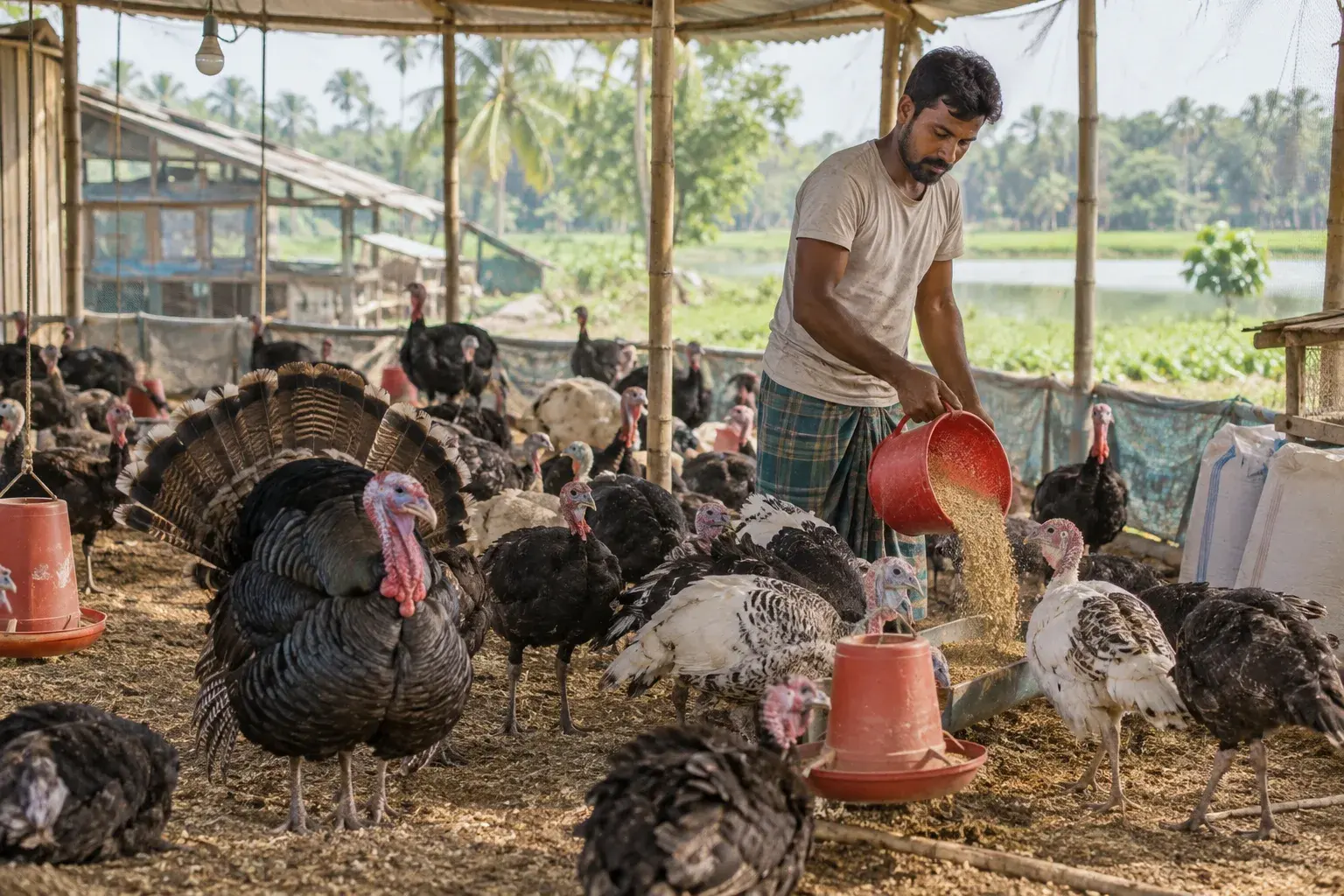 Agriculture & farming
Turkey farming
About 5,000 farms sprang up in the 2015-2020 rush and a few hundred remain. Chick prices fell from Tk 600 to Tk 150 and the livestock department discourages the trade.
- Capital
- ৳1 lakh
- People
- 1 – 3
- First income
- 30 days
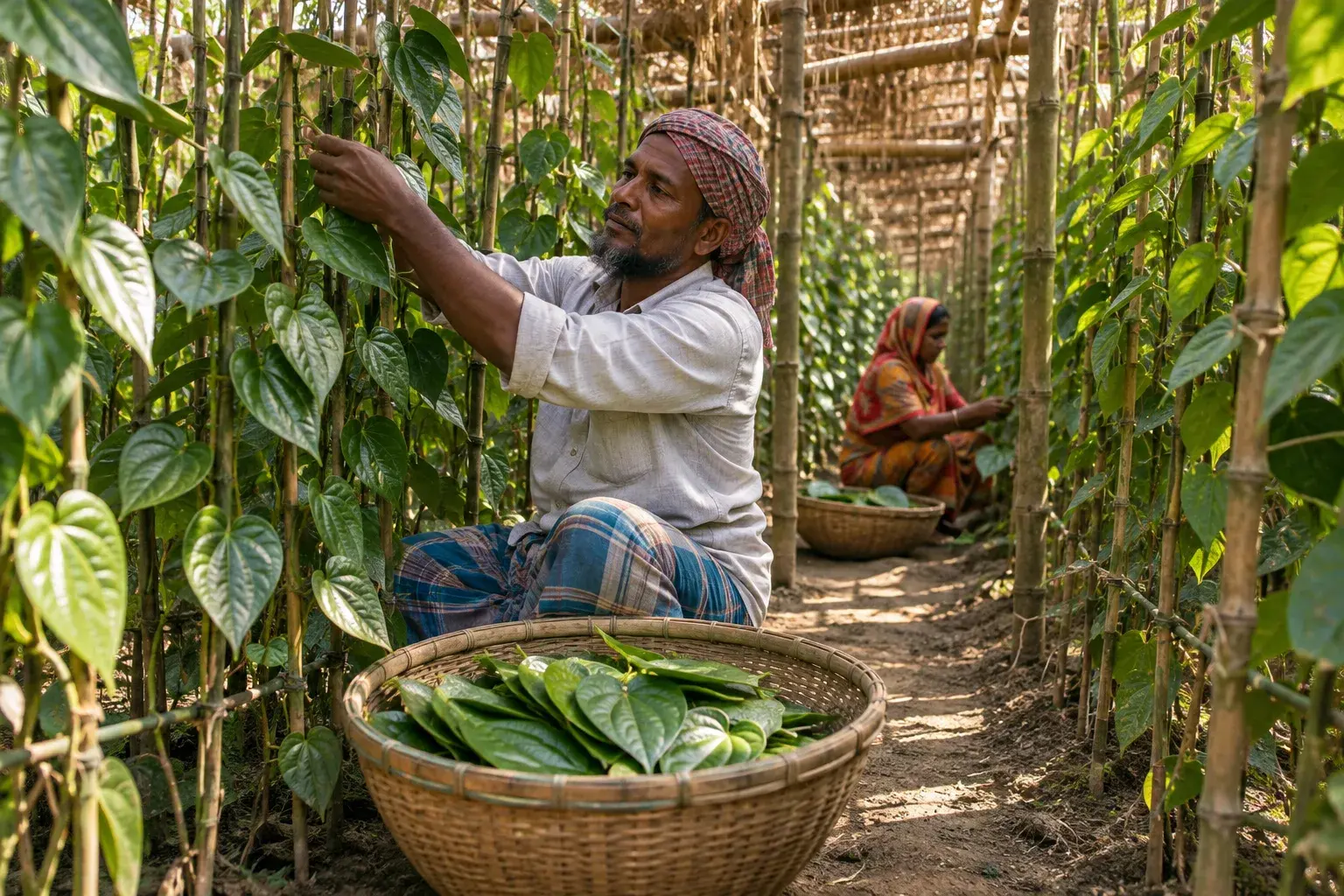 Agriculture & farming
Betel leaf cultivation (boroj)
Growing betel vine inside a bamboo-and-thatch boroj. About Tk 1 lakh a bigha to run, and in Rajshahi a bira of 64 leaves has gone from Tk 100-120 to Tk 4.
- Capital
- ৳1 lakh
- People
- 1 – 4
- First income
- 120 – 180 days
 Agriculture & farming
Plain-land tea growing
Growing tea on flat land, plucking green leaf and selling it to factories for cash. The fixed rate in March 2026 was Tk 28 a kg with the market at Tk 34-35, but up to 40 percent can be cut off the weight.
- Capital
- ৳1 lakh – ৳5 lakh
- People
- 1 – 6
- First income
- 730 – 1,095 days
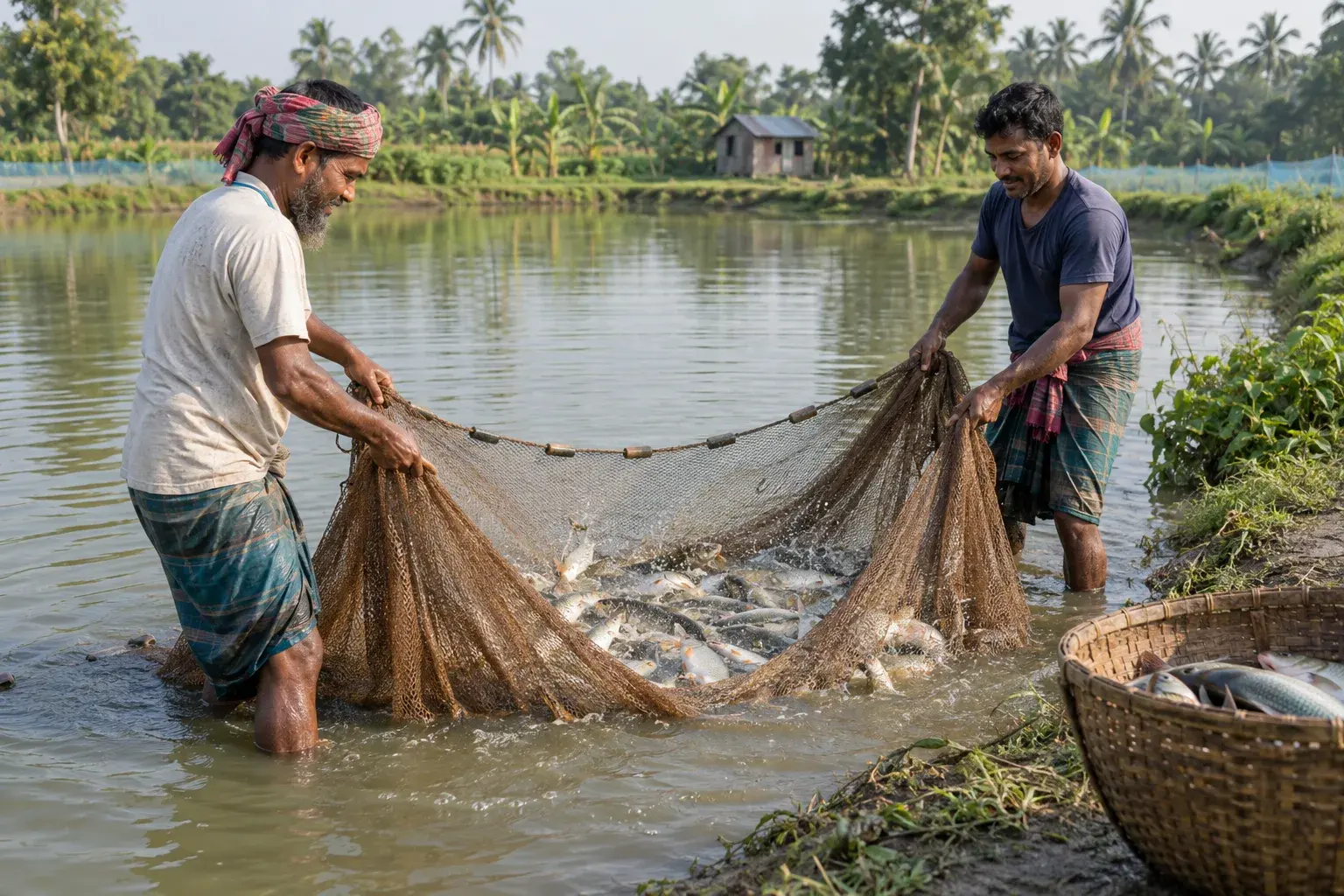 Agriculture & farming
Pond fish farming
The Department of Fisheries measures pond yield at a national average of 4.96 tonnes per hectare: 12.72 in Mymensingh, 2.01 in Rangamati. The district decides the income.
- Capital
- ৳1 lakh – ৳6 lakh
- People
- 1 – 4
- First income
- 240 – 365 days