
Betel leaf cultivation (boroj)
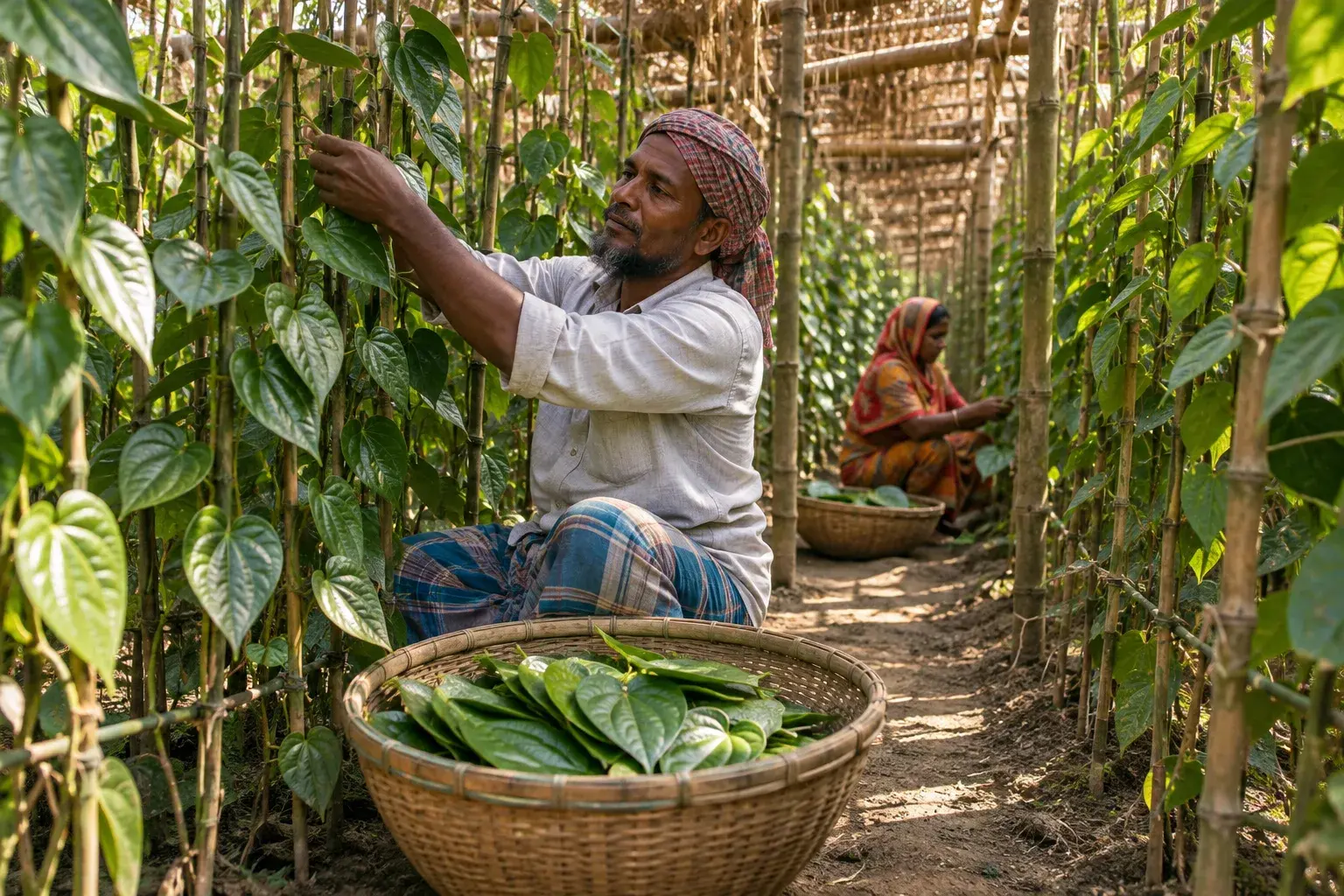
Growing betel vine inside a bamboo-and-thatch boroj. About Tk 1 lakh a bigha to run, and in Rajshahi a bira of 64 leaves has gone from Tk 100-120 to Tk 4.
- Last reviewed: 19 September 2026
- Version 1
Betel leaf cultivation (boroj)
- Starting capital
- ৳1,00,000 Editorial estimate
- Manpower
- 1 – 4 people
- First sale
- 120 – 180 days Editorial estimate
- Break-even
- 10 – 28 months Editorial estimate
- Kind of work
- Farm · Hard
About the business
Betel vine grown inside a boroj: a low house of bamboo posts, bamboo slats and thatch that shades the vines from sun and wind. The Department of Agricultural Extension's own guide calls betel cultivation intensive, expensive and labour-heavy. A boroj usually covers 12 to 20 decimals and, kept up, lasts ten to twenty years before it has to be rebuilt on fresh land. Income is daily because leaves can be picked every day, but the price swings violently. In Rajshahi in July 2025 a bira of 64 leaves sold for as little as Tk 4, when the same bira had been Tk 100-120 a fortnight earlier. A picker can lift at most three pora a day, which costs Tk 600 in wages, and those three pora fetched at most Tk 400 - on a bad day the leaf does not even cover the picking. In 2026 heavy rain wrecked hundreds of borojes in Durgapur, Poba, Bagha and Charghat in Rajshahi, and many growers recovered less than half of the roughly one lakh taka a bigha they had spent. It is a house of bamboo and thatch, and in a storm it is the first thing to go.
Unit economics
| Item | Range | Evidence | Suggest a correction |
|---|---|---|---|
| Monthly working capital | ৳8,000 – ৳25,000 | Editorial estimate | |
| Selling price | ৳4 – ৳120 / unit | Market quote | |
| Variable cost | ৳6 – ৳7 / unit | Editorial estimate | |
| Gross margin | 0% – 95% | Editorial estimate | |
| Time to first revenue | 120 – 180 days | Editorial estimate | |
| Break-even time | 10 – 28 months | Editorial estimate | |
| Cash cycle | 1 – 30 days | Editorial estimate | |
| Waste / loss | 10% – 30% | Editorial estimate | |
| Daily capacity | 96 | Editorial estimate |
What you need to start
- A tank and chemicals for treating the bamboo: for 100 litres of 10 percent solution, 4 kg copper sulphate, 4 kg sodium dichromate, 2 kg boric acid and 90 litres water. Thatch and straw soak six hours in a 2.5 percent solution.Equipment
- Bamboo posts 2.5-3 m long with tar on the buried end, bamboo slats and battens, thatch or straw roofing, and a fence of dried banana, date and betel-nut leaves. Their 2026 market prices could not be verified.Equipment
- Betel cuttings taken from a healthy two- or three-year-old boroj, treated before planting.Starting stock
- Trade licence from the union parishad, municipality or city corporation: form Tk 10, licence book Tk 50, standard tax Tk 30, stamp Tk 150-300, licence fee Tk 100-60,000 by trade type, issued in 3-5 working days. Selling your own leaf at the haat usually does not need it; opening an arat or trading wholesale does.Licence
- Lowering the vine, banking soil at the base, and tying the bira. The extension department calls betel cultivation intensive, expensive and labour-heavy, and it cannot be picked up without learning it.Skill
- The local betel haat and its aratdars. Rajshahi trades about Tk 35 billion worth of betel a year.Supplier
- The boroj itself, usually 12 to 20 decimals, with bamboo posts and a thatched roof. A boroj can be kept 10 to 20 years and then has to be moved to fresh land. It needs irrigation and drainage.Workspace
How the work is done
- 1Pick high, loamy land that does not hold water, and slope it to one or two sides so rain drains off.
- 2Plough three or four times, clear the weeds and level it. Solarise the soil under clear polythene for a month in Chaitra-Baishakh.
- 3Build the boroj: bamboo posts 2.5-3 m long with tar on the buried end, a roof of bamboo slats and thatch, and a fence of dried banana, date and betel-nut leaves. A boroj is usually 12 to 20 decimals.
- 4Treat the bamboo slats, posts and thatch in a copper sulphate, sodium dichromate and boric acid solution before use; it makes them last four to five times longer. One cost, several years of benefit.
- 5Make the beds: 50 cm wide, 15 cm high, two rows per bed, 20-25 cm between rows and 15-20 cm between plants, with a 30 cm drain between every two beds.
- 6Take cuttings from a healthy two- or three-year-old boroj, and dip them in fungicide solution for 12-15 minutes before planting.
- 7Twice a year, in Magh-Baishakh and Ashar-Ashwin, lower the vine, coil the leafless part and bury it. This keeps leaf size up and raises the yield.
- 8Once or twice a year bring in fresh crumbly soil and bank it up at the base, or the roots come out and the vine weakens.
- 9Watch for black fly, white fly, mealybug and mites. The warm damp boroj gets far more pests and fungus than other crops.
- 10Plant gourd, pumpkin, bitter gourd, potol or danta alongside the boroj. It gives shade, and when the leaf price falls that money is what carries you.
- 11Tie the bira by size and quality. A good large bira gets Tk 30-40 and small leaf Tk 4; tied together, the lot goes at the small-leaf rate.
- 12Check the posts, slats and roof before the storm season. When a boroj comes down it takes the vines inside with it, not just the structure.
Seasons
- JanLow
- FebNormal
- MarNormal
- AprNormal
- MayNormal
- JunNormal
- JulHigh
- AugHigh
- SepNormal
- OctNormal
- NovNormal
- DecLow
Where it works well
- Strong fitChattogram · The extension department describes Chattogram leaf as dark green, hardy and in demand; being hardy, it travels.
- Strong fitNatore · The extension department describes Rajshahi and Natore leaf as larger, juicier and sweeter, which is why it fetches a better price.
- Strong fitRajshahi · The country's biggest betel belt: 4,509 hectares across nine upazilas, a production target of 79,681 tonnes and about Tk 35 billion of trade a year. Borojes are thickest in Durgapur, Poba, Bagha and Charghat.
- PossibleCox's Bazar · Grows the same dark green, hardy leaf as Chattogram, though the area planted and the local rate could not be verified here.
- PossibleNarayanganj · The extension department calls Narayanganj leaf small but unique in taste, and the Dhaka market is right next door.
- UnknownBagerhat · A coastal district where a bamboo-and-thatch boroj is highly exposed to cyclones, but the area planted could not be found.
- UnknownBarishal · Betel is known to be grown across the south, but the figures could not be verified. On the coast the cyclone risk to borojes is higher.
- UnknownJashore · Long known as betel country, but no documentation of area, yield or price here was found in this research.
- UnknownKushtia · Long known as betel country, but the area and price here could not be verified.
Risks and cautions
- HighSpoilage: Betel is a perishable leaf with nowhere to keep it. Once picked it must be sold within days and there is no cold storage, so whatever the haat is paying that day is what the grower takes. That is exactly where the aratdar's bargaining power comes from.
- HighDemand: The price can collapse within days. In Rajshahi in July 2025 a bira of 64 leaves fell to Tk 4 when it had been Tk 100-120 a fortnight before. Rain brings the crop in all at once and the price goes with it. A picker's wage for three pora is Tk 600 while those three pora sell for at most Tk 400, so picking itself becomes a loss.
- HighOther: Storms and heavy rain bring the boroj down. It is a house of bamboo, slats and thatch; wind breaks it and the vines inside are ruined with it. In July 2026 heavy rain destroyed hundreds of borojes in Durgapur, Poba, Bagha and Charghat in Rajshahi, waterlogging rotted the plants and the bamboo frames collapsed. Many growers who had spent about one lakh taka a bigha that season recovered less than half.
- HighOther: Pests and fungus are relentless. The boroj interior stays warm and damp, so black fly, white fly, mealybug and mite attacks are far heavier than on other crops, and winter brings disease outbreaks. Once it spreads the whole boroj's leaf is lost, and replanting takes time to come back.
- MediumWorking capital: The money goes in first and goes in every year. One season costs about a lakh taka a bigha before the cost of replacing bamboo, posts and thatch. A boroj may last 10 to 20 years but the roof and slats need changing long before that, and no published figure for that cost was found.
Sources
পান (Betel leaf) চাষ প্রযুক্তি — ই-কৃষি (প্রকাশ ০৬-০৪-২০১৫, হালনাগাদ ০১-০৬-২০২৬)
Collected: 16 Sept 2026Supports: Starting capital · বাংলাদেশ
সিটি কর্পোরেশন থেকে ট্রেড লাইসেন্স প্রাপ্তির ধাপ সমূহ
Collected: 16 Sept 2026Supports: Starting capital · বাংলাদেশ
What changed
No corrections have been published yet.
Questions and answers
No questions yet. Be the first to ask.
Stories about this business
Two lakh a year on a bigha, and even one lakh of leaf is hard to sell
Building a one-bigha boroj costs about 1 lakh taka and another lakh a year to keep, but small leaf sells at 10-25 taka a bira and growers say 35 is where the cost is covered.
- Capital
- ৳1 lakh
- Reasons
- Price drop, Working capital
Similar businesses
 Agriculture & farming
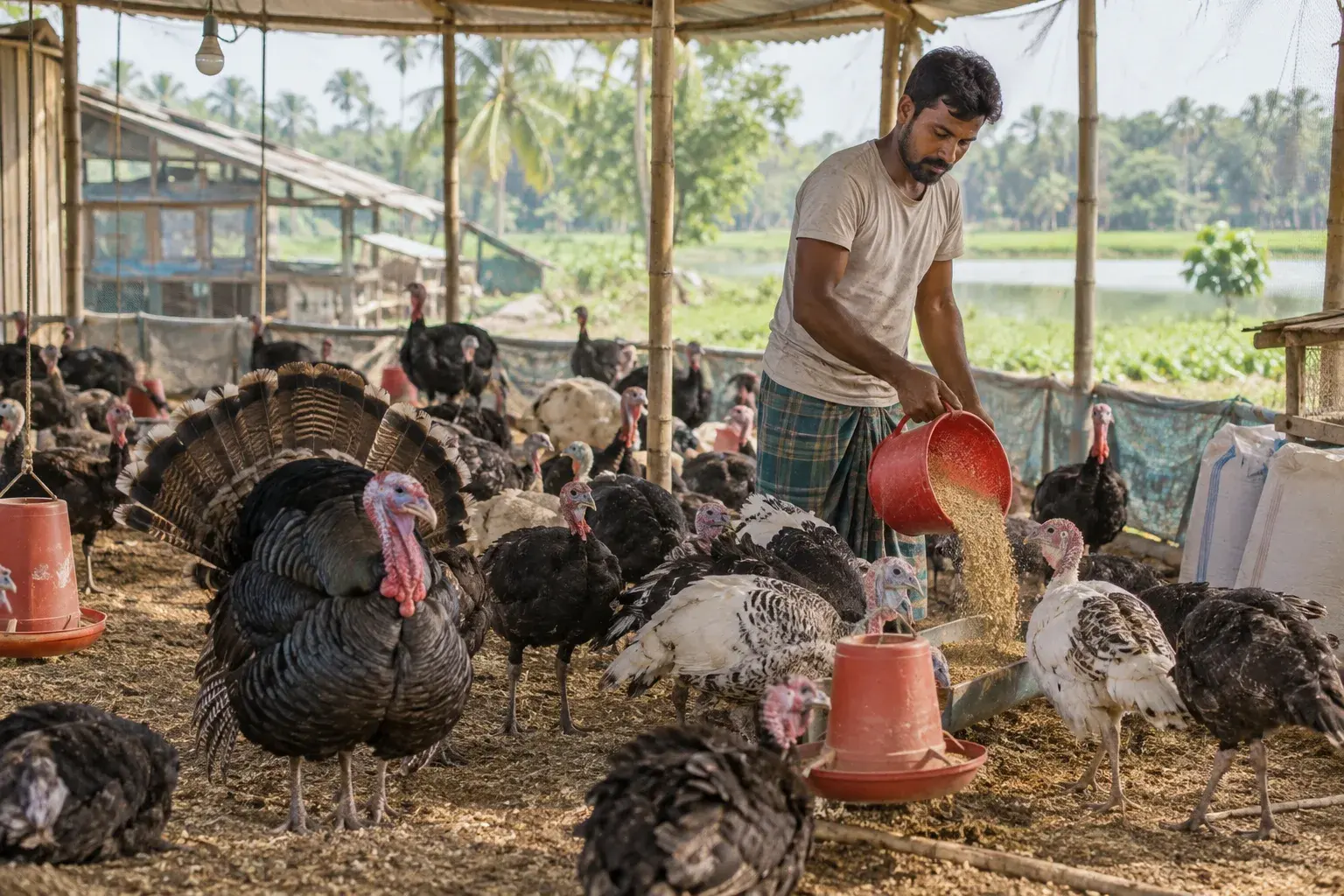
Turkey farming
About 5,000 farms sprang up in the 2015-2020 rush and a few hundred remain. Chick prices fell from Tk 600 to Tk 150 and the livestock department discourages the trade.
- Capital
- ৳1 lakh
- People
- 1 – 3
- First income
- 30 days
 Agriculture & farming
Agar (agarwood) plantation
Growing agar trees, driving nails into them to force the resin, and selling the wood or the attar. The first money arrives 8 to 16 years after planting, and exporting needs a CITES no-objection certificate from the Forest Department.
- Capital
- ৳1 lakh – ৳10 lakh
- People
- 1 – 6
- First income
- 2,555 – 5,840 days
 Agriculture & farming
Plain-land tea growing
Growing tea on flat land, plucking green leaf and selling it to factories for cash. The fixed rate in March 2026 was Tk 28 a kg with the market at Tk 34-35, but up to 40 percent can be cut off the weight.
- Capital
- ৳1 lakh – ৳5 lakh
- People
- 1 – 6
- First income
- 730 – 1,095 days
 Agriculture & farming
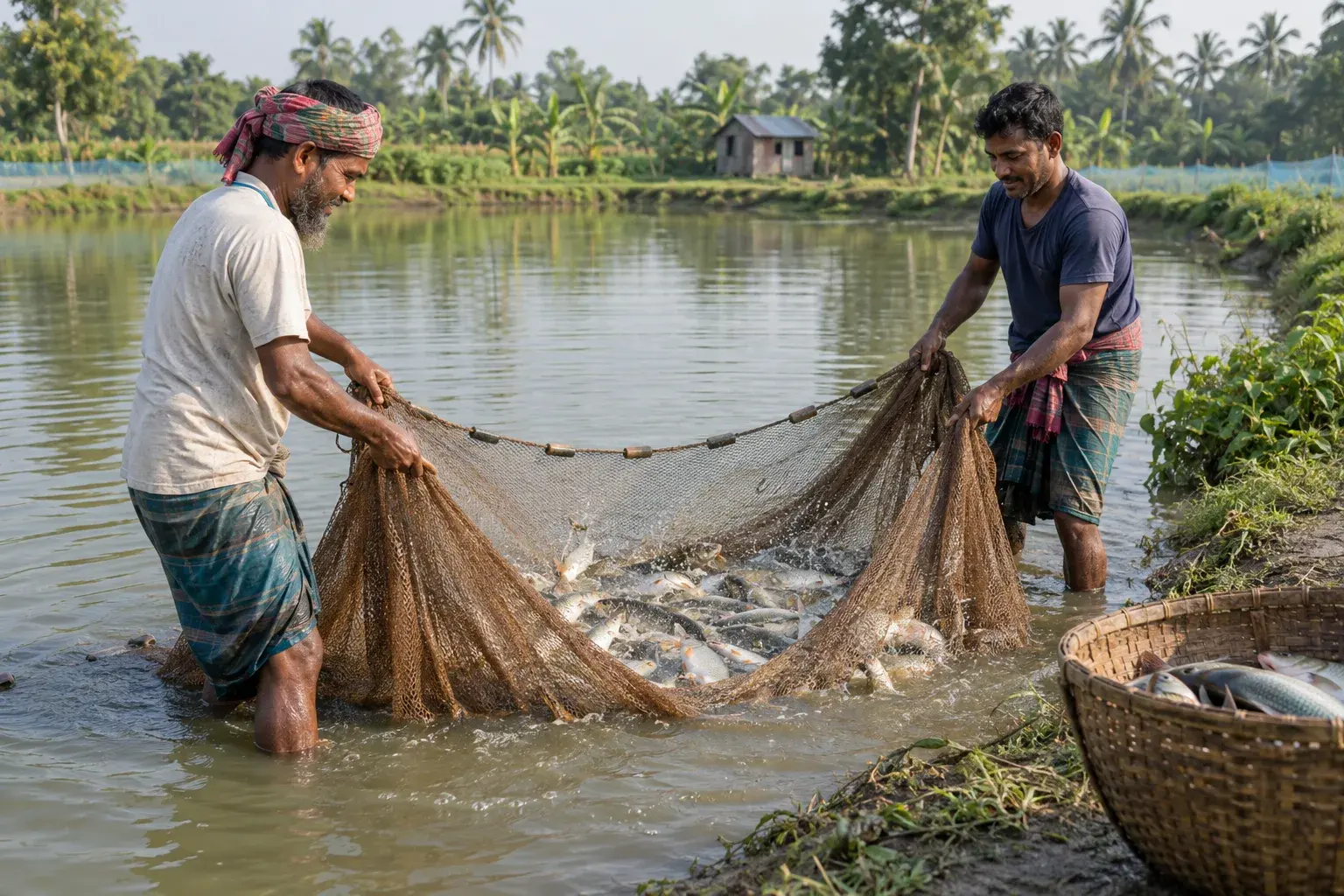
Pond fish farming
The Department of Fisheries measures pond yield at a national average of 4.96 tonnes per hectare: 12.72 in Mymensingh, 2.01 in Rangamati. The district decides the income.
- Capital
- ৳1 lakh – ৳6 lakh
- People
- 1 – 4
- First income
- 240 – 365 days