
Book publishing and printing
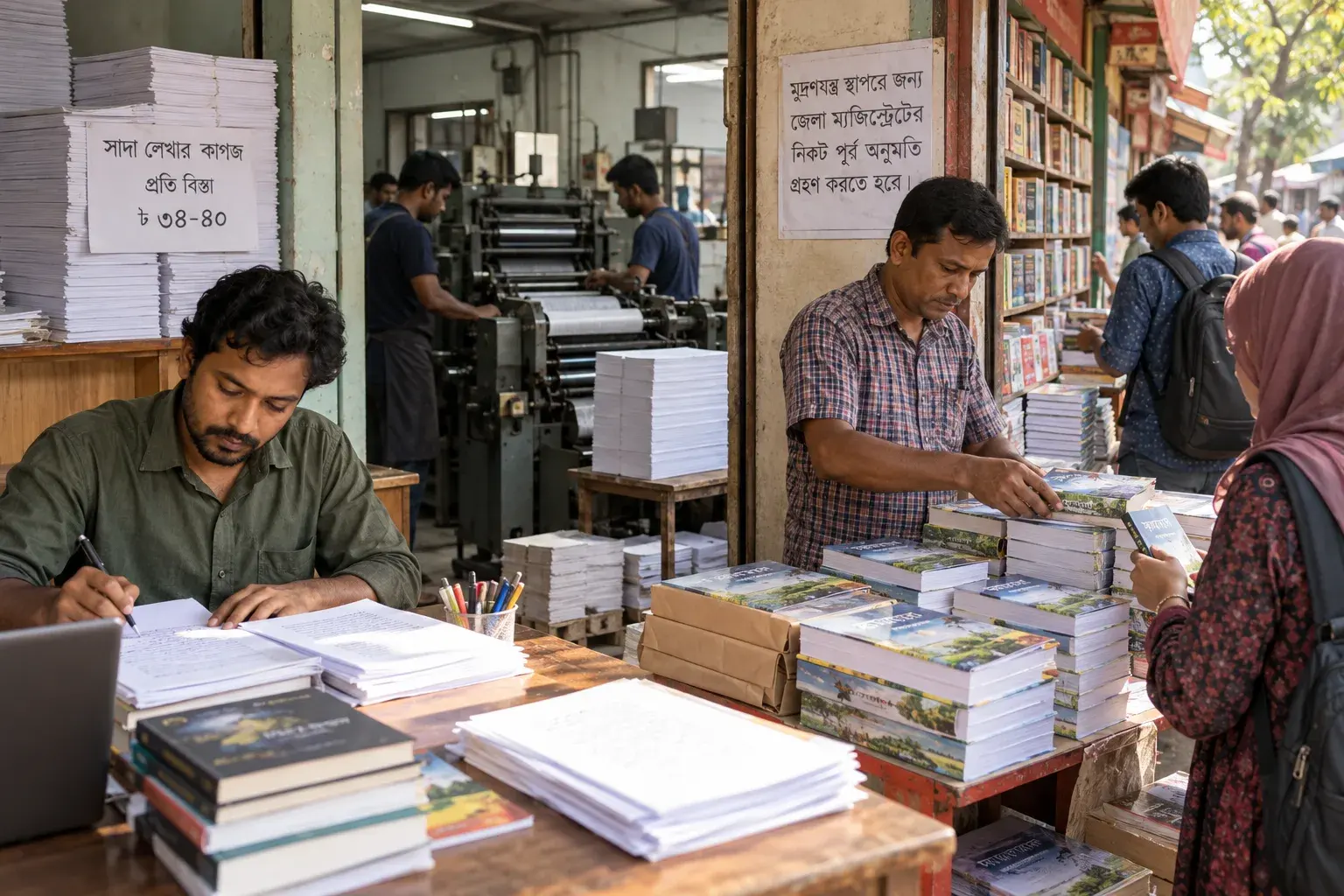
Turning a manuscript into a printed book and getting it to market. White writing paper is Tk 34-40 per dista, and keeping a press requires a declaration before the District Magistrate.
- Last reviewed: 19 September 2026
- Version 1
Book publishing and printing
- Starting capital
- ৳2,00,000 – ৳50,00,000 Editorial estimate
- Manpower
- 2 – 20 people
- First sale
- 60 – 240 days Editorial estimate
- Break-even
- 12 – 36 months Editorial estimate
- Kind of work
- Workshop · Medium difficulty
About the business
Taking a manuscript, printing it as a book and putting it into the market. The work splits in two: the publisher chooses the manuscript, has it edited, gets a cover made and carries the selling; the press buys paper, prints the formas and binds. Some do both, some hand the printing out. Paper is the largest cost: TCB's Dhaka sheet of 15 September 2026 puts white writing paper at Tk 34-40 per dista. When paper rises the cover price cannot rise with it, because the price is already printed on the book, so the whole shock lands on the publisher. The legal side is not light either. Under the Printing Presses and Publications (Declaration and Registration) Act 1973 no one may keep a printing press without making a declaration in Form A before the District Magistrate; failing to do so carries a fine up to Tk 5,000 or simple imprisonment up to six months, or both. Every book must carry the printer's name and the place of printing, and the publisher's name and place of publication if it is published. Within one month of a book leaving the press the printer must supply four free copies to the officer the Government appoints. The money comes late: printing is paid for first, selling happens afterwards, and one month of book fair decides much of the year.
Unit economics
| Item | Range | Evidence | Suggest a correction |
|---|---|---|---|
| Monthly working capital | ৳80,000 – ৳15,00,000 | Editorial estimate | |
| Selling price | ৳150 – ৳300 / unit | Editorial estimate | |
| Variable cost | ৳34 – ৳40 / unit | Official source | |
| Gross margin | 40% – 60% | Editorial estimate | |
| Time to first revenue | 60 – 240 days | Editorial estimate | |
| Break-even time | 12 – 36 months | Editorial estimate | |
| Cash cycle | 60 – 180 days | Editorial estimate | |
| Waste / loss | 10% – 25% | Editorial estimate | |
| Daily capacity | 15 – 130 | Editorial estimate |
What you need to start
- If you print yourself: an offset or digital press, platemaking, a cutting machine and binding. As publisher only, a computer with composing and design software and a dry godown for stock are enough.Equipment
- Paper, the main raw material. White writing paper in Dhaka was Tk 34-40 per dista on 15 September 2026. Plus art paper for covers, board for binding, ink and glue.Starting stock
- Compulsory imprint: every book printed in Bangladesh must legibly carry the printer's name and the place of printing, and, if published, the publisher's name and the place of publication (section 3 of the 1973 Act).Licence
- Four copies to the Government: notwithstanding any agreement between printer and publisher, within one month of a book leaving the press the printer must supply, free of expense, four copies of it with all maps, prints and engravings, finished and coloured like the best copies, to the officer notified by the Government (section 24). Those copies feed the Government's Catalogue of Books.Licence
- Printing press declaration (Form A) before the District Magistrate. Under section 4(1) of the Printing Presses and Publications (Declaration and Registration) Act 1973, no person may keep a press for printing books or papers without making and subscribing a declaration in Form A before the District Magistrate in whose jurisdiction the press lies. A change of location needs a fresh declaration; for a move of not more than sixty days within the same District Magistrate's jurisdiction, with the same keeper, written notice within twenty-four hours suffices. Keeping a press without the declaration carries a fine up to Tk 5,000 or simple imprisonment up to six months, or both.Licence
- Trade licence from the city corporation or municipality: form Tk 10, licence book Tk 50, standard tax Tk 30, stamp Tk 150-300, licence fee Tk 100-60,000 by trade type, plus VAT and signboard fee. Issued in 3-5 working days.Licence
- Judging from a manuscript what will sell, editing and proofing, and costing formas, paper and binding to set the cover price. Once the price is printed it cannot be changed, so an error in that sum loses money on the whole run.Skill
- A wholesale paper supplier, a press if you do not own one, a bindery, and a network of bookshops and distributors.Supplier
How the work is done
- 1Decide whether you are the publisher, the printer, or both. Owning a press means much heavier machine and space costs and the legal declaration falls on you; as publisher only you can have the printing done outside.
- 2If you keep a press, make and subscribe the declaration in Form A before the District Magistrate in whose jurisdiction the press sits. Keeping a press without it is itself an offence.
- 3Take the trade licence from the city corporation or municipality, and have the trade named as printing or publishing.
- 4Choose the manuscript and put the terms with the author in writing: how many copies, what royalty, and who decides on a reprint.
- 5Fix the number of formas and the paper size and get a written quotation from the press. Settle whether you supply the paper or the press does, because that is where it is decided who pays when paper rises.
- 6Buy the paper. On 15 September 2026 white writing paper in Dhaka was Tk 34-40 per dista. Buying by the ream or the tonne before a long run brings the rate down.
- 7Get the cover and the interior laid out, then proof and finalise. Every book must legibly carry the printer's name and place of printing and the publisher's name and place of publication - this is a legal requirement.
- 8Print and bind. Keep the first run small: if the book does not move, every extra copy is money lying in the godown.
- 9Within one month of the book leaving the press, supply four free copies to the officer appointed by the Government, complete with maps and prints, finished like the best copies.
- 10Get the books to shops and distributors. Settle three things in writing first: the discount, whether unsold copies come back, and when you are paid.
- 11Plan early for the February book fair - the stall, the number of copies, the list of new titles. Much of the year is settled in that one month, and that is this trade's greatest weakness.
Seasons
- JanHigh
- FebHigh
- MarNormal
- AprNormal
- MayNormal
- JunNormal
- JulNormal
- AugNormal
- SepNormal
- OctNormal
- NovHigh
- DecHigh
Where it works well
- Strong fitChattogram · Its own cluster of publishers and presses, with paper coming in through the port so supply is close at hand.
- Strong fitDhaka · Banglabazar is the country's publishing and printing centre - paper wholesalers, presses, binderies and distributors in one place - and the February book fair is here too.
- Strong fitGazipur · Larger presses and binderies sit here because space and power cost less than in Dhaka while Banglabazar is still close.
- PossibleBogura · The trading hub of the north; printing work from surrounding districts comes here.
- PossibleCumilla · On the highway, so books move easily towards both Dhaka and Chattogram.
- PossibleKhulna · A divisional city with regular school, college and office printing work.
- PossibleMymensingh · A university and many educational institutions keep demand for study material.
- PossibleNarayanganj · Close to Dhaka with easy transport; printing work is subcontracted here from the capital.
- PossibleRajshahi · A university and college market with steady work in study aids and academic titles.
- PossibleSylhet · Local publishing and a readership among expatriate families, though paper has to come from Dhaka.
Risks and cautions
- HighWorking capital: All the money goes out first and comes back much later. Paper, printing and binding are paid before a single copy sells, and the longer the run the more is locked up. If the book does not move the copies sit in the godown - they do not spoil, but the money does not return either. This is where new publishers die: the pressure to print the next title arrives before the last one has paid for itself.
- HighDemand: Much of the year's selling happens in the single month of the February book fair, and its dates, length and turnout are not in the publisher's hands. If the fair is pushed back or shortened the printed books stay printed while the paper and printing have already been paid for. Standing a whole year on one fair is this trade's structural weakness.
- HighDependency: The cover price gets printed; the paper price does not. Once a run is printed, a rise in paper or ink cannot be passed on until the next edition. White writing paper was Tk 34-40 per dista on 15 September 2026, and even a small move in that figure is a large sum across a long run.
- HighLate payment: Shops and distributors take the stock first and pay after it sells - and in many cases return what does not sell. So a book leaving the godown is not yet a sale, it is a loan. For a small publisher most of the money hangs in that state for much of the year.
- MediumCompliance: Keeping a press requires the declaration before the District Magistrate, and keeping one without it carries a fine up to Tk 5,000 or simple imprisonment up to six months, or both. Moving the press also requires a fresh declaration - and moving because of rent is common in this trade, which is exactly when the rule gets forgotten.
Sources
- Collected: 16 Sept 2026
Supports: Starting capital · বাংলাদেশ
সিটি কর্পোরেশন থেকে ট্রেড লাইসেন্স প্রাপ্তির ধাপ সমূহ
Collected: 16 Sept 2026Supports: Starting capital, Time to first revenue · বাংলাদেশ
- Collected: 15 Sept 2026
Supports: Variable cost · ঢাকা মহানগর — সিপাহীবাগ, মিরপুর-৬, মোহাম্মদপুর টাউন হল, নিউমার্কেট, রামপুরা, মহাখালী বাজার
What changed
No corrections have been published yet.
Questions and answers
No questions yet. Be the first to ask.
Stories about this business
Paper up 30 per cent in a week, and the presses stop
Paper-based inputs rose about 30 per cent in a week just before the book season: white print paper up 25,000 taka a tonne to 135,000-160,000, and newsprint from 64,000 to 85,000.
- Reasons
- Supplier problem, Weak demand
Similar businesses
 Light manufacturing & workshop
Hosiery unit: socks and vests
A factory making vests, socks and sweaters from jhut cloth. Pabna has about a thousand units making 180-200 million pieces a year, but with the land route to India closed 65 percent of the workers are idle.
- Capital
- ৳2 lakh – ৳25 lakh
- People
- 5 – 100
- First income
- 30 – 90 days
 Light manufacturing & workshop
Jute bag making
Buy jute fabric and stitch shopping and gift bags. Corporate orders bring the bigger money.
- Capital
- ৳2 lakh – ৳5 lakh
- People
- 4 – 8
- First income
- 20 – 40 days
 Light manufacturing & workshop
Rubber and plastic sandal making
Melting old shoes and waste plastic into cheap sandals. Bangladesh has 300-400 such factories making over a crore pairs a year, and they retail at Tk 100-500 a pair.
- Capital
- ৳2.5 lakh – ৳25 lakh
- People
- 3 – 25
- First income
- 60 – 180 days
 Light manufacturing & workshop
Small shoe making unit
A small unit making sandals and shoes for wholesalers. Sandals sell at Tk 250-700 and leather shoes at Tk 1,200. Bhairab alone has 3,500-5,000 units employing about 25,000 people.
- Capital
- ৳1.5 lakh – ৳10 lakh
- People
- 4 – 20
- First income
- 30 – 90 days