
Rubber and plastic sandal making
Melting old shoes and waste plastic into cheap sandals. Bangladesh has 300-400 such factories making over a crore pairs a year, and they retail at Tk 100-500 a pair.
- Last reviewed: 19 September 2026
- Version 1

Rubber and plastic sandal making
- Starting capital
- ৳2,50,000 – ৳25,00,000 Editorial estimate
- Manpower
- 3 – 25 people
- First sale
- 60 – 180 days Editorial estimate
- Break-even
- 8 – 14 months Editorial estimate
- Kind of work
- Workshop · Medium difficulty
About the business
From a village haat to a city footpath, the cheapest footwear in Bangladesh means a rubber or plastic sandal. The Bangladesh Footwear Manufacturers Association counts 300-400 sandal factories, of which only ten are large, together making more than a crore pairs a year; about 60 percent of the market is domestic product and most of the other 40 percent is Chinese. In shops and on vans these sandals sell for Tk 100-500 a pair. The most important fact is the raw material: 95 percent of it comes from old shoes and discarded plastic bought from waste pickers and melted down again. No virgin resin needs to be bought, and that is exactly why the price can be this low. But a new problem has appeared - many waste pickers have moved from collecting plastic to driving autorickshaws because it pays better, so the raw material supply is thinning. Design is the other weakness: soles, rubber and decorative flowers come from China shipped separately, which attracts less duty, and local factories survive largely by copying those designs. The monsoon is the real season, because nobody wears leather through mud and water.
Unit economics
| Item | Range | Evidence | Suggest a correction |
|---|---|---|---|
| Monthly working capital | ৳1,40,000 – ৳13,00,000 | Editorial estimate | |
| Selling price | ৳100 – ৳500 / unit | Market quote | |
| Variable cost | ৳55 – ৳230 / unit | Editorial estimate | |
| Gross margin | 25% – 30% | Editorial estimate | |
| Time to first revenue | 60 – 180 days | Editorial estimate | |
| Break-even time | 8 – 14 months | Editorial estimate | |
| Cash cycle | 30 – 90 days | Editorial estimate | |
| Waste / loss | 2% – 5% | Editorial estimate | |
| Daily capacity | 50 – 300 | Editorial estimate |
What you need to start
- Melting and moulding machines plus a separate mould for each model. Bismillah Machinery BD listed a plastic moulding machine at Tk 525,000 on Daraz (16-09-2026); a separate quote for a sandal sole press could not be found.Equipment
- Trade licence from the city corporation or municipality: form Tk 10, licence book Tk 50, standard tax Tk 30, stamp Tk 150-300, licence fee Tk 100-60,000 by trade type. Issued in 3-5 working days and renewed yearly.Licence
- Check with the local offices whether a Fire Service and Civil Defence fire licence and Department of Environment clearance apply to the unit. Melting plastic produces fumes and waste, so this is not something to skip. Fees and validity could not be verified here.Licence
- Running the moulds, holding the melt temperature, and copying a design into a new model fast. The association's own president says local factories bring in Chinese machines to try to improve design.Skill
- Scrap dealers and the waste-picker network supplying old shoes and discarded plastic - 95 percent of this industry's raw material.Supplier
- A rented workshop with power, water and ventilation, plus separate store space for raw material and finished stock.Workspace
How the work is done
- 1Decide the price point first. The Tk 150-200 everyday model is the biggest market and also where the fight with Chinese product is hardest.
- 2Fix the raw material source. Ninety-five percent of this industry's input is old shoes and discarded plastic. Without a direct line to scrap dealers and waste pickers the factory will not run.
- 3Take a rented space with power, water and a store room. Melting and moulding produce heat and fumes, so it is better not to set up inside a residential building.
- 4Take the trade licence from the city corporation or municipality, and check whether a fire licence and Department of Environment clearance apply to the unit as a factory.
- 5Install the machines and moulds. The mould is the real asset here - changing a design means a new mould, and that is the biggest sunk cost.
- 6Make samples and take them to the wholesale market. Footwear wholesalers order from samples, and the first order sets your price.
- 7Build stock before the monsoon. Rain is the real season - in mud and water people drop leather for a cheap sandal.
- 8Keep a separate batch for Eid. Cheap footwear sales jump then, and wholesalers take stock for cash.
- 9Track sales model by model. A model that does not move eats both mould cost and raw material while sitting still.
Seasons
- JanNormal
- FebNormal
- MarNormal
- AprHigh
- MayHigh
- JunHigh
- JulHigh
- AugHigh
- SepHigh
- OctNormal
- NovNormal
- DecNormal
Where it works well
- Strong fitChattogram · The port makes imported soles and rubber easy to get, and there is a large consumer market.
- Strong fitDhaka · The country's biggest footwear wholesale market and its scrap dealers are both here, along with the largest footpath and van trade.
- Strong fitNarayanganj · A dense cluster of small factories, close to Dhaka's wholesale market with a good supply of waste plastic.
- PossibleBogura · The northern wholesale hub, where small machinery and moulds can be made locally.
- PossibleCumilla · On the Dhaka-Chattogram highway, so stock moves both ways easily.
- PossibleGazipur · Factory workers are a large customer base and rented space is cheaper than Dhaka.
- PossibleJashore · Strong demand for cheap sandals in south-western haats and bazaars.
- PossibleRangpur · Lower purchasing power makes this the strongest market for the cheapest sandals.
Risks and cautions
- HighDependency: The raw material supply hangs by one thread. Ninety-five percent of the input is old shoes and plastic gathered by waste pickers, and many of them have switched to driving autorickshaws because it pays better. Less supply means a higher input price, and a Tk 150 sandal has no room to raise its price.
- HighDemand: Chinese product floods the market. Domestic makers hold about 60 percent and most of the other 40 percent is Chinese. The managing director of Pacific Plastic says plainly that they cannot match Chinese design, and because soles, rubber and flowers are shipped separately from China they attract less duty, so Chinese goods also win on price.
- MediumWorking capital: Money locks up in moulds. Every new model needs a new mould, and if the model does not sell that money does not come back. A single plastic moulding machine is listed at Tk 525,000 on Daraz, and for a small unit that is the biggest exposure.
- MediumOther: The season is short. In the association president's words the monsoon is the real season. Sales are thin the rest of the year while wages and rent run all twelve months, so a dry year or a late monsoon upsets the whole year's arithmetic.
Sources
সিটি কর্পোরেশন থেকে ট্রেড লাইসেন্স প্রাপ্তির ধাপ সমূহ
Collected: 16 Sept 2026Supports: Starting capital · বাংলাদেশ
What changed
No corrections have been published yet.
Questions and answers
No questions yet. Be the first to ask.
Similar businesses
 Light manufacturing & workshop
Computer embroidery unit
Machine-stitching thread designs onto cloth as a job for others. The customers are cap factories, boutiques and saree workshops. What takes fifteen days by hand, the machine does in hours.
- Capital
- ৳3 lakh – ৳12 lakh
- People
- 2 – 30
- First income
- 30 – 90 days
 Light manufacturing & workshop
Hosiery unit: socks and vests
A factory making vests, socks and sweaters from jhut cloth. Pabna has about a thousand units making 180-200 million pieces a year, but with the land route to India closed 65 percent of the workers are idle.
- Capital
- ৳2 lakh – ৳25 lakh
- People
- 5 – 100
- First income
- 30 – 90 days
 Light manufacturing & workshop
Carton and box making
A unit making corrugated cartons and boxes. Small parcel cartons retail at Tk 24-40 each, and the 350,000-400,000 parcels moving daily are the biggest market.
- Capital
- ৳3 lakh – ৳30 lakh
- People
- 4 – 30
- First income
- 45 – 120 days
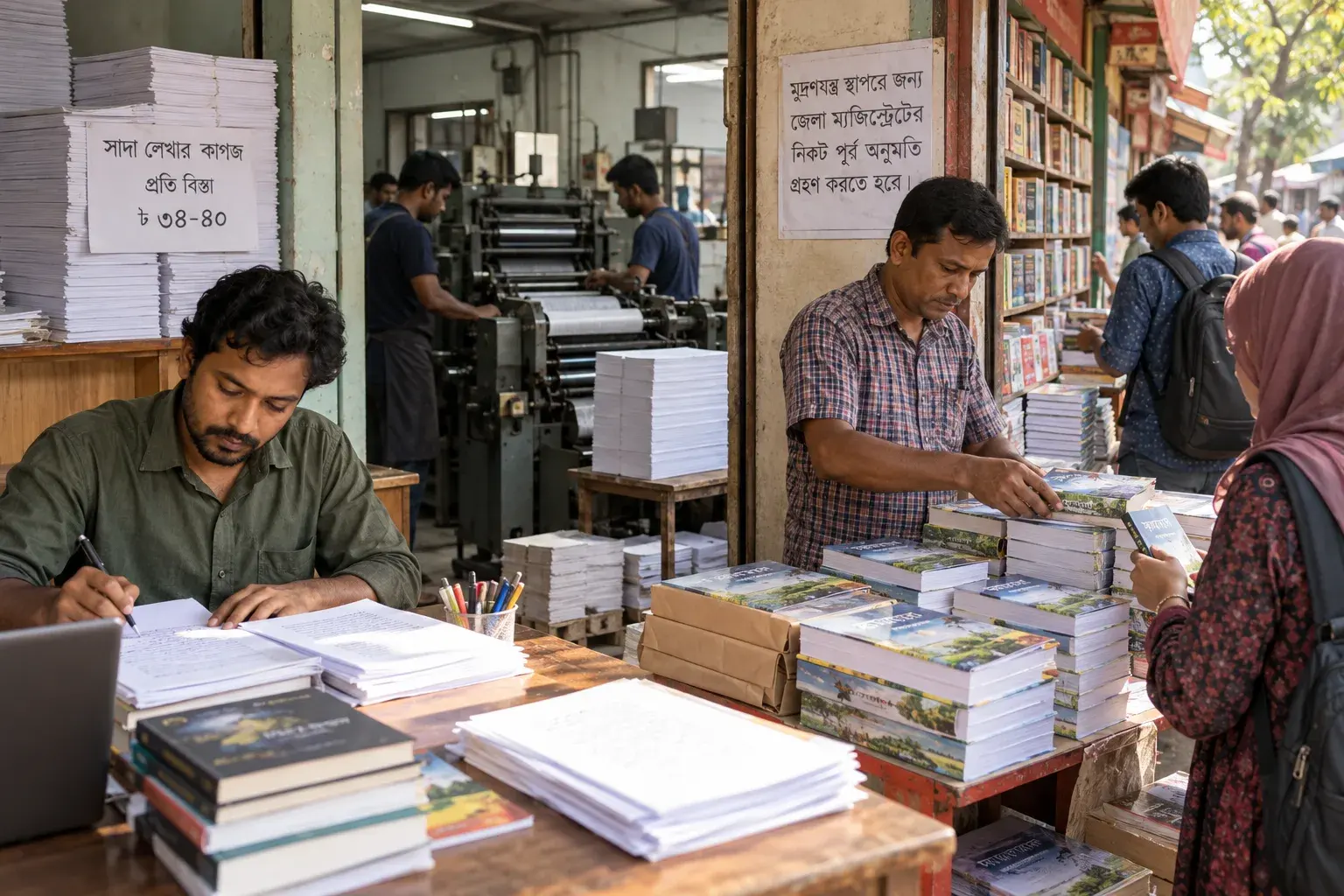 Light manufacturing & workshop
Book publishing and printing
Turning a manuscript into a printed book and getting it to market. White writing paper is Tk 34-40 per dista, and keeping a press requires a declaration before the District Magistrate.
- Capital
- ৳2 lakh – ৳50 lakh
- People
- 2 – 20
- First income
- 60 – 240 days