
Hosiery unit: socks and vests
A factory making vests, socks and sweaters from jhut cloth. Pabna has about a thousand units making 180-200 million pieces a year, but with the land route to India closed 65 percent of the workers are idle.
- Last reviewed: 19 September 2026
- Version 1

Hosiery unit: socks and vests
- Starting capital
- ৳2,00,000 – ৳25,00,000 Editorial estimate
- Manpower
- 5 – 100 people
- First sale
- 30 – 90 days Editorial estimate
- Break-even
- 6 – 12 months Editorial estimate
- Kind of work
- Workshop · Medium difficulty
About the business
A small factory making vests, socks, singlets, sweaters and children's clothes. The centre of this trade in Bangladesh is Pabna, and its story is worth knowing. It began about two hundred years ago on the bank of the Ichamati with cotton-yarn vests, all but collapsed in 1972, and was reborn around 1990 -- not from yarn this time but from jhut, the offcuts thrown away by garment factories. Buy jhut from the mills of Dhaka, Chattogram and Gazipur, cut and stitch it, and you have vests, socks and shirts in export-quality cloth. In 2024 Pabna had about a thousand registered jhut factories employing 50,000 to 60,000 people, making 180 to 200 million pieces a year and turning over Tk 1,200 to 1,500 crore. Then the land route to India closed and everything turned over. Sixty-five percent of the country's hosiery exports went from Pabna, more than a hundred truckloads a week. Now it is seven or eight, by sea, around through Chattogram port. The land route delivered in two or three days and paid in five; the sea route takes 20 to 25 days and pays in 30 to 35. The District Hosiery Manufacturers Group says 65 percent of the workers in its three thousand factories are now out of work.
Unit economics
| Item | Range | Evidence | Suggest a correction |
|---|---|---|---|
| Monthly working capital | ৳1,50,000 – ৳12,00,000 | Editorial estimate | |
| Selling price | ৳60 – ৳83 / unit | Editorial estimate | |
| Variable cost | ৳42 – ৳55 / unit | Editorial estimate | |
| Gross margin | 30% – 34% | Editorial estimate | |
| Time to first revenue | 30 – 90 days | Editorial estimate | |
| Break-even time | 6 – 12 months | Editorial estimate | |
| Cash cycle | 5 – 35 days | Practitioner verified | |
| Waste / loss | 3% – 8% | Editorial estimate | |
| Daily capacity | 600 – 670 | Editorial estimate |
What you need to start
- Cutting table and cutter, sewing and overlock machines, knitting machines for socks, printing kit, laundry and ironing, and packing equipment. Second-hand machines can start the unit; no documented price for new or used machines could be found.Equipment
- Jhut cloth bought from garment factories in Dhaka, Chattogram and Gazipur. Because the cloth is export quality, garments made from it sell well. No published price for jhut could be found.Starting stock
- TIN and VAT registration from the National Board of Revenue, and for export an Export Registration Certificate from the Export Promotion Bureau plus an exporter's bank account. The EPB fee and validity could not be verified.Licence
- Trade licence from the city corporation or municipality: form Tk 10, licence book Tk 50, standard tax Tk 30, stamp Tk 150-300, licence fee Tk 100-60,000 by trade type, in 3-5 working days.Licence
- The cutting master's skill. Jhut comes in small pieces, so cutting to size with least waste is where the money is. Stitching, overlocking and printing can be taught, but a cutting master takes years to make.Skill
- Jhut traders such as those in Sadhupara in Pabna, a yarn and elastic shop, and a supplier of printing colours.Supplier
- Separate space for cutting, stitching, dyeing and printing, laundry and packing, with uninterrupted power, plus a godown for jhut and finished goods.Workspace
How the work is done
- 1Decide what you will make: socks, vests, singlets or sweaters. Socks need their own machines and the cutting and stitching differ.
- 2Fix your jhut source. It is bought from garment factories in Dhaka, Chattogram and Gazipur, and graded cloth is available in jhut markets like Sadhupara in Pabna.
- 3Take a shed with separate space for cutting, stitching, dyeing and printing, laundry and packing. Make sure the power supply is steady.
- 4Take the trade licence from the city corporation or municipality and get listed with the District Hosiery Manufacturers Group, which is where market news and prices come from.
- 5Buy the machines: cutting table and cutter, sewing and overlock machines, separate knitting machines for socks, and printing kit. Starting with second-hand machines cuts the capital sharply.
- 6Hire a skilled cutting master. Jhut comes in small pieces, so who wastes least in cutting is where the profit in this business lies.
- 7Make samples and show them to wholesalers. The district hosiery market and the Dhaka wholesale arots are the first market.
- 8To export, register with EPB, open an exporter's account at the bank and settle the LC or advance terms with the buyer beforehand.
- 9Plan your cash around the route and its timing. By sea the goods take 20-25 days and the money 30-35, and you need enough in hand to run through it.
- 10Do not depend on buyers in one country. Pabna's units leaned on India, and a single decision there put 65 percent of the workers out of a job.
- 11Plan separately for the months before winter, when sweaters, socks and full-sleeve vests sell hardest.
Seasons
- JanHigh
- FebNormal
- MarNormal
- AprNormal
- MayNormal
- JunNormal
- JulLow
- AugLow
- SepNormal
- OctHigh
- NovHigh
- DecHigh
Where it works well
- Strong fitDhaka · The biggest wholesale market and buyer base, and where the export paperwork and banking happen.
- Strong fitGazipur · The densest concentration of garment factories, so jhut is cheapest and freshest here.
- Strong fitNarayanganj · A large jhut and yarn market with the wholesale cloth arots close by.
- Strong fitPabna · The centre of the country's hosiery trade, with jhut markets at Sadhupara, Banglabazar and Dilalpur and about a thousand registered units.
- PossibleChattogram · Jhut from the garment mills, and the port nearby makes sea export easier.
- PossibleJashore · The district of the Benapole land port, which would gain most if the land route reopens.
- PossibleKushtia · An old textile and handloom area where workers are easy to find.
- PossibleNatore · Beside Pabna, convenient for both buying jhut and wholesaling.
- PossibleRajshahi · The divisional city's retail and wholesale market, close to the Pabna units.
- PossibleSirajganj · A weaving and textile district next to Pabna, with both skilled labour and jhut supply close at hand.
Risks and cautions
- HighDependency: Dependence on one market broke this industry. Sixty-five percent of the country's hosiery exports went from Pabna, more than a hundred truckloads a week earning 150,000 to 200,000 US dollars. Since the land route closed it is seven or eight trucks a week. The District Hosiery Manufacturers Group says 65 percent of the workers across about three thousand units are now idle. One owner who built a 400-worker factory on a bank loan went bankrupt, and Johnny Garments has gone from 500 workers to 200.
- HighLate payment: Export money now takes 30-35 days where it once took five. Through all of it, wages, jhut purchases and electricity bills come out of the owner's pocket. For anyone carrying a bank or NGO instalment, those extra 25 days are enough to sink the business.
- HighWorking capital: Production does not stop when sales do, and the godown fills up. Pabna's factories are holding finished stock in their stores and showrooms and sacks of unsold jhut besides. One jhut trader with no sales for a year and a half laid off ten of his fifteen staff. Money locked in stock is money not available for the next order.
- MediumDemand: Sales run on seasons. Sweaters, socks and full-sleeve vests sell before winter and children's clothes before Eid. The rest of the year is slow, yet the unit has to keep running to hold its workers, or the skilled hands are gone when the season comes.
- MediumCompliance: The paperwork and the route for export are not in the trader's hands. Whether a land port stays open and what conditions attach to which goods are state decisions that change overnight. Those who built factories on the arithmetic of the land route had no fallback.
Sources
সিটি কর্পোরেশন থেকে ট্রেড লাইসেন্স প্রাপ্তির ধাপ সমূহ
Collected: 16 Sept 2026Supports: Starting capital · বাংলাদেশ
What changed
No corrections have been published yet.
Questions and answers
No questions yet. Be the first to ask.
Stories about this business
The land route closed, a 400-worker hosiery factory shut, and the owner went under
A bank-financed hosiery factory employing about 400 people closed after overland exports to India stopped. Across the district's roughly 3,000 units, about 65 percent of more than a lakh of workers are now out of work.
- Reasons
- Dependency, Late payment
Similar businesses
 Light manufacturing & workshop
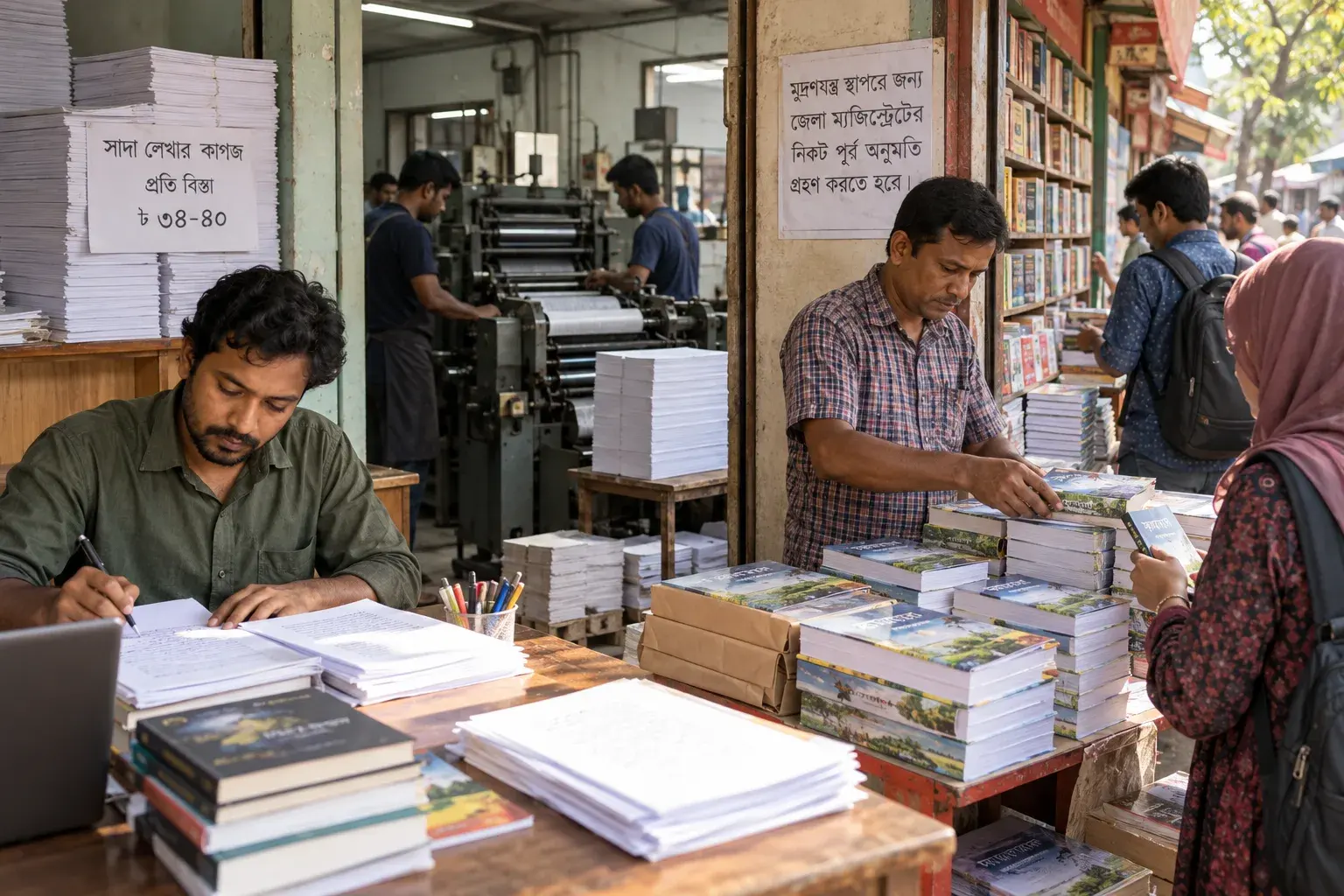
Book publishing and printing
Turning a manuscript into a printed book and getting it to market. White writing paper is Tk 34-40 per dista, and keeping a press requires a declaration before the District Magistrate.
- Capital
- ৳2 lakh – ৳50 lakh
- People
- 2 – 20
- First income
- 60 – 240 days
 Light manufacturing & workshop
Jute bag making
Buy jute fabric and stitch shopping and gift bags. Corporate orders bring the bigger money.
- Capital
- ৳2 lakh – ৳5 lakh
- People
- 4 – 8
- First income
- 20 – 40 days
 Light manufacturing & workshop
Rubber and plastic sandal making
Melting old shoes and waste plastic into cheap sandals. Bangladesh has 300-400 such factories making over a crore pairs a year, and they retail at Tk 100-500 a pair.
- Capital
- ৳2.5 lakh – ৳25 lakh
- People
- 3 – 25
- First income
- 60 – 180 days
 Light manufacturing & workshop
Small shoe making unit
A small unit making sandals and shoes for wholesalers. Sandals sell at Tk 250-700 and leather shoes at Tk 1,200. Bhairab alone has 3,500-5,000 units employing about 25,000 people.
- Capital
- ৳1.5 lakh – ৳10 lakh
- People
- 4 – 20
- First income
- 30 – 90 days