
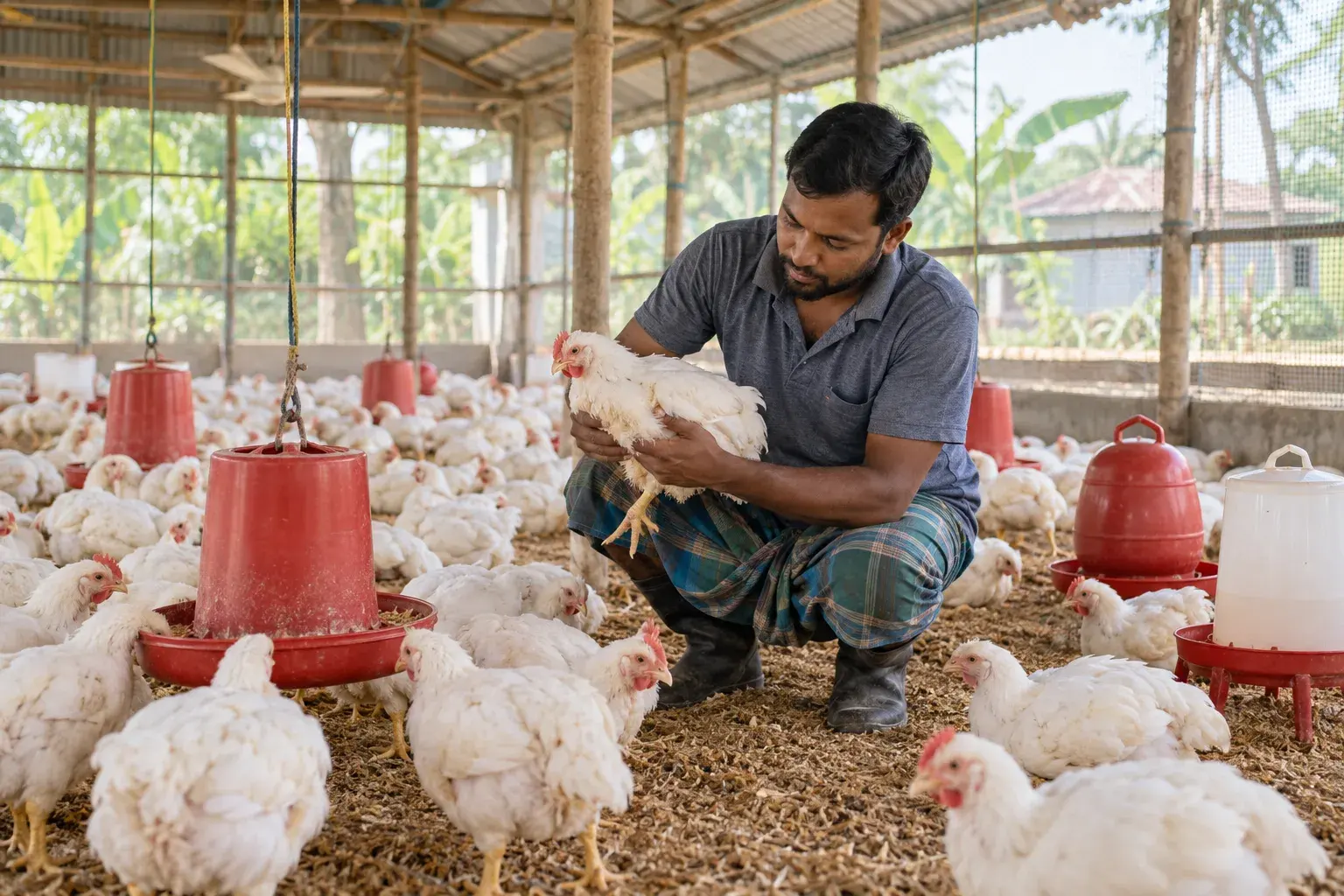
Broiler poultry farm
Raising day-old chicks to live birds in about a month. Farm-gate prices swung from Tk 110 to Tk 198 a kg during 2026 against a production cost of roughly Tk 140.
- Last reviewed: 19 September 2026
- Version 1
Broiler poultry farm
- Starting capital
- ৳1,50,000 – ৳6,00,000 Editorial estimate
- Manpower
- 1 – 3 people
- First sale
- 32 – 60 days Editorial estimate
- Break-even
- 6.5 – 13.5 months Editorial estimate
- Kind of work
- Farm · Hard
About the business
Take day-old chicks, feed them for a little over a month, and sell live birds. What the farmer controls is labour and cleanliness; the two numbers that decide the result - the chick price and the feed price - he does not control, and both move several times a year. A day-old broiler chick was Tk 22-25 in December 2025, Tk 30-40 in January and Tk 80-85 by mid-February 2026, even though the government maximum was Tk 69; by June the same chick was Tk 15. Feed only goes one way: on 7 September 2026 a 50 kg sack of broiler starter and grower went from Tk 3,300 to Tk 3,450, and feed is about 80 percent of a farm's total cost. The selling side is just as unstable. Live broiler at the farm was Tk 180-198 a kg in March 2026 and Tk 110-120 in June after Qurbani Eid, against a production cost of about Tk 140. One farmer in Mirsarai lost Tk 70,000 on a single batch of 1,000 birds. Dhaka retail on 15 September 2026 was Tk 180-200, up 7 percent in a year, but the farmer does not get that price - he gets the farm gate. Only someone who can absorb two losing batches in a row has a real chance of staying in this.
Unit economics
| Item | Range | Evidence | Suggest a correction |
|---|---|---|---|
| Monthly working capital | ৳15,000 – ৳85,000 | Market quote | |
| Selling price | ৳110 – ৳198 / kg | Market quote | |
| Variable cost | ৳140 / kg | Market quote | |
| Gross margin | -27% – 29% | Editorial estimate | |
| Time to first revenue | 32 – 60 days | Editorial estimate | |
| Break-even time | 6.5 – 13.5 months | Editorial estimate | |
| Cash cycle | 0 – 1 days | Editorial estimate | |
| Waste / loss | 3% – 8% | Editorial estimate | |
| Daily capacity | 35 – 150 | Editorial estimate |
What you need to start
- A brooder with gas or electric heating, feeders, drinkers, fans, husk or sawdust litter, and a weighing scale.Equipment
- Day-old chicks and broiler feed. From 7 September 2026 a 50 kg sack of broiler starter and grower is Tk 3,450, with some specialised feeds up to Tk 3,675.Starting stock
- Farm registration at the Upazila Livestock Officer's office. In Mirsarai only about 400 of some 2,000 farms are registered, so registration exists but most farmers skip it. Ask your own upazila office for the fee and validity.Licence
- Trade licence from the union parishad, municipality or city corporation: form Tk 10, licence book Tk 50, standard tax Tk 30, stamp Tk 150-300, licence fee Tk 100-60,000 by trade type.Licence
- Brooding, vaccination, heat management and spotting disease. The first week's care and hot-weather management decide the mortality.Skill
- A hatchery or chick dealer, a feed dealer, and the live-bird traders who come to the gate. Chick prices are set by a handful of companies.Supplier
- A shed on dry raised ground away from housing, with water and electricity. Without cross-ventilation birds die at midday in the heat.Workspace
How the work is done
- 1Put the shed on dry raised ground a little away from housing, with water and electricity nearby and proper cross-ventilation.
- 2Register the farm with the Upazila Livestock Officer and take a trade licence. Many farms stay unregistered, and that puts them outside government advice, vaccination support and any relief.
- 3Fix a feed dealer before you take chicks, and get it in writing: how much extra a sack costs on credit and by when it must be cleared.
- 4Decide the day you take chicks by the price, not by impatience. Chicks at Tk 80-85 do not pay unless the bird sells at Tk 180.
- 5Disinfect the shed and warm the brooder before the chicks arrive. Most of the deaths happen in the first seven days.
- 6Get the vaccination schedule from the upazila livestock office and follow it by date, and write down the day's deaths in a register.
- 7In hot weather cool the shed at midday with fans, wet sacking and water, and arrange beforehand that air does not stop when the power goes.
- 8Record the sacks of feed used and the weight gained every day. The ratio between those two numbers tells you early whether the batch is going to pay.
- 9Take quotes from at least three traders before selling, and consider selling in parts rather than emptying the shed in one day.
- 10After each batch empty the shed completely, wash it, disinfect it and leave it idle for some days. Disease carried from the last batch into the new chicks finishes the whole lot.
Seasons
- JanNormal
- FebHigh
- MarHigh
- AprNormal
- MayNormal
- JunLow
- JulLow
- AugNormal
- SepNormal
- OctNormal
- NovNormal
- DecLow
Where it works well
- Strong fitChattogram · Mirsarai upazila alone has around 2,000 farms, a working farm association, and heavy trader movement along the Dhaka-Chattogram highway.
- Strong fitGazipur · Next to Dhaka, so traders and arat buyers come daily and chick and feed dealers are close at hand.
- Strong fitMymensingh · A dense belt of farms and feed mills along the Dhaka-Mymensingh highway, with easy delivery into Dhaka.
- Strong fitNarsingdi · Farmers in Shibpur sold at Tk 180-198 a kg before Ramadan; being close to the Dhaka market keeps prices comparatively good.
- PossibleBogura · The northern trading hub, where arats and transport are easy to find, though local prices run below Dhaka.
- PossibleCumilla · On the Dhaka-Chattogram highway, so birds can go to either the Dhaka or the Chattogram market.
- PossibleDinajpur · A maize-growing area so feed raw material is nearby, but sending live birds to distant markets is costly.
- PossibleRangpur · Farm-gate prices in the north fell to Tk 110-120 a kg in June 2026; being far from the big consumer markets, a price crash hits harder here.
- PossibleTangail · Sits where the Dhaka-Mymensingh and northern highways meet, and birds reach Dhaka in a few hours.
Risks and cautions
- HighDemand: Selling below cost is routine here. The farm-gate price was Tk 180-198 a kg in March 2026 and Tk 110-120 in June after Qurbani Eid, against a production cost of about Tk 140. For weeks after Qurbani households still have stored meat and chicken demand falls away. One Mirsarai farmer lost Tk 70,000 on a single batch of 1,000 birds.
- HighDependency: The chick price is out of the farmer's hands and can triple in two months: Tk 22-25 in December 2025, Tk 30-40 in January and Tk 80-85 by mid-February, sold above the government maximum of Tk 69. The president of the Mirsarai poultry farm association says four or five companies control it. By June the same chick was Tk 15.
- HighWorking capital: Feed is about 80 percent of the cost and its price only rises. On 7 September 2026 a 50 kg sack of broiler starter and grower went from Tk 3,300 to Tk 3,450, Tk 2-3 a kg, with maize up from Tk 29-30 to Tk 49 a kg. Most farmers take feed on credit, so two losing batches leave a large debt to the dealer - one farmer's had reached Tk 600,000.
- MediumCompliance: The government set a maximum day-old chick price of Tk 69, yet chicks sold at Tk 80-85 in February 2026, and the upazila livestock officer said the decision is taken centrally and is out of his hands. On the other side, an unregistered farm does not appear on any government support list - only 400 of some 2,000 farms in Mirsarai are registered.
Sources
সিটি কর্পোরেশন থেকে ট্রেড লাইসেন্স প্রাপ্তির ধাপ সমূহ
Collected: 16 Sept 2026Supports: Starting capital · বাংলাদেশ
- Collected: 15 Sept 2026
Supports: Selling price · ঢাকা মহানগর — সিপাহীবাগ, মিরপুর-৬, মোহাম্মদপুর টাউন হল, নিউমার্কেট, রামপুরা, মহাখালী বাজার
What changed
No corrections have been published yet.
Questions and answers
No questions yet. Be the first to ask.
Stories about this business
300 chicks for 15,000 taka grew into a 40-lakh farm earning 8 lakh a year
He fenced off his own yard and began with 300 chicks bought for 15,000 taka. Seven years on, about 40 lakh taka is tied up in the farm and it earns around 8 lakh a year.
- Capital
- ৳15k
- Reasons
- Working capital
Similar businesses
 Agriculture & farming
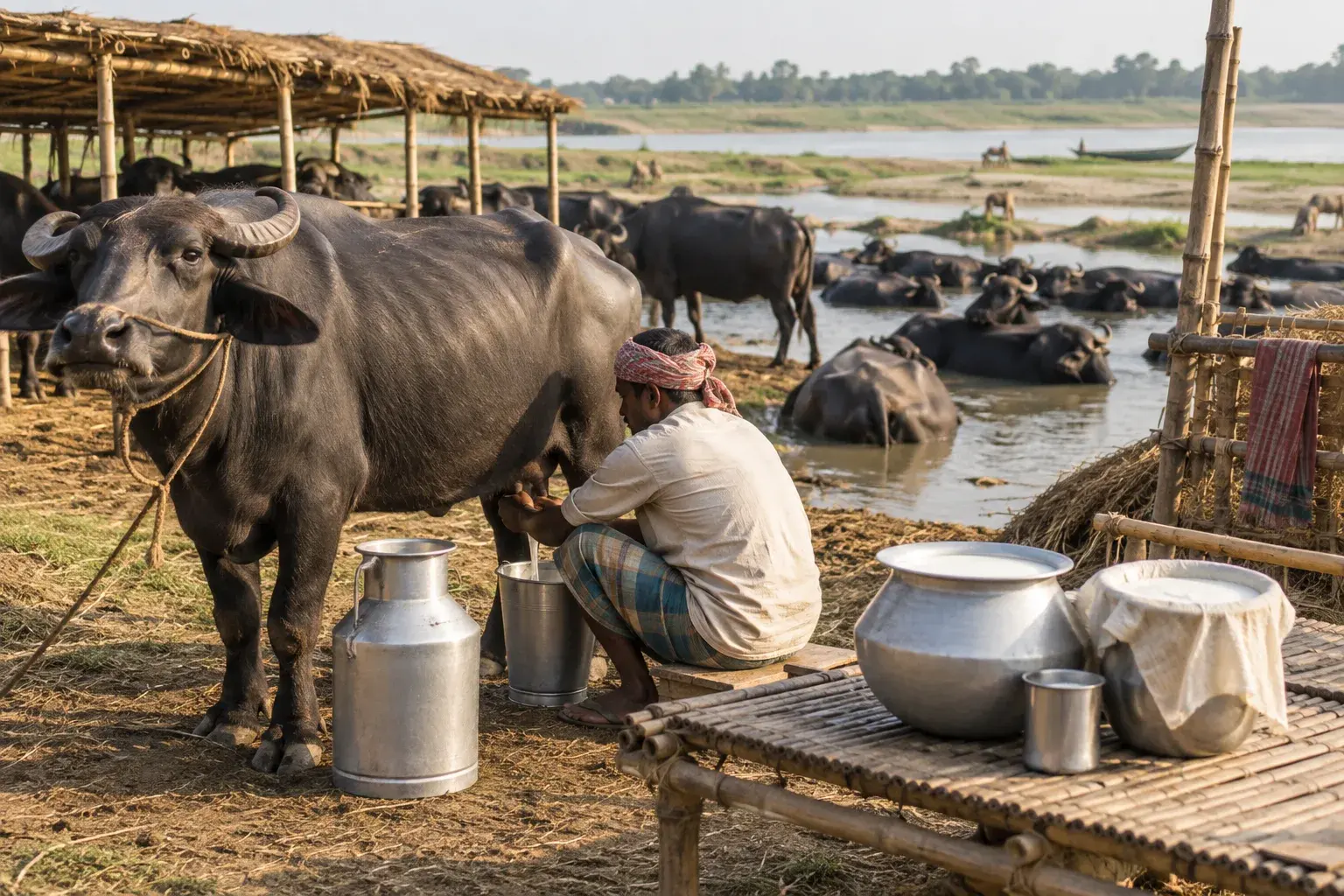
Buffalo rearing
Keeping buffalo on the chars or in a bathan herd and selling the milk. A buffalo gives 4 to 8 kg of milk a day and buffalo milk fetches Tk 80 to 130 a litre, but only in districts where there are curd and sweet makers to buy it.
- Capital
- ৳1.5 lakh – ৳10 lakh
- People
- 1 – 5
- First income
- 1 – 365 days
 Agriculture & farming
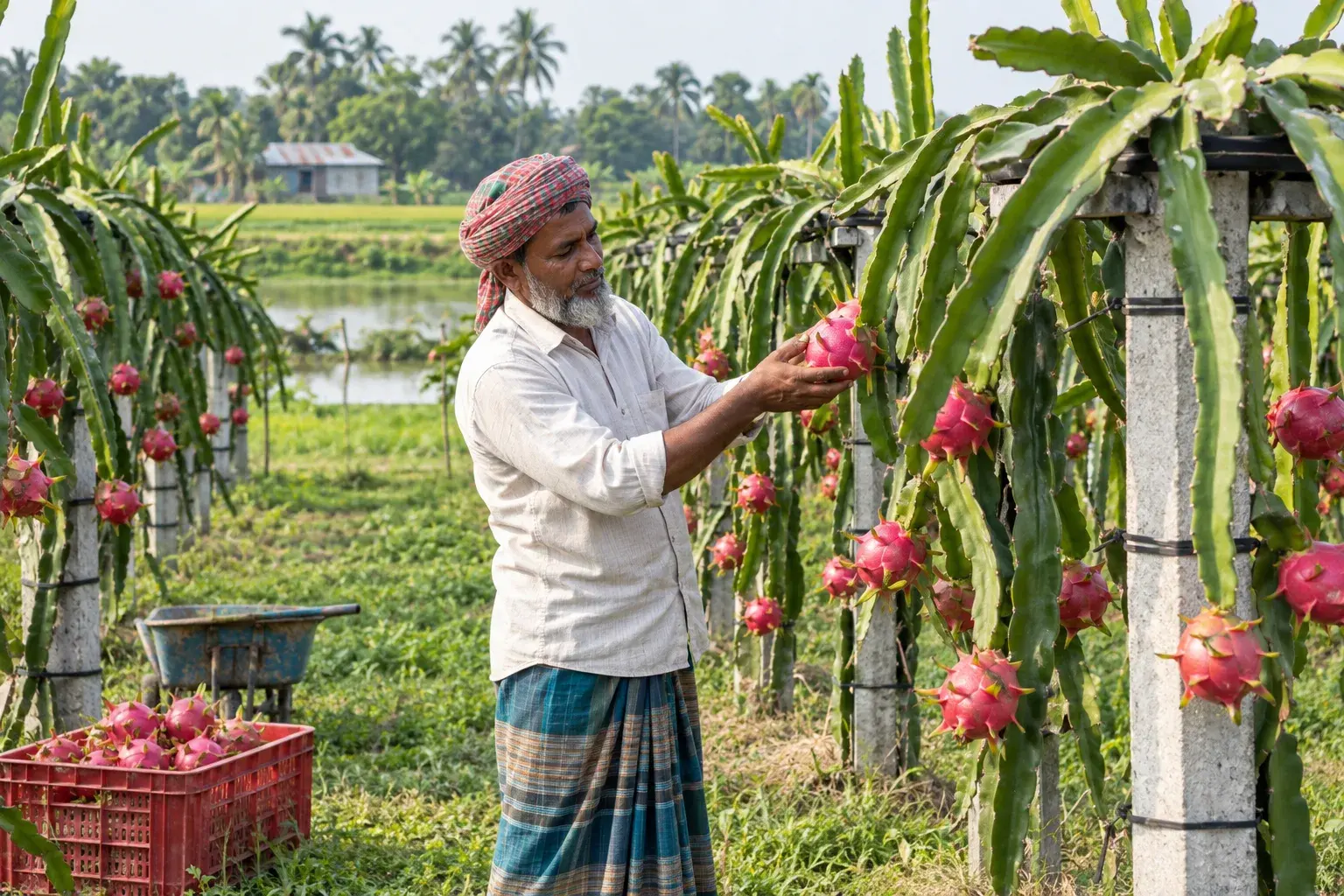
Dragon fruit farming
Growing dragon fruit on posts. One to four lakh taka a bigha up front, first fruit about a year later, and a price that has fallen from Tk 500 to Tk 80-100 a kilo in Karwan Market.
- Capital
- ৳1.5 lakh – ৳4 lakh
- People
- 1 – 4
- First income
- 365 days
 Agriculture & farming
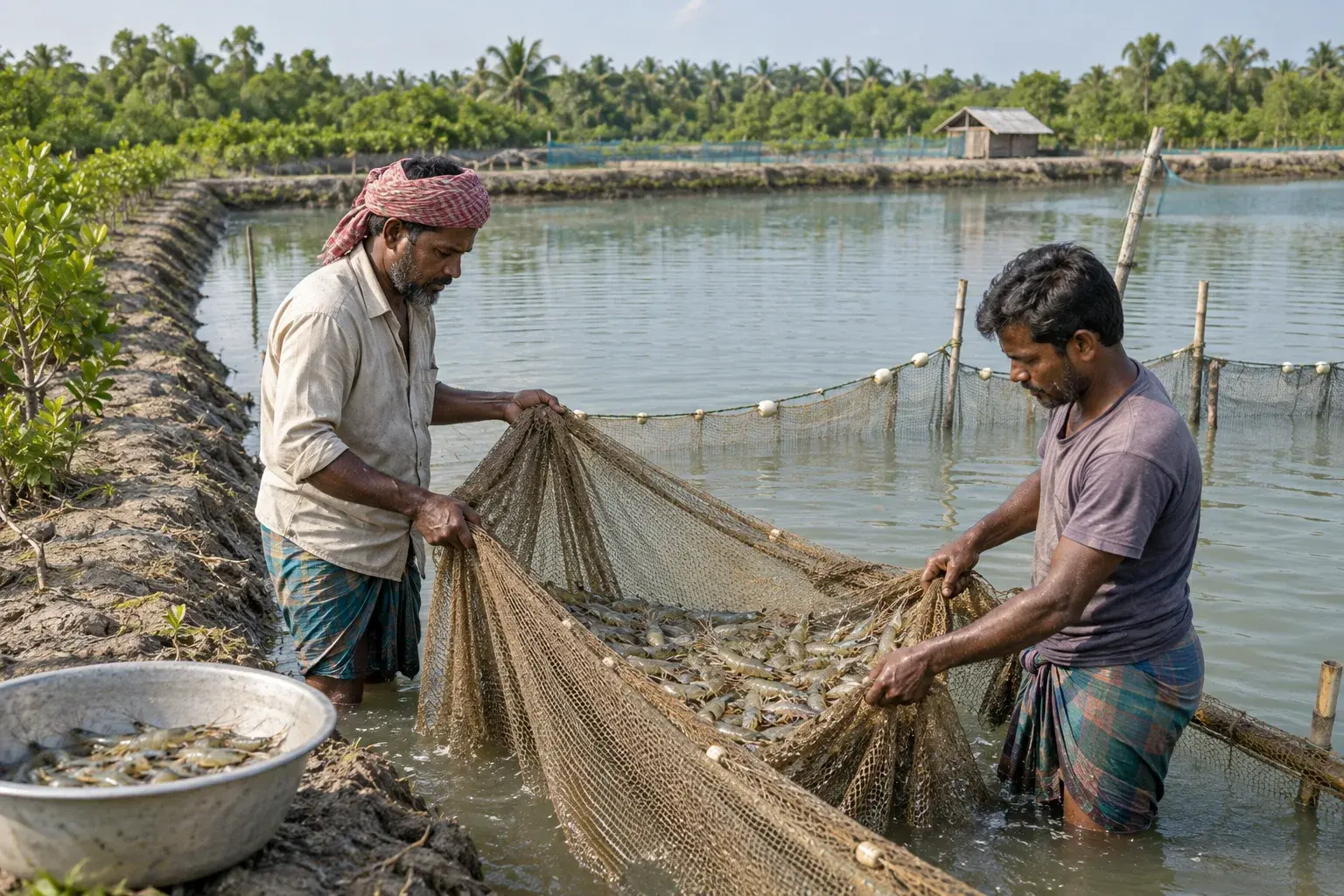
Shrimp farming (gher)
Farming bagda and golda in embanked saline ponds. Fry has gone from Tk 1,300-1,700 to about Tk 3,000 per thousand this season and southern hatcheries have fallen from 78 to 37.
- Capital
- ৳1.5 lakh – ৳6 lakh
- People
- 1 – 5
- First income
- 90 – 150 days
 Agriculture & farming
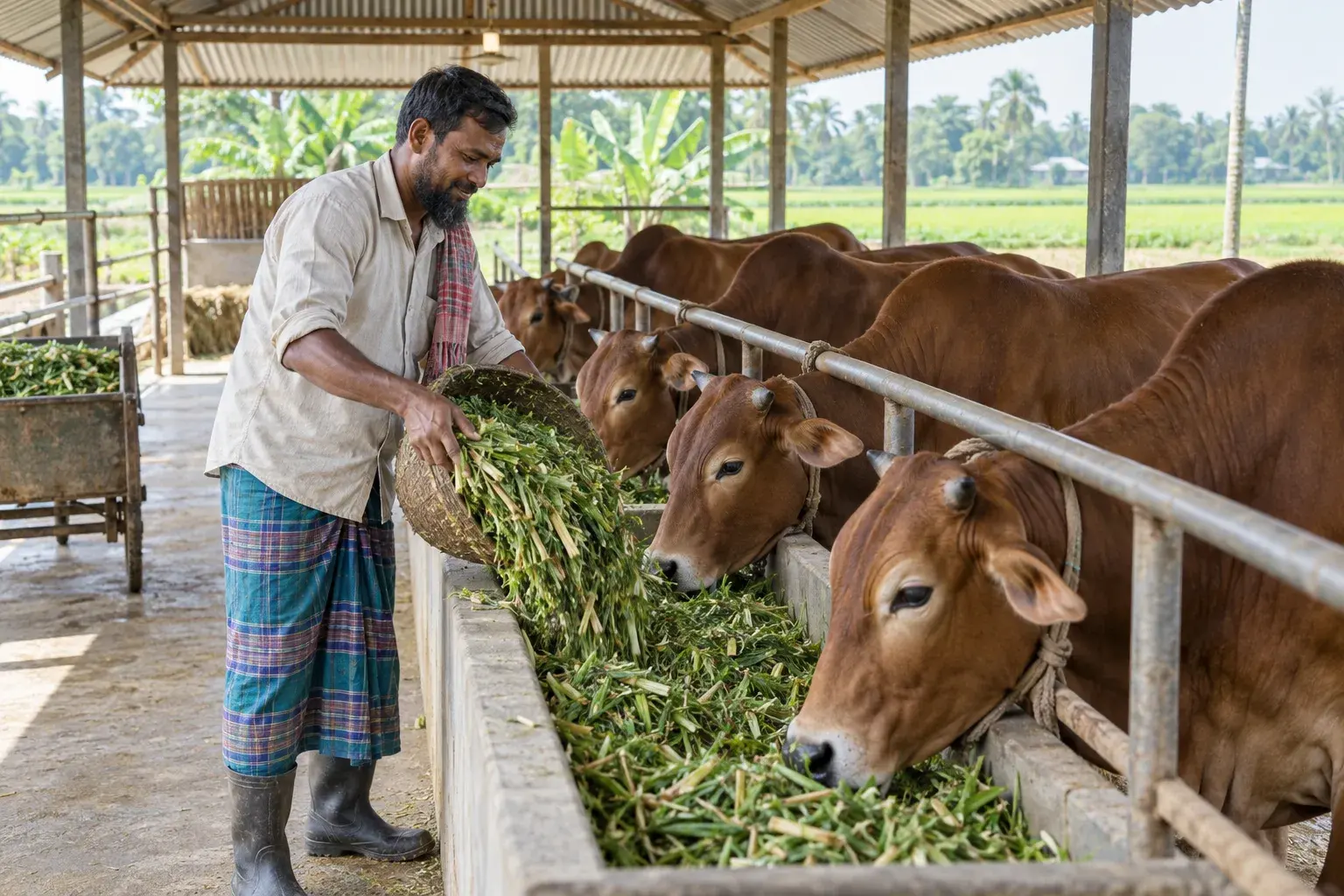
Cattle fattening
Buying cattle cheap, feeding them up and selling at the Qurbani market. About Tk 225 a day per animal, and at Qurbani 2026 one in four prepared animals did not sell.
- Capital
- ৳1.5 lakh – ৳8 lakh
- People
- 1 – 4
- First income
- 120 – 365 days