
Dragon fruit farming
Growing dragon fruit on posts. One to four lakh taka a bigha up front, first fruit about a year later, and a price that has fallen from Tk 500 to Tk 80-100 a kilo in Karwan Market.
- Last reviewed: 19 September 2026
- Version 1
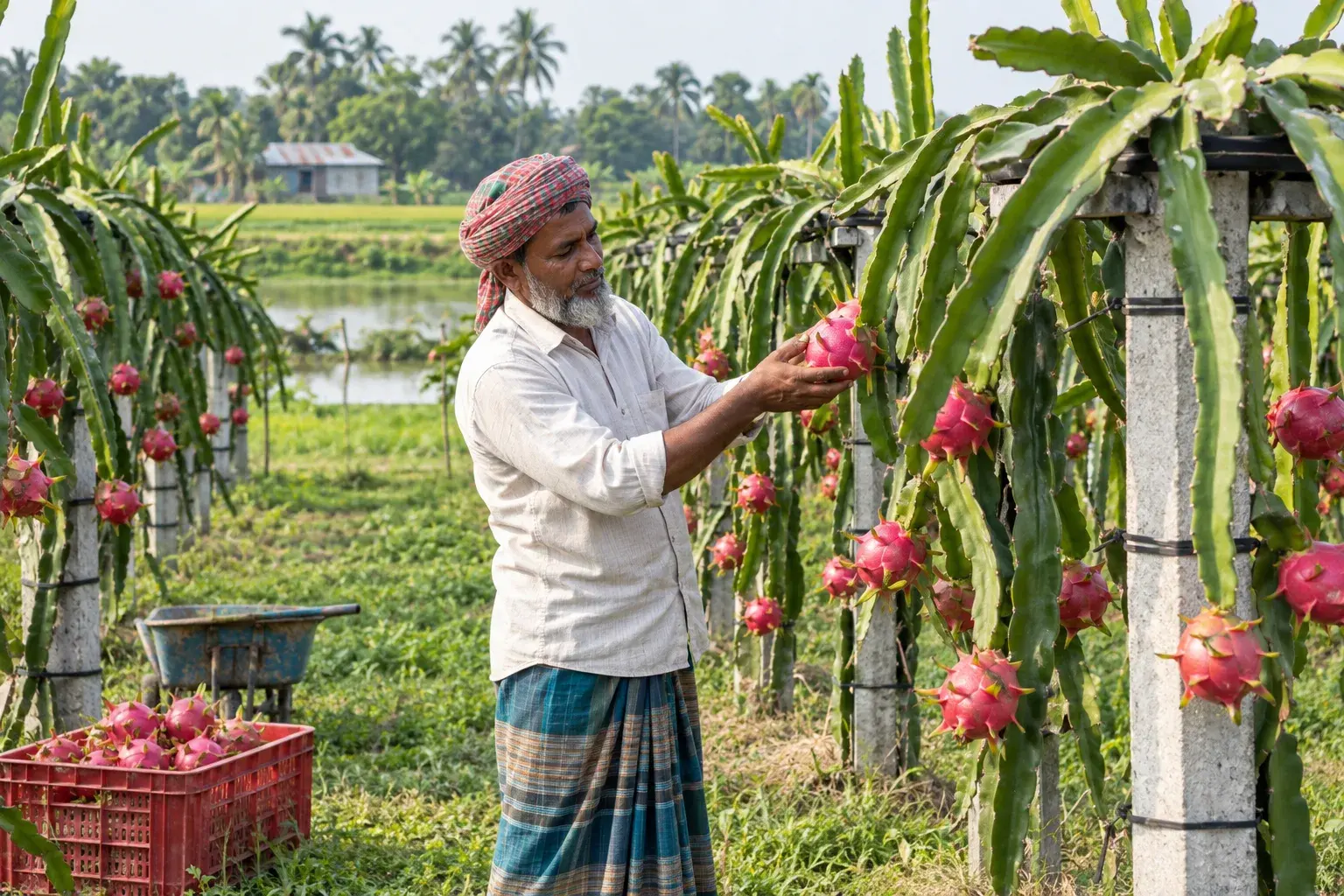
Dragon fruit farming
- Starting capital
- ৳1,50,000 – ৳4,00,000 Disputed
- Manpower
- 1 – 4 people
- First sale
- 365 days Editorial estimate
- Break-even
- 30 – 60 months Editorial estimate
- Kind of work
- Farm · Medium difficulty
About the business
Planting dragon fruit cactus on concrete posts and cropping it for years. This page exists to stop losses, not to sell the crop. The money goes in first and the fruit comes later: posts, cuttings, fencing and irrigation cost somewhere between one and four lakh taka a bigha, and a plant starts fruiting about a year after planting. That first year earns nothing and still has to be tended. The real problem is price. Fruit that sold at Tk 500-600 a kilo a few years ago was selling at Tk 80-100 in Dhaka's Karwan Market in August 2025, because planting has exploded: national output went from 13,872 tonnes on 1,115 hectares in 2021-22 to 68,813 tonnes in 2023-24, five times the supply in three years, and the price has followed it down. In Jashore in 2024 growers were getting Tk 50-60 a kilo wholesale while production cost works out at Tk 50-80 a kilo, so in a bad year the crop does not even cover its cost. Rumours about growth hormone push buyers away and drive the price lower still. When somebody tells you dragon fruit makes lakhs, ask which year and at which price.
Unit economics
| Item | Range | Evidence | Suggest a correction |
|---|---|---|---|
| Monthly working capital | ৳8,000 – ৳20,000 | Editorial estimate | |
| Selling price | ৳50 – ৳300 / kg | Market quote | |
| Variable cost | ৳50 – ৳80 / kg | Editorial estimate | |
| Gross margin | 0% – 50% | Editorial estimate | |
| Time to first revenue | 365 days | Editorial estimate | |
| Break-even time | 30 – 60 months | Editorial estimate | |
| Cash cycle | 35 – 60 days | Editorial estimate | |
| Waste / loss | 5% – 15% | Editorial estimate | |
| Daily capacity | 14 – 33 | Editorial estimate |
What you need to start
- Concrete posts with a wheel or frame on top, four plants to a post. One grower had 2,400 posts and 9,600 plants on 20 bighas, about 120 posts a bigha. The unit price of a post could not be verified.Equipment
- Irrigation: a pump and pipe. Without water in the dry season the fruit stays small.Equipment
- Dragon fruit cuttings or saplings. Record the variety, because red and white flesh sell at different rates.Starting stock
- Trade licence from the union parishad, municipality or city corporation: form Tk 10, licence book Tk 50, standard tax Tk 30, stamp Tk 150-300, licence fee Tk 100-60,000 by trade type. Selling straight off the farm may not need it, but opening a stall or arat does.Licence
- Pruning, getting the plant to flower, and grading by size. Grade badly and the large fruit goes at the small fruit's price.Skill
- A fruit arat or wholesaler: Karwan Market and Badamtoli in Dhaka, and the district fruit arats.Supplier
- High, well-drained land measured in bighas (33 decimals). It has to be fenced or the fruit is stolen.Workspace
How the work is done
- 1Check the market before the land. Who buys dragon fruit near you, and what did growers actually get per kilo last season? Do not sink a single post before you know both.
- 2Take high land that drains and gets full sun. Water standing at the base rots the plant.
- 3Ask the upazila agriculture office which varieties do well locally and how much land is already under dragon fruit. Where supply is heavy, the price will not be there.
- 4Set the posts and fit a wheel or frame on top. Four cuttings go around each post.
- 5Take cuttings from a healthy orchard or buy from a nursery, and write down the variety. Red and white flesh do not fetch the same price.
- 6Put in irrigation. Without water in the dry months the fruit stays small, and small fruit sells at half the rate.
- 7Budget no income for the first year. Keep aside the money for weeding, fertiliser and labour for that period before you start.
- 8Do not use hormone or 'tonic'. Reports about it drove buyers away and pulled the price down; one grower's shortcut ruins the price for a whole area.
- 9Fruit comes in waves from April to November. It spoils if left on the plant after ripening, so line up the buyer first.
- 10Grade by size before selling. Large fruit fetches Tk 250-300 and small Tk 50-100; sold together, the lot goes at the small-fruit rate.
- 11The plants fruit for ten to fifteen years or more, so an orchard once planted is not easily pulled up. That is exactly why the decision at the start matters so much.
Seasons
- JanLow
- FebLow
- MarLow
- AprNormal
- MayHigh
- JunHigh
- JulHigh
- AugHigh
- SepHigh
- OctHigh
- NovNormal
- DecLow
Where it works well
- Strong fitJashore · 12,553 tonnes in 2023-24. Sharsha upazila alone had 28 hectares in 2024, the year growers got only Tk 50-60 a kilo wholesale.
- Strong fitJhenaidah · The country's biggest producer at 32,768 tonnes in 2023-24. Orchards and buyers are both here, but heavy supply means the price falls here first.
- Strong fitRajshahi · 4,477 tonnes in 2023-24, concentrated in Godagari. This is where the wholesale rate fell from Tk 600-1,200 to Tk 260-280 in January 2024.
- PossibleBandarban · 847 tonnes on 92 hectares in 2024-25, the highest in the hill districts; the area has grown about 11.5 times in seven years.
- PossibleBogura · Has the north's big fruit arats, so finding a buyer is easier.
- PossibleChuadanga · Sits inside the Jhenaidah-Jashore belt and uses the same wholesale markets.
- PossibleKhagrachhari · 301 tonnes on 85 hectares in 2024-25. Hill land drains well so the plants do better, but getting fruit to market costs more.
- PossibleMagura · Commercial orchards exist; one farm has 2,400 posts and 9,600 plants on 20 bighas.
- PossibleNatore · Home to some of the older large orchards; one had 5,000 posts and 20,000 plants on about 10 acres. The know-how is available locally.
- PossibleRangamati · 548 tonnes on 50 hectares in 2024-25; the three hill districts sold about Tk 340 million worth that year.
Risks and cautions
- MediumSpoilage: Dragon fruit does not keep long once ripe. Without a buyer growers wait, and then throw rotted fruit away, which is what happened in Jashore in 2024. No cold storage chain has been built for this fruit.
- MediumDependency: You cannot undo the orchard. The plants fruit for ten to fifteen years or more and the money in posts, cuttings and fencing does not come back. If the price falls the grower is stuck, because switching crops means tearing the whole thing out.
- HighDemand: A rumour can flatten the market. After reports that growers were using hormone or 'tonic' to swell the fruit, buyers pulled back and the wholesale rate collapsed. In Rajshahi in January 2024 the wholesale price fell from Tk 600-1,200 to Tk 260-280. A grower who did nothing wrong still loses, because buyers cannot tell one orchard from another.
- HighDemand: Supply has swamped the price and shows no sign of stopping. National output went from 13,872 tonnes on 1,115 hectares in 2021-22 to 51,287 tonnes on 2,588 hectares in 2022-23 and 68,813 tonnes in 2023-24, close to five times in three years. The price fell from Tk 500-600 a few years ago to Tk 80-100 at Karwan Market in August 2025. An orchard planted today will fruit into an even bigger glut.
- HighWorking capital: The money goes out long before the fruit comes in. An orchard costs Tk 1.5-2 lakh a bigha (August 2025) or Tk 3-4 lakh (July 2024) and the plants fruit about a year after planting. Posts, cuttings, fencing, irrigation and labour all come out of pocket in that time. Borrow to start and the interest runs while there is still no income.
Sources
What changed
No corrections have been published yet.
Questions and answers
No questions yet. Be the first to ask.
Stories about this business
A bigha of dragon fruit that sold for 10 lakh now brings 3-3.5
He started in 2017 when dragon fruit was still scarce in Bangladesh. In the early years a single bigha sold about 10 lakh taka of fruit; by the 2025 season the same bigha brought 3 to 3.5 lakh.
- Reasons
- Price drop, Other
Similar businesses
 Agriculture & farming
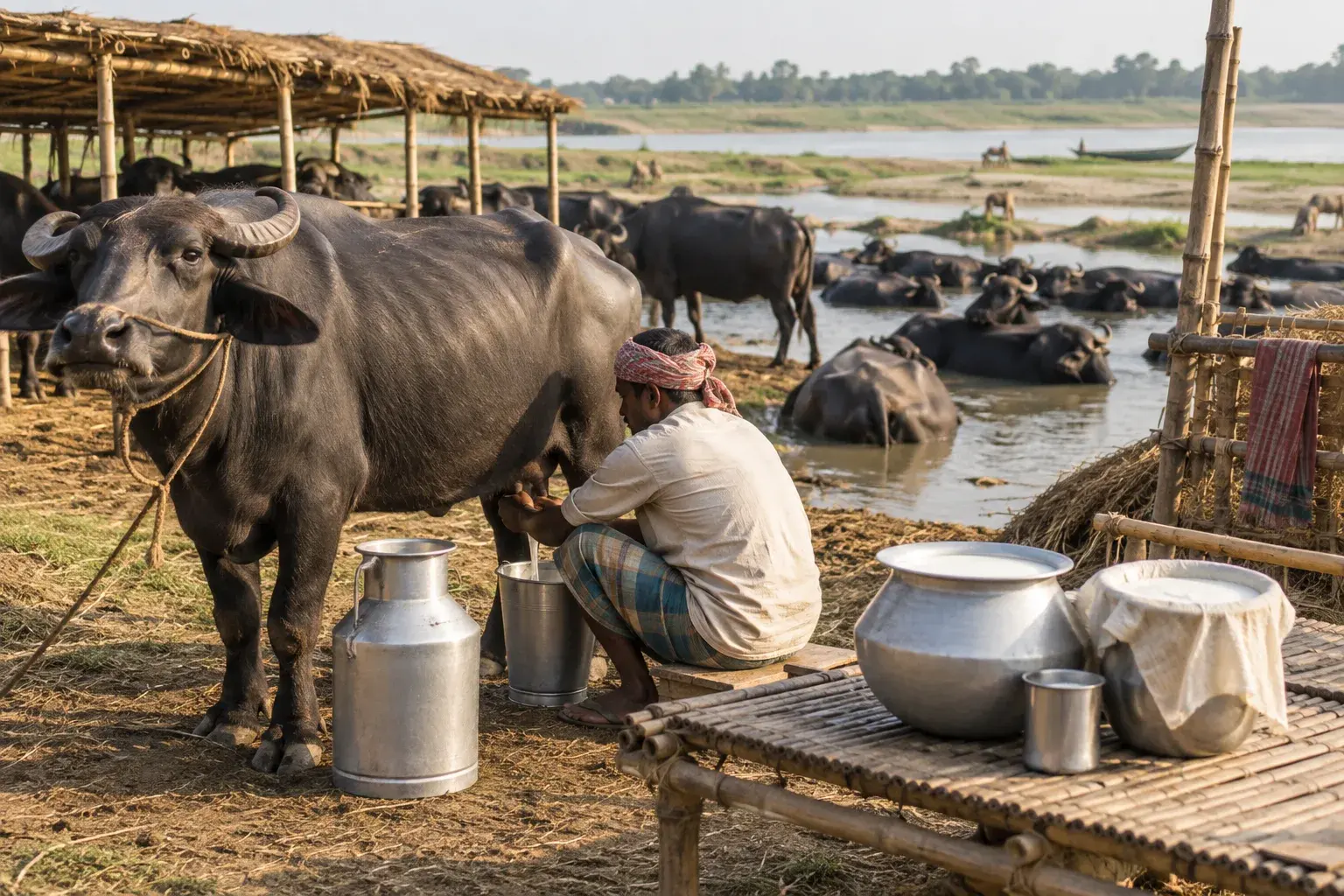
Buffalo rearing
Keeping buffalo on the chars or in a bathan herd and selling the milk. A buffalo gives 4 to 8 kg of milk a day and buffalo milk fetches Tk 80 to 130 a litre, but only in districts where there are curd and sweet makers to buy it.
- Capital
- ৳1.5 lakh – ৳10 lakh
- People
- 1 – 5
- First income
- 1 – 365 days
 Agriculture & farming
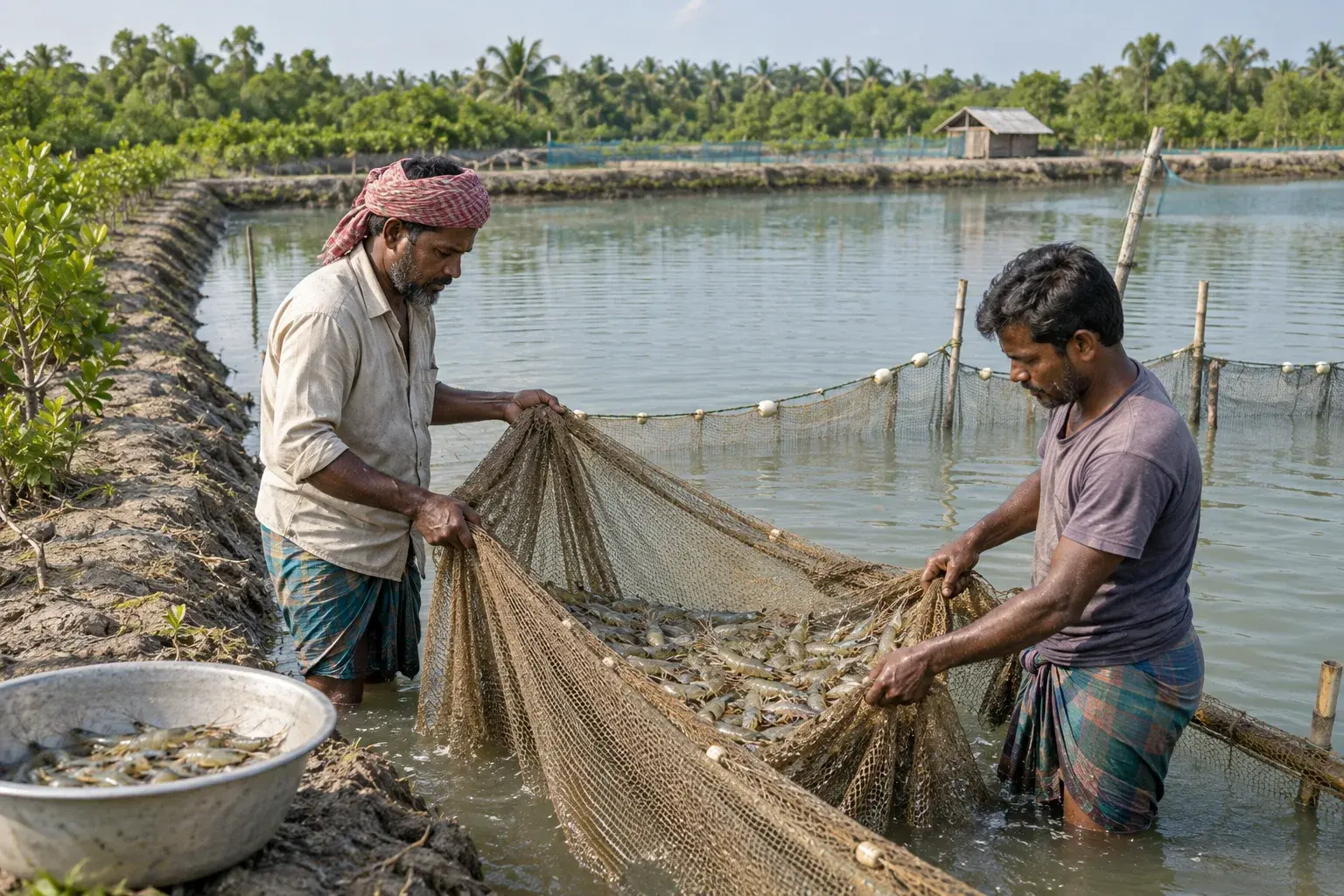
Shrimp farming (gher)
Farming bagda and golda in embanked saline ponds. Fry has gone from Tk 1,300-1,700 to about Tk 3,000 per thousand this season and southern hatcheries have fallen from 78 to 37.
- Capital
- ৳1.5 lakh – ৳6 lakh
- People
- 1 – 5
- First income
- 90 – 150 days
 Agriculture & farming
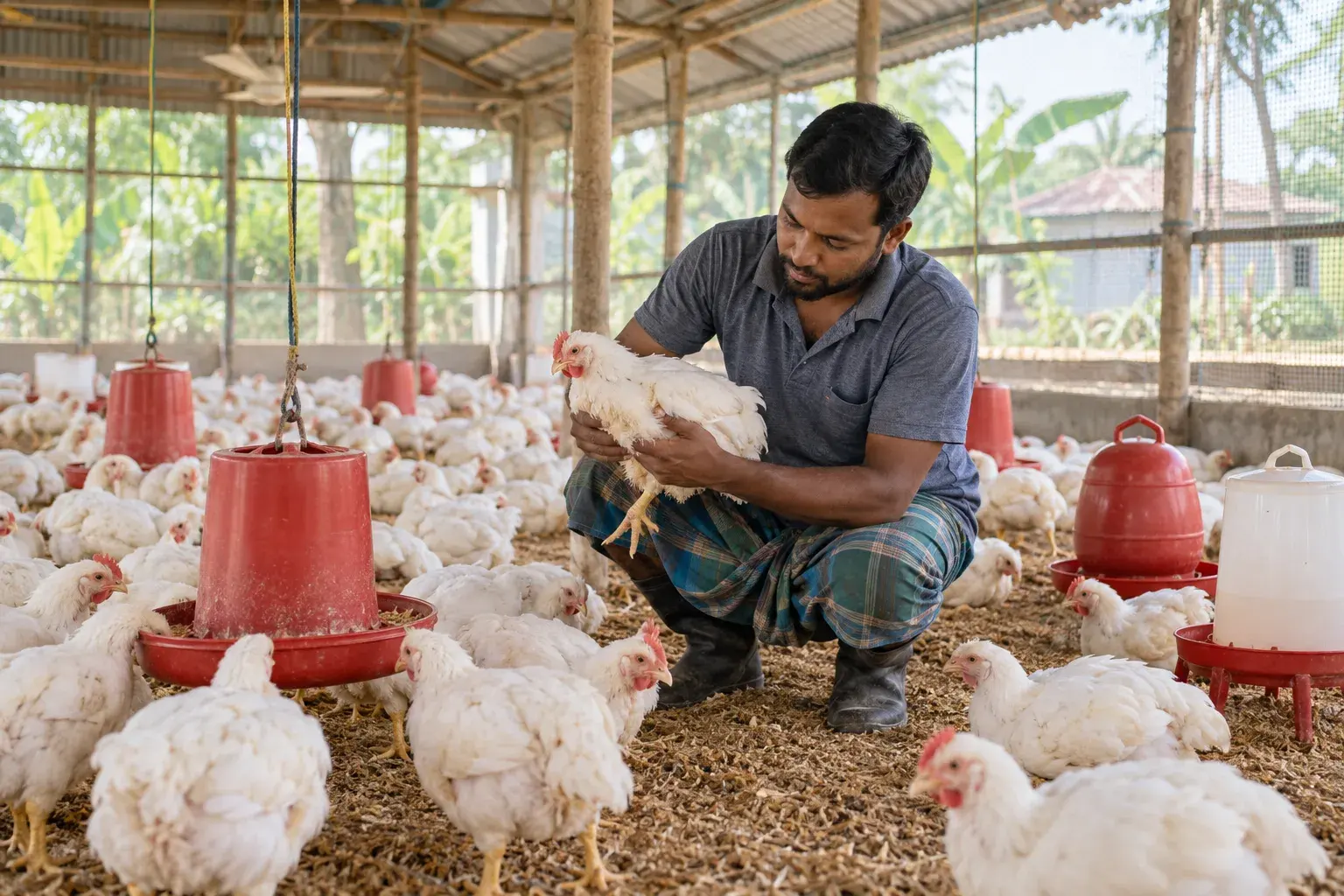
Broiler poultry farm
Raising day-old chicks to live birds in about a month. Farm-gate prices swung from Tk 110 to Tk 198 a kg during 2026 against a production cost of roughly Tk 140.
- Capital
- ৳1.5 lakh – ৳6 lakh
- People
- 1 – 3
- First income
- 32 – 60 days
 Agriculture & farming
Cattle fattening
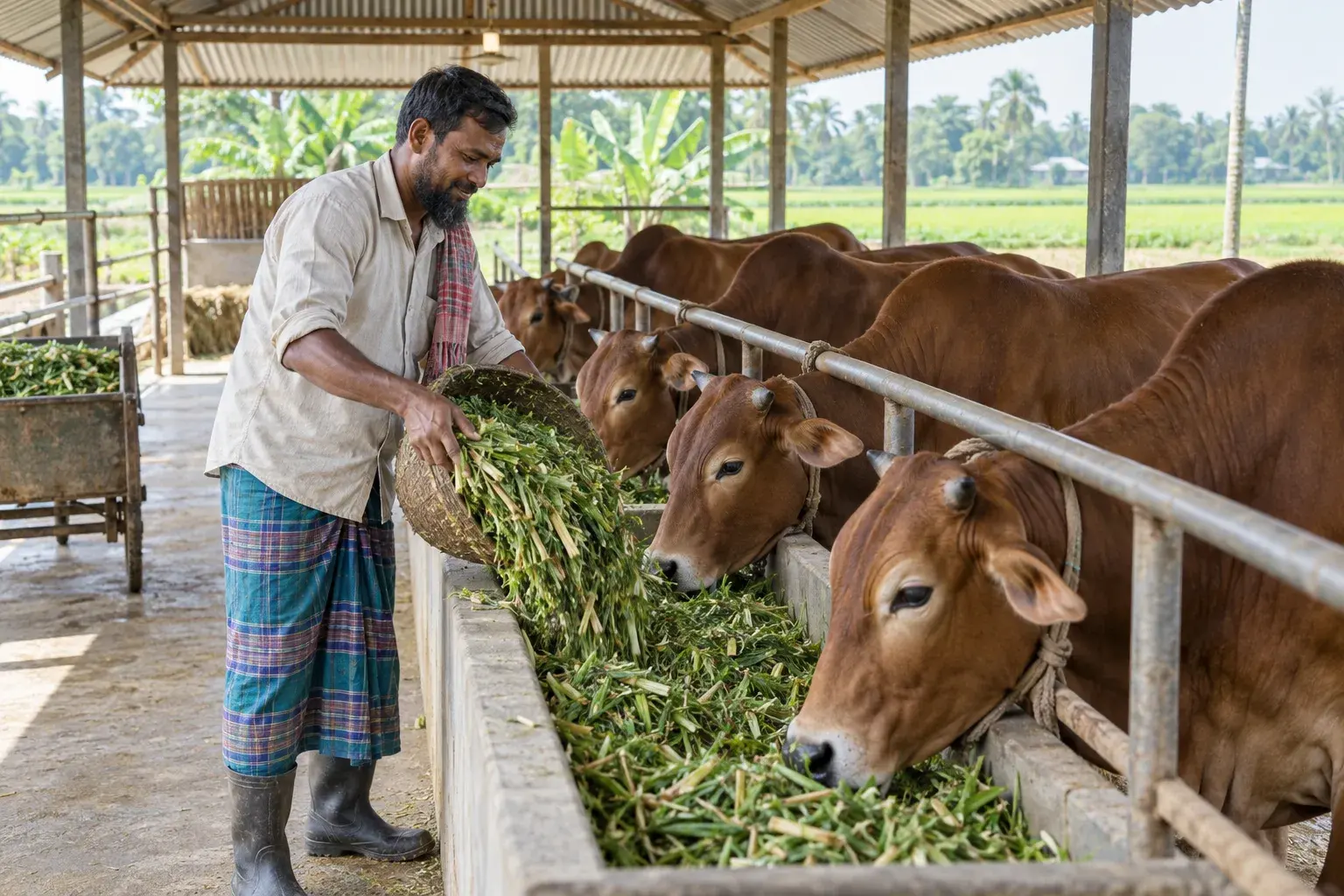
Buying cattle cheap, feeding them up and selling at the Qurbani market. About Tk 225 a day per animal, and at Qurbani 2026 one in four prepared animals did not sell.
- Capital
- ৳1.5 lakh – ৳8 lakh
- People
- 1 – 4
- First income
- 120 – 365 days