
Cattle fattening
Buying cattle cheap, feeding them up and selling at the Qurbani market. About Tk 225 a day per animal, and at Qurbani 2026 one in four prepared animals did not sell.
- Last reviewed: 19 September 2026
- Version 1
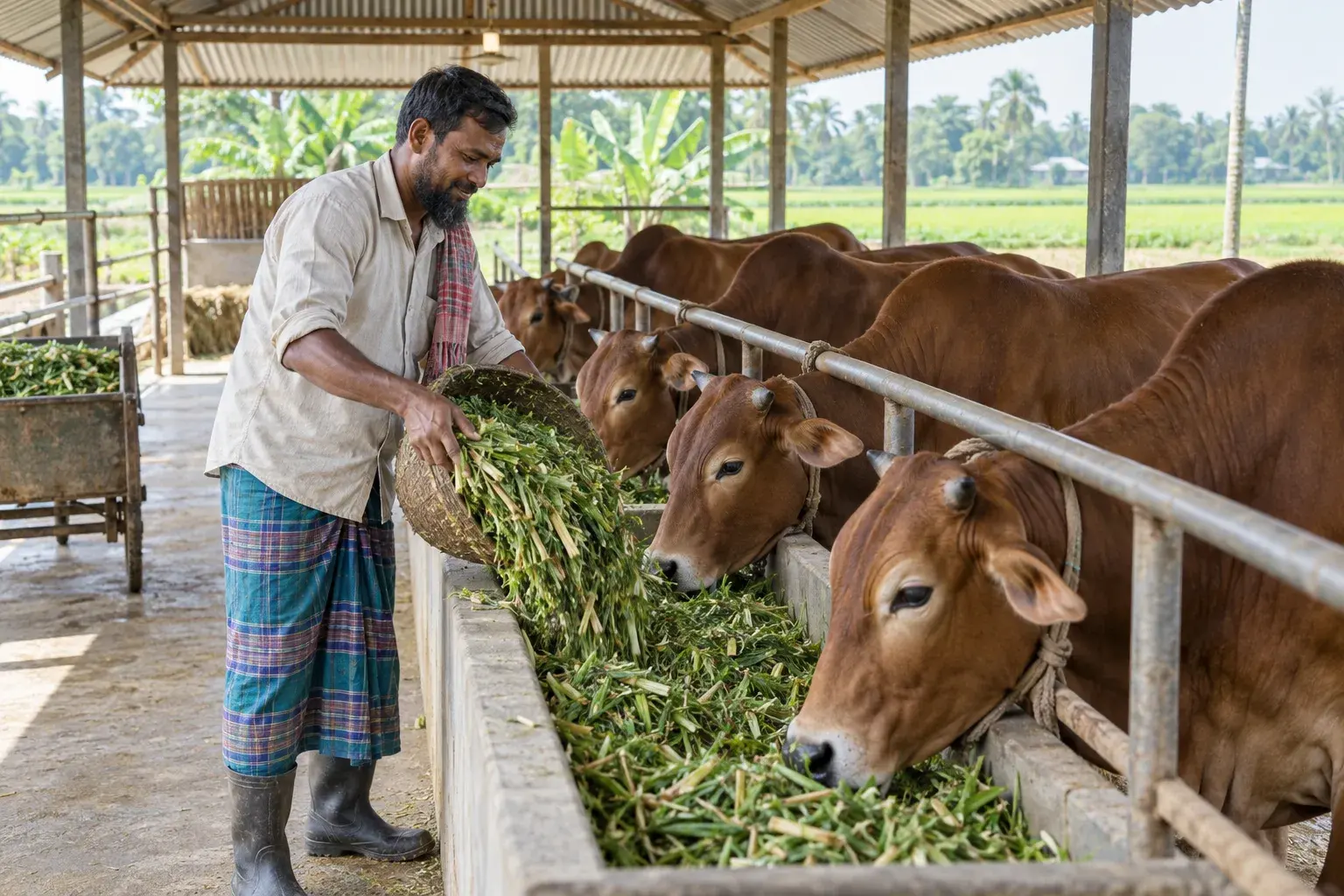
Cattle fattening
- Starting capital
- ৳1,50,000 – ৳8,00,000 Editorial estimate
- Manpower
- 1 – 4 people
- First sale
- 120 – 365 days Editorial estimate
- Break-even
- 4 – 12 months Editorial estimate
- Kind of work
- Farm · Medium difficulty
About the business
Buying calves or thin cattle cheap, feeding them up over some months and selling them at the Qurbani market. A year of work and one day of income, and that sentence contains the whole risk. According to the Department of Livestock Services, demand at Qurbani 2026 was 1,01,06,334 animals against 1,23,33,840 prepared. 93,67,418 were sacrificed and 29,66,422 were left over - roughly one in every four animals prepared did not sell at that Eid, and whoever had counted on selling all of them went on buying feed for months afterwards. Feed price decides profit and loss. A 300 kg animal eats about Tk 180 a day in concentrate, silage and green grass, and about Tk 225 a day once labour, medicine and water are counted. To cover that the animal has to gain at least 540 to 600 grams a day; one that cannot is eating its owner's money daily. Live cattle price rests on the meat price - about 55 percent of live weight is taken as meat - so at Tk 700 a kg of meat, a kilo of live weight is worth roughly Tk 385. On 15 September 2026 Dhaka retail beef was Tk 780-800 a kg. All Qurbani animals now come from inside the country, so imported cattle are not the threat; the country's own surplus is.
Unit economics
| Item | Range | Evidence | Suggest a correction |
|---|---|---|---|
| Monthly working capital | ৳14,000 – ৳70,000 | Editorial estimate | |
| Selling price | ৳385 – ৳413 / kg | Editorial estimate | |
| Variable cost | ৳330 – ৳360 / kg | Editorial estimate | |
| Gross margin | 6% – 20% | Editorial estimate | |
| Time to first revenue | 120 – 365 days | Editorial estimate | |
| Break-even time | 4 – 12 months | Editorial estimate | |
| Cash cycle | 120 – 365 days | Editorial estimate | |
| Waste / loss | 24% | Official source | |
| Daily capacity | 1.5 – 8 | Editorial estimate |
What you need to start
- A way to weigh (scale or weigh-tape), measures for feed, a water supply, and if making silage a chopper and drums or a pit to store it.Equipment
- Feed. Daily for a 300 kg animal: 2 kg concentrate about Tk 70, 9 kg silage about Tk 90, 4 kg green grass about Tk 20, total about Tk 180; with labour about Tk 30, water and power about Tk 5 and medicine and vitamins about Tk 10, about Tk 225 a day. Feed is 70-80 percent of total production cost. These figures come from a specialist blog, not a government source.Starting stock
- Trade licence from the city corporation or municipality (union parishad in a village): form Tk 10, licence book Tk 50, standard tax Tk 30, non-judicial stamp Tk 150-300, licence fee Tk 100-60,000 by trade type. It is the first paper asked for when applying for a bank loan or a government incentive.Licence
- Judging an animal's growth potential by eye, calculating rations, and spotting disease early. A mistake at purchase cannot be undone by five months of feeding.Skill
- The upazila livestock office for deworming, vaccination and treatment. Losing one animal to disease takes several months of costs with it.Supplier
- A livestock market and a trusted dealer, plus someone who can price by weight at the time of purchase. The buying price decides half the profit.Supplier
- A shed with shade, a dry floor, air movement and drainage for dung and water. Land nearby for green fodder cuts the feed cost sharply.Workspace
How the work is done
- 1Count backwards from the Eid date. Decide how many days you will feed before you decide the day you buy; an animal bought after Eid means nearly a year of feed.
- 2Before buying, work out how much feed a day you can afford. A 300 kg animal takes about Tk 180 a day in feed and about Tk 225 with labour, medicine and water - and that money is needed every day, not on Eid day.
- 3At the market pick an animal with a big frame but currently thin. One that is already fat cannot be grown further, and there is no profit from there.
- 4As soon as you buy, get deworming and vaccination through the upazila livestock office. If disease strikes, months of feed money go at once.
- 5Fix the shelter: shade, a dry floor, air movement and a way to clear the dung. A wet floor ruins feet and hide, and a damaged hide lowers the price.
- 6Arrange cheap feed: plant napier grass on your own land, make silage from maize or grass. Feed is 70 to 80 percent of the cost, so this is where profit and loss are decided.
- 7Weigh the animal every 15 days and write it down. Gaining less than 540-600 grams a day means it is not covering its cost; change the feed or sell it.
- 8Do not try to fatten fast with drugs or hormones. Animals fattened that way are spotted at the market, buyers know, and the price falls.
- 9Start looking for buyers at least two months before Eid - direct sale from the farm, selling online with photographs, or an advance word with a dealer. Do not leave everything to the last day of the market.
- 10If you take the animal to the market, count the toll, the transport and several days of feed separately. If it does not sell that money does not come back and the animal comes home with you.
- 11Decide in advance what you will do if it does not sell at Eid. In 2026, 24 percent of prepared animals did not; a prior word with a butcher or a meat shop leaves you a way out.
Seasons
- JanNormal
- FebNormal
- MarNormal
- AprNormal
- MayHigh
- JunHigh
- JulLow
- AugLow
- SepLow
- OctLow
- NovNormal
- DecNormal
Where it works well
- Strong fitBogura · The commercial centre of the north, with both cattle and feed moving along the Dhaka-Rangpur highway. A modern slaughterhouse has been opened nearby.
- Strong fitKushtia · An old cattle market area near the Indian border, with animals moving out along the Dhaka-Khulna highway. Khulna division saw 8,46,005 animals sacrificed in 2026.
- Strong fitPabna · Inside the Sirajganj-Pabna dairy belt, so calves and thin cattle are easy to buy and fodder and straw are close by.
- Strong fitRangpur · Rangpur division saw 10,50,554 animals sacrificed in 2026; land and feed are cheap, but truck fares to Dhaka are high.
- Strong fitSirajganj · Dense grazing and dairy farming on the Jamuna chars, with direct road access to Dhaka's markets over the Bangabandhu bridge. Rajshahi division saw 23,42,869 animals sacrificed in 2026, almost equal to Dhaka division.
- PossibleChuadanga · Cattle rearing is common in this border area with lower feed costs, but the journey to the Eid markets is long.
- PossibleDhaka · Expensive as a place to rear but the largest as a place to sell - Dhaka division alone saw 23,51,666 animals sacrificed in 2026, the highest in the country.
- PossibleDinajpur · A maize and paddy area, so the raw material for concentrate feed is nearby; distance from Dhaka is the main problem.
- PossibleJhenaidah · A market-centred area of Khulna division, on the Dhaka-Khulna highway so animals load onto trucks easily before Eid.
- PossibleMeherpur · A small border district where land and fodder are relatively cheap, though Dhaka's markets are far and transport costs more.
- PossibleNaogaon · A paddy and maize area, so straw and broken rice are close at hand, and part of Rajshahi division's large Qurbani market.
- PossibleTangail · Close to Dhaka and on the highway, so truck fares at Eid are lower, which helps a small farmer.
Risks and cautions
- HighDemand: Not every animal sells at Qurbani, and that is the biggest danger in this business. Department of Livestock Services figures for 2026: demand 1,01,06,334, prepared 1,23,33,840, sacrificed 93,67,418, leaving 29,66,422 surplus - one in four. An unsold animal wants feeding again from the day after Eid, and its price is then nowhere near the Eid price. Anyone who borrowed to buy starts repaying right after Eid.
- HighWorking capital: Money goes out daily and comes in once a year. At about Tk 225 a day per animal, five months is about Tk 33,750 per head in keeping alone, on top of the purchase price. Four animals means about Tk 1,35,000 in five months on feed and care. Run short halfway and the feed is cut, and cut feed means no weight gain, which loses the whole season.
- HighDependency: Profit hangs entirely on the feed price, which the farmer does not control. Feed is 70 to 80 percent of the production cost. If bran, oilcake or maize rises mid-season the whole calculation changes, because the animals are already bought and the selling date is fixed at Eid, so there is no way to pass the increase to the buyer.
- MediumOther: The animal is not growing, and many notice too late. To cover costs it must gain at least 540 to 600 grams a day. One gaining 300 grams a day is eating its owner's money daily and the eye cannot tell. Without weighing every 15 days this only shows up after five months, when nothing can be done.
- MediumSpoilage: If one animal dies of disease or falls sick and loses weight, the months of money poured into it go at once. A small farm has two to four animals, so one loss is a quarter of the season. Deworming and vaccination cost about Tk 10 a day; skipping them costs a thousand times more.
Sources
সিটি কর্পোরেশন থেকে ট্রেড লাইসেন্স প্রাপ্তির ধাপ সমূহ
Collected: 16 Sept 2026Supports: Starting capital · বাংলাদেশ
ঢাকা মহানগরীর দৈনিক খুচরা বাজারদর, ১৫-০৯-২০২৬
Collected: 15 Sept 2026Supports: Selling price · ঢাকা
- Collected: 15 Sept 2026
Supports: Selling price · ঢাকা মহানগর — সিপাহীবাগ, মিরপুর-৬, মোহাম্মদপুর টাউন হল, নিউমার্কেট, রামপুরা, মহাখালী বাজার
What changed
No corrections have been published yet.
Questions and answers
No questions yet. Be the first to ask.
Stories about this business
A 16-maund bull priced at 6 lakh drew one offer of 2.5 lakh
Over two years this one bull ate more than 200,000 taka of bought feed and still costs 500-600 taka a day. It did not sell at the Eid haat.
- Reasons
- Weak demand, Price drop
Similar businesses
 Agriculture & farming
Buffalo rearing
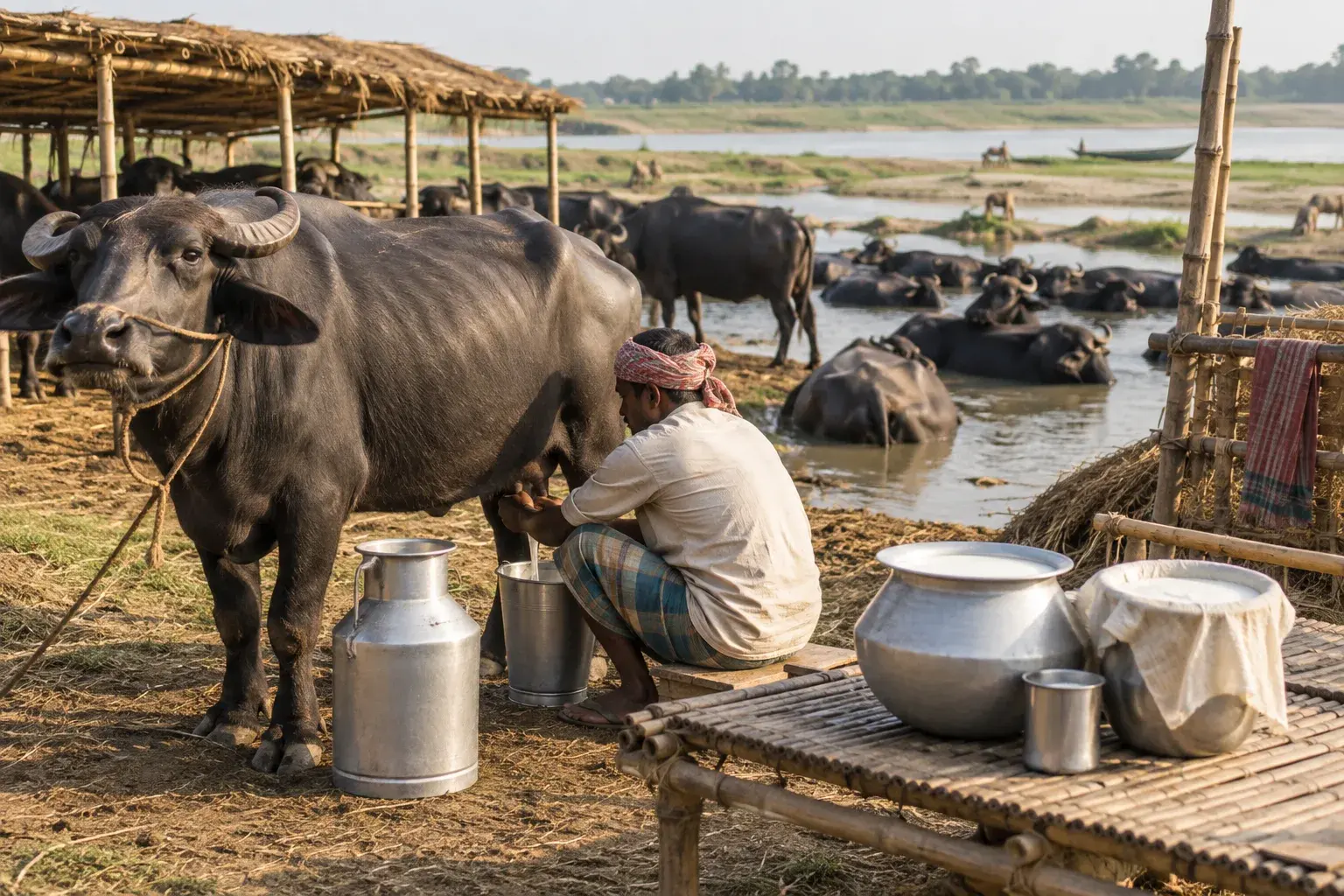
Keeping buffalo on the chars or in a bathan herd and selling the milk. A buffalo gives 4 to 8 kg of milk a day and buffalo milk fetches Tk 80 to 130 a litre, but only in districts where there are curd and sweet makers to buy it.
- Capital
- ৳1.5 lakh – ৳10 lakh
- People
- 1 – 5
- First income
- 1 – 365 days
 Agriculture & farming
Dragon fruit farming
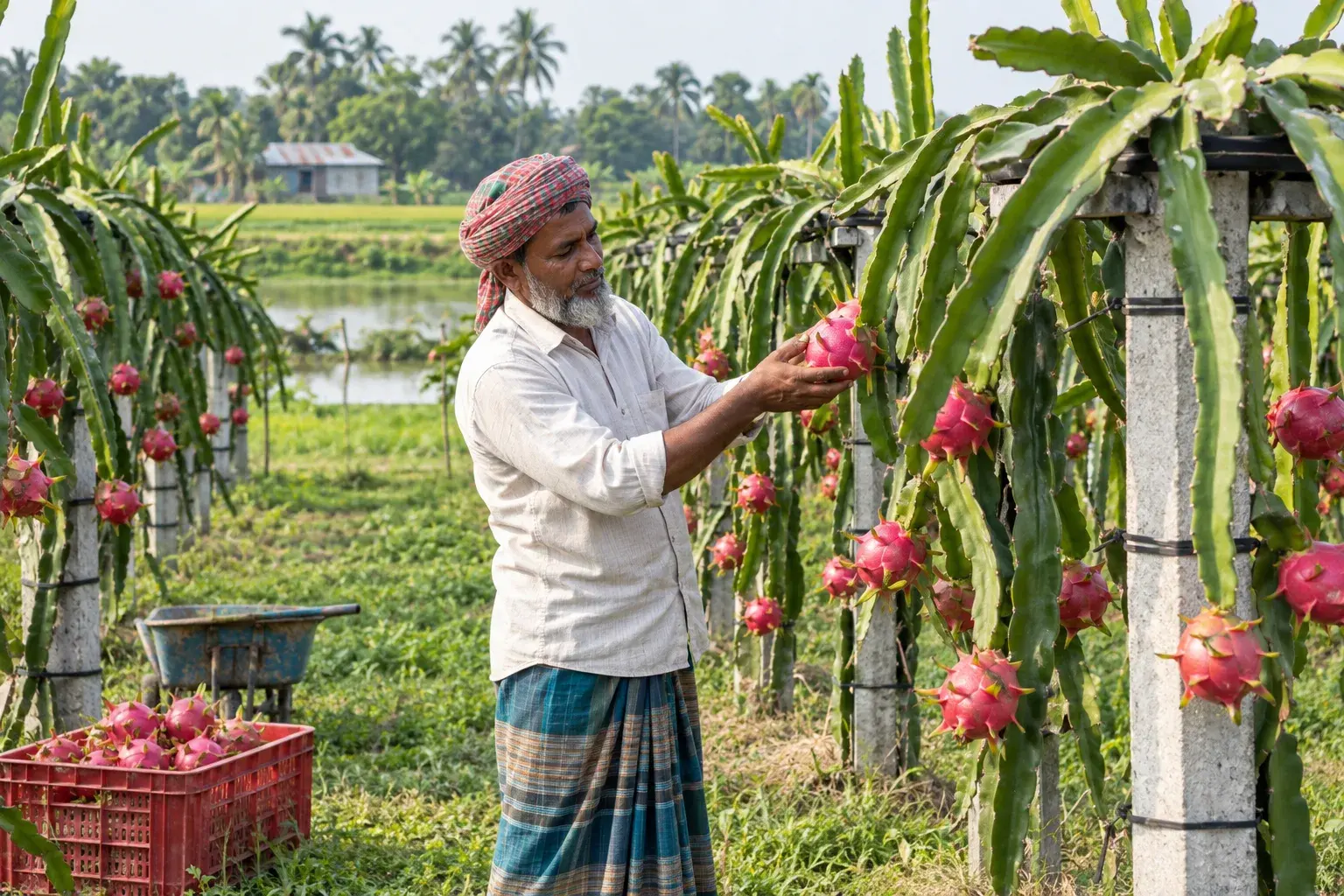
Growing dragon fruit on posts. One to four lakh taka a bigha up front, first fruit about a year later, and a price that has fallen from Tk 500 to Tk 80-100 a kilo in Karwan Market.
- Capital
- ৳1.5 lakh – ৳4 lakh
- People
- 1 – 4
- First income
- 365 days
 Agriculture & farming
Shrimp farming (gher)
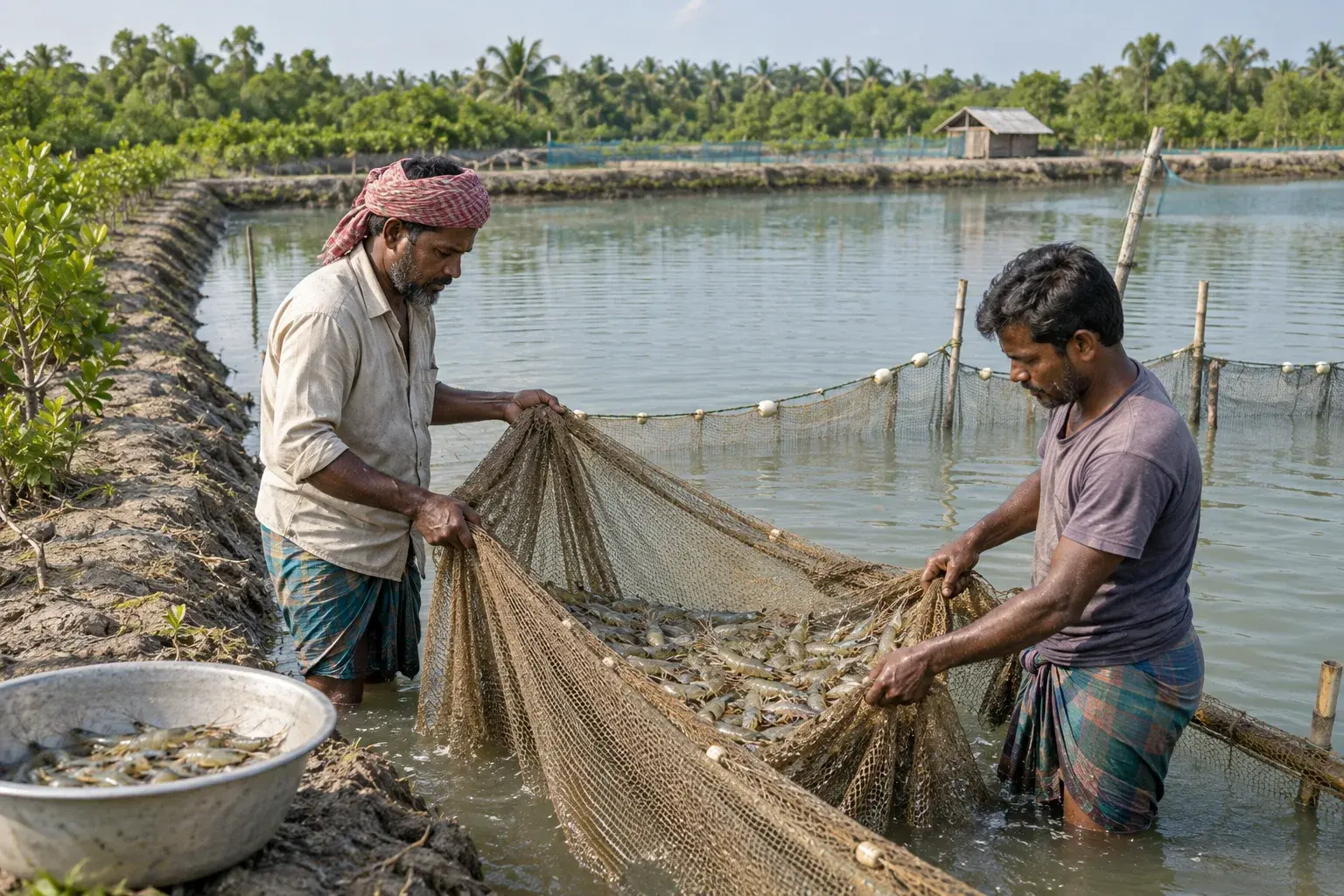
Farming bagda and golda in embanked saline ponds. Fry has gone from Tk 1,300-1,700 to about Tk 3,000 per thousand this season and southern hatcheries have fallen from 78 to 37.
- Capital
- ৳1.5 lakh – ৳6 lakh
- People
- 1 – 5
- First income
- 90 – 150 days
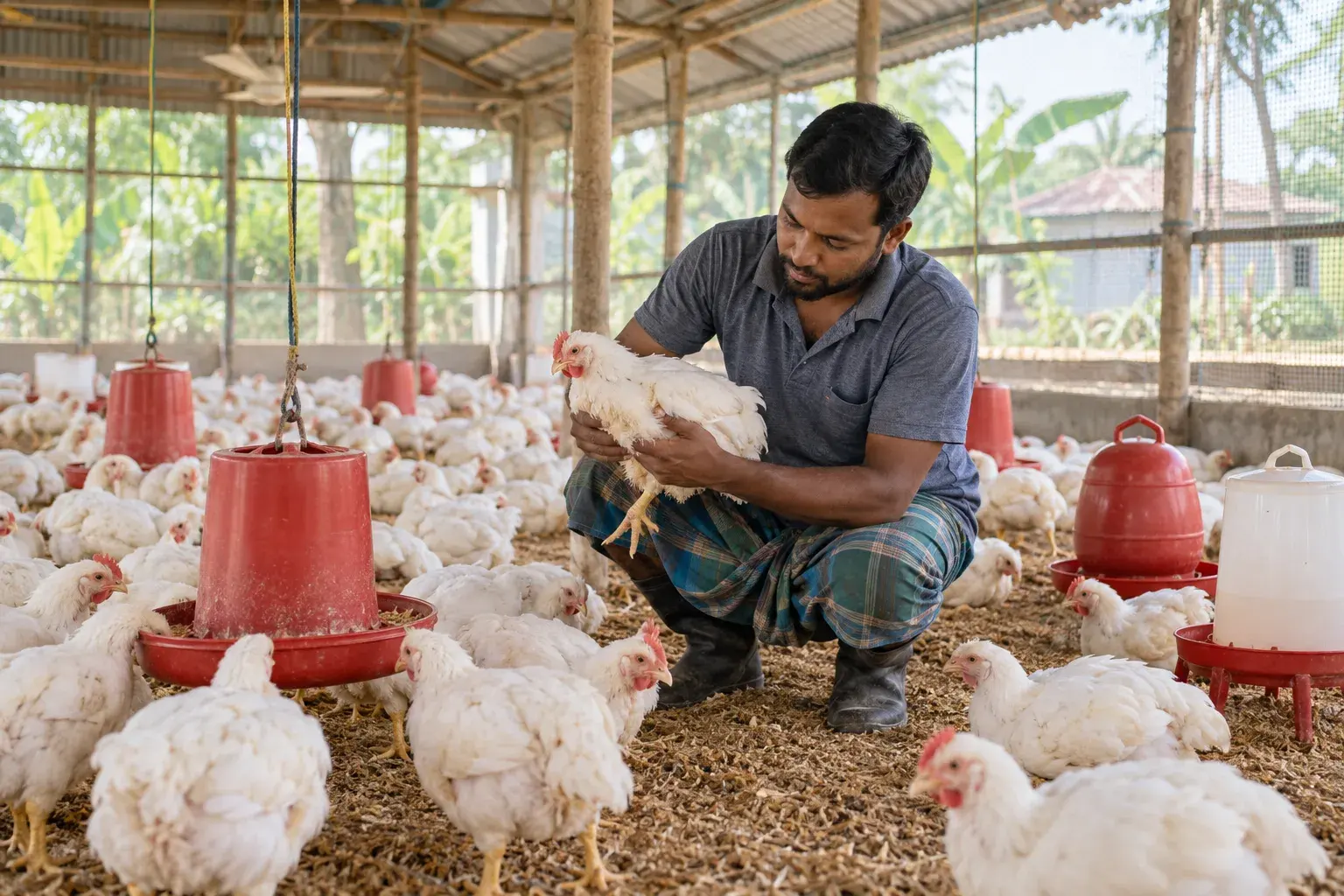 Agriculture & farming
Broiler poultry farm
Raising day-old chicks to live birds in about a month. Farm-gate prices swung from Tk 110 to Tk 198 a kg during 2026 against a production cost of roughly Tk 140.
- Capital
- ৳1.5 lakh – ৳6 lakh
- People
- 1 – 3
- First income
- 32 – 60 days