
Crab farming and fattening
Fattening mud crab in brackish-water pens or boxes and selling on to a depot and an exporter. Bangladesh shipped Tk 867.88 crore of crab in FY2024-25, almost all of it to China, and when China shuts the door a Tk 2,000 kg crab falls to Tk 300.
- Last reviewed: 21 September 2026
- Version 1
Crab farming and fattening
- Starting capital
- ৳1,50,000 – ৳20,00,000 Editorial estimate
- Manpower
- 2 – 15 people
- First sale
- 20 – 35 days Editorial estimate
- Break-even
- 5 – 20 months Editorial estimate
- Kind of work
- Farm · Hard
About the business
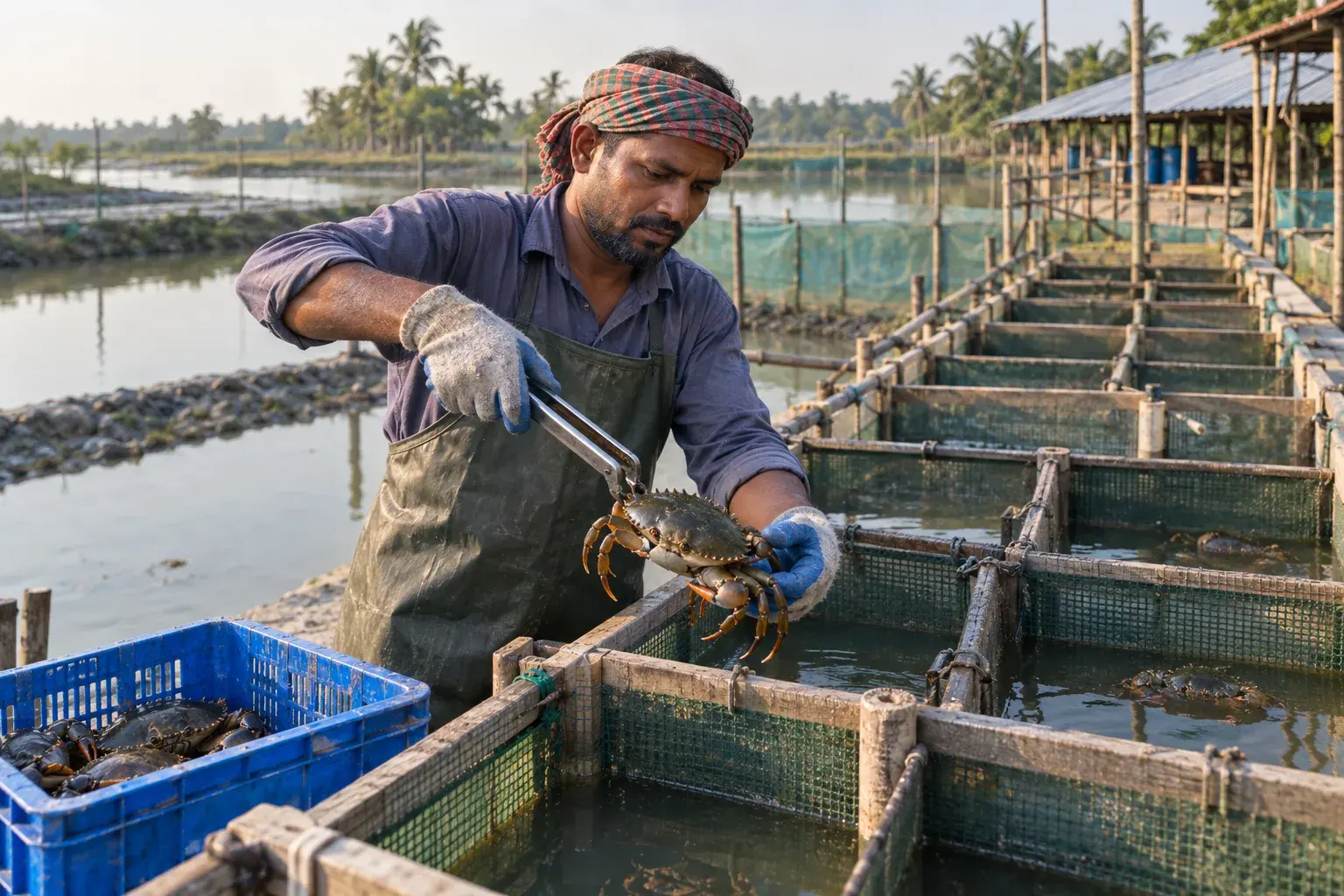
Holding mud crab in brackish-water pens or in small plastic boxes until it is worth more, then passing it through a depot to an exporter. There are two quite different trades here. The first is ordinary fattening: light crabs caught from rivers and creeks are stocked in a pen and fed for 20 to 25 days on trash fish, snail and shellfish meat until they fill out. Export-grade crabs weigh 200 to 250 grams. The second is soft-shell crab, where each crab sits in its own box and is watched for the moult; it has to be lifted within about three hours of shedding, or the shell hardens and the price goes. A Satkhira farmer, Abdullah Al Kaiyum, said in May 2026 that his farm runs about 12,000 boxes and each box costs around Tk 110 to make, which is over Tk 13 lakh in boxes alone. The money is real and so is the risk. Almost the whole crop goes to China, and prices run highest in the weeks before Chinese New Year. When China halted imports on 25 January 2020, crab that had been Tk 1,800-2,000 a kg sold at Tk 300, and the trade was losing about Tk 4 crore a day. One more thing has to be said plainly: the seed is not from a hatchery. Juveniles are caught from the wild, so in a year when the rivers are thin the pens sit empty. And you cannot export in your own name; a small number of exporters approved through the Department of Fisheries do that, and everyone else sells to a depot.
Unit economics
| Item | Range | Evidence | Suggest a correction |
|---|---|---|---|
| Monthly working capital | ৳40,000 – ৳6,00,000 | Editorial estimate | |
| Selling price | ৳300 – ৳2,000 / kg | Disputed | |
| Variable cost | ৳60 – ৳140 / kg | Editorial estimate | |
| Gross margin | 3% – 46% | Editorial estimate | |
| Time to first revenue | 20 – 35 days | Editorial estimate | |
| Break-even time | 5 – 20 months | Editorial estimate | |
| Cash cycle | 20 – 45 days | Editorial estimate | |
| Waste / loss | 10% – 30% | Editorial estimate | |
| Daily capacity | 3 – 80 | Editorial estimate |
What you need to start
- Individual plastic boxes for soft-shell crab. A Satkhira farmer put the cost at about Tk 110 a box in May 2026, with 12,000 boxes on his farm. Plus a water pump, nets, ice boxes and scales.Equipment
- Feed: trash fish, snail and shellfish meat at 30-40 percent protein. In 2020 this cost Tk 15-20 a kg; today's price could not be verified.Starting stock
- Depot licence from the Fish Inspection and Quality Control office of the Department of Fisheries; the list of licensed depots is published on its website. The fee and validity could not be verified here and must be checked with the divisional office.Licence
- Trade licence from the city corporation, municipality or union parishad: form Tk 10, licence book Tk 50, standard tax Tk 30, stamp Tk 150-300, licence fee Tk 100-60,000, issued in 3-5 working days.Licence
- Exporting in your own name needs Department of Fisheries approval and certification against the Chinese authorities' conditions. In 2023 only 14 exporters were approved with 18 more applications pending. For a small farmer this route is effectively shut; they sell to a depot.Licence
- Grading crab, spotting the moult, measuring salinity, and sorting and packing live. Miss the moult and the whole box loses half its value.Skill
- A supplier of lean crab and juveniles: fishermen or middlemen. These are not hatchery produced but caught from rivers and creeks. When the catch thins the price rises and the pens stand empty.Supplier
- A site with tidal brackish water at 5-10 ppt salinity, a pen of 0.04-0.2 hectares, and a bamboo fence 1.5 m high with 0.5 m buried and gaps under half a centimetre.Workspace
How the work is done
- 1Decide which trade: ordinary fattening in a pen, or soft-shell crab in boxes. The box work needs far more money and has to be watched every single day.
- 2Find the site: water salinity of 5 to 10 ppt, with a way to take tidal water in and let it out. This cannot be done in a freshwater pond.
- 3Keep the pen small, 0.04 to 0.2 hectares, that is 10 decimals to half an acre. In a big pen you cannot count the crabs and you cannot stop them escaping.
- 4Put up the bamboo fence: 1.5 metres high, buried half a metre, with gaps under half a centimetre. Crabs dig out, and that is the most ordinary way to lose them.
- 5Line up a supplier of juveniles or lean crab. Remember these do not come from a hatchery; fishermen catch them from the rivers and creeks. Without an arrangement in advance you will not get them in season.
- 6Keep males and females apart, and in the pen stock nine females to one male, 10,000 to 12,500 per hectare. Overstock and they break each other's claws, which costs the grade.
- 7Feed once a day in the evening: trash fish, snail or shellfish meat, at least 30 to 40 percent protein. Rotting feed fouls the water, so give only what they eat.
- 8For soft-shell, put each crab in its own box and check several times day and night. It has to come out and go on ice within about three hours of shedding.
- 9Grade before selling, by weight and by whether the claws are intact. Export-grade crab weighs 200 to 250 grams; below that the depot pays less.
- 10Work with a licensed depot. The Fish Inspection and Quality Control office of the Department of Fisheries licenses depots and publishes the list of licensed ones; check the list.
- 11Take a trade licence from the union parishad or municipality and register the farm with the upazila fisheries office. Training and government support come through that record.
- 12Time your batches against the Chinese New Year calendar. That is when the price is highest, but crab held past the festival turns into a stone round your neck.
Seasons
- JanHigh
- FebHigh
- MarNormal
- AprNormal
- MayLow
- JunLow
- JulLow
- AugLow
- SepNormal
- OctNormal
- NovHigh
- DecHigh
Where it works well
- Strong fitBagerhat · Crab is farmed alongside shrimp in the Rampal and Mongla ghers, and consignments move out fast through Mongla port and the highway.
- Strong fitKhulna · Paikgacha alone once had 300 fattening farms, with more pens in Batiaghata, Dacope and Dumuria, and the exporters' offices and depots are in Khulna town.
- Strong fitSatkhira · Shyamnagar, Kaliganj, Assasuni and Debhata have the densest crab farming; the big soft-shell farms are here and the district fisheries office runs training for farmers.
- PossibleBarguna · Coastal creeks and brackish ghers are here, but with few crab depots the stock has to be sent on to Khulna or Satkhira.
- PossibleChattogram · The Fish Inspection and Quality Control office here issues the licensed depot list, and both the port and the airport are close.
- PossibleCox's Bazar · Brackish water and tides are there, and hotels and restaurants give some domestic demand, but the depot and middleman network is not as organised as in Khulna.
- PossibleDhaka · No farming here, but the exporters' offices and the airport cold rooms are in Dhaka, and live crab consignments fly out from here.
- PossiblePatuakhali · Pens can be built on the tidal creeks and chars and lean crab is available locally, but the selling network is not yet fully built.
- Weak fitPirojpur · Brackish water reaches some parts but salinity is unreliable and the depots are far, which raises the risk of moving live stock.
Risks and cautions
- HighDependency: The whole trade rests on one buyer. As of 2023 about 90 percent of Bangladesh's crab went to China. When China halted imports on 25 January 2020, crab that had been Tk 1,800-2,000 a kg sold at Tk 300, losses ran at Tk 150-200 crore a month, and about 25,000 farms were hit. The decision is taken in Beijing and the farmer does not even hear about it.
- HighDemand: The price is tied to a few weeks of the year. Demand and price peak before Chinese New Year and everyone holds stock for it. Past the festival the same crab is worth less, and when the 2020 halt fell exactly at that point the held stock died in the pens.
- HighSpoilage: It is a live product, so loss is immediate. A dead crab is worth nothing, and one that rots takes the ones around it in the box or pen. Soft-shell crab not lifted and iced within about three hours of moulting hardens and loses its price, and that mistake happens most at night.
- HighDependency: The seed comes from the wild, not from a hatchery. Fishermen catch it from rivers and creeks, so supply follows the weather and the tide. When the catch thins, lean crab costs more while the selling price does not move, and the margin is squeezed from both ends.
- MediumCompliance: You cannot export in your own name. Only firms approved by the Department of Fisheries and meeting the Chinese conditions can, and in 2023 there were just 14 of them. So the farmer sells at whatever the depot or middleman offers, with little room to bargain.
- MediumWorking capital: In a soft-shell farm the money is locked up in boxes. Twelve thousand boxes is over Tk 13 lakh in boxes alone, and on top of that crab has to be bought every cycle. Boxes break and wash away in storms, and that spend comes before any income.
Sources
লাইসেন্সপ্রাপ্ত ডিপোর তালিকা ২০২৪ এবং লাইসেন্স প্রাপ্তির শর্তাবলী
Collected: 21 Sept 2026Supports: requirements · বাংলাদেশ
সিটি কর্পোরেশন থেকে ট্রেড লাইসেন্স প্রাপ্তির ধাপ সমূহ
Collected: 16 Sept 2026Supports: Starting capital · বাংলাদেশ
Rising global demand boosts Satkhira's crab exports
Collected: 7 May 2026Supports: Starting capital, districts, Monthly working capital, Variable cost, Waste / loss · সাতক্ষীরা ও বাংলাদেশ
Crab exports have nearly tripled in five years
Collected: 24 Apr 2026Supports: Selling price · খুলনা, বাগেরহাট, সাতক্ষীরা ও উপকূলীয় বাংলাদেশ
Crab exports recovering from pandemic loss
Collected: 17 Aug 2023Supports: risks · বাংলাদেশ
Crab, eel exports suffer as China halts import
Collected: 14 Feb 2020Supports: Selling price, risks · খুলনা, সাতক্ষীরা, বাগেরহাট
What changed
No corrections have been published yet.
Questions and answers
No questions yet. Be the first to ask.
Stories about this business
From shrimp to crab: 2-taka fry, and hopes pinned on December
To escape the disease risk that kills shrimp fry, this farmer turned a 100-decimal gher over to crab. The 1,700 fry released in May at 2 taka each are expected to reach 350-700 grams by December, when crab sells at 500-1,200 taka a kg.
- Reasons
- Good location, Weak demand
Similar businesses
 Agriculture & farming
Buffalo rearing
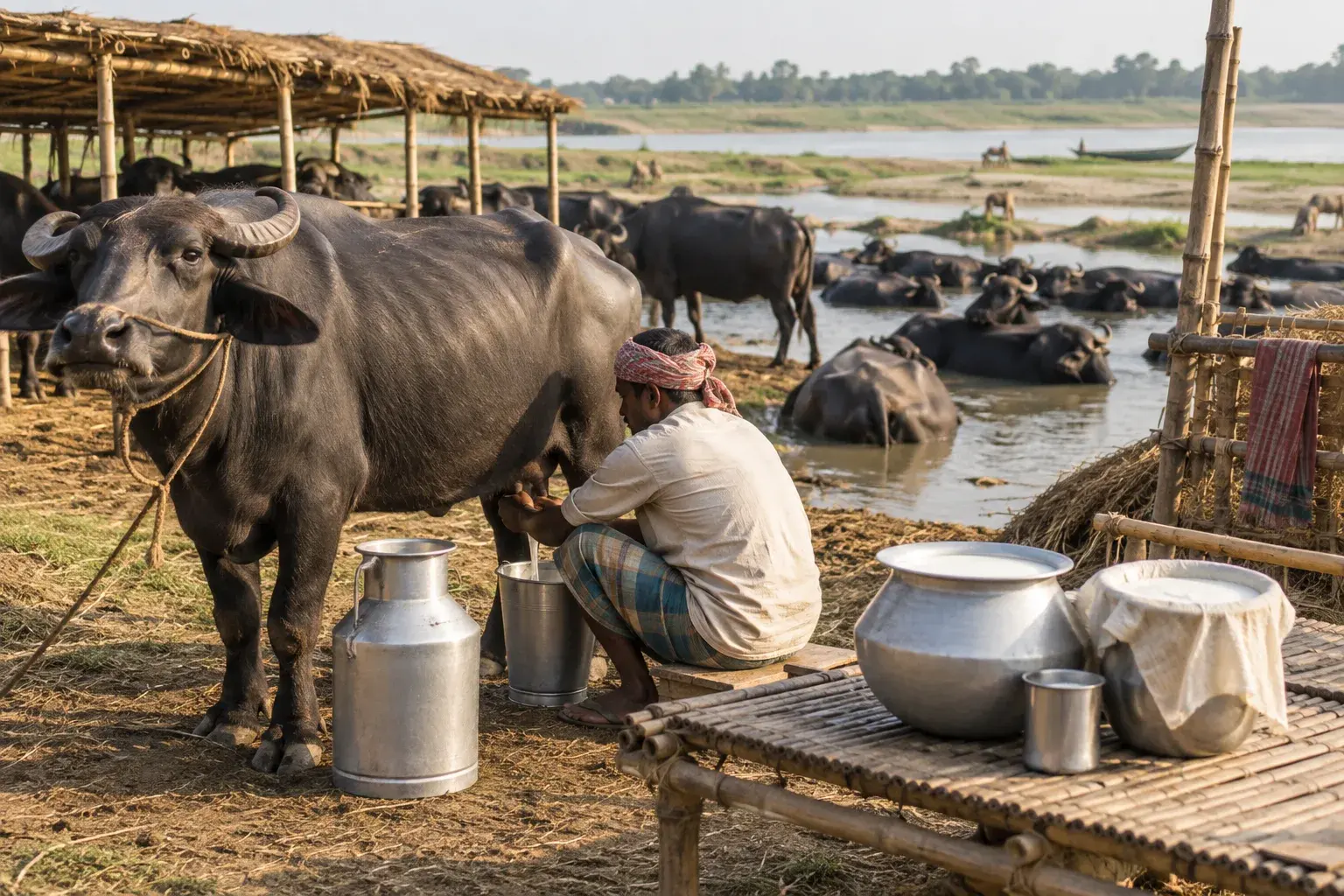
Keeping buffalo on the chars or in a bathan herd and selling the milk. A buffalo gives 4 to 8 kg of milk a day and buffalo milk fetches Tk 80 to 130 a litre, but only in districts where there are curd and sweet makers to buy it.
- Capital
- ৳1.5 lakh – ৳10 lakh
- People
- 1 – 5
- First income
- 1 – 365 days
 Agriculture & farming
Dragon fruit farming
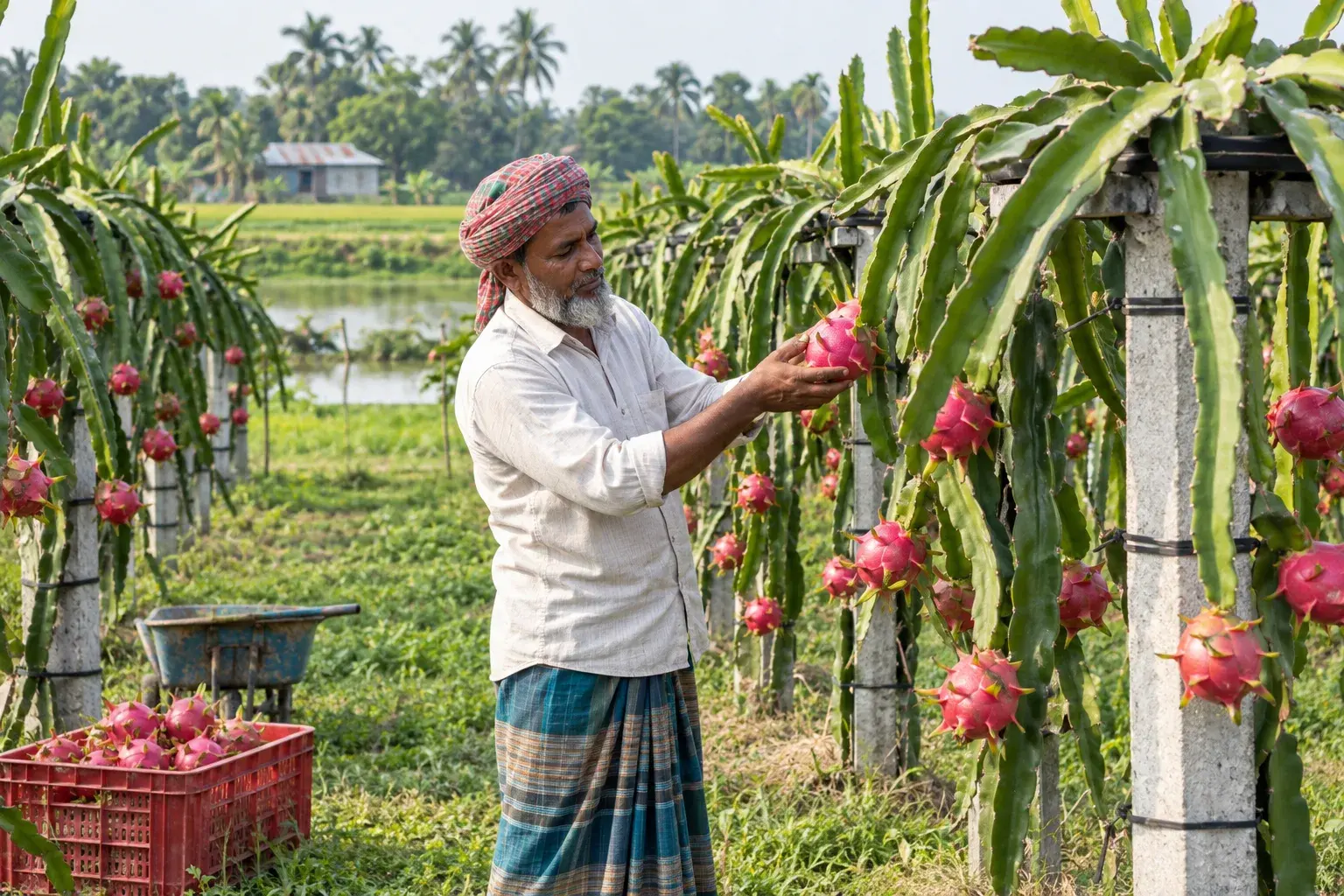
Growing dragon fruit on posts. One to four lakh taka a bigha up front, first fruit about a year later, and a price that has fallen from Tk 500 to Tk 80-100 a kilo in Karwan Market.
- Capital
- ৳1.5 lakh – ৳4 lakh
- People
- 1 – 4
- First income
- 365 days
 Agriculture & farming
Shrimp farming (gher)
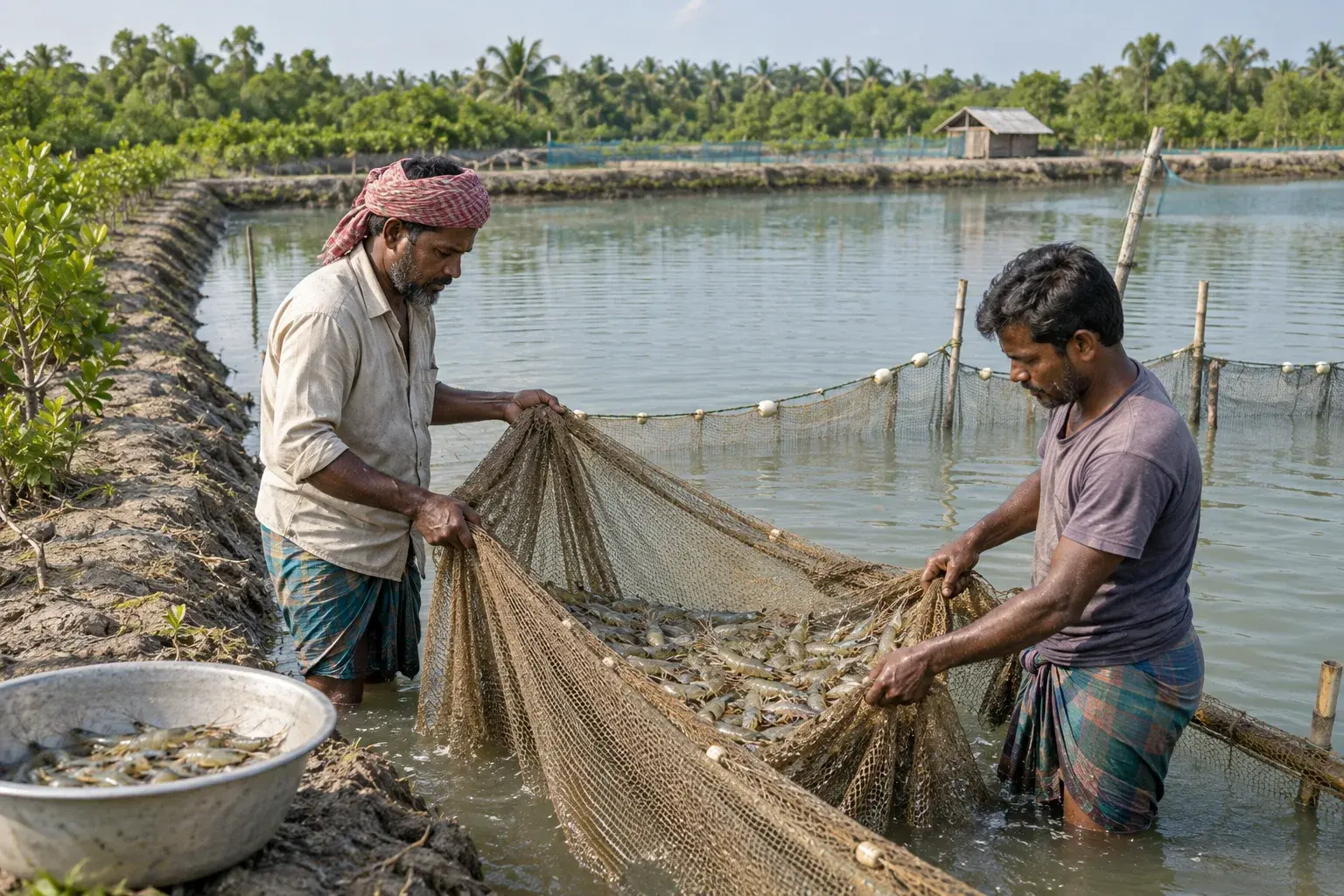
Farming bagda and golda in embanked saline ponds. Fry has gone from Tk 1,300-1,700 to about Tk 3,000 per thousand this season and southern hatcheries have fallen from 78 to 37.
- Capital
- ৳1.5 lakh – ৳6 lakh
- People
- 1 – 5
- First income
- 90 – 150 days
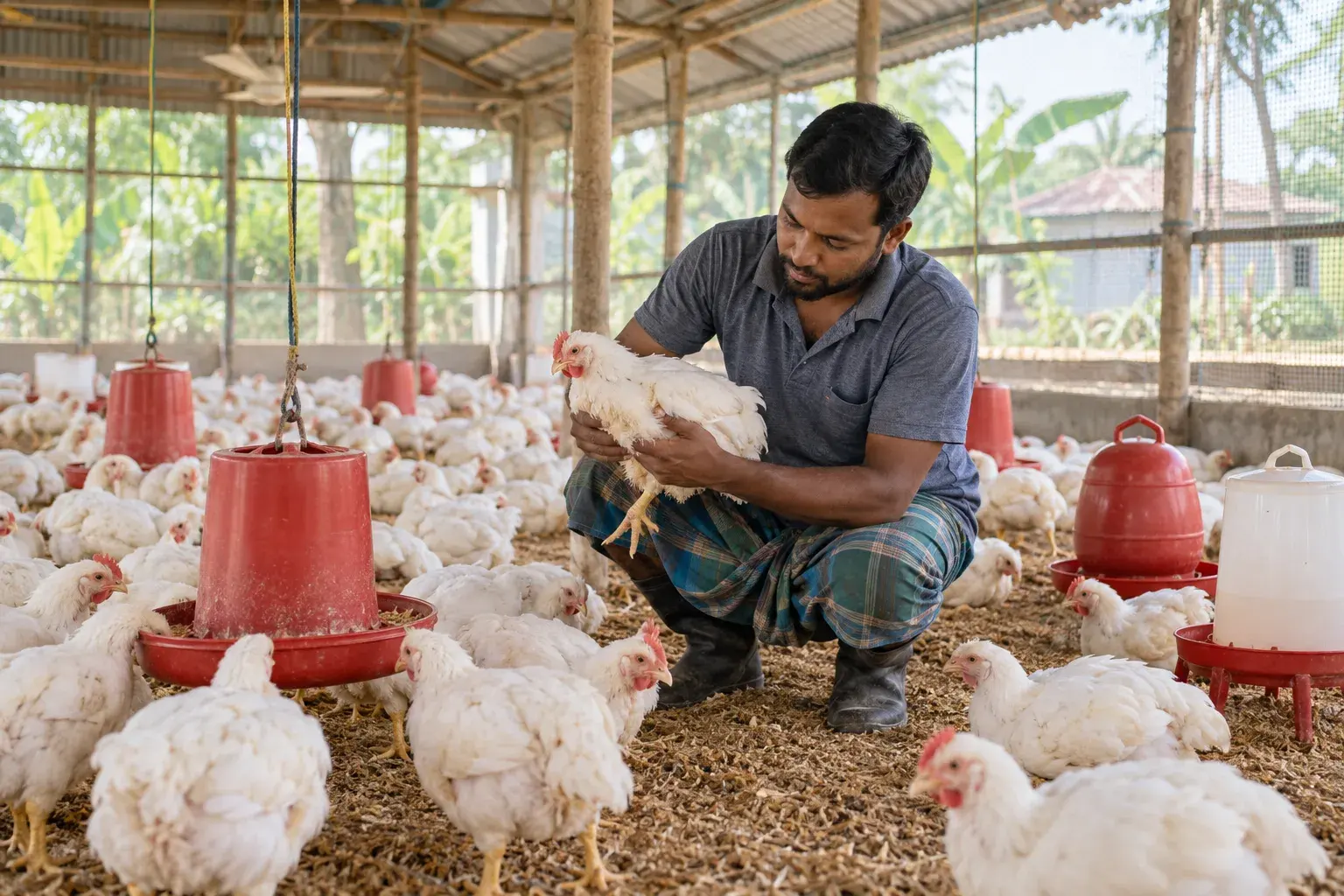 Agriculture & farming
Broiler poultry farm
Raising day-old chicks to live birds in about a month. Farm-gate prices swung from Tk 110 to Tk 198 a kg during 2026 against a production cost of roughly Tk 140.
- Capital
- ৳1.5 lakh – ৳6 lakh
- People
- 1 – 3
- First income
- 32 – 60 days