
Hardware and sanitary shop
A shop selling rod, cement and sanitary fittings. Rod is Tk 92,500-94,500 a tonne and up 10 percent in a year, but the bigger question is when the contractor's credit comes back.
- Last reviewed: 19 September 2026
- Version 1
Hardware and sanitary shop
- Starting capital
- ৳2,00,000 – ৳5,00,000 Editorial estimate
- Manpower
- 1 – 4 people
- First sale
- 15 – 45 days Editorial estimate
- Break-even
- 10 – 20 months Editorial estimate
- Kind of work
- Shop · Medium difficulty
About the business
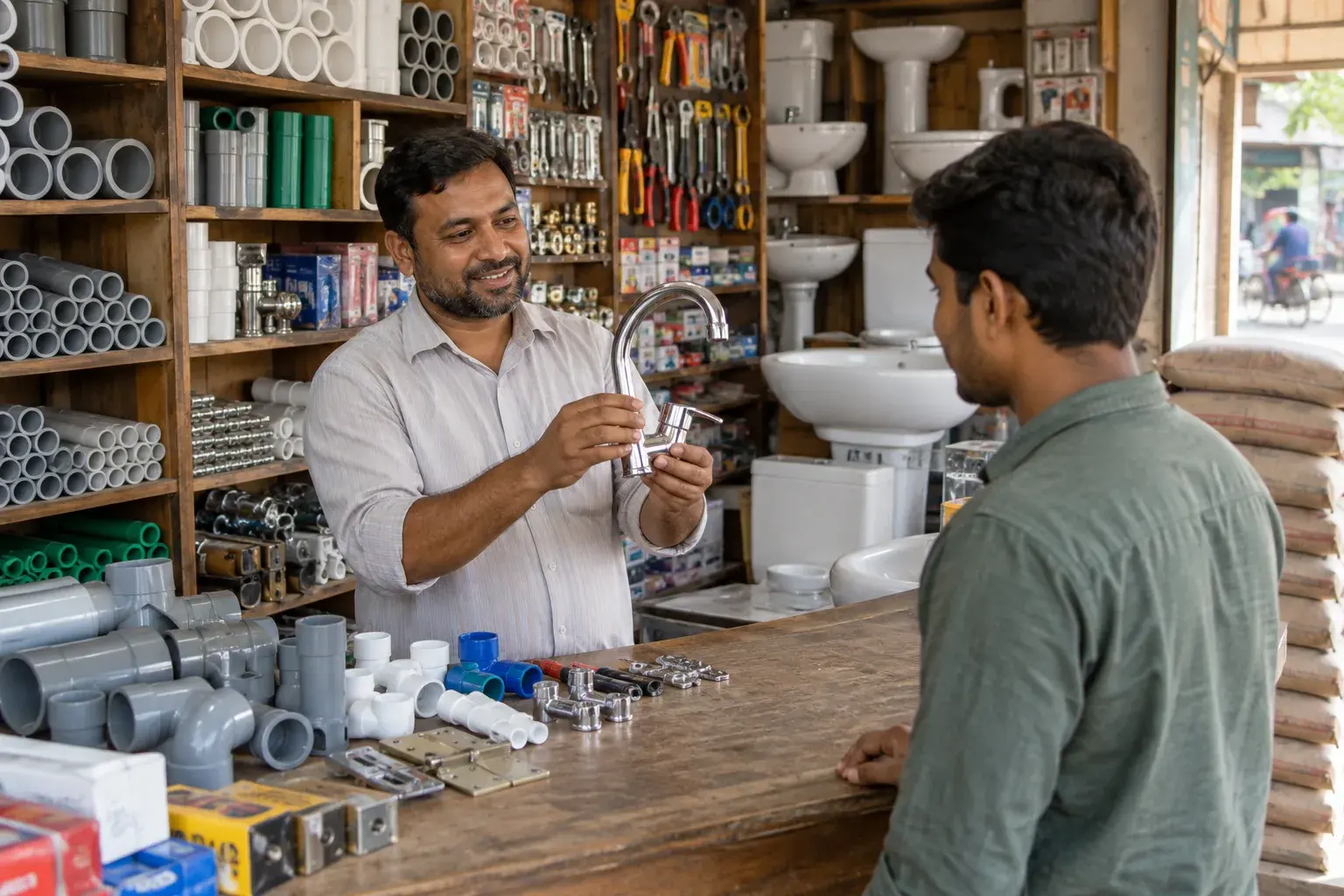
Rod, cement, wire, nails, pipe, taps, basins and commodes — everything a house needs to be built or repaired, under one roof. There are two kinds of customer. Neighbours come in for two hinges or a kilo of nails and pay cash. Contractors and masons take a lot at once, and take it on credit. That credit is the real story of this trade: the goods leave the shop, the money comes after the job is finished, and if the job stalls, so does the money. Prices swing hard as well. On 15 September 2026 TCB listed 60-grade MS rod at Tk 92,500-94,500 a tonne, more than 10 percent up on the year, and 40-grade at Tk 89,000-91,000, up about 17 percent. In March 2026 rod rose Tk 6,000-7,000 a tonne inside a single week and cement Tk 15-50 a bag. A sudden rise makes the stock you bought earlier profitable; a fall turns the same stock into a loss. Demand is weak too: in July 2026 traders said that with no new large government projects, rod and cement demand had hit bottom and 10 to 20 mills had shut permanently. Taking a company dealership means a deposit and a monthly sales target, and a shopkeeper who does not read those terms ends up with his money sitting in the company's warehouse.
Unit economics
| Item | Range | Evidence | Suggest a correction |
|---|---|---|---|
| Monthly working capital | ৳3,00,000 – ৳12,00,000 | Editorial estimate | |
| Selling price | ৳89,000 – ৳94,500 / unit | Official source | |
| Variable cost | ৳84,000 – ৳91,500 / unit | Editorial estimate | |
| Gross margin | 3% – 6% | Editorial estimate | |
| Time to first revenue | 15 – 45 days | Editorial estimate | |
| Break-even time | 10 – 20 months | Editorial estimate | |
| Cash cycle | 20 – 75 days | Editorial estimate | |
| Waste / loss | 2% – 5% | Editorial estimate | |
| Daily capacity | 0.2 – 0.6 | Editorial estimate |
What you need to start
- Weighing scales, a rod cutter, shelving and racks, a handcart or van, and a credit ledger.Equipment
- Start with fast-moving lines: cement, rod, wire, nails, hinges, PVC pipe, taps, white cement. Expensive slow-moving sanitary sets are best left until later.Starting stock
- Trade licence from the city corporation or municipality: form Tk 10, licence book Tk 50, standard tax Tk 30, stamp Tk 150-300, licence fee Tk 100-60,000 by trade type, plus VAT and a signboard fee. Issued in 3-5 working days.Licence
- A TIN from the National Board of Revenue, and VAT registration once turnover crosses the threshold. A company dealership almost always requires both a TIN and a bank account.Licence
- Knowing which gauge of rod, which pipe and which wire a given job needs. A mason who is given the wrong item does not come back.Skill
- A rod and cement company dealership or distributor, plus a wholesale market for sanitary ware, pipe and electrical goods. Get the deposit, monthly target and return terms in writing first.Supplier
- A shopfront with a dry store behind or beside it. There must be room to unload rod and cement from a truck, and cement cannot be stacked on bare floor.Workspace
How the work is done
- 1Pick the location: a neighbourhood where houses are going up, or the part of the bazar where masons and contractors gather. Check that a truck can reach it and that there is room to unload.
- 2Take the trade licence from the city corporation or municipality, and get a TIN, and VAT registration if required, from the NBR.
- 3Decide what you will actually stock. Not everything at once: start with one line — cement and rod, or plumbing and sanitary, or electrical — and widen later.
- 4Get the company's dealership terms in writing: how much deposit, what monthly sales target, who bears the loss on stock if prices fall, and whether unsold goods can be returned.
- 5Keep a book with the buying price, the selling price and how long each item has sat in the store. Rod and cement prices move week to week.
- 6Set the credit rule before you start: which contractor gets how much, and within how many days it must come back. Put the rule on the wall.
- 7Take a signature in the book for every credit sale and keep a photo on your phone. Credit given on a verbal promise leaves you no paper to recover it with.
- 8Stay close to the local masons, rod fitters, plumbers and electricians. It is the mason, not the house owner, who decides which shop the materials come from.
- 9Plan separately for the four or five monsoon months. Construction slows, so heavy stocking at that time just locks up cash.
- 10Store cement dry and raised on wooden pallets. If it gets damp, or sits too long, the bag sets hard and cannot be sold.
- 11Once a month pull out the list of dues and chase the oldest money first. The older a debt gets, the less likely it is to come back.
Seasons
- JanHigh
- FebHigh
- MarHigh
- AprHigh
- MayNormal
- JunLow
- JulLow
- AugLow
- SepLow
- OctNormal
- NovHigh
- DecHigh
Where it works well
- Strong fitChattogram · The country's big steel mills are here, so rod comes from close by and freight costs less.
- Strong fitDhaka · The wholesale hardware and sanitary markets of Nawabpur Road and Dholaikhal supply the whole country, and the city itself has the most new building and repair work.
- Strong fitGazipur · Factories and worker housing are both going up continuously, so rod and cement demand stays steady.
- Strong fitNarayanganj · An industrial town next to Dhaka, with sand, cement and rod easy to bring in by river.
- Strong fitSylhet · House building by families with relatives abroad runs all year, and those jobs use more expensive sanitary fittings.
- PossibleBogura · The trading centre of the north; small shops in the surrounding districts buy their stock here.
- PossibleCumilla · The bazars along the Dhaka-Chattogram highway see a steady flow of contractors and masons.
- PossibleKhulna · A divisional city near the port, though building activity is slower than in Dhaka or Chattogram.
- PossibleMymensingh · As a newly created divisional city it has seen more government and private construction.
- PossibleRajshahi · A divisional city with regular government building and institutional construction.
Risks and cautions
- HighLate payment: Contractors and masons take goods on credit and pay when their own bill is settled. If the job stalls, or a government bill is held up, the shop's money is held up with it. One big contractor's unpaid balance can freeze a month's working capital, and a small shop cannot afford to go to court over it.
- HighWorking capital: Rod and cement prices move week to week: in March 2026 rod jumped Tk 6,000-7,000 a tonne and cement Tk 15-50 a bag inside a week. A rise makes old stock profitable, but a fall costs thousands of taka on every tonne sitting in the store — and that risk sits with the shop, not the company.
- HighDemand: Construction is in a slump. In July 2026 steel traders said demand had hit bottom for want of new large government projects, and that 10 to 20 mills had closed permanently during the downturn. Private building also slows through four or five monsoon months, while rent and wages still have to be paid.
- MediumDependency: A company dealership comes with a monthly sales target. Miss it and the discount or commission is cut, while the deposit stays with the company. A shop tied to one brand has no answer when that brand changes its price or its terms.
- MediumSpoilage: Cement that gets damp, or sits too long, sets inside the bag and cannot be sold — the whole bag is lost. A damp store in the monsoon makes this worse.
Sources
সিটি কর্পোরেশন থেকে ট্রেড লাইসেন্স প্রাপ্তির ধাপ সমূহ
Collected: 16 Sept 2026Supports: Starting capital, Time to first revenue · বাংলাদেশ
- Collected: 15 Sept 2026
Supports: Starting capital, Monthly working capital, Selling price · ঢাকা মহানগর — সিপাহীবাগ, মিরপুর-৬, মোহাম্মদপুর টাউন হল, নিউমার্কেট, রামপুরা, মহাখালী বাজার
What changed
No corrections have been published yet.
Questions and answers
No questions yet. Be the first to ask.
Similar businesses
 Retail & wholesale
Cosmetics shop
A retail shop for creams, shampoo, face wash and make-up. At least 18 cosmetic categories are on BSTI's mandatory list, and uncertified or undocumented imported stock is the shopkeeper's liability.
- Capital
- ৳2 lakh – ৳15 lakh
- People
- 1 – 5
- First income
- 15 – 45 days
 Retail & wholesale
Optical shop (spectacles)
Buying frames and lenses and assembling spectacles over the counter. A complete ordinary pair retails at Tk 649 to Tk 5,400 (online prices, 21 Sep 2026). No BSTI certificate is needed; the trade licence is the only paper.
- Capital
- ৳2 lakh – ৳15 lakh
- People
- 1 – 4
- First income
- 15 – 60 days
 Retail & wholesale
Pet food and supplies shop
A shop selling imported cat and dog food, litter and accessories. Dry food runs Tk 487 to Tk 1,900 a kg (21-09-2026). Customs duty on pet food is 25%, and demand is still mostly confined to Dhaka.
- Capital
- ৳2 lakh – ৳10 lakh
- People
- 1 – 4
- First income
- 15 – 60 days
 Retail & wholesale
Fish wholesale arot
Auctioning farmers' fish on commission. The rate is about 3 per cent, and holding suppliers means giving interest-free advances - the money is in volume, not margin.
- Capital
- ৳2 lakh – ৳15 lakh
- People
- 3 – 12
- First income
- 15 – 60 days