
Mobile phone servicing
The part carries little margin; the money is in the labour. The repairer who can work on a motherboard gets the other shops' sets too.
- Last reviewed: 19 September 2026
- Version 1
Mobile phone servicing
- Starting capital
- ৳40,000 – ৳2,50,000 Editorial estimate
- Manpower
- 1 – 3 people
- First sale
- 7 – 30 days Editorial estimate
- Break-even
- 3 – 6 months Editorial estimate
- Kind of work
- Shop · Medium difficulty
About the business
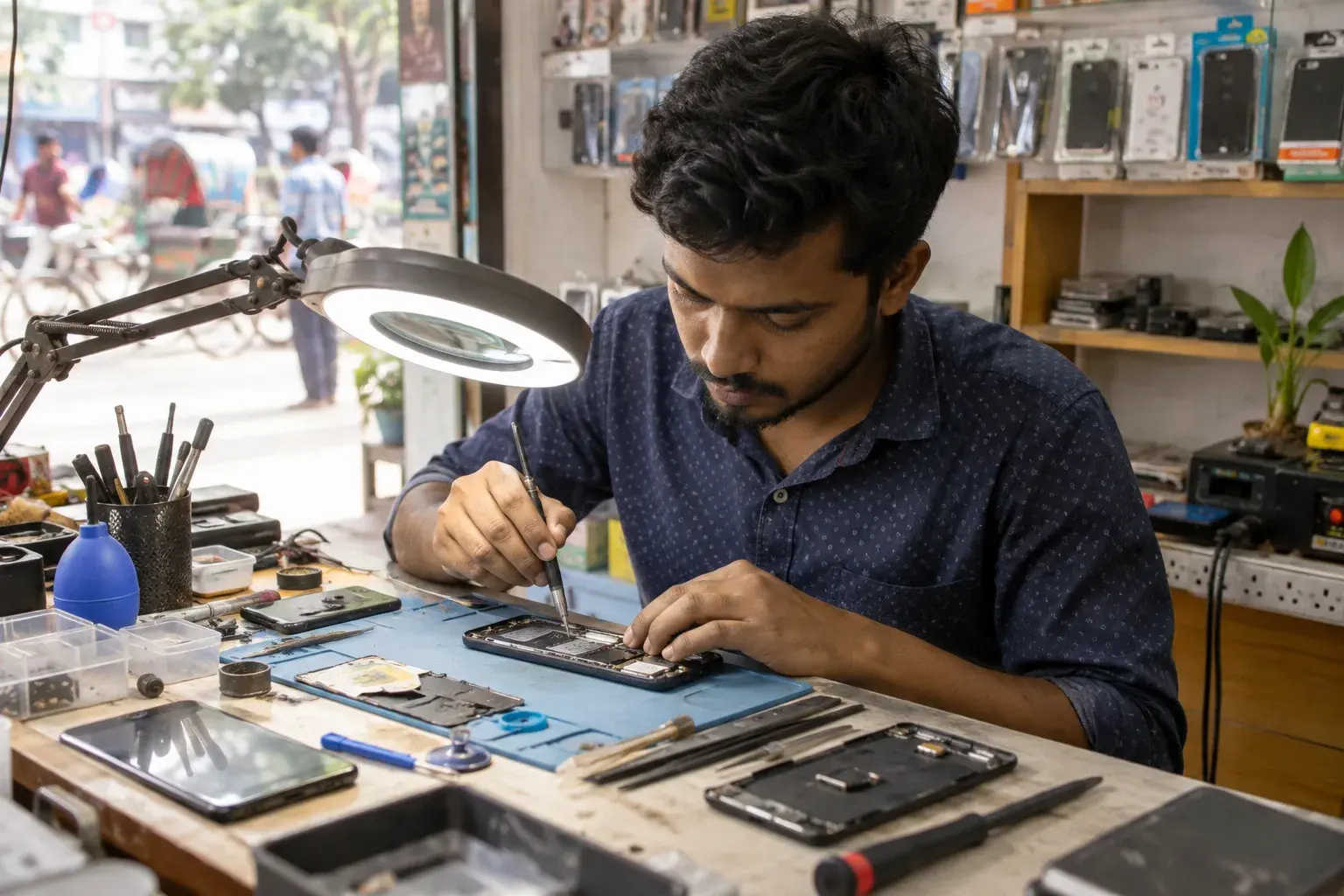
A shop that repairs broken phones. Replacing cracked displays, fixing charging ports, swapping batteries, opening and drying water-damaged sets, flashing software and unlocking pattern locks is where most of the day goes. A bill splits into two parts: the price of the part and the labour on top. The part carries little margin; the money is in the labour, and the labour depends on whether you can actually do the job. A repairer who can only change displays and batteries is really a parts trader. The one who can work on the motherboard is the actual technician, because other shops cannot do that work and send their sets to him. Parts come from Motalib Plaza at Hatirpool in Dhaka; district shops buy from there by courier or by sending someone, which is why their buying price is above Dhaka's. The shop itself can be tiny, but the tools and a stock of fast-moving parts cannot be skipped. The money comes in cash on the day the job is finished, and that is the best thing about this trade.
Unit economics
| Item | Range | Evidence | Suggest a correction |
|---|---|---|---|
| Monthly working capital | ৳25,000 – ৳1,00,000 | Editorial estimate | |
| Selling price | ৳150 – ৳3,000 / unit | Editorial estimate | |
| Variable cost | ৳20 – ৳2,200 / unit | Editorial estimate | |
| Gross margin | 27% – 87% | Editorial estimate | |
| Time to first revenue | 7 – 30 days | Editorial estimate | |
| Break-even time | 3 – 6 months | Editorial estimate | |
| Cash cycle | 0 – 1 days | Editorial estimate | |
| Waste / loss | 3% – 8% | Editorial estimate | |
| Daily capacity | 4 – 15 | Editorial estimate |
What you need to start
- Soldering iron, hot air rework station, DC power supply, digital multimeter, microscope or magnifier lamp, opening tool set, ultrasonic cleaner and a software box.Equipment
- Displays and batteries for the models that actually run locally, plus charging ports, flex cables, screws and adhesive. Parts stock locks up cash, but without it the job walks out.Starting stock
- Trade licence from the city corporation, municipality or union parishad: form Tk 10, licence book Tk 50, standard tax Tk 30, non-judicial stamp Tk 150-300, licence fee Tk 100-60,000 by trade type, plus VAT and signboard fee. Issued in 3-5 working days and renewed annually.Licence
- Hands-on skill: soldering, display and battery replacement, charging port repair, software flashing, and above all working on the motherboard. That last one is what separates one shop from the next.Skill
- Parts source: Motalib Plaza at Hatirpool in Dhaka is the wholesale centre of this trade, with separate shops for displays, batteries, charging ports and flex cables. District shops buy from there by courier, so their buying price is above Dhaka's.Supplier
- A small shop is enough: one workbench, good light, uninterrupted power, and a lockable place for customers' handsets.Workspace
How the work is done
- 1Learn the work first. Opening your own shop without six months to a year on someone's bench means the first few sets you kill take the capital with them.
- 2Pick the spot: a row of phone shops, a bazar, outside a college, or beside a bus stand. People do not travel far with a broken phone; they walk into the one they can see.
- 3Take the trade licence from the city corporation, municipality or union parishad: form Tk 10, book Tk 50, standard tax Tk 30, stamp Tk 150-300, plus the licence fee for the trade type, issued in 3-5 working days.
- 4Buy the tools: soldering iron, hot air gun, DC power supply, multimeter, microscope or magnifier, opening tool set and an ultrasonic cleaner. Not all of it on day one, but nothing starts without the first four.
- 5Go to Motalib Plaza at Hatirpool in Dhaka and fix your parts sources; displays, batteries, charging ports and flex cables are separate shops. If you are in a district town, set up a courier arrangement.
- 6Keep a small stock of displays and batteries for the models that actually run in your area. Without the part in hand the customer takes the set to the next shop.
- 7Open the set in front of the customer, write down the fault and give a receipt, so there is no argument later about a scratch that was not there before.
- 8Quote the bill in two parts: the price of the part and the labour. Quote one number and the customer bargains on the total, and it is the labour that gets cut.
- 9On water-damaged sets and motherboard work, say up front that it may not be fixable. Say nothing and you will be asked to pay for the handset when it fails.
- 10Stay on good terms with nearby shops that cannot do motherboard work. The sets they send become the steady part of the income.
- 11Keep a register of which model came in with which fault. After a few months you will see a handful of models make up most of the work; point both your stock and your learning there.
Seasons
- JanNormal
- FebNormal
- MarNormal
- AprHigh
- MayNormal
- JunHigh
- JulNormal
- AugNormal
- SepNormal
- OctNormal
- NovNormal
- DecNormal
Where it works well
- Strong fitChattogram · A large user base and a mobile market of its own, so it depends less on Dhaka.
- Strong fitDhaka · Motalib Plaza at Hatirpool, the wholesale centre for parts, is here; parts are bought over the counter so the buying price is lowest and no job stalls.
- Strong fitGazipur · Huge numbers of low-cost handsets among factory workers, and parts come easily from Dhaka.
- Strong fitNarayanganj · Dense settlement and factories, and close enough to Dhaka to fetch an urgent part the same day.
- PossibleBogura · The commercial centre of the north; sets come in from neighbouring districts, especially for motherboard work.
- PossibleCumilla · Steady work in the district town bazar, though parts come by courier from Dhaka with a two or three day wait.
- PossibleMymensingh · A large student population brings a steady flow of broken displays and charging ports.
- PossibleRangpur · Plenty of users but lower purchasing power, so the work is cheap repairs at low labour rates.
- PossibleSylhet · More expensive handsets, so the labour charges are higher, but the skill needed is higher too.
- Weak fitBandarban · Few users, and parts take both time and money to bring in.
Risks and cautions
- HighOther: Killing a customer's handset. A motherboard job or a water-damaged set that goes fully dead ends with the customer demanding the price of a new phone. Paying for one expensive handset wipes out months of labour income, and without a written warning up front the claim cannot be resisted.
- HighDependency: The entire parts supply depends on one Dhaka market. A district shop buys by courier, so the buying price is higher and an urgent part takes two or three days - and in those two or three days the customer takes the set elsewhere.
- MediumDemand: On cheap handsets a new phone is becoming cheaper than the repair, so that work is shrinking, while expensive phones need more skill and more equipment. A shop that can only change displays and batteries sees its work slowly disappear.
- MediumWorking capital: Cash gets locked into parts stock, and when a model goes out of use nobody wants that display any more; the money just sits on the shelf. Stocking for too many models makes this worse.
- MediumCompliance: Stolen and snatched phones come in for repair, and taking one in unknowingly can put the shop's name in a police file. Recording the customer's name, number and the handset's IMEI at intake is the only protection.
Sources
সিটি কর্পোরেশন থেকে ট্রেড লাইসেন্স প্রাপ্তির ধাপ সমূহ
Collected: 16 Sept 2026Supports: Starting capital · বাংলাদেশ
What changed
No corrections have been published yet.
Questions and answers
No questions yet. Be the first to ask.
Stories about this business
Started because no one could fix his phone; now five branches in Dhaka
Five branches across Dhaka shopping centres and 50-60 technicians, all paid on commission rather than salary. The national phone repair market is put at about 3,000 crore taka.
- Reasons
- Weak demand, Strong network
Similar businesses
 Home & local services
Septic tank and drain cleaning
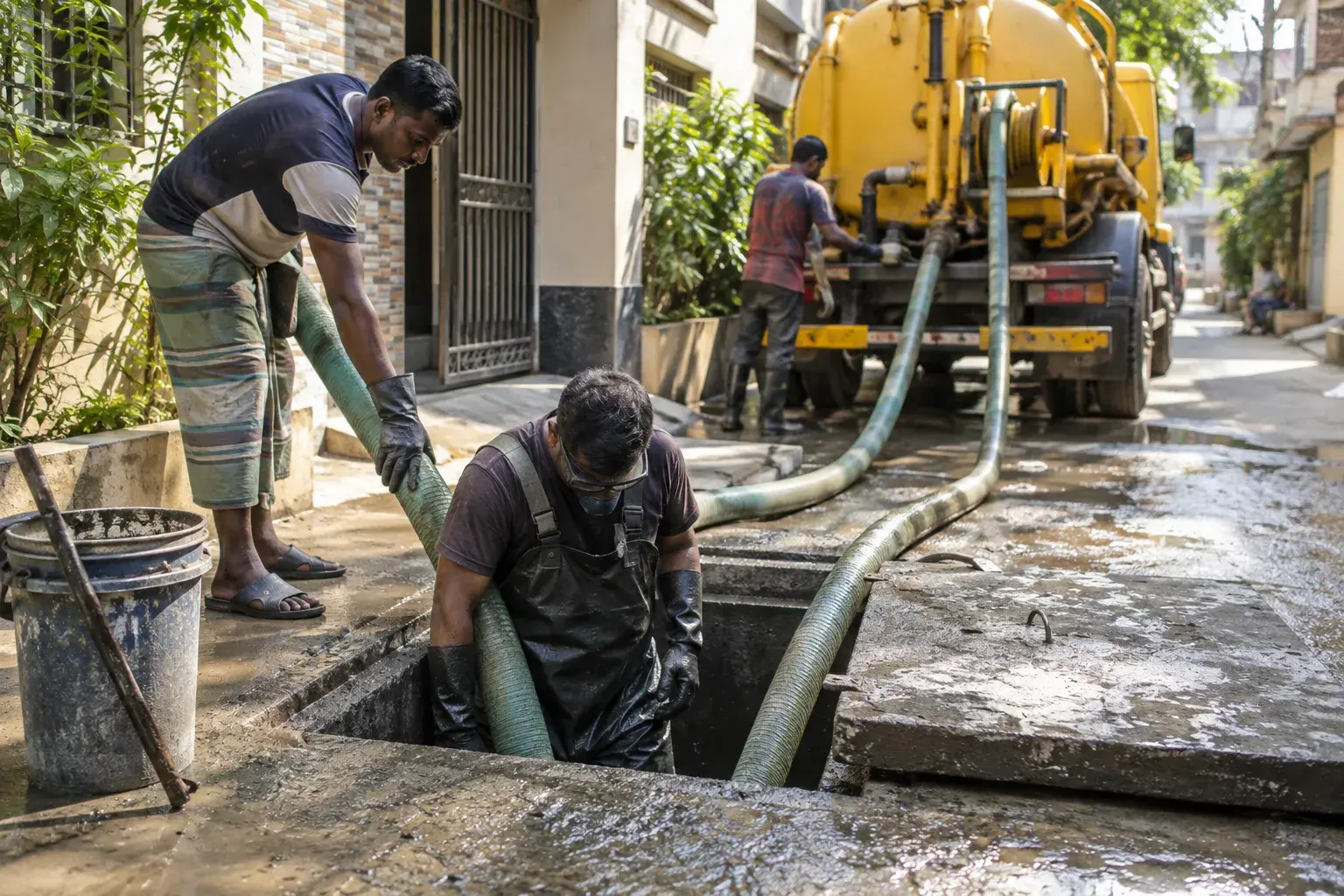
Emptying septic tanks and clearing drains. One Dhaka firm puts its starting price near Tk 7,000. But people die doing this work, from the gas, inside the tank.
- Capital
- ৳50k – ৳25 lakh
- People
- 2 – 6
- First income
- 10 – 45 days
 Home & local services
Pest control service
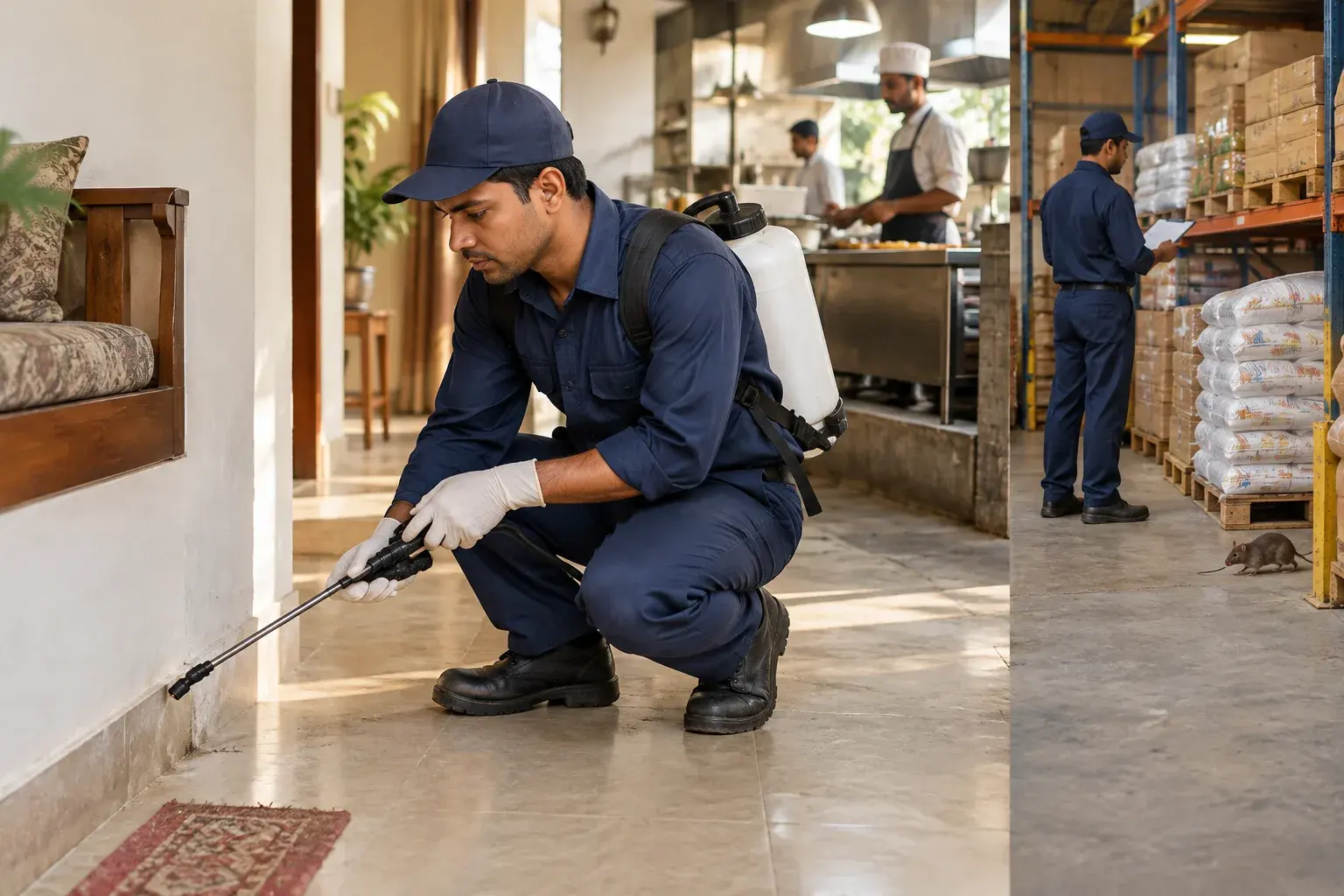
Controlling insects and rodents in homes, restaurants and warehouses. Annual contracts make the income predictable, and the work is illegal without a licence.
- Capital
- ৳50k – ৳3 lakh
- People
- 2 – 6
- First income
- 15 – 60 days
 Home & local services
Home and office cleaning service
Deep-cleaning flats and offices. In Dhaka a bathroom is Tk 1,225-2,250, a full home Tk 5,100-9,200 and floors Tk 3.5-10 per square foot.
- Capital
- ৳30k – ৳3 lakh
- People
- 2 – 10
- First income
- 7 – 30 days
 Home & local services
Motorcycle servicing
Servicing motorcycles and selling parts. Bangladesh has 4,980,747 registered motorcycles, and 86 percent of all 2025 vehicle registrations were motorcycles.
- Capital
- ৳50k – ৳5 lakh
- People
- 1 – 5
- First income
- 10 – 45 days