
Mustard farming
The 80-90 day crop that fits between the Aman harvest and Boro planting. Mustard seed averaged Tk 91.27 a kg wholesale nationally in August 2026, about Tk 3,651 a maund, and the government hands out Tk 550.50 worth of inputs per bigha.
- Last reviewed: 21 September 2026
- Version 1
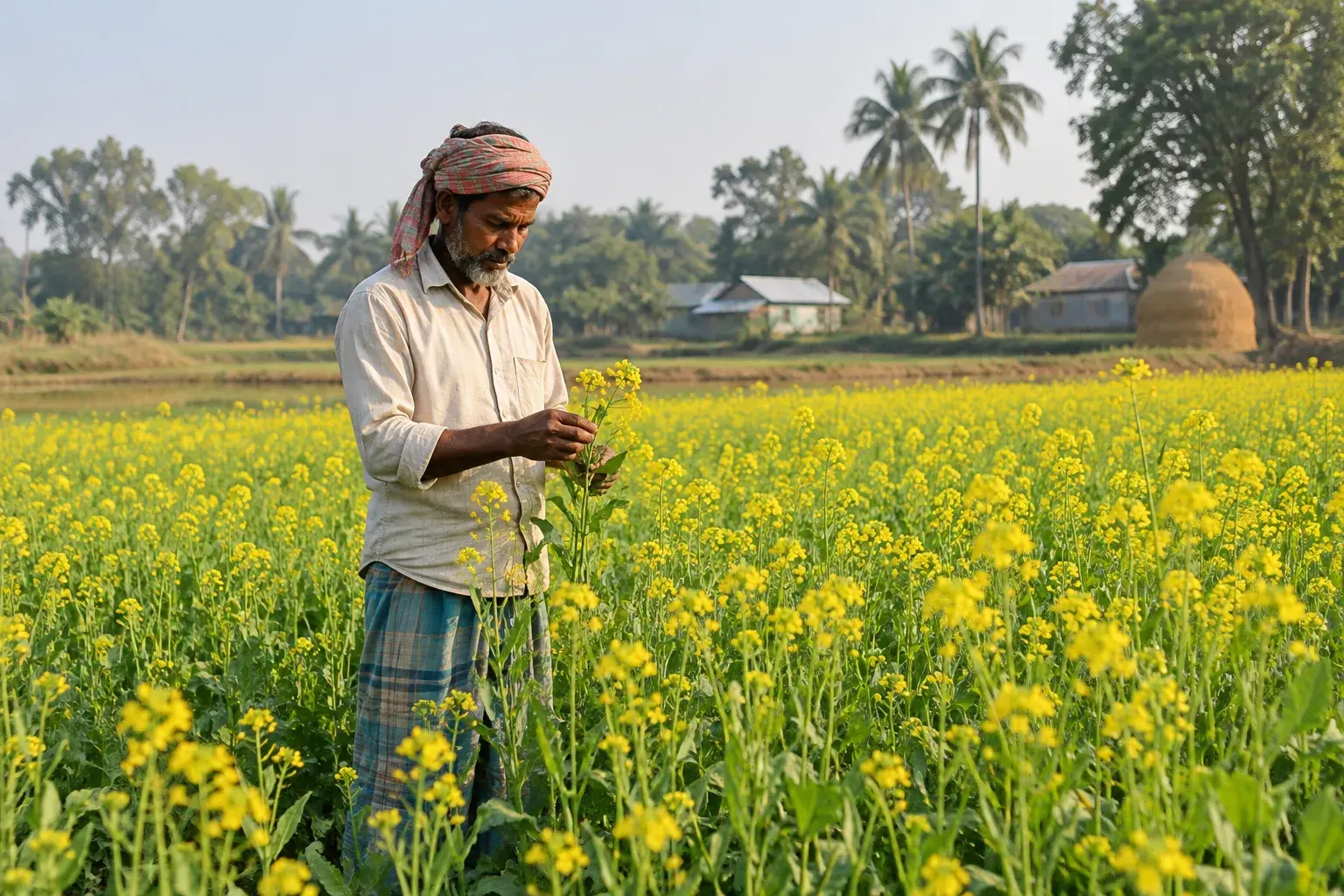
Mustard farming
- Starting capital
- ৳5,000 – ৳50,000 Editorial estimate
- Manpower
- 1 – 4 people
- First sale
- 75 – 110 days Editorial estimate
- Break-even
- 3 – 4 months Editorial estimate
- Kind of work
- Farm · Easy
About the business
Mustard is the one major crop in Bangladesh that does not take land away from anything else. It goes into the gap of two or two and a half months when the field lies empty between the Aman rice harvest and Boro planting, sown from the end of October to mid-November and cut in late January or February. The costs are light: one or two irrigations, little spraying, and the government gives 1 kg of seed, 10 kg of DAP and 10 kg of MoP free per bigha. Of the eleven crops in the Ministry of Agriculture's rabi 2025-26 incentive programme, mustard got the largest share, 904,800 farmer-bighas and Tk 50.00 crore, about a third of the whole programme. The reason is plain: the country runs on imported edible oil and mustard is the only domestic alternative. The price holds up. In August 2026 mustard seed was Tk 91.27 a kg wholesale and Tk 102 retail; loose mustard oil was Tk 218.10 a litre wholesale nationally and Tk 185-200 in the Dhaka wholesale market, against Tk 181-183 for soybean. The cake left after crushing sells too, at Tk 44.92 a kg wholesale and Tk 51 retail, mostly as cattle and fish feed. The real risk in this crop is not yield but timing. A late Aman harvest pushes the sowing back, and then the field has to be cleared for Boro, so the mustard is cut before it has filled.
Unit economics
| Item | Range | Evidence | Suggest a correction |
|---|---|---|---|
| Monthly working capital | ৳1,000 – ৳17,000 | Editorial estimate | |
| Selling price | ৳91 – ৳102 / kg | Official source | |
| Variable cost | ৳10 – ৳25 / kg | Editorial estimate | |
| Gross margin | 72% – 89% | Editorial estimate | |
| Time to first revenue | 75 – 110 days | Editorial estimate | |
| Break-even time | 3 – 4 months | Editorial estimate | |
| Cash cycle | 75 – 130 days | Editorial estimate | |
| Waste / loss | 5% – 20% | Editorial estimate | |
| Daily capacity | 1.5 – 6 | Editorial estimate |
What you need to start
- Nothing special for sowing; it is broadcast by hand. One or two irrigations, an aphid spray and sprayer, sickles, a threshing floor and winnowing basket, and sacks for the dried seed.Equipment
- Seed, 1 kg per bigha per the Ministry of Agriculture's incentive schedule, valued at Tk 128 a kg. It is free if your name is on the incentive list. BADC buys seed from contract growers at Tk 105-110 a kg.Starting stock
- Fertiliser: 10 kg of DAP and 10 kg of MoP per bigha per the incentive schedule, at the government farmer-level rates of Tk 21 for DAP, Tk 20 for MoP and Tk 27 for urea and TSP. The recommended urea dose could not be verified here.Starting stock
- Trade licence from the city corporation, municipality or union parishad: form Tk 10, licence book Tk 50, standard tax Tk 30, stamp Tk 150-300, licence fee Tk 100-60,000, issued in 3-5 working days and renewed yearly. Not needed to sell your own mustard, but needed to run a ghani or crushing mill or to trade seed.Licence
- Agricultural marketing licence from the Department of Agricultural Marketing under the Agricultural Marketing Act 2018 and its rules, applied for on Form-1. It applies to traders and arotdars. The fee and validity could not be verified here.Licence
- Timing above all: judging the sowing date that lets you take the crop off before Boro, recognising aphid, and reading the stage when about three quarters of the pods have yellowed. Cut late and the seed drops in the field.Skill
- The upazila agriculture office for incentive seed and fertiliser, a fertiliser dealer, the village ghani or crushing mill, the trader at the haat, cattle and fish farmers for the cake, and BADC's Pulses and Oilseeds Division for contract seed production.Supplier
- The field left empty after Aman. Mustard does not need land of its own, it needs time. The land must not hold water, and there must be at least 75 days before Boro planting.Workspace
How the work is done
- 1Look at your Aman harvest date and decide whether mustard is on at all. If you cannot sow between late October and mid-November, Boro will come round and the mustard will be cut unripe. That one decision settles the whole crop.
- 2Get your name on the incentive list at the upazila agriculture office in September. For 2025-26 mustard had 904,800 farmer-bigha slots, the largest of the eleven rabi crops, each getting 1 kg of seed, 10 kg of DAP and 10 kg of MoP.
- 3Pick the variety by duration, not by yield. BARI Sarisha-14, -17, -20 and Bina Sarisha-11 are the yellow-seeded types; BARI Sarisha-9 and -18, BADC-1 and BAU Sarisha-1 are the brown ones. BADC pays more for yellow seed (Tk 108-110 against Tk 105-107 a kg).
- 4On the damp field left after Aman, broadcast the seed without ploughing, which saves both time and the cost of land preparation. On a dry field, give a light irrigation after sowing.
- 5Put the DAP and MoP in at sowing. The incentive schedule assumes 10 kg of each per bigha, at the government farmer-level rates of Tk 21 for DAP and Tk 20 for MoP.
- 6Watch the field for aphid. Fog at the end of winter brings aphid at flowering and the pods do not fill; once it is established, spraying is too late.
- 7Let a beekeeper stand hives in the field. The pollination lifts the yield and mustard flower honey has its own market, so even without a fee the yield gain stays with you.
- 8Cut when about three quarters of the pods have turned yellow; do not wait for the whole field to dry, because the pods shatter and the seed drops in the field.
- 9Dry the cut crop two or three days in the sun, thresh it, winnow it well and bag it. Damp seed goes off and the oil quality drops, and the crusher then pays less.
- 10Decide whether to sell the seed or have it crushed and sell oil and cake separately. In August 2026 seed was Tk 91.27 a kg wholesale, loose mustard oil Tk 218.10 a litre and cake Tk 44.92 a kg. Oil plus cake fetches more, but there is the crushing charge and the time.
- 11Keep your own seed. One kg does a bigha, and stored properly it means not buying from the market next year.
- 12Ask whether BADC contract seed growing is open to you. For 2025-26 BADC bought standard-class yellow mustard seed at Tk 108 and foundation class at Tk 110 a kg, above the ordinary grain wholesale price.
Seasons
- JanHigh
- FebHigh
- MarNormal
- AprLow
- MayLow
- JunLow
- JulLow
- AugLow
- SepNormal
- OctHigh
- NovHigh
- DecHigh
Where it works well
- Strong fitFaridpur · An old oilseed district where mustard runs as the second rabi crop alongside onion, with the Dhaka market close.
- Strong fitJamalpur · 35,000 farmer-bighas in the rabi incentive; mustard does well after Aman on the sandy loam of the Jamuna chars.
- Strong fitManikganj · 58,350 farmer-bighas in the rabi incentive, second only to Tangail, and close enough to Dhaka that both seed and oil have a market at hand.
- Strong fitMymensingh · 27,900 farmer-bighas in the rabi incentive; a big Aman area means a big opening for mustard after it.
- Strong fitPabna · Wide low-lying land including the Chalan Beel falls free for mustard once the water goes down, with oil mills in Sirajganj and Dhaka nearby.
- Strong fitRajshahi · Mustard does well on little irrigation in the Barind tract, which is exactly why it makes sense here.
- Strong fitSirajganj · Heavy winter mustard on the Jamuna chars, and the honey collectors place their hives here, which lifts the yield through pollination.
- Strong fitTangail · The largest district allocation in the 2025-26 rabi incentive list, 77,000 farmer-bighas, more than any other district in Dhaka division; mustard covers wide areas here in winter and the Dhaka crushing mills are close.
- PossibleBogura · A large rabi area in the north, though potato is mustard's main rival here: the same land, the same weeks, and more money in potato.
- PossibleGopalganj · Once the beel water drops, mustard can be broadcast on the fallow without ploughing, so land preparation costs almost nothing.
- PossibleMagura · Large mustard fields in winter and a known area for mustard flower honey; most of the seed goes to local ghanis and small mills.
- PossibleNetrokona · 15,800 farmer-bighas in the rabi incentive; mustard is spreading on the haor land as the water drops, though a late drawdown leaves no time for it.
Risks and cautions
- MediumDemand: Competition from imported edible oil. In the Dhaka wholesale market on 17 September 2026 loose soybean was Tk 181-183 a litre, palm Tk 163-164 and mustard Tk 185-200. Mustard oil is the dearest of the three, so when imported oil gets cheaper the demand for mustard seed falls with it. Government decisions on import duty and price fixing move that gap overnight.
- MediumOther: Fog and aphid. Thick fog at the end of winter spreads aphid through flowering and pod set and the seed does not fill. Because the crop is cheap, many growers skip spraying, and one bad week takes a large part of the yield. This happens every year, not occasionally.
- LowWorking capital: Cash pressure is light in this crop: inputs are Tk 538 a bigha and the total cost about Tk 3,000-5,000, all of it back within 75-110 days. The risk runs the other way: because it is cheap, growers cut out irrigation and spraying, and the yield falls for it.
- LowCompliance: Selling seed needs no licence. But bottling mustard oil under your own name falls under a different law; that is food manufacturing, not farming, and it needs BSTI and Food Safety Authority registration. Those costs have to be worked out separately before going in.
- HighDependency: Dependence on the Aman rice crop. Mustard only gets the field after Aman is cut, and a late harvest or a flood that pushes Aman back closes the sowing window. Sow late and the pressure to plant Boro forces an early cut, so the seed is light and the oil content falls. None of this is in the farmer's hands; it all follows the previous crop's calendar.
Sources
- Collected: 21 Sept 2026
Supports: requirements · বাংলাদেশ
পণ্যভিত্তিক মাসিক পাইকারী ও খুচরা জাতীয় গড় বাজারদর, আগষ্ট ২০২৬ (২৭১টি কৃষিপণ্যের বুলেটিন)
Collected: 21 Sept 2026Supports: Selling price · বাংলাদেশ (জাতীয় গড়)
সারের বিক্রয়মূল্য — টিএসপি, এমওপি ও ডিএপি সারের ডিলার ও কৃষক পর্যায়ে বিক্রয়মূল্য
Collected: 21 Sept 2026Supports: requirements · বাংলাদেশ
সিটি কর্পোরেশন থেকে ট্রেড লাইসেন্স প্রাপ্তির ধাপ সমূহ ও ফি
Collected: 21 Sept 2026Supports: requirements · বাংলাদেশ
- Collected: 17 Sept 2026
Supports: Selling price, risks · ঢাকা মহানগর
Govt raises fertiliser dealer commission
Collected: 15 Sept 2026Supports: requirements · বাংলাদেশ
- Collected: 13 Apr 2026
Supports: Selling price · বাংলাদেশ
Supports: Starting capital, districts, Variable cost · বাংলাদেশ
পাবনায় আগাম পাটের বাজার চড়া, বেশি দাম পেয়ে কৃষক খুশি — করমজা চতুরহাট, সাঁথিয়া
Collected: 29 Jul 2025Supports: Variable cost · সাঁথিয়া, পাবনা — করমজা চতুরহাট
এক নজরে কৃষি পরিসংখ্যান — অন্যান্য ফসলে আবাদ ও উৎপাদন, ২০২১-২২
Collected: 1 May 2025Supports: Daily capacity · বাংলাদেশ
- Collected: 11 Apr 2023
Supports: Variable cost · বাংলাদেশ
What changed
No corrections have been published yet.
Questions and answers
No questions yet. Be the first to ask.
Similar businesses
 Agriculture & farming
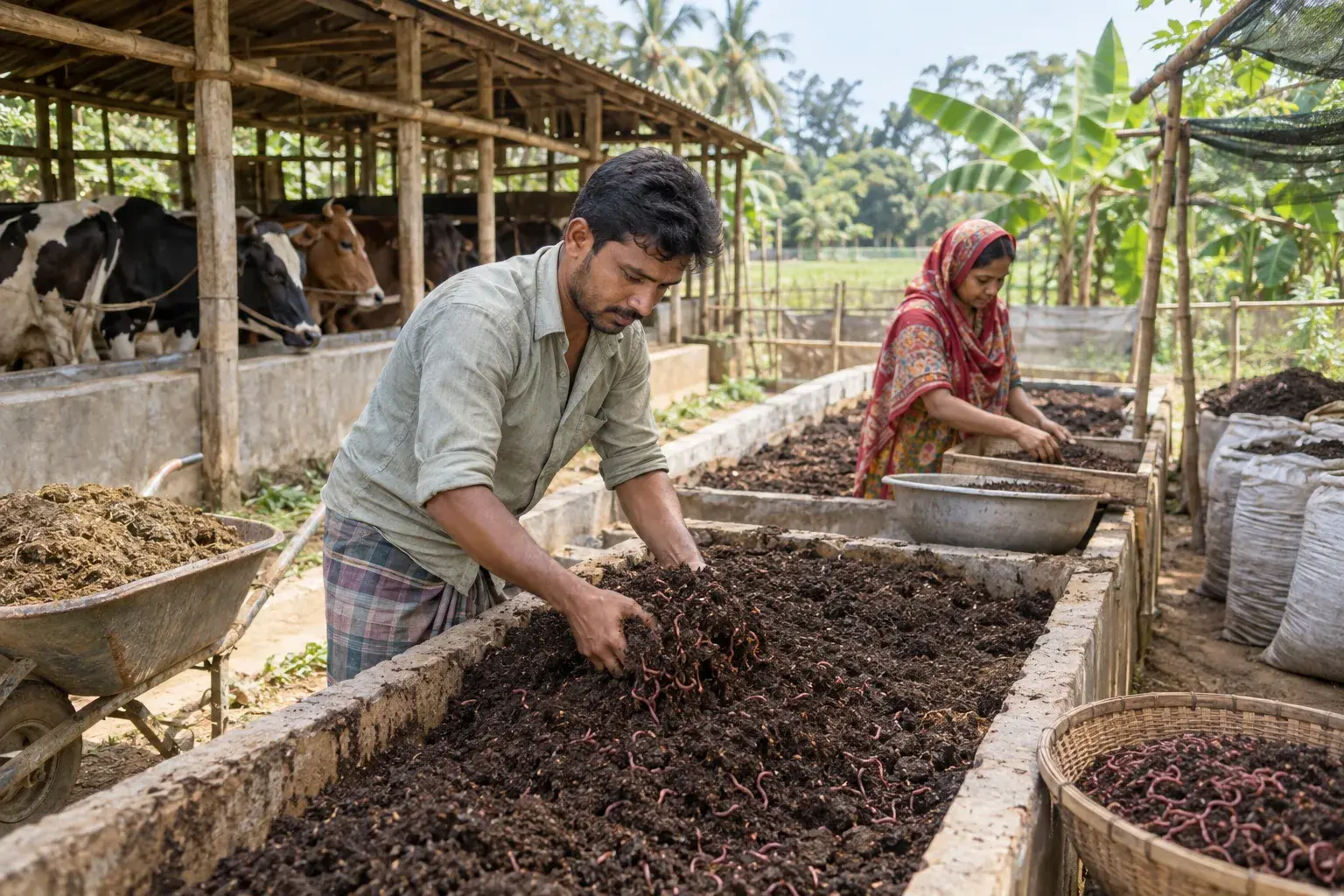
Vermicompost production
Making compost from cow dung and earthworms beside the cattle shed. Compost sells at Tk 10-13/kg against a cost of Tk 6-7, but the real income is selling breeding worms at Tk 2,000/kg.
- Capital
- ৳5k – ৳60k
- People
- 1 – 2
- First income
- 30 – 50 days
 Agriculture & farming
Rooftop farming and nursery
Growing plants in pots on the roof and selling seedlings. A small plant is Tk 50 while cactus and ferns reach Tk 1,200-5,000, and the pot, soil and fertiliser carry more money than the plant itself.
- Capital
- ৳5k – ৳80k
- People
- 1 – 2
- First income
- 60 – 180 days
 Agriculture & farming
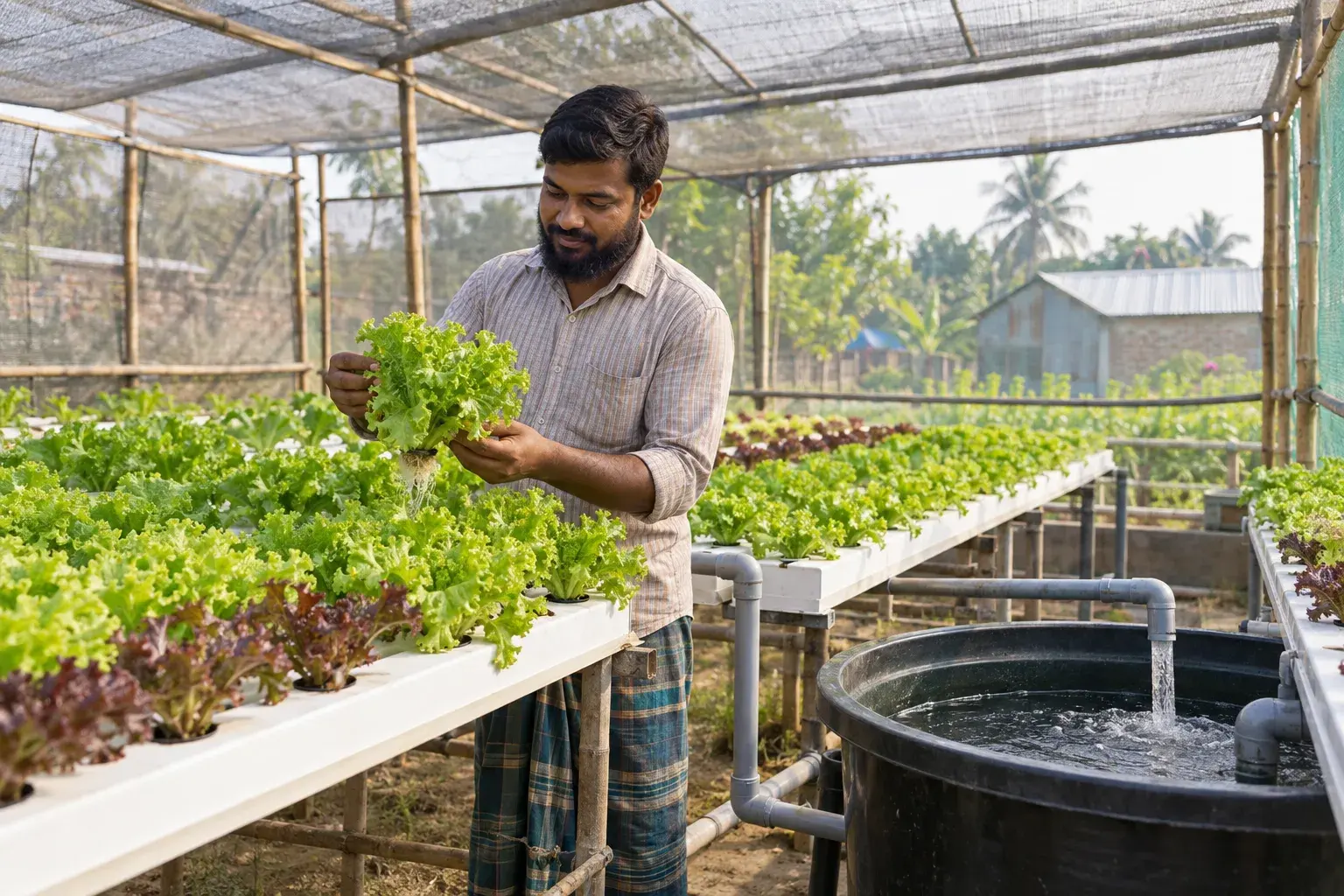
Hydroponic farming
Growing vegetables in water without soil. One Dhaka rooftop setup cost about Tk 2,00,000, and outside Dhaka there is still almost no commercial buyer.
- Capital
- ৳4k – ৳2 lakh
- People
- 1 – 3
- First income
- 45 – 120 days
 Agriculture & farming
Wheat farming
A single winter crop, sown mid-November and cut in March. The government bought wheat from farmers at Tk 36 a kg in the 2025 procurement, against a reported Tk 6,000-7,000 to grow one bigha.
- Capital
- ৳6k – ৳35k
- People
- 1 – 4
- First income
- 108 – 180 days