
Shitalpati mat weaving
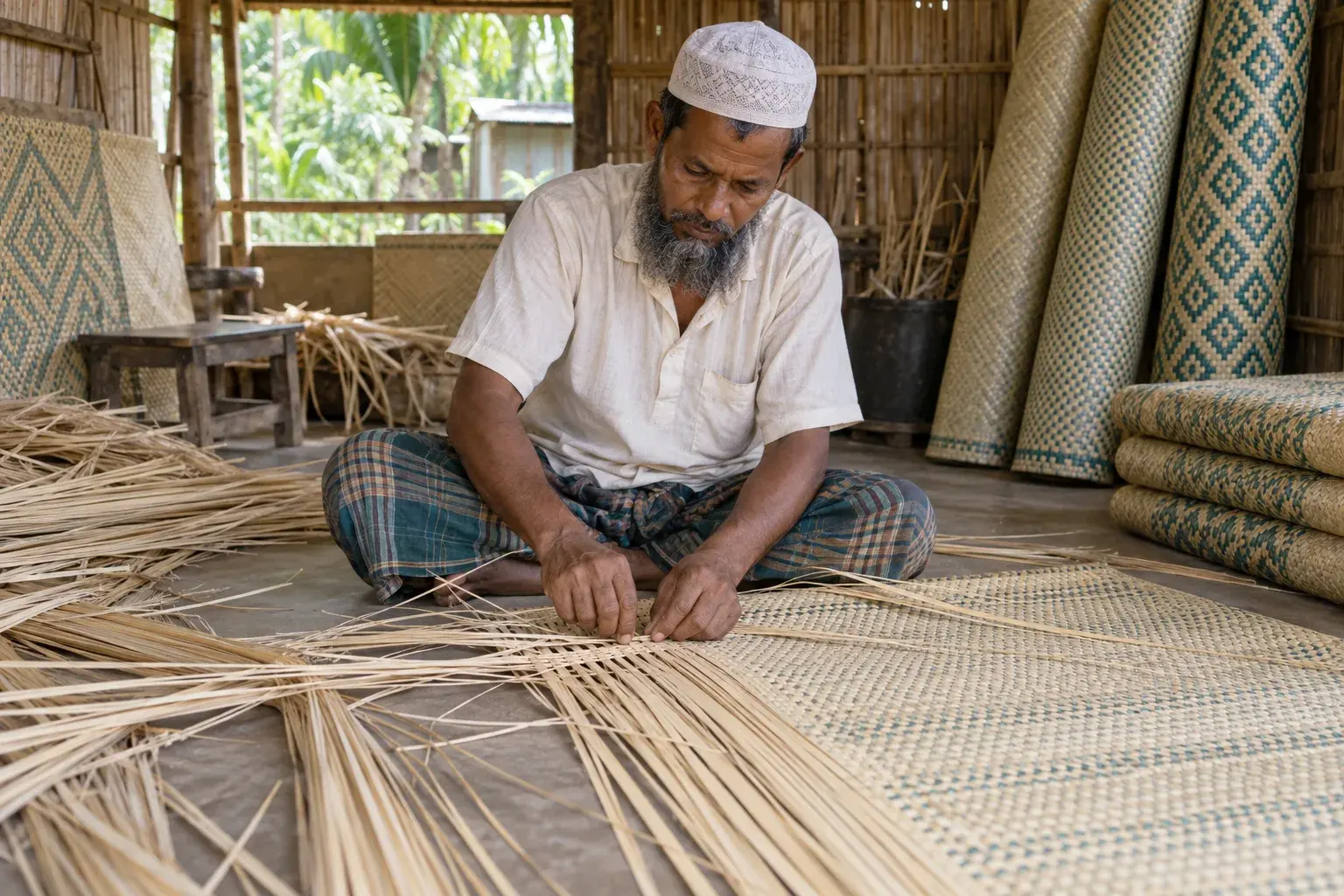
Hand-weaving mats from murta strips. In Jhalokathi one mat takes four to five days and sells for Tk 1,000-3,500, and the GI certificate has not raised that price; the weaver is still tied to the mahajan's advance.
- Last reviewed: 19 September 2026
- Version 1
Shitalpati mat weaving
- Starting capital
- ৳10,000 – ৳80,000 Editorial estimate
- Manpower
- 1 – 5 people
- First sale
- 12 – 365 days Practitioner verified
- Break-even
- 2 – 6 months Editorial estimate
- Kind of work
- Home-based · Medium difficulty
About the business
Splitting the stalk of the murta or paitra plant into fine strips, soaking, drying and dyeing them, then weaving a mat by hand. It is slow work. The plant takes about a year to mature and a pon of eighty long stalks costs Tk 700-800 in the market. One stalk normally yields ten to twelve strips, though a real master can pull eighteen to twenty. The strips are soaked seven or eight days in rice starch and water, washed, sun-dried and partly dyed before the weaving even begins. At Rajapur in Jhalokathi a plain mat takes four or five days and sells for Tk 1,000 to at most Tk 3,500, which is Tk 200 to Tk 875 a day before the raw material is paid for. Finely patterned mats take far longer and fetch more. The question is whether recognition raises the price, and the answer is no. Shitalpati weaving entered UNESCO's intangible cultural heritage list in 2017 and BSCIC received the GI registration certificate for Bangladesh's Shitalpati in 2023. Even so, in 2026 the Jhalokathi weaver Krishna Chandra Das says there is no government support at all and that weavers, short of money, take dadon advances from the mahajan and are forced to let mats go cheap. At Dhulijura in Rajnagar, Moulvibazar, more than a hundred families once wove; four or five are left and the rest have gone to day labour, driven out by plastic mats and electric fans. So do not price off the GI or the UNESCO listing. The market sets the price, and the market is shrinking.
Unit economics
| Item | Range | Evidence | Suggest a correction |
|---|---|---|---|
| Monthly working capital | ৳4,500 – ৳30,000 | Editorial estimate | |
| Selling price | ৳1,000 – ৳7,000 / unit | Practitioner verified | |
| Variable cost | ৳800 – ৳2,000 / unit | Editorial estimate | |
| Gross margin | 20% – 71% | Editorial estimate | |
| Time to first revenue | 12 – 365 days | Practitioner verified | |
| Break-even time | 2 – 6 months | Editorial estimate | |
| Cash cycle | 0 – 45 days | Editorial estimate | |
| Waste / loss | 33% – 50% | Editorial estimate | |
| Daily capacity | 0.1 – 1 | Editorial estimate |
What you need to start
- Knives and a dao for splitting, a pond or tank for soaking the strips, a pot and stove for boil-dyeing, and open ground for drying. No workshop is needed; the work is done in the yard.Equipment
- Murta or paitra stalks. A pon of eighty long stalks costs Tk 700-800 in the market. The plant takes about a year to mature, and the paitra groves are shrinking in places including Bakerganj in Barishal.Starting stock
- Registration as an authorised user of a Geographical Indication, from the Department of Patents, Designs and Trademarks (DPDT) under the Ministry of Industries, under the Geographical Indications (Registration and Protection) Act 2013. BSCIC holds the GI registration certificate for Bangladesh's Shitalpati (2023). The user registration fee and conditions have to be obtained from DPDT, and the certificate brings no extra price in the market.Licence
- Trade licence from the union parishad, municipality or city corporation, needed for regular wholesale supply or a shop: form Tk 10, licence book Tk 50, standard tax Tk 30, stamp Tk 150-300, licence fee Tk 100-60,000 by trade type.Licence
- Pulling the strips and weaving, which is the real capital. A stalk normally gives ten to twelve strips and a master pulls eighteen to twenty. Patterning is a separate skill; few weavers can raise designs like the chessboard or the chamar kanta.Skill
- Arotdars and mahajans, who place the orders at the end of Chaitra. Beyond them, the Baishakh fair wholesalers, Dhaka shops and designers, and the Middle East market reached through big traders.Supplier
- The house yard and a dry room, with water close by. Harendra Kumar Das soaks his murta and strips in the eighty-year-old pond his grandfather dug.Workspace
How the work is done
- 1Sort out the raw material first. Murta or paitra takes about a year to mature; without your own grove you buy in the market, where a pon of eighty long stalks costs Tk 700-800.
- 2Learn to split the stalk into strips. A stalk normally gives ten to twelve; the better the hand the more and the finer the strips, and the lower the raw material cost.
- 3Soak the strips seven or eight days in rice starch and water, then wash in clean water and sun-dry. Hurrying this step snaps the strips.
- 4Boil-dye some of the strips for the pattern. The design comes from mixing dyed and undyed strips.
- 5Fix the size and start weaving. A plain mat comes off in four or five days; a finely patterned one takes fifteen to twenty. The best selling size is 7ft by 5ft.
- 6Take the arotdar's order at the end of Chaitra. That is when you learn how many mats will move in Baishakh, and you buy raw material accordingly.
- 7Have the stock ready ahead of the Baishakh fairs. The year's biggest selling happens then: for the Jabbarer Boli Khela fair in Chattogram on 12 Baishakh, one Jhalokathi wholesaler alone was preparing to take about Tk 2 crore of mats.
- 8Think before taking dadon. Weavers short of money take the mahajan's advance and are then forced to sell him the mats cheap. Once you are inside the dadon you no longer set your own price.
- 9Do not stay only with bed mats. Murta is also made into table mats, wall mats, prayer mats, bags, file folders, pen stands and picture and mirror frames, and it is these that Dhaka designers and shops order.
- 10Take a trade licence from the union parishad or municipality and ask the district BSCIC office about small and cottage industry registration and training; BSCIC is the body that obtained the GI registration for this product.
- 11Do not price off the GI or the UNESCO listing. Even after the 2017 UNESCO recognition and the 2023 GI certificate, weavers in 2026 say there is no government support and the price has not moved. Find the buyer first, then make the mat.
Seasons
- JanNormal
- FebNormal
- MarHigh
- AprHigh
- MayHigh
- JunHigh
- JulNormal
- AugNormal
- SepNormal
- OctNormal
- NovLow
- DecLow
Where it works well
- Strong fitJhalokathi · Still the most active cluster. Mats are woven house by house in Hailakathi and Dahorshankar in Rajapur upazila, the arotdars' orders come at the end of Chaitra, and the mats reach the Middle East through big traders.
- Strong fitSylhet · The historic home of shitalpati: mats from Tegharia village in Balaganj upazila reached the Mughal court and Queen Victoria's. But the old mat market at Balaganj no longer sits.
- PossibleBarishal · Bakerganj has groves of paitra, the main raw material, which is an advantage on the supply side even as the groves shrink.
- PossibleChattogram · The biggest selling ground. The year's large sale happens around the Jabbarer Boli Khela fair on 12 Baishakh, where one wholesaler alone was preparing to take about Tk 2 crore of mats.
- PossibleDhaka · The order market. Orders from Dhaka are the only earning many weavers have, and a shitalpati fashion exhibition has even been held in Dhanmondi.
- PossibleHabiganj · One of the Sylhet division areas where mat weaving was practised, with the raw material available locally.
- PossibleMoulvibazar · Weavers of national standing survive at Dhulijura in Rajnagar; Harendra Kumar Das demonstrated the weaving at the UNESCO conference. But the families have fallen from over a hundred to four or five, the rest now day labourers.
- PossiblePirojpur · Kaukhali shitalpati is valued beyond the country, and being next to the Jhalokathi cluster it shares the same arots and wholesalers.
- PossibleSirajganj · Kamarkhand had a traditional shitalpati craft, though reports say it is disappearing.
- PossibleSunamganj · Murta grows in the haor country and old weaver families remain, though the work has shrunk.
Risks and cautions
- LowCompliance: There is little licensing trouble; the trade licence is enough. But registering as an authorised user of the GI needs a separate DPDT application whose fee and conditions are published nowhere. Selling under a 'GI product' label without that registration is not proper.
- HighDemand: The recognition exists and the buyer does not. UNESCO listed shitalpati weaving as intangible cultural heritage in 2017 and BSCIC obtained the GI registration certificate in 2023. Even so, plastic mats and electric fans have removed the need for the product; only hobbyists now buy it as a table mat or a wall hanging. The weaver Harendra Kumar Das says anything under Tk 6,000-7,000 does not cover their costs, and that at that price nobody wants to buy. Planning a price off the GI will not work.
- HighDependency: The dadon is what holds the weaver. Krishna Chandra Das of Jhalokathi says there is no government support in this trade and that weavers, short of money, take advances from the local mahajan and are then forced to sell him the mats cheap. With no easy credit available there is no way out of the cycle.
- HighOther: The weavers are leaving. At Dhulijura in Rajnagar, Moulvibazar more than a hundred families once wove; four or five are left. The busy mat market under the banyan tree beside the Madanmohan Akhra at Balaganj no longer sits. Artisans like Promesh Chandra Das now clear scrub as day labourers. As the weavers go, so does anyone left to teach it.
- MediumWorking capital: The income arrives in a few weeks of the year. The Jhalokathi weaver Akhi Rani says the Baishakh mat earnings run the household all year, and that the arotdar's order at the end of Chaitra is what tells them how many mats will move. If the fairs do not fill, the whole year's arithmetic goes over: the wholesaler Jubal Chandra named exactly that fear about how the fairs are run.
Sources
সিটি কর্পোরেশন থেকে ট্রেড লাইসেন্স প্রাপ্তির ধাপ সমূহ
Collected: 16 Sept 2026Supports: Starting capital · বাংলাদেশ
What changed
No corrections have been published yet.
Questions and answers
No questions yet. Be the first to ask.
Stories about this business
A lakh taka of mats a month before Covid, now not even 30,000-40,000
A weaver of forty years saw monthly sales fall from about 1 lakh taka to under 30,000-40,000, and his artisans from 30 to five. A shitalpati artisan never made more than 200-300 taka a day, so many left the trade.
- Reasons
- Skill gap, Weak demand
Similar businesses
 Light manufacturing & workshop
Paper bag and packaging making
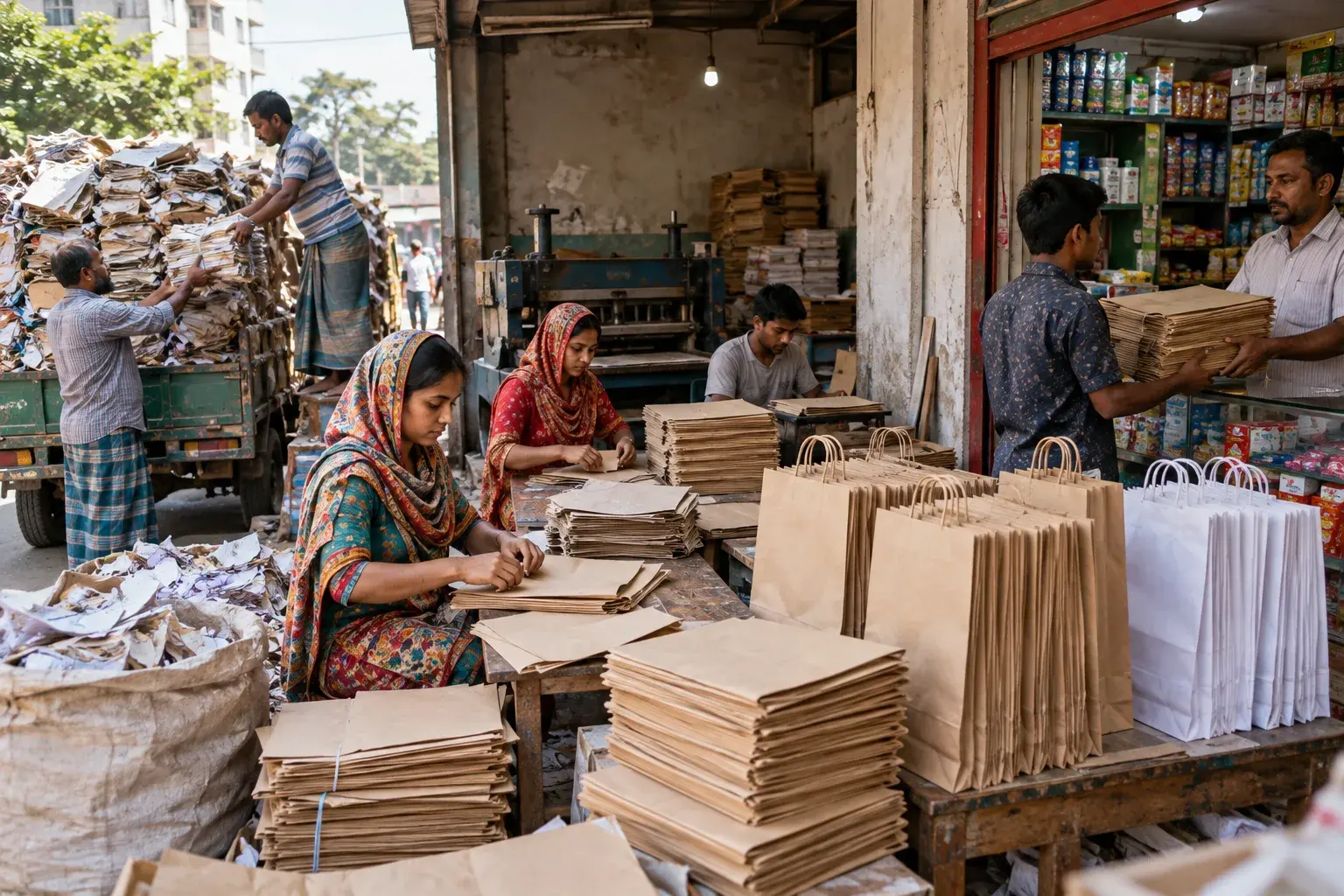
Buying waste paper, folding bags by hand and supplying shops. Khaki bags sell at Tk 135-140 a kg and white at Tk 80; 60 kg of paper costs Tk 7,500 and yields 70 kg of bags for Tk 2,300 profit.
- Capital
- ৳10k – ৳60k
- People
- 1 – 20
- First income
- 3 – 15 days
 Light manufacturing & workshop
Bamboo and cane handicraft
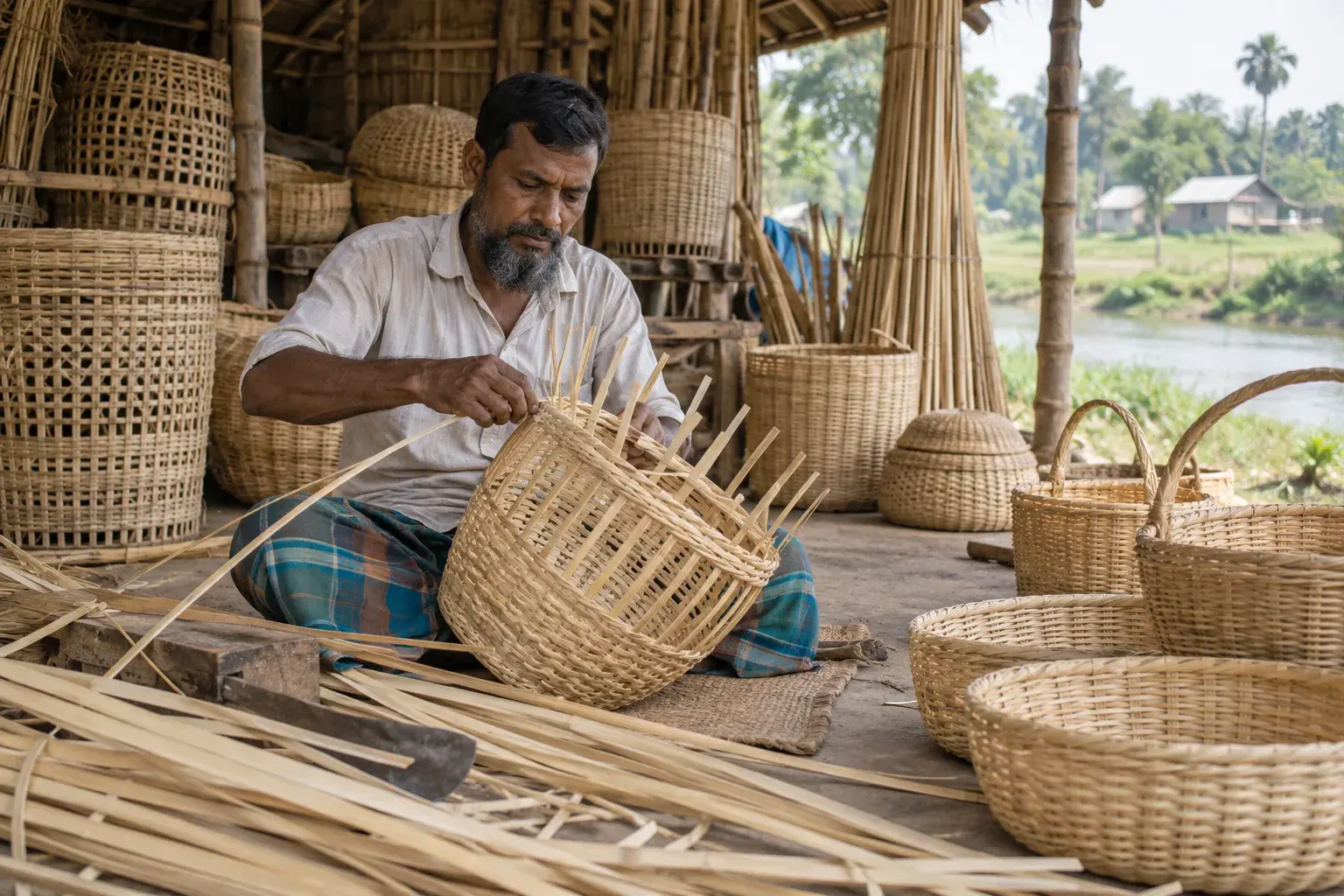
Splitting bamboo and cane into kula, baskets, cages and tourist crafts. A good bamboo costs Tk 400-500 and makes 15-20 kula in five days; a poultry cage earns the maker Tk 180 and the shopkeeper sells it at Tk 200.
- Capital
- ৳10k – ৳1 lakh
- People
- 1 – 6
- First income
- 5 – 30 days
 Light manufacturing & workshop
Cycle and rickshaw repair shop
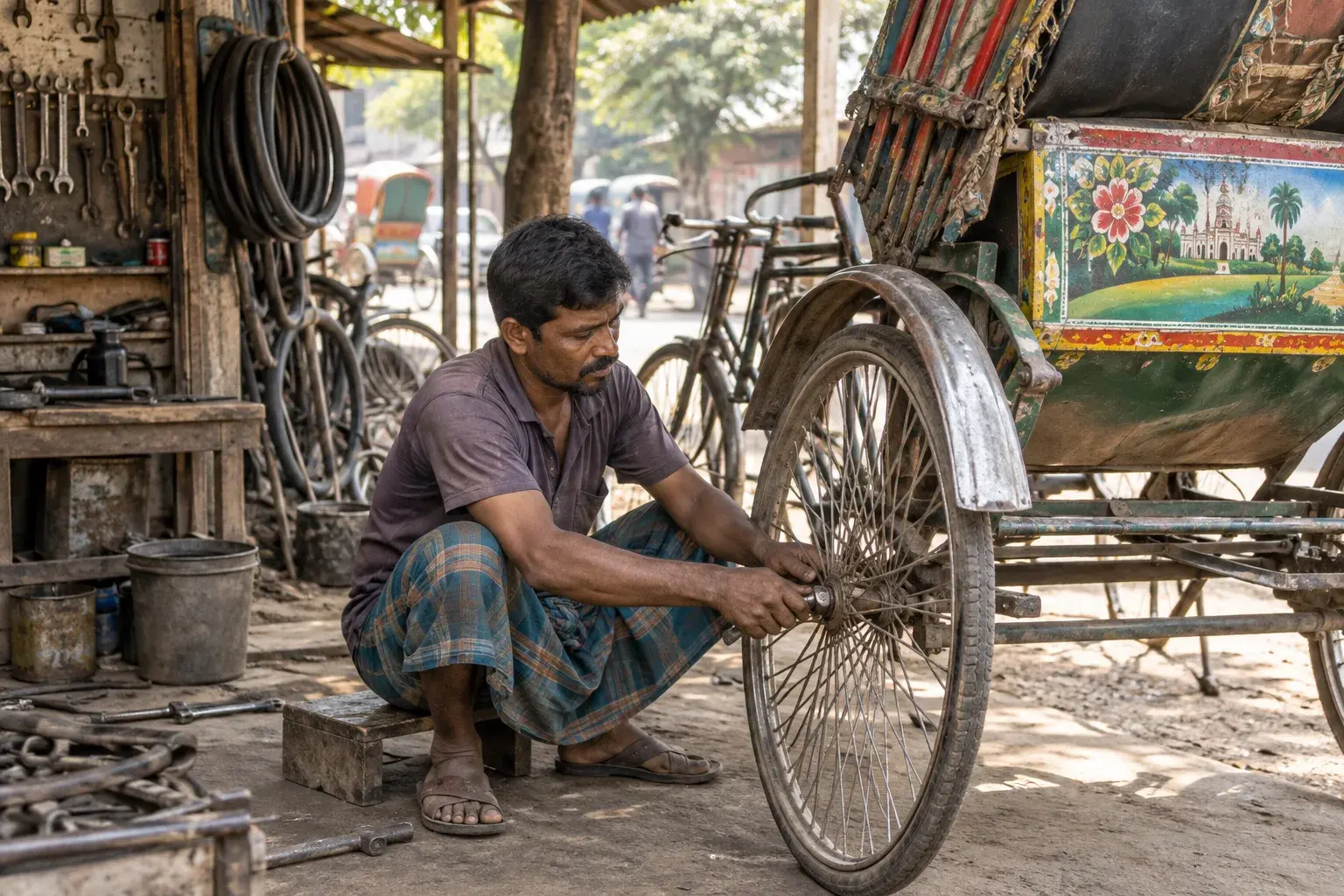
A roadside shop repairing bicycles, rickshaws and e-rickshaws. It can start from about Tk 15,000 of tools and stock, and customers pay cash when the job is done.
- Capital
- ৳15k – ৳1.2 lakh
- People
- 1 – 3
- First income
- 7 – 30 days
 Light manufacturing & workshop
Block, batik and tie-dye
Making batik and tie-dye sarees and three-pieces at home with wax and dye on cotton. Cumilla shops sell batik sarees from Tk 500 to Tk 1,700, and one karigar can finish about ten sarees a day.
- Capital
- ৳5k – ৳50k
- People
- 1 – 20
- First income
- 7 – 30 days