
Stationery and book shop
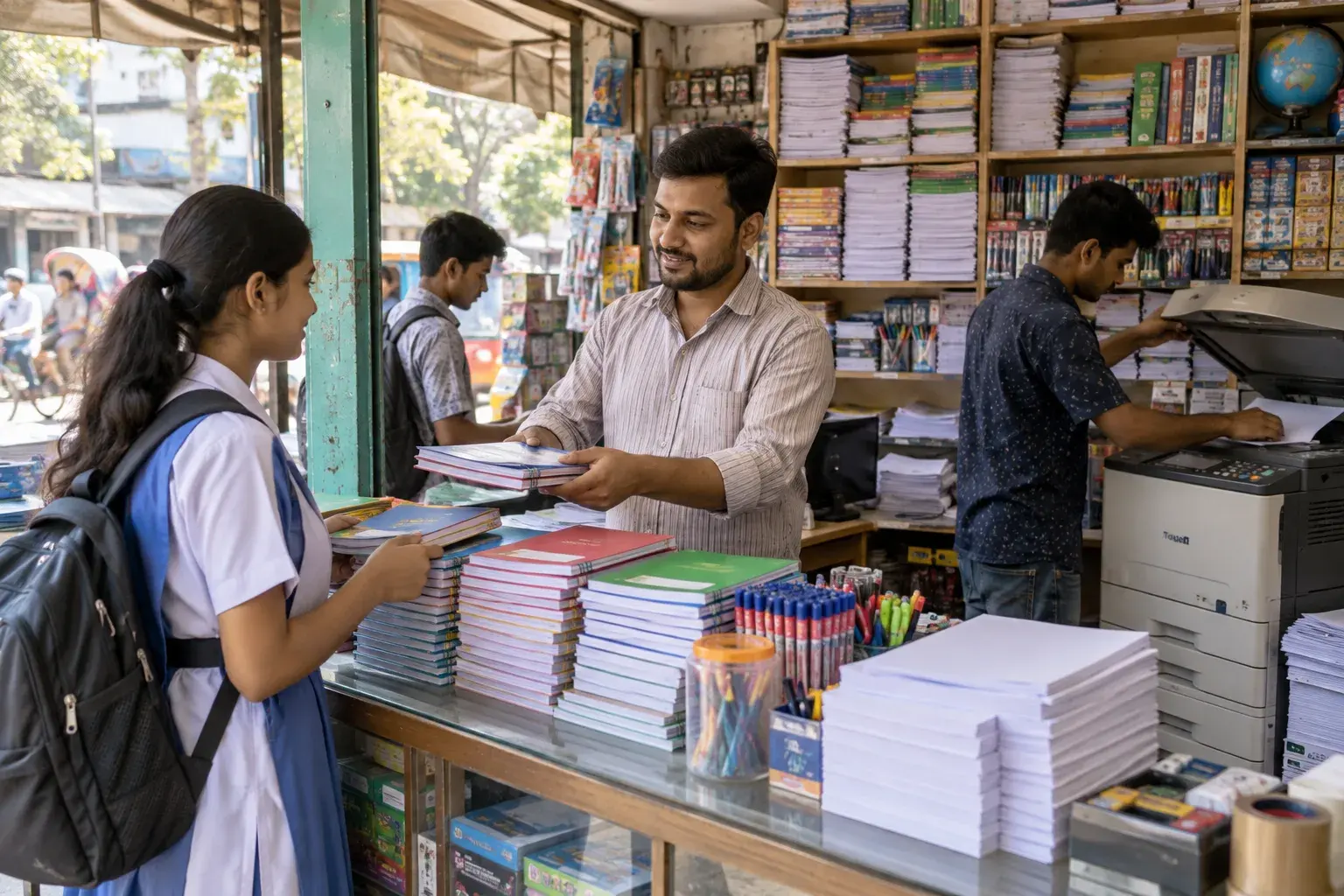
A stationery and book shop with photocopying. A 204-page exercise book is Tk 68, a 300-page one Tk 169, and white paper Tk 34-40 a dista. Textbooks come free from the government, so the season's money is in exercise books and photocopies.
- Last reviewed: 19 September 2026
- Version 1
Stationery and book shop
- Starting capital
- ৳1,50,000 – ৳8,00,000 Editorial estimate
- Manpower
- 1 – 4 people
- First sale
- 15 – 45 days Editorial estimate
- Break-even
- 9 – 22 months Editorial estimate
- Kind of work
- Shop · Easy
About the business
A shop selling exercise books, pens, pencils, paper, files, registers and books, with photocopying and printing alongside. One thing should be clear from the start: you will not be selling the textbooks. Primary and secondary textbooks are printed and supplied by the National Curriculum and Textbook Board - for the 2026 academic year NCTB printed and supplied 30,02,55,154 books in all, 11,70,46,461 at primary and ebtedayi level and 18,32,08,693 at secondary. Your season income comes instead from exercise books, pens, bags, covers and supplementary books - and from photocopying. The irony is that the photocopy demand is created by the textbooks arriving late. For the 2025 academic year about 39.5 crore books were printed for four crore students, but the last delivery approval came only on 24 March, roughly three months after the year began on 1 January; in 2026 it took until 7 February. Through those weeks students and teachers run on photocopies, and that is the shop's busiest stretch. On prices: white writing paper was Tk 34-40 a dista on 15 September 2026, and on Chaldal on 16 September 2026 a 204-page exercise book was Tk 68, a 300-page university khata Tk 169 and a 300-page register Tk 179. The rest of the year the shop lives on office stationery, photocopying and small daily sales.
Unit economics
| Item | Range | Evidence | Suggest a correction |
|---|---|---|---|
| Monthly working capital | ৳70,000 – ৳4,00,000 | Editorial estimate | |
| Selling price | ৳34 – ৳179 / unit | Market quote | |
| Variable cost | ৳29 – ৳143 / unit | Editorial estimate | |
| Gross margin | 15% – 20% | Editorial estimate | |
| Time to first revenue | 15 – 45 days | Editorial estimate | |
| Break-even time | 9 – 22 months | Editorial estimate | |
| Cash cycle | 0 – 1 days | Editorial estimate | |
| Waste / loss | 2% – 5% | Editorial estimate | |
| Daily capacity | 60 – 250 | Editorial estimate |
What you need to start
- A photocopier, printer, computer, lamination machine, spiral binding machine and a glass showcase. Current prices for these could not be verified in this research.Equipment
- Exercise books, pens, pencils, plain and ruled paper, files, registers, geometry boxes, covers, glue and bags. White writing paper was Tk 34-40 a dista on 15 September 2026; on 16 September 2026 a 204-page khata was Tk 68, a 300-page khata Tk 169 and a 300-page register Tk 179 at retail.Starting stock
- Trade licence from the city corporation, municipality or union parishad: form Tk 10, licence book Tk 50, standard tax Tk 30, non-judicial stamp Tk 150-300, licence fee Tk 100-60,000 by trade type, plus VAT and signboard fee. Issued in 3-5 working days, renewed yearly.Licence
- Running a computer and a photocopier, binding and laminating, and keeping track of how fast each item sells. The last of these is the real skill in this trade.Skill
- A wholesale market or large dealer (Bangla Bazar in Dhaka is the main wholesale centre for books and stationery), a toner and paper supplier, and a photocopier mechanic.Supplier
- A small roadside shop near an educational institution or office, with a glass showcase, wall shelving and space for a photocopier. The shop deposit varies by locality and could not be verified in this research.Workspace
How the work is done
- 1Find a shop near the gate of a school, college, madrasa, coaching centre or government office. Location decides sales here - a hundred yards away and the customer walks into someone else's shop.
- 2Take the trade licence from the city corporation, municipality or union parishad and pay the signboard fee.
- 3Make the stock list - exercise books, pens, pencils, erasers, scales, geometry boxes, plain and ruled paper, files, registers, glue, staplers, covers and bags. Each item ties up a little money, but the total is large.
- 4Fix your wholesale source and write down the rates and terms. Bangla Bazar in Dhaka is the main wholesale centre for books and stationery; in district towns stock comes from the large local dealer.
- 5Install a photocopier and put the per-page rate up where customers can see it. If the machine is not yours, put the rental or commission terms in writing first.
- 6Line up a supplier for toner, paper and parts, and a mechanic. A machine that fails before exams costs the whole of those days' income.
- 7Bring in the season's stock by December. Buying for the new academic year happens between late December and February.
- 8Watch when NCTB's books actually reach students. In 2025 the last delivery approval came on 24 March and in 2026 it took until 7 February - those weeks of delay are when photocopy demand peaks.
- 9Stock against the exam calendar - pens, exercise books, photocopies and staplers all jump before half-yearly, annual and board exams.
- 10Arrange regular supply to nearby offices, banks and coaching centres. Out of season this is what keeps the shop open, but put the credit terms in writing first.
- 11Keep a separate list of whatever has not sold in six months. Stationery does not spoil, but money stuck in dead stock cannot be used when the season comes.
Seasons
- JanHigh
- FebHigh
- MarNormal
- AprNormal
- MayNormal
- JunNormal
- JulNormal
- AugNormal
- SepNormal
- OctNormal
- NovNormal
- DecHigh
Where it works well
- Strong fitChattogram · A big city with many institutions and offices, and port-related offices give steady paperwork and photocopy demand all year.
- Strong fitDhaka · The greatest concentration of schools, colleges, universities, coaching centres and offices, with Bangla Bazar as the main wholesale centre for books and stationery, so stock costs less to bring in.
- Strong fitRajshahi · A university and college city, where shops beside hostels and messes get photocopy and binding work all year.
- PossibleBogura · A northern trading centre from which retail shops in surrounding districts buy their stock.
- PossibleCumilla · Many educational institutions, with wholesale stock arriving quickly along the Dhaka-Chattogram highway.
- PossibleGazipur · Demand comes from both factory offices and the schools and colleges of a densely settled area.
- PossibleKhulna · Divisional offices and institutions, and a wholesale base for the south-western districts.
- PossibleMymensingh · A divisional city with a university and large colleges, giving steady student-driven demand.
- PossibleRangpur · Divisional offices and colleges, though lower purchasing power means the expensive lines sell slowly.
- PossibleSylhet · Universities and many private institutions, with remittance households able to spend more.
Risks and cautions
- HighDemand: Sales are packed into a few weeks. Buying for the new academic year is done between late December and February, and for months after that the shop is nearly empty. Catching that window means putting a large sum into stock in November and December, and that money takes two or three months to come back. Miss the season and the next chance is a year away.
- HighWorking capital: The money is spread across hundreds of small items. The shop has to carry exercise books, pens, paper, files, registers and geometry boxes all at once, because the one thing you lack is what sends the customer next door - where he then buys the rest too. So a large amount sits in slow stock, and that money is not available when the season comes.
- MediumDependency: A large part of the season depends on when NCTB's books reach students, and that is not in your hands. For 2025 about 39.5 crore books were printed for four crore students but the last delivery approval came on 24 March, roughly three months late. For 2026, 30,02,55,154 books were supplied and the distribution finished on 7 February. Late books lift photocopy and supplementary book sales; books on time remove that income. Part of the year's earnings is therefore uncertain every year.
- MediumLate payment: Supplying schools, coaching centres and offices does not bring cash at once; the bill is settled at month or quarter end. A large outstanding balance blocks the money needed to buy the season's stock. The actual length of the delay could not be verified in this research.
- MediumDependency: A rise in paper prices hits this shop directly, since paper and exercise books are its main line. White writing paper was Tk 34-40 a dista on 15 September 2026. Where a printed price is on the cover there is no room to raise it, so the increase comes out of the shopkeeper's margin.
Sources
সিটি কর্পোরেশন থেকে ট্রেড লাইসেন্স প্রাপ্তির ধাপ সমূহ
Collected: 16 Sept 2026Supports: Starting capital, Cash cycle, Time to first revenue · বাংলাদেশ
- Collected: 15 Sept 2026
Supports: Starting capital, Selling price · ঢাকা মহানগর — সিপাহীবাগ, মিরপুর-৬, মোহাম্মদপুর টাউন হল, নিউমার্কেট, রামপুরা, মহাখালী বাজার
What changed
No corrections have been published yet.
Questions and answers
No questions yet. Be the first to ask.
Stories about this business
From 40-50 book shops down to 10-12 in New Market
New Market once had more than 40-50 book shops and now has 10-12, six of them closing since 2019; the survivors have shifted their shelves to stationery.
- Reasons
- Weak demand, Other
Similar businesses
 Retail & wholesale
Stone and sand trading
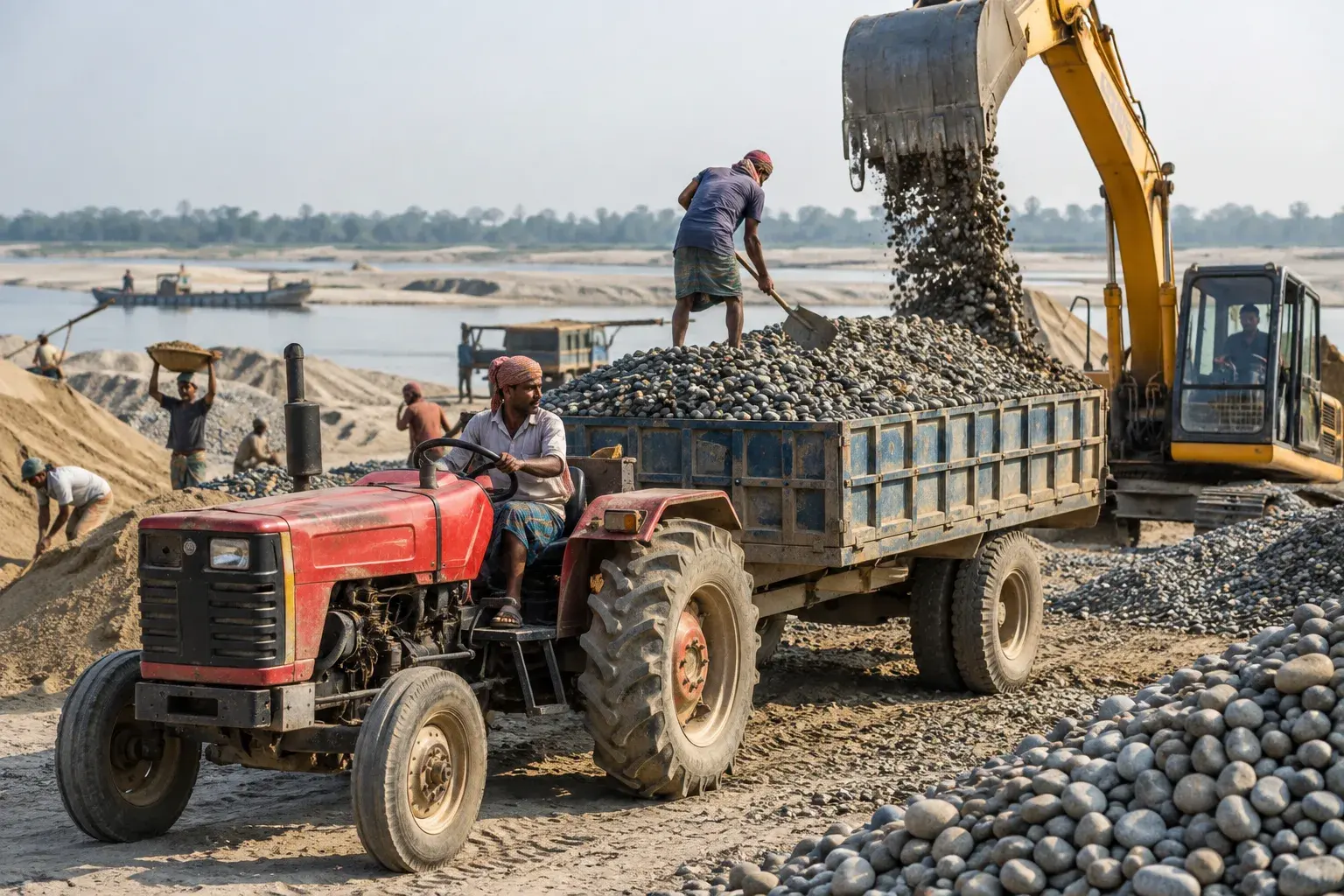
Buying river stone and sand and selling it into construction. A 100-cubic-foot tractor load costs Tk 8,000 at the Panchagarh pit head while Dhaka pays Tk 123-125 a cubic foot for local three-quarter stone, and the gap is freight and lease tolls.
- Capital
- ৳1.5 lakh – ৳15 lakh
- People
- 2 – 20
- First income
- 30 – 365 days
 Retail & wholesale
Children's clothing shop
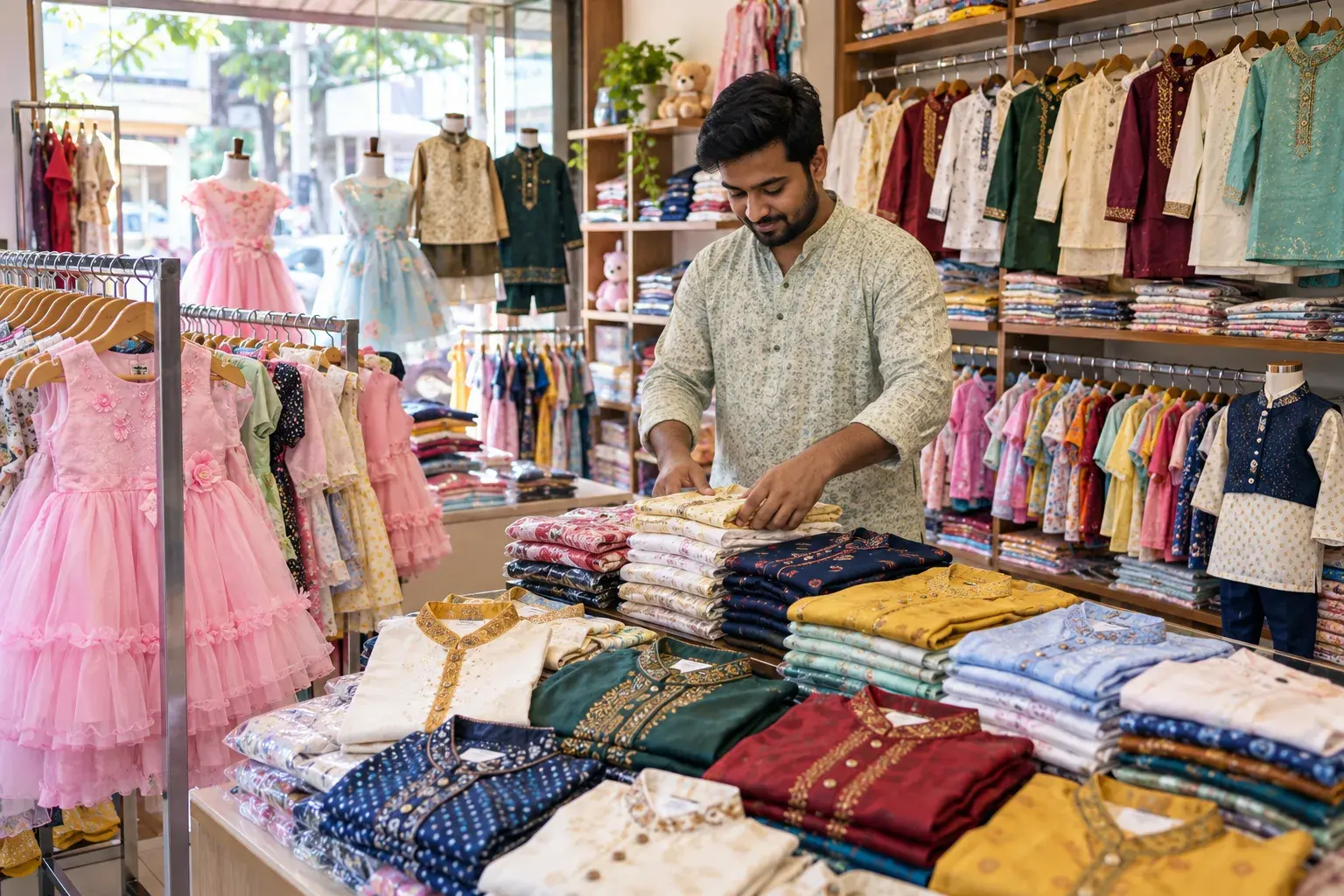
Retailing clothes for children aged 0-12. Panjabi sets Tk 260-985, frocks Tk 150-650. Children outgrow clothes, so stock turns over far faster than in an adult boutique.
- Capital
- ৳1.5 lakh – ৳7 lakh
- People
- 1 – 3
- First income
- 20 – 45 days
 Retail & wholesale
Toy and gift shop
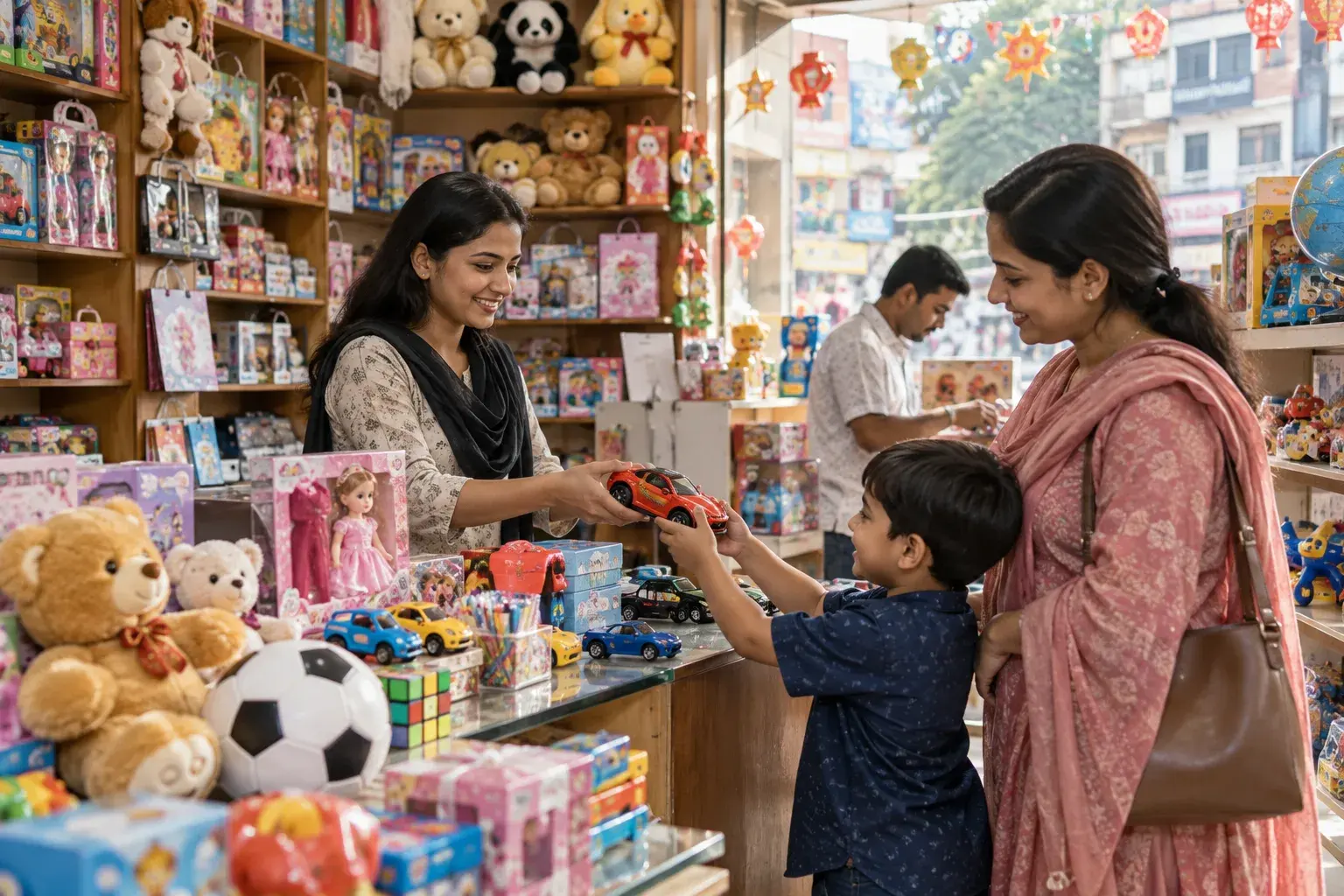
Retailing toys and gift items. In September 2026 online toy prices ran from Tk 58 to Tk 3,815. Imported toys carry 25 percent customs duty, and most of the year's selling happens in the few weeks around Eid and Pohela Boishakh.
- Capital
- ৳1.5 lakh – ৳14 lakh
- People
- 1 – 5
- First income
- 3 – 45 days
 Retail & wholesale
Seed, fertiliser and feed dealership
A farm input shop selling seed, fertiliser, pesticide and feed. The fertiliser margin is fixed by government at Tk 2 a kg today, rising to Tk 3 from 1 July 2027.
- Capital
- ৳1.5 lakh – ৳25 lakh
- People
- 1 – 5
- First income
- 30 – 180 days