
Seed, fertiliser and feed dealership
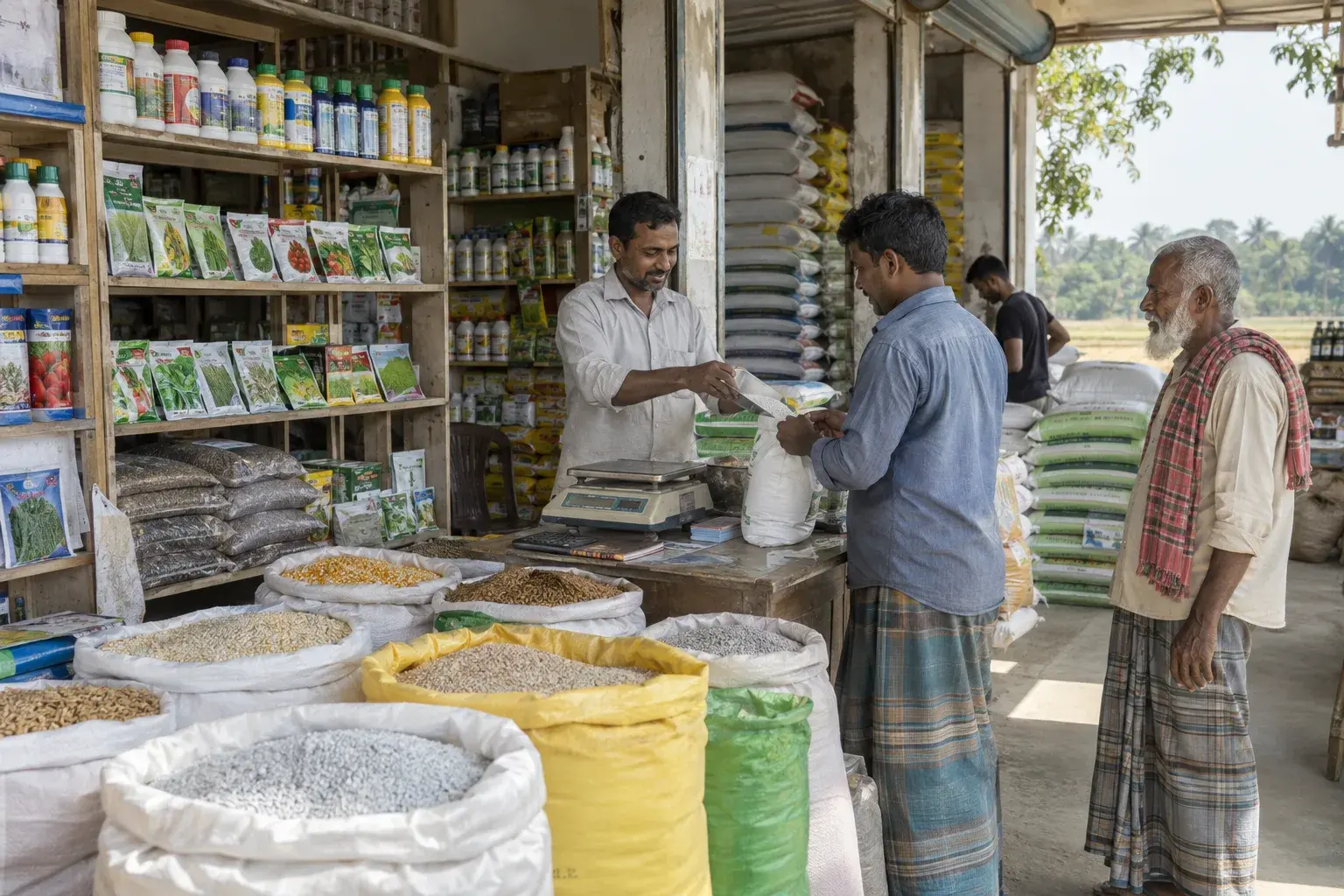
A farm input shop selling seed, fertiliser, pesticide and feed. The fertiliser margin is fixed by government at Tk 2 a kg today, rising to Tk 3 from 1 July 2027.
- Last reviewed: 19 September 2026
- Version 1
Seed, fertiliser and feed dealership
- Starting capital
- ৳1,50,000 – ৳25,00,000 Editorial estimate
- Manpower
- 1 – 5 people
- First sale
- 30 – 180 days Editorial estimate
- Break-even
- 11 – 35 months Editorial estimate
- Kind of work
- Shop · Medium difficulty
About the business
The shop in the local market where farmers buy seed, fertiliser, pesticide and fish or poultry feed. You do not set the price here; the companies and the government do, and you take a fixed margin in between. Under the Finance Division notification, a dealer today buys urea at Tk 25, TSP at Tk 25, DAP at Tk 19 and MOP at Tk 18 a kg and sells to the farmer at Tk 27, Tk 27, Tk 21 and Tk 20 respectively. That is two taka a kilo, one hundred taka a sack. From 1 July 2027 the dealer price drops by one taka on each while the farmer price stays put, lifting the commission to three taka a kilo. The fertiliser dealership itself is no longer easy to get. Under the policy in force since 16 November 2025 the security deposit rose from two lakh to four lakh taka, a dealer must run three sales centres, cannot sell outside the assigned area, cannot hold more than one dealership in a family, and the whole sub-dealer and retailer tier has been abolished. Sales and stock records must be kept digitally, and renewal or cancellation follows a performance review. A seed and feed shop is far cheaper to open, with no deposit, though each licence is taken separately. The real risk is not capital but credit: the farmer pays after harvest and the poultry farmer after the birds sell, and in between the shop's money is sitting out in the fields.
Unit economics
| Item | Range | Evidence | Suggest a correction |
|---|---|---|---|
| Monthly working capital | ৳2,40,000 – ৳12,00,000 | Editorial estimate | |
| Selling price | ৳20 – ৳27 / kg | Official source | |
| Variable cost | ৳18 – ৳25 / kg | Official source | |
| Gross margin | 7% – 15% | Official source | |
| Time to first revenue | 30 – 180 days | Editorial estimate | |
| Break-even time | 11 – 35 months | Editorial estimate | |
| Cash cycle | 10 – 90 days | Editorial estimate | |
| Waste / loss | 1% – 4% | Editorial estimate | |
| Daily capacity | 300 – 3,000 | Editorial estimate |
What you need to start
- Trade licence from the city corporation or municipality: form Tk 10, licence book Tk 50, standard tax Tk 30, stamp Tk 150-300, licence fee Tk 100-60,000. Issued in 3-5 working days.Licence
- Fertiliser dealer appointment under the Integrated Policy on Fertiliser Dealer Appointment and Distribution 2025, in force from 16 November 2025. The deposit rose from Tk 200,000 to Tk 400,000 and renewal costs Tk 1,000. More than one dealership per family is prohibited; government employees, elected representatives and convicted persons cannot be dealers. The sub-dealer and retailer tier is abolished.Licence
- Seed dealer registration, applied for on the prescribed form of the Ministry of Agriculture and the Department of Agricultural Extension, and renewable. The registration fee and any deposit could not be verified here.Licence
- Pesticide retail sale licence (Form 15) from the Department of Agricultural Extension, required to hold and sell pesticide. The fee could not be verified here.Licence
- Fish feed and animal feed sale licence under the Fish Feed and Animal Feed Act 2010, from the Department of Fisheries or the Department of Livestock Services. There are separate classes for production, import, marketing and sale; fees could not be verified here.Licence
- Digital record keeping is compulsory under the new policy. Beyond that: knowing seed varieties, checking expiry dates, and being able to tell a farmer how much of which fertiliser his land needs.Skill
- Fertiliser allocation comes through BCIC and BADC; seed and feed come through the companies' area representatives. The companies set the commission, the credit period and the return terms.Supplier
- Under the policy a fertiliser dealer must run three sales centres and hold two godowns, of 50 tonnes and 10 tonnes. Seed and feed need a dry store, free of rats and damp.Workspace
How the work is done
- 1Decide what you will sell. Seed, fertiliser, pesticide and feed are licensed by four different authorities, and fertiliser is the hardest of the four.
- 2Ask the upazila agriculture office whether there is a vacant fertiliser dealer post in your union. Vacancies are filled by the district committee, so check before you plan.
- 3Take the trade licence from the city corporation or municipality, naming farm inputs as the trade.
- 4Apply to the Department of Agricultural Extension for seed dealer registration, and take the pesticide retail sale licence (Form 15).
- 5To sell fish or animal feed, take a seller's licence under the Fish Feed and Animal Feed Act 2010 from the Department of Fisheries or the Department of Livestock Services.
- 6Arrange the godowns. A fertiliser dealer needs one of 50 tonnes and one of 10 tonnes; seed and feed need a dry, rat-proof store.
- 7Sit with the area representative of the seed and feed companies. Get the commission slab, the credit period and the return policy in writing.
- 8Keep sales and stock records digitally. The new policy makes this compulsory, and the subsidised and retail prices must be displayed in the shop.
- 9Keep a separate credit book and reconcile it monthly. Money has to be collected at harvest or it rolls into the next season.
- 10Stock up before the season starts. A week's delay at sowing time sends the farmer to another shop, and that season does not come back.
Seasons
- JanNormal
- FebNormal
- MarNormal
- AprNormal
- MayNormal
- JunNormal
- JulNormal
- AugNormal
- SepNormal
- OctNormal
- NovNormal
- DecNormal
Where it works well
- Strong fitBogura · The trading centre of northern agriculture, with year-round demand for potato and vegetable seed and for fertiliser.
- Strong fitDinajpur · A rice granary and a seed production area, with a strong BADC presence.
- Strong fitJashore · A big market for flower and vegetable seed, and the country's largest trade in fish fry around Chanchra, which pulls fish feed with it.
- Strong fitMymensingh · The country's largest fish farming belt; the sheer number of ponds and enclosures creates steady demand for fish feed.
- Strong fitRangpur · A major rice and maize belt, with large seasonal demand for seed and fertiliser.
- PossibleCumilla · A vegetable and rice area beside the highway, so company supply reaches easily.
- PossibleKushtia · Heavy rice, wheat and vegetable cultivation, plus cattle fattening, which brings animal feed demand.
- PossibleNilphamari · A maize and potato area, and maize brings animal and fish feed demand with it.
Risks and cautions
- HighCompliance: The rules for a fertiliser dealership changed on 16 November 2025. The deposit doubled to four lakh taka, three sales centres are mandatory, selling outside the assigned area is banned, one family may hold only one dealership, and the entire sub-dealer and retailer tier was abolished. Anyone who has been selling fertiliser as a sub-dealer no longer has any legal basis for it. Renewal or cancellation follows a performance review, and false information cancels the registration.
- HighWorking capital: The margin is fixed by government at two taka a kilo and you cannot raise it. Meanwhile four lakh taka sits locked as deposit and filling a 50 tonne godown with urea at the dealer rate of Tk 24 costs twelve lakh. Large money, small commission: the arithmetic only works on volume.
- HighLate payment: Farmers take seed and fertiliser at sowing and pay after harvest. Poultry farmers take feed when the chicks arrive and pay when the birds sell. For those months the shop's whole capital is out in the fields, and when a crop or a flock fails the money does not come back. The average length of that credit could not be verified in this research.
- HighDependency: The business rests entirely on allocation and appointment. Fertiliser allocation comes through BCIC and BADC, and a district committee fills vacant dealer posts. If the licence goes or the allocation shrinks, the shop stays open with nothing to sell.
- MediumDemand: Large poultry companies now run contract farming, delivering chicks and feed straight to the farm and cutting out the dealer's commission entirely. A director of Kazi Farms wrote in 2023 that dealers used to earn a commission on every sack of feed and a profit on every chick, and that the contract model removes it. Where contract farming spreads, feed sales through the shop fall.
Sources
সিটি কর্পোরেশন থেকে ট্রেড লাইসেন্স প্রাপ্তির ধাপ সমূহ
Collected: 16 Sept 2026Supports: Starting capital, Time to first revenue · বাংলাদেশ
What changed
No corrections have been published yet.
Questions and answers
No questions yet. Be the first to ask.
Similar businesses
 Retail & wholesale
Stone and sand trading
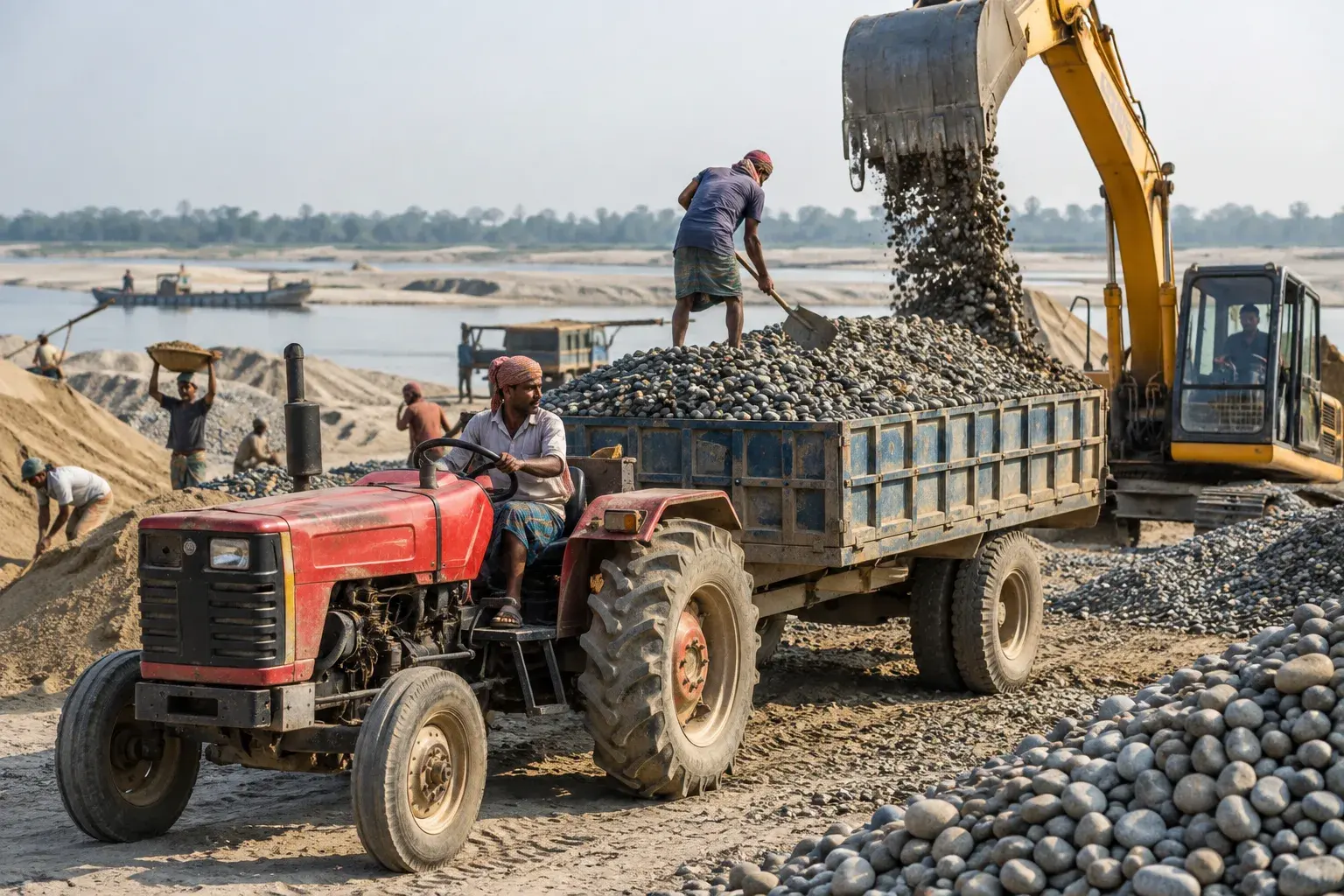
Buying river stone and sand and selling it into construction. A 100-cubic-foot tractor load costs Tk 8,000 at the Panchagarh pit head while Dhaka pays Tk 123-125 a cubic foot for local three-quarter stone, and the gap is freight and lease tolls.
- Capital
- ৳1.5 lakh – ৳15 lakh
- People
- 2 – 20
- First income
- 30 – 365 days
 Retail & wholesale
Children's clothing shop
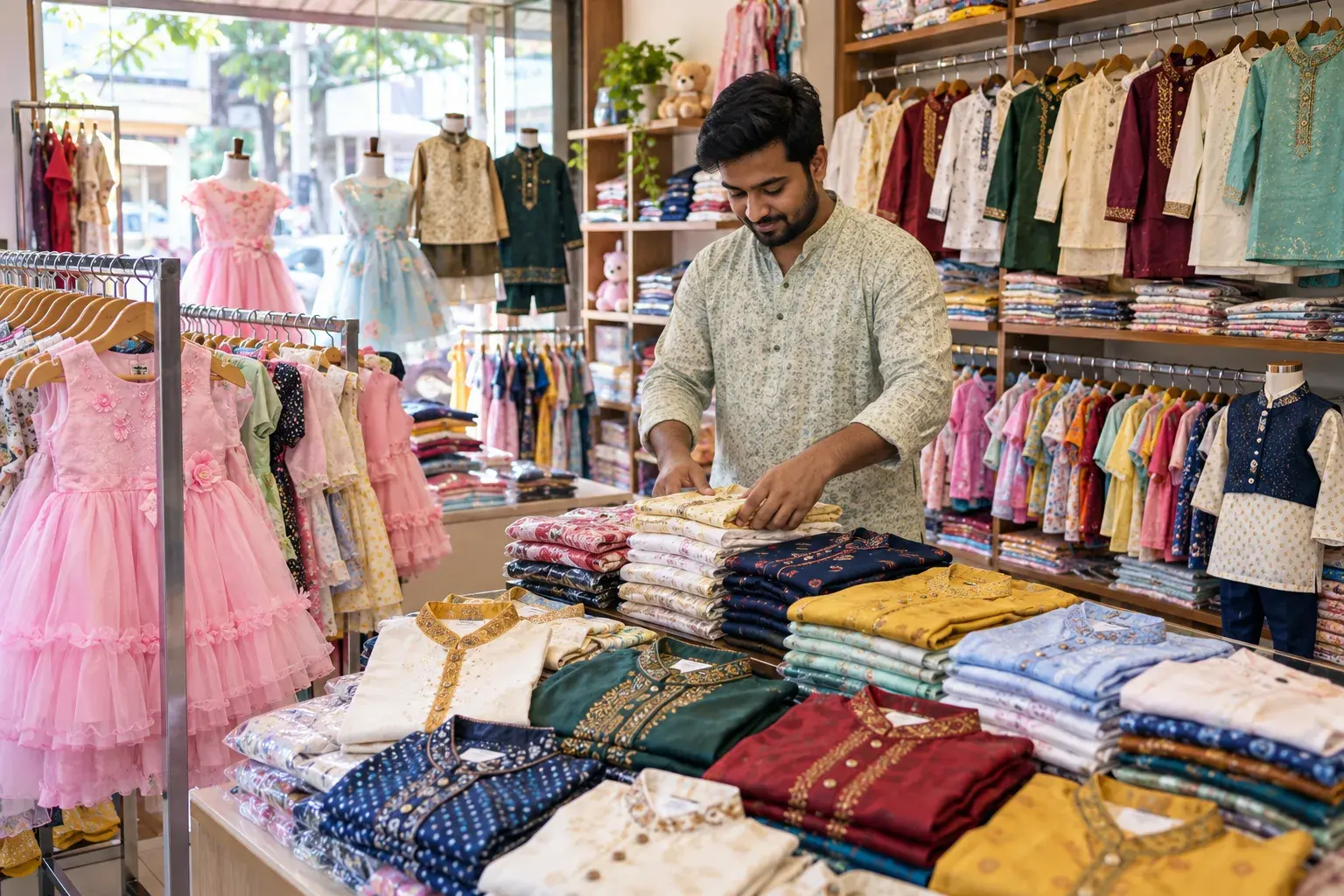
Retailing clothes for children aged 0-12. Panjabi sets Tk 260-985, frocks Tk 150-650. Children outgrow clothes, so stock turns over far faster than in an adult boutique.
- Capital
- ৳1.5 lakh – ৳7 lakh
- People
- 1 – 3
- First income
- 20 – 45 days
 Retail & wholesale
Stationery and book shop
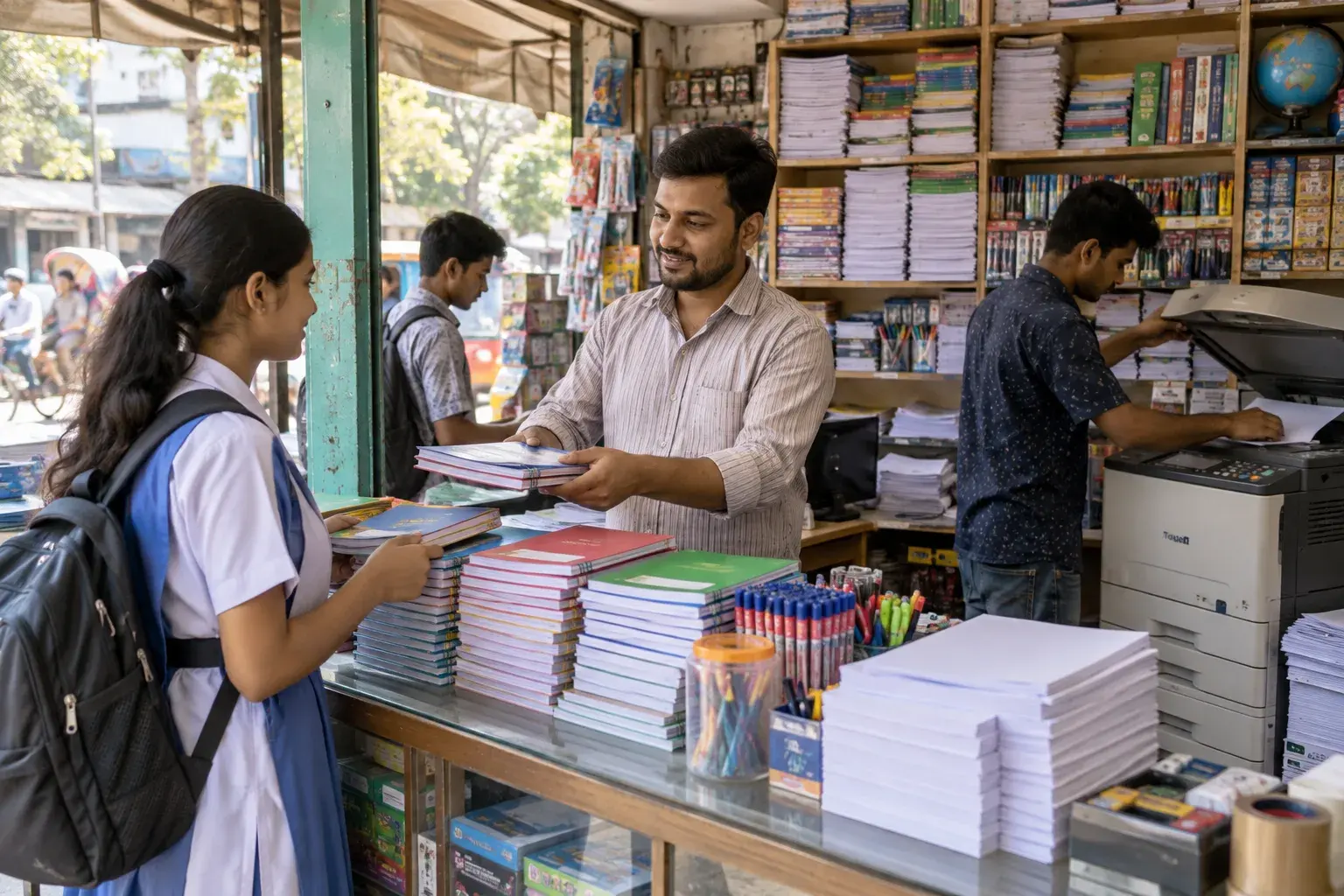
A stationery and book shop with photocopying. A 204-page exercise book is Tk 68, a 300-page one Tk 169, and white paper Tk 34-40 a dista. Textbooks come free from the government, so the season's money is in exercise books and photocopies.
- Capital
- ৳1.5 lakh – ৳8 lakh
- People
- 1 – 4
- First income
- 15 – 45 days
 Retail & wholesale
Toy and gift shop
Retailing toys and gift items. In September 2026 online toy prices ran from Tk 58 to Tk 3,815. Imported toys carry 25 percent customs duty, and most of the year's selling happens in the few weeks around Eid and Pohela Boishakh.
- Capital
- ৳1.5 lakh – ৳14 lakh
- People
- 1 – 5
- First income
- 3 – 45 days