
Water hyacinth and hogla handicraft
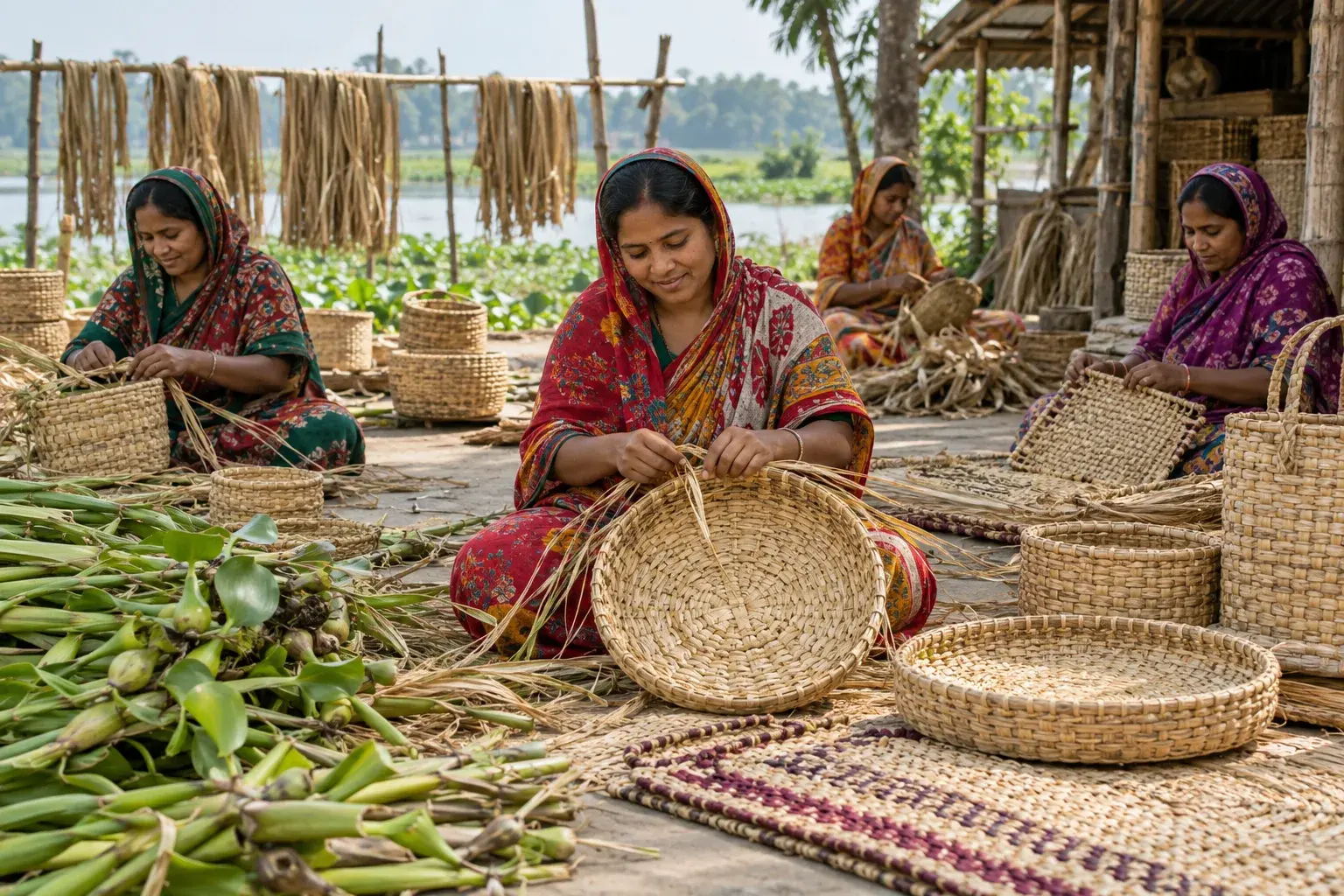
Drying water hyacinth and weaving it into trays, baskets and doormats. In Jhenaidah 800 women do this at home at Tk 20 a piece, 12-15 pieces a day, about Tk 3,000 a month, and the goods go to 82 countries.
- Last reviewed: 19 September 2026
- Version 1
Water hyacinth and hogla handicraft
- Starting capital
- ৳1,000 – ৳40,000 Editorial estimate
- Manpower
- 1 – 5 people
- First sale
- 7 – 30 days Editorial estimate
- Break-even
- 0.5 – 4.5 months Editorial estimate
- Kind of work
- Home-based · Easy
About the business
Lifting water hyacinth from canals and beels, drying it in the sun, and weaving it into trays, baskets and doormats. The work is done sitting on the verandah and needs no machine at all. Across nine villages in Kaliganj, Sadar and Kotchandpur of Jhenaidah, 800 women work at home in 40 groups for a firm called BD Creation, and 35,000 to 40,000 pieces a month go to 82 countries. But look at the money calmly. Shampa Debi of Talsar village in Kotchandpur makes 12 to 15 pieces a day in the gaps between housework, is paid Tk 20 a piece, and earns about Tk 3,000 a month. The company delivers the raw material to her house and collects the finished goods. So this is not a business of your own - it is piece work at home. The risk is low and so is the control: somebody else sets the price. Two things are worth knowing first. One, water hyacinth is no longer free; as the work spread, dried hyacinth now has to be bought at Tk 40 a kg from local people who lift it from the river and dry it. Two, the barrier is not the raw material, it is the buyer. The Export Promotion Bureau puts Bangladesh's handicraft exports at only USD 380 million against a global market of about USD 32 billion for these goods - a 1.18 percent share - and the cash incentive has been cut from 20 percent to 6 percent since LDC graduation.
Unit economics
| Item | Range | Evidence | Suggest a correction |
|---|---|---|---|
| Monthly working capital | ৳0 – ৳5,000 | Practitioner verified | |
| Selling price | ৳20 / unit | Practitioner verified | |
| Variable cost | ৳0 – ৳8 / unit | Editorial estimate | |
| Gross margin | 60% – 100% | Editorial estimate | |
| Time to first revenue | 7 – 30 days | Editorial estimate | |
| Break-even time | 0.5 – 4.5 months | Editorial estimate | |
| Cash cycle | 7 – 30 days | Editorial estimate | |
| Waste / loss | 3% – 10% | Editorial estimate | |
| Daily capacity | 12 – 15 | Practitioner verified |
What you need to start
- Dried water hyacinth at Tk 40 a kg (Jhenaidah, May 2026). Rice straw and date palm leaf are used the same way. On piece work the company delivers this raw material to the house.Starting stock
- Trade licence from the union parishad, municipality or city corporation if you collect, make and sell on your own account: form Tk 10, book Tk 50, standard tax Tk 30, stamp Tk 150-300, licence fee by trade type. Women doing piece work need no licence; the Baluhar organiser says no extra formalities are required.Licence
- Export Registration Certificate from the Office of the Chief Controller of Imports and Exports if you want to ship abroad yourself. The fee and renewal terms could not be verified here. Most village makers work for an exporting firm rather than exporting themselves.Licence
- Hand weaving to a fixed size with a tight weave. The firm trains first and gives work after. No machine is involved, so the skill is the only asset.Skill
- People who lift and dry the hyacinth, and an exporting firm or its local organiser to take the goods. BANGLACRAFT, the Bangladesh Handicrafts Manufacturers and Exporters Association, is the body those buyers belong to.Supplier
- The verandah or yard: a place to sit and work and open ground to dry the stalks in the sun. No separate workshop is needed; all 800 women in Jhenaidah work in their own homes.Workspace
How the work is done
- 1First find out which firm gets this work done in your area and who comes to collect. Weaving before the buyer is fixed leaves the goods sitting in the house; in this trade the barrier is the buyer, not the raw material.
- 2Join a firm and take their training. In Jhenaidah 800 women work in 40 groups; joining a group brings both the raw material and the work to your door.
- 3Lifting and drying the hyacinth is a separate earning: pull it from the river or canal, dry it in the sun and sell it at Tk 40 a kg. For anyone with no time to weave, this is the way in.
- 4Fix a drying space in the yard or on the roof. Without sun in the monsoon the hyacinth rots and darkens, and dark stalks are rejected for export goods.
- 5Start with one product only: a doormat, a tray or a basket. Repeating the same item makes the hands fast, and the count per day is the income.
- 6Keep the size and the tightness of the weave exactly like the sample. On a foreign order a finger's difference in size sends the whole lot back, and the piece rate is then cut.
- 7Write down how many pieces you handed over and how much you were paid. In piece work the record is your responsibility, not the company's.
- 8Form a group. Alone you cannot do the work of five or ten, but with twenty women in one village the company sends a vehicle to collect; for one household it does not.
- 9To trade on your own account take a trade licence, and to export directly take an Export Registration Certificate from the Office of the Chief Controller of Imports and Exports.
- 10Contact the BSCIC district office; the Jhenaidah deputy director says such small industries get full support if they approach. For credit, Bangladesh Bank has described a Tk 30,000 crore fund lending at 5-7 percent.
- 11Stock dried hyacinth ahead of the three monsoon months. Because it cannot be dried then, that is exactly when the raw material costs the most.
Seasons
- JanHigh
- FebHigh
- MarNormal
- AprNormal
- MayNormal
- JunLow
- JulLow
- AugLow
- SepNormal
- OctHigh
- NovHigh
- DecHigh
Where it works well
- Strong fitJhenaidah · The largest documented cluster: 800 women in 40 groups across Barobazar and Kashima in Kaliganj, Kaluhati and Kamarkundu in Sadar, and Balabaria, Solemanpur, Baluhar, Harindia and Mamunshia in Kotchandpur, with a factory being built at Naihati in Sadar.
- PossibleBarishal · A district of canals and rivers with easy raw material, and goods can move from the divisional city to Dhaka exporters.
- PossibleChuadanga · Adjoins Jhenaidah and lies on the same collector's route, with the same supply of hyacinth in its canals and beels.
- PossibleDhaka · Where the BANGLACRAFT member exporters and handicraft showrooms are. Raw material has to come from far, but the buyer is close.
- PossibleGopalganj · A district of beels and wetlands with hyacinth all year, though few buying firms operate there.
- PossibleJashore · Next to Jhenaidah and close to Benapole port, within reach of exporters' collection routes.
- PossibleKushtia · Plenty of hyacinth along the Padma and Gorai, with an older handicraft habit.
- PossibleMagura · A district of the same region with many water bodies and a large number of women available for home work.
- PossibleNarayanganj · Close to exporters and finishing units; less weaving happens here but reaching the buyer is easy.
- PossiblePirojpur · The floating-bed farming area of Nazirpur has hyacinth in abundance, and there have been reports of hyacinth stalks being sent abroad from there.
Risks and cautions
- HighDependency: The whole thing rests on one firm. In Jhenaidah the raw material arrives in that company's vehicle and the goods leave in it. If the firm's foreign orders fall or it moves to another district, 800 women lose the work at once. The maker has no power over the price: the Tk 20 a piece is set by the company.
- HighDemand: The work depends on exports and the state support is shrinking. After LDC graduation the cash incentive on handicraft exports was cut from 20 percent to 6 percent, as the EPB vice chairman himself stated in December 2025. A smaller incentive squeezes the exporter's margin, and that pressure ends up on the piece rate.
- MediumOther: The raw material is no longer free. As more people enter, the price rises: dried hyacinth in Jhenaidah now has to be bought at Tk 40 a kg, where it used to be a weed thrown away and cleared by hired labour. Any calculation that assumes free raw material no longer holds.
- MediumWorking capital: Buying your own raw material means paying out first and getting back only after delivery. Since it cannot be dried in the monsoon, stock has to be bought ahead, and that is the biggest cash pressure of the year. Piece work avoids this risk, but it also caps the income at the piece rate.
- MediumLate payment: When payment comes after delivery depends on the company's accounts, and the maker has no written contract. If size or weave is questioned the rate is cut, and there is nowhere to appeal.
Sources
সিটি কর্পোরেশন থেকে ট্রেড লাইসেন্স প্রাপ্তির ধাপ সমূহ
Collected: 16 Sept 2026Supports: Starting capital · বাংলাদেশ
What changed
No corrections have been published yet.
Questions and answers
No questions yet. Be the first to ask.
Stories about this business
Learned the trade in a Dhaka firm, came home, and now makes a crore taka of hogla goods a year
He learned the craft at a Dhaka handicraft firm while still in class nine, returned home in 2016 and set up production. The unit now turns out about 1 crore taka of goods a year, and women weaving at home earn 5,000-6,000 taka a month.
- Reasons
- Strong network, Weak demand
50-60 maunds of water hyacinth a day, 30,000-40,000 taka a month after costs
They started in 2020 after seeing water hyacinth goods at a Dhaka buyer's place. They now buy 50-60 maunds of fresh hyacinth a day at 100-120 taka a maund, clear 30,000-40,000 taka a month after costs, and give work to 60-70 people.
- Reasons
- Dependency, Strong network
Similar businesses
 Light manufacturing & workshop
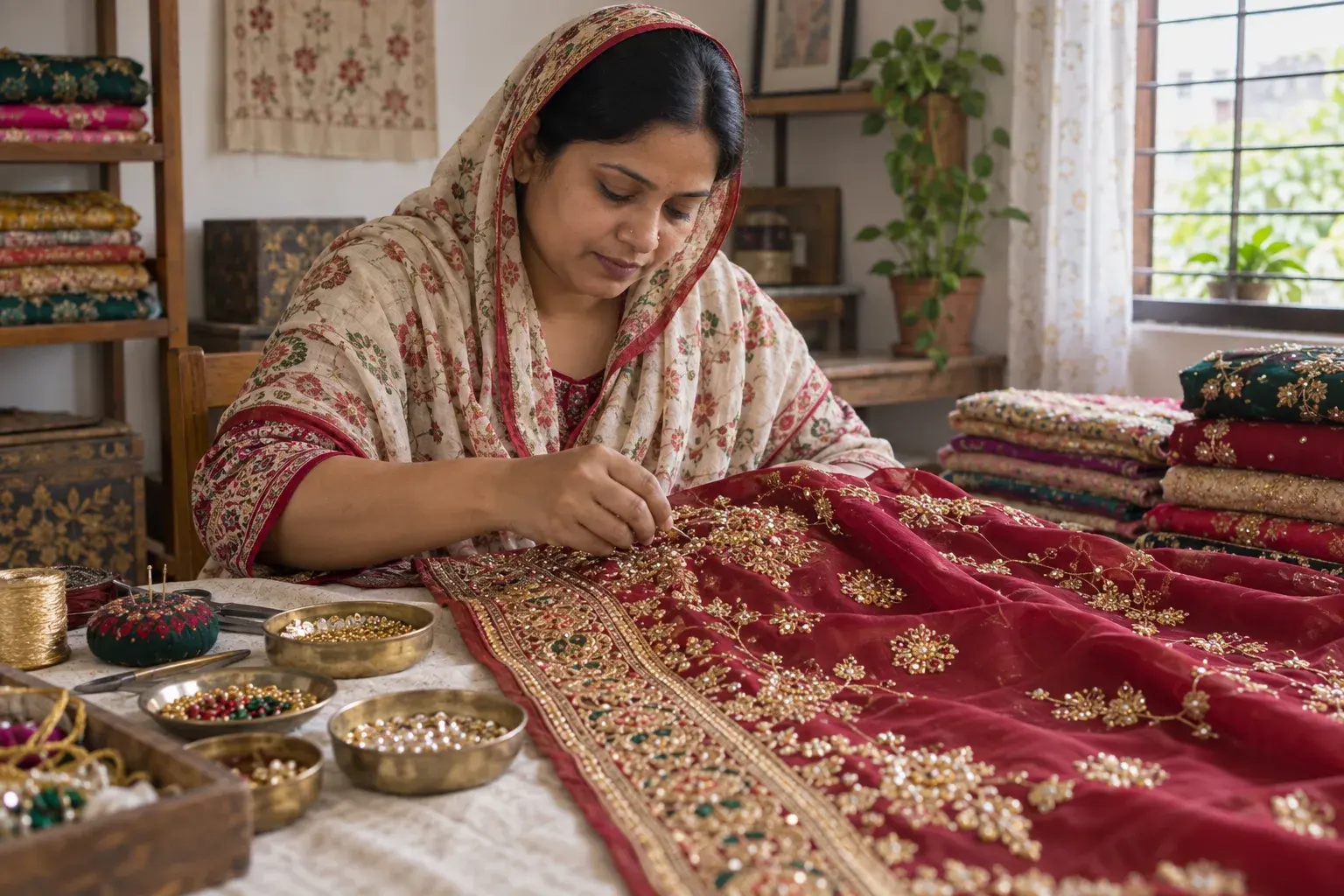
Karchupi hand embroidery
Sequin, bead and zari handwork on sarees and three-pieces, done at home. The mohajon supplies every material; the piece rate is Tk 700-800 a saree and one saree takes at least fifteen days.
- Capital
- ৳500 – ৳5k
- People
- 1 – 3
- First income
- 15 – 20 days
 Light manufacturing & workshop
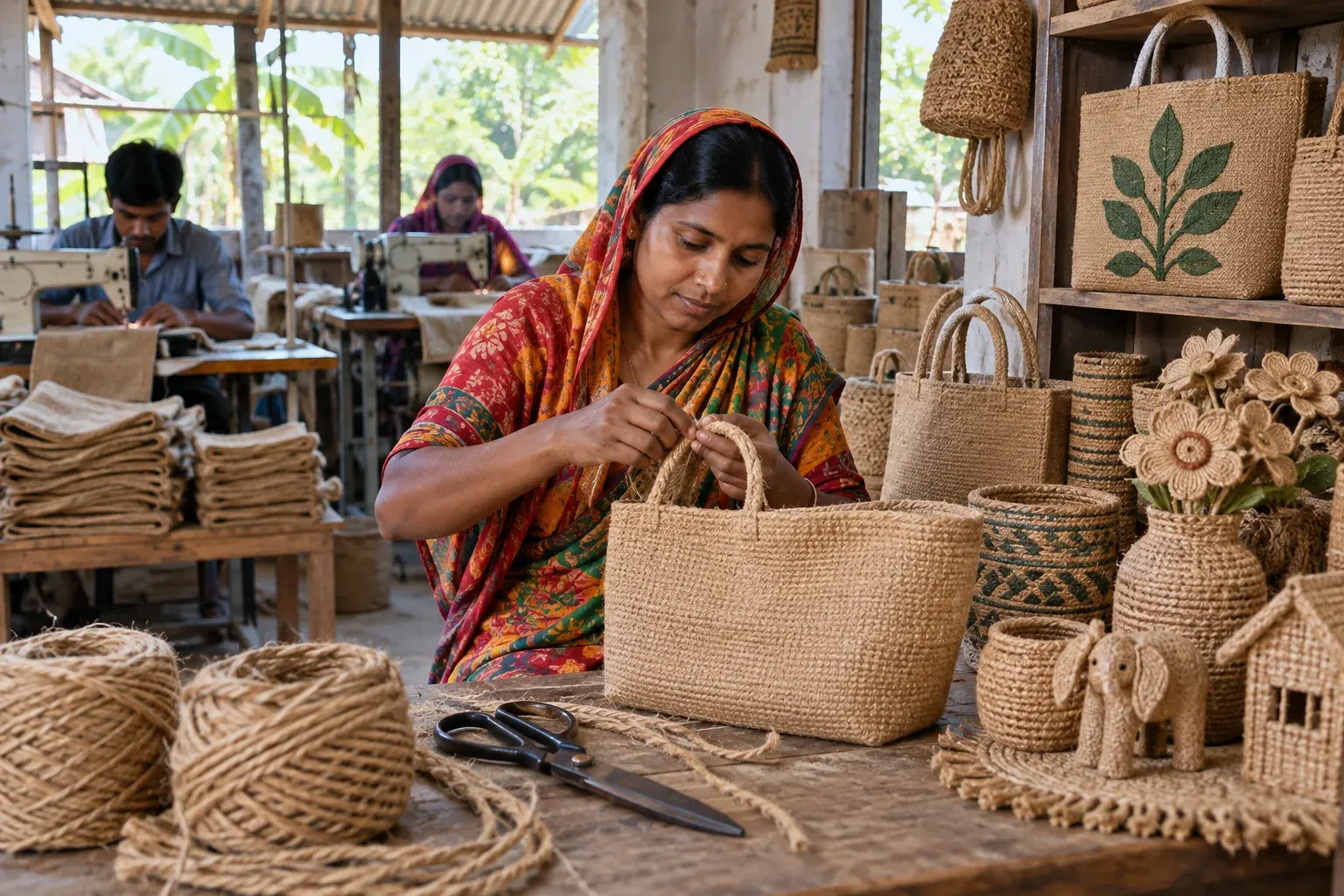
Jute handicraft
Making bags, pots and showpieces from jute. Tk 2,000 of scissors and rope starts it by hand, but an export order needs a workshop, and ten machines cost about Tk 500,000.
- Capital
- ৳2k – ৳10 lakh
- People
- 1 – 40
- First income
- 7 – 120 days
 Light manufacturing & workshop
Block, batik and tie-dye
Making batik and tie-dye sarees and three-pieces at home with wax and dye on cotton. Cumilla shops sell batik sarees from Tk 500 to Tk 1,700, and one karigar can finish about ten sarees a day.
- Capital
- ৳5k – ৳50k
- People
- 1 – 20
- First income
- 7 – 30 days
 Light manufacturing & workshop
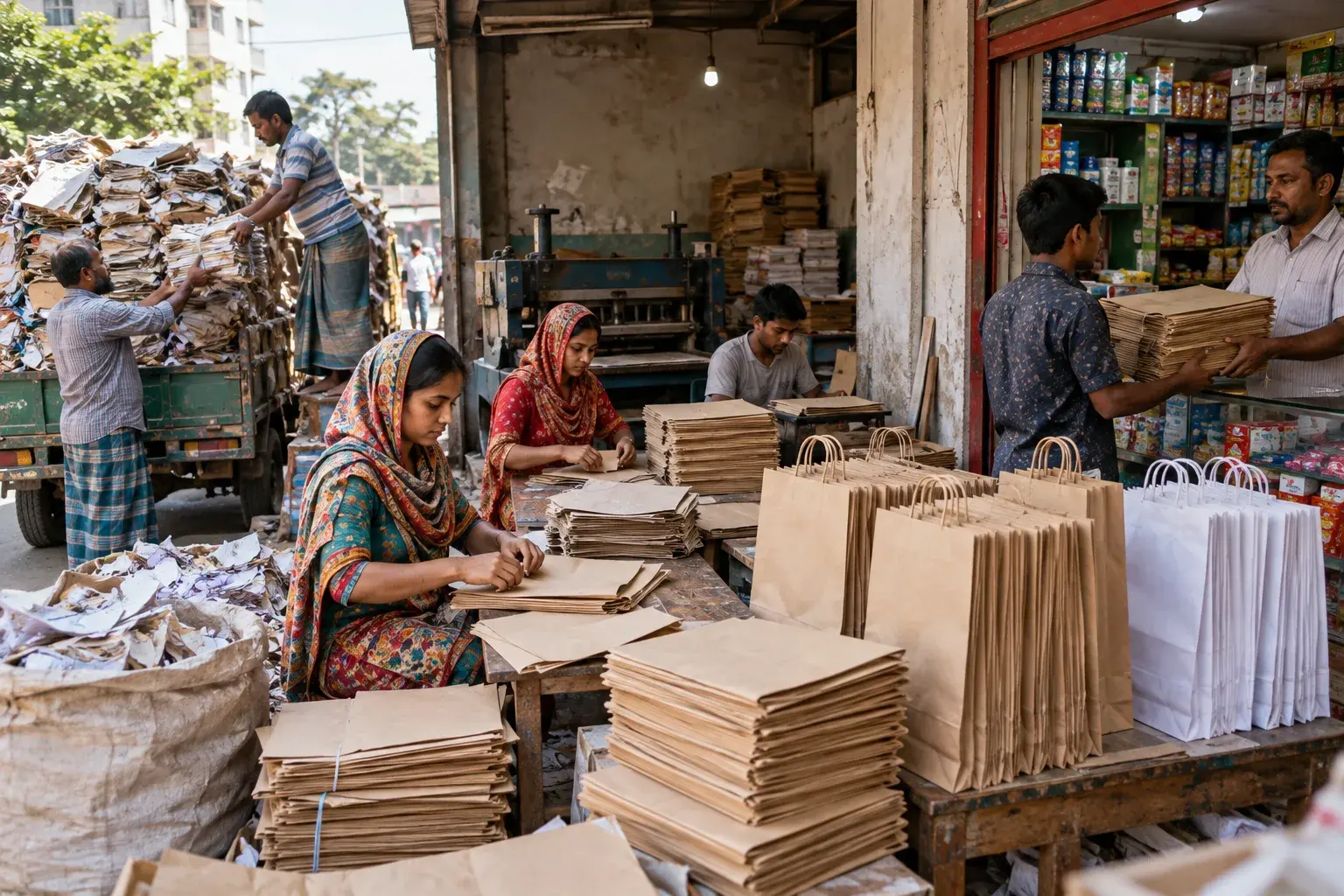
Paper bag and packaging making
Buying waste paper, folding bags by hand and supplying shops. Khaki bags sell at Tk 135-140 a kg and white at Tk 80; 60 kg of paper costs Tk 7,500 and yields 70 kg of bags for Tk 2,300 profit.
- Capital
- ৳10k – ৳60k
- People
- 1 – 20
- First income
- 3 – 15 days