
Betel nut trading
Buying betel nut from households and selling at the hat, or soaking and drying it to sell later. In Lakshmipur in October 2025 a kaun fetched Tk 2,500-2,800 and a pon Tk 150-250.
- Last reviewed: 19 September 2026
- Version 1

Betel nut trading
- Starting capital
- ৳1,00,000 – ৳25,00,000 Editorial estimate
- Manpower
- 1 – 8 people
- First sale
- 1 – 240 days Editorial estimate
- Break-even
- 5 – 59 months Editorial estimate
- Kind of work
- Shop · Medium difficulty
About the business
Buying betel nut from households and orchard owners, bringing it to the hat and selling it on to wholesalers - or soaking or drying it and selling later. Lakshmipur is the country's supari capital, with about 7,360 hectares of orchard across its five upazilas and roughly Tk 1,000 crore changing hands a year. At least a hundred places in the district hold supari hats: Haidarganj, Khaserhat, Mollarhat and Rakhalia in Raipur; Mirganj, Panpara and Kanchanpur in Ramganj; Dalal Bazar, Rasulganj, Chandraganj and Mandari in Sadar; Hajirhat in Kamalnagar and Alexander in Ramgati. It is counted, not weighed: eighty nuts make a pon and sixteen pon make a kaun. In October 2025 a kaun was selling at Tk 2,500-2,800 and a pon at Tk 150-250 by grade, against Tk 1,700-2,200 a kaun the year before - seven or eight hundred taka a kaun more in one year. The season runs October to January with the heaviest collection from late October to late November. The real skill is holding. Retail traders soak the nuts in water for about three months, then lift them and sell to big traders in Dhaka and Chattogram; others dry them and sell through the year. Whoever can afford to have money tied up is the one who gets the price.
Unit economics
| Item | Range | Evidence | Suggest a correction |
|---|---|---|---|
| Monthly working capital | ৳6,25,000 – ৳25,00,000 | Editorial estimate | |
| Selling price | ৳150 – ৳250 / unit | Market quote | |
| Variable cost | ৳135 – ৳200 / unit | Editorial estimate | |
| Gross margin | 10% – 20% | Editorial estimate | |
| Time to first revenue | 1 – 240 days | Editorial estimate | |
| Break-even time | 5 – 59 months | Editorial estimate | |
| Cash cycle | 1 – 120 days | Practitioner verified | |
| Waste / loss | 3% – 8% | Editorial estimate | |
| Daily capacity | 100 – 600 | Editorial estimate |
What you need to start
- Sacks, baskets for counting, a van or auto-rickshaw, and arrangements for soaking and drying. No scales are needed; supari is sold by count.Equipment
- Trade licence from the union parishad, municipality or city corporation: form Tk 10, licence book Tk 50, standard tax Tk 30, stamp Tk 150-300, licence fee Tk 100-60,000 by trade type, plus VAT and signboard fee. Issued in three to five working days.Licence
- Agricultural Marketing Licence under the Agricultural Marketing Act 2018 and the Agricultural Marketing Rules 2021, required of wholesalers, arotdars and commission agents in agricultural produce. Application is on Form 1 to the district marketing office of the Department of Agricultural Marketing. The fee and validity could not be verified and must be checked at the district office.Licence
- Grading by eye and counting fast and accurately. The price is haggled over the sack and the counting happens after the rate is agreed, so a wrong guess is a loss.Skill
- Village households and orchard owners, plus small beparis who buy door to door and bring it to the hat. A season's crop can also be bought off the trees in advance - one trader had bought the crop of about two thousand palms from a single household.Supplier
- A place at the hat or an arat, plus a dry room to stack the nuts. To hold stock you also need a soaking pit or tank and an open yard for drying.Workspace
How the work is done
- 1Pick your area before the season. Raipur upazila has the most orchards in Lakshmipur, and the northern and western parts of the district grow more than the south.
- 2Take a trade licence from the union parishad or municipality, and if you are trading agricultural produce wholesale or running an arat, apply for an Agricultural Marketing Licence at the district office of the Department of Agricultural Marketing (Form 1).
- 3Learn the counting: eighty nuts to a pon, sixteen pon to a kaun. It is bought and sold by count, not weight, and counting is where most of the cheating happens.
- 4Buy directly from households village by village. Nearly every house in the district has supari palms, and a mature tree gives four or five pon a season. You can also buy a season's crop off a large owner's trees in advance.
- 5Bring your stock to the weekly hats. Haidarganj, Khaserhat and Mollarhat in Raipur, Mirganj and Panpara in Ramganj, Dalal Bazar and Chandraganj in Sadar - this is where wholesalers come from Chattogram and elsewhere.
- 6Sort by size. Big nuts fetch much more: in December 2024 an ordinary pon was Tk 150-200 while a larger grade reached Tk 220. Selling unsorted throws that difference away.
- 7Decide whether to sell at once or hold. There are two ways to hold: soak in water for about three months, or sun-dry and sell through the year.
- 8Build and cover the soaking pit or tank carefully. Two brothers died after going down into a supari soaking pit in Chattogram; poisonous gas builds up inside.
- 9Line up arotdars in Dhaka and Chattogram before the season and settle the price and payment terms in advance. It is the big arotdars who also ship abroad.
- 10Write down every day's buying and selling - which village, how many pon, at what rate. Next season that book will tell you where and when the nuts come cheap.
Seasons
- JanHigh
- FebNormal
- MarNormal
- AprNormal
- MayNormal
- JunNormal
- JulNormal
- AugNormal
- SepNormal
- OctHigh
- NovHigh
- DecHigh
Where it works well
- Strong fitChattogram · The biggest buyer. Wholesalers come from Chattogram to Lakshmipur to buy, and arotdars here also ship abroad. Much of the soaking and storing is done in Chattogram too.
- Strong fitDhaka · Not the growing end but the selling end. Lakshmipur supari goes to Dhaka's big arats, and soaked nuts are sold here after their three months.
- Strong fitLakshmipur · The country's supari capital: about 7,360 hectares of orchard across five upazilas, roughly Tk 1,000 crore of trade a year and supari hats in at least a hundred places. The biggest are Haidarganj, Khaserhat, Mollarhat, Mitali Bazar and Rakhalia in Raipur; Mirganj, Panpara and Kanchanpur in Ramganj; Dalal Bazar, Rasulganj, Chandraganj and Mandari in Sadar; Hajirhat in Kamalnagar; and Alexander in Ramgati.
- Strong fitMoulvibazar · It has its own supari hat. Kamalpur Bazar in Sadar upazila holds a separate supari hat on Saturdays and Tuesdays from Bhadra to Agrahayan, where the unit is the 'ghaa' of ten nuts, priced at Tk 20-30 and Tk 35-40 for large ones in October 2025.
- PossibleMymensingh · Lakshmipur supari goes to Mymensingh. It is not a growing district but it has a wholesale market.
- PossibleNoakhali · It adjoins Lakshmipur in the same Meghna coastal belt with similar soil and weather, and Lakshmipur's hats are easy to reach. No separate supari hat here was documented.
- PossibleRangpur · One of the districts Lakshmipur supari travels to. The distance raises freight and spoilage risk, so dried nuts suit this route better.
- PossibleSylhet · A buying centre: wholesalers come to the Kamalpur hat in Moulvibazar from Nabiganj, Inatganj, Goalabazar, Tengra, Adampur, Shamshernagar and Sreemangal across greater Sylhet.
Risks and cautions
- HighWorking capital: A whole year's money has to go out in four months. The season is October to January and most of the buying happens in the five or six weeks from late October to late November, which is when large amounts of cash are needed. One Lakshmipur trader bought Tk 25 lakh of supari in a single season. Without cash you miss the cheap window and end up buying dear later.
- HighDemand: Prices swing hard from year to year with the crop. A heavy 2023 crop left a pon at Tk 100-120 and a kaun at Tk 1,800-1,900, and traders made nothing that year. A weaker crop the next year pushed the kaun to Tk 2,700-3,000. Anyone who buys dear and holds gets caught if the next crop is good.
- MediumSpoilage: Holding stock is the strategy and also the risk. Three months in water, or drying in the sun, brings rot, spoilage and discolouration. No figure for the loss rate could be found, so this page carries none - count it yourself in your first season.
- MediumOther: Soaking pits kill. Two brothers died after going down into a supari soaking pit in Chattogram. The gas in the pit cannot be seen, and when one man falls the second dies going in to pull him out - that is the pattern. Cover the pit and never go down alone.
- MediumLate payment: Once stock goes to a big arotdar in Dhaka or Chattogram, payment drifts unless the terms are written down. In season the whole capital is tied up in goods, so one held-up payment stops next week's buying. Actual payment periods could not be verified.
Sources
- Collected: 16 Sept 2026
Supports: Starting capital · কৃষি বিপণন অধিদপ্তর
সিটি কর্পোরেশন থেকে ট্রেড লাইসেন্স প্রাপ্তির ধাপ সমূহ
Collected: 16 Sept 2026Supports: Starting capital · বাংলাদেশ
What changed
No corrections have been published yet.
Questions and answers
No questions yet. Be the first to ask.
Stories about this business
Twenty betel nuts: from 700-800 taka down to 200-300
The supari harvest in Indurkani was better than last year, but the price for twenty nuts fell from 700-800 taka to 200-300.
- Reasons
- Price drop, Weak demand
Similar businesses
 Retail & wholesale
Clothing and boutique shop
A shop selling fabric and ready-made clothes. Cotton runs Tk 300-700 a yard in Dhaka, and most of the year's takings arrive in the last ten days of Ramadan.
- Capital
- ৳1 lakh – ৳8 lakh
- People
- 1 – 5
- First income
- 15 – 45 days
 Retail & wholesale
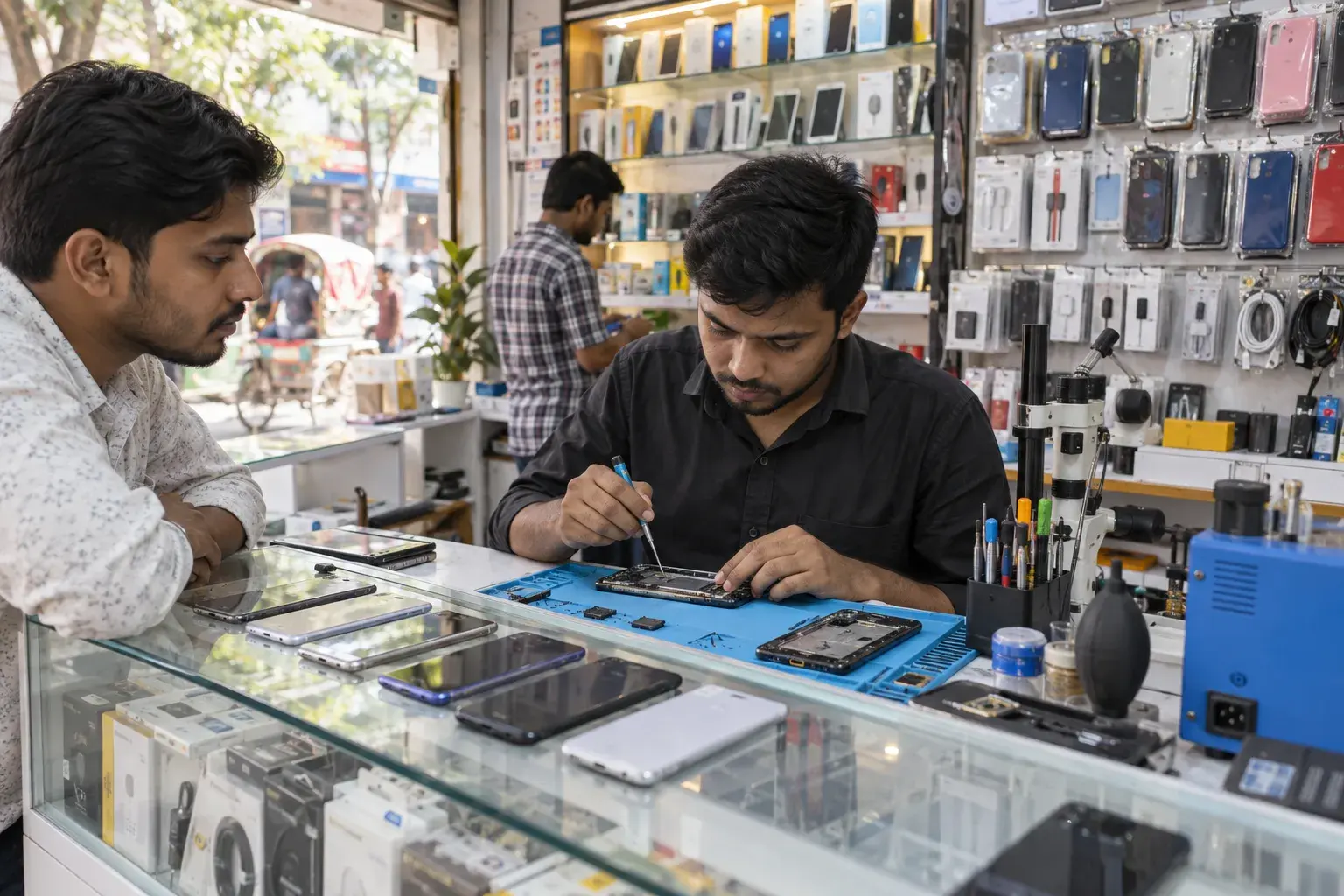
Mobile and accessories shop
A shop selling phones, accessories and repairs. There is almost nothing in a handset — accessories and repair labour are what keep the shop open.
- Capital
- ৳1 lakh – ৳5 lakh
- People
- 1 – 3
- First income
- 10 – 30 days
 Retail & wholesale
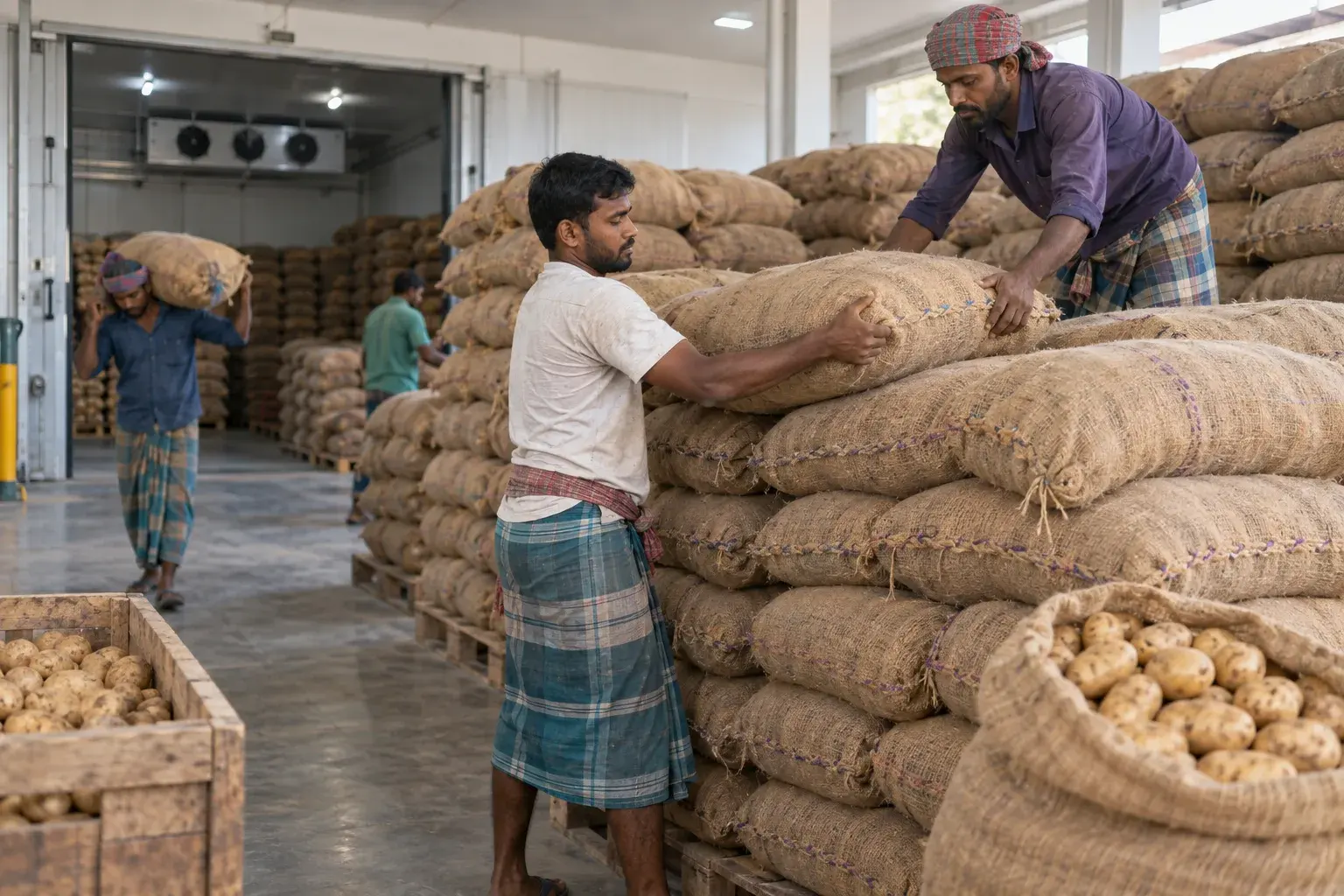
Potato storage trading
Buying potatoes at harvest, storing them cold and selling later. Rent is capped at Tk 6.00/kg, but in 2026 a 60 kg sack cost Tk 1,150-1,300 and sold for Tk 800-870.
- Capital
- ৳1.2 lakh – ৳6.5 lakh
- People
- 1 – 3
- First income
- 150 – 270 days
 Retail & wholesale
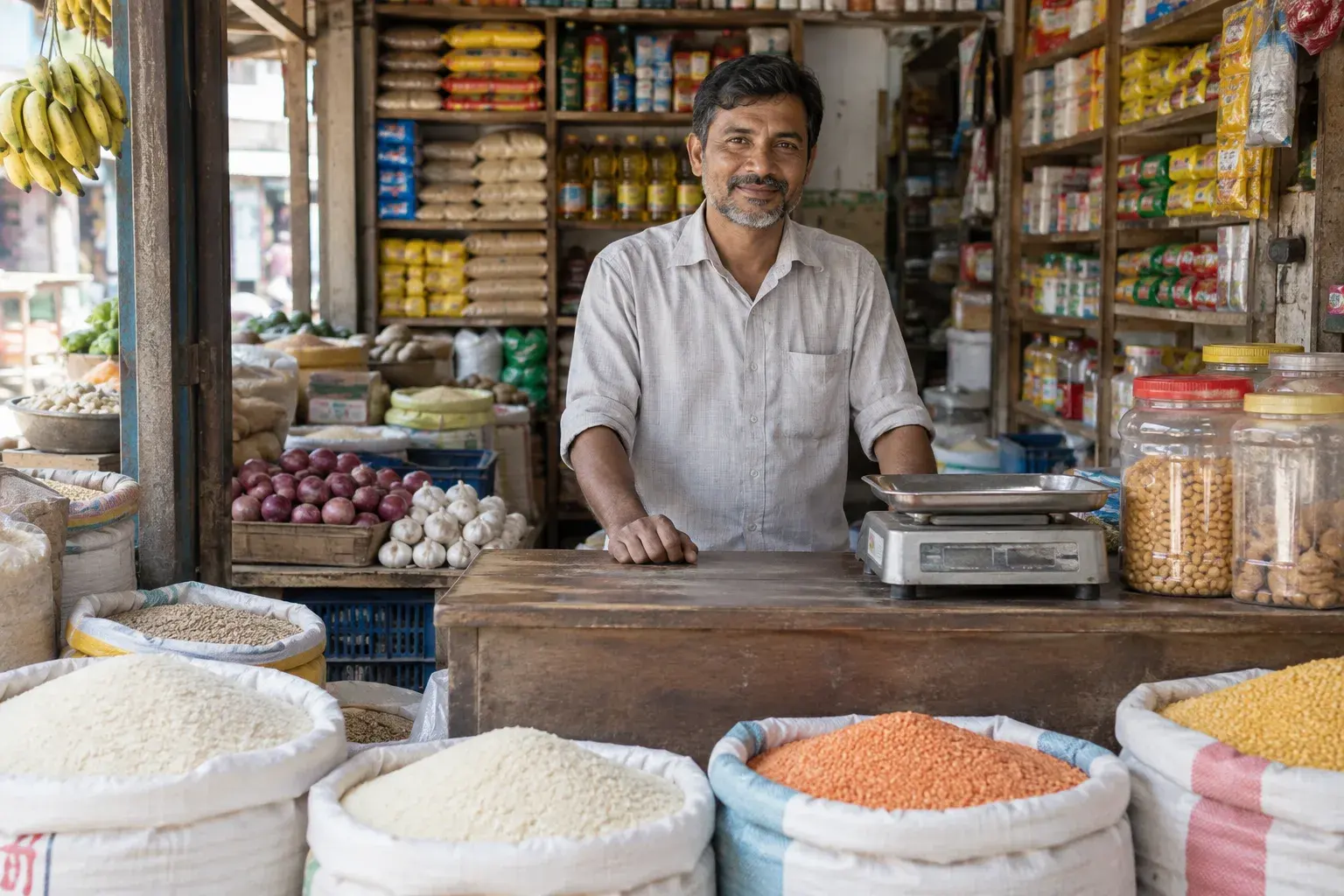
Grocery shop
The neighbourhood everyday-goods shop. A few taka a kilo, so income depends on volume - and the shop usually dies when customer credit locks up the cash.
- Capital
- ৳80k – ৳5 lakh
- People
- 1 – 3
- First income
- 10 – 30 days