
Potato storage trading
Buying potatoes at harvest, storing them cold and selling later. Rent is capped at Tk 6.00/kg, but in 2026 a 60 kg sack cost Tk 1,150-1,300 and sold for Tk 800-870.
- Last reviewed: 19 September 2026
- Version 1
Potato storage trading
- Starting capital
- ৳1,15,000 – ৳6,50,000 Editorial estimate
- Manpower
- 1 – 3 people
- First sale
- 150 – 270 days Editorial estimate
- Break-even
- 8 – 20 months Editorial estimate
- Kind of work
- Shop · Hard
About the business
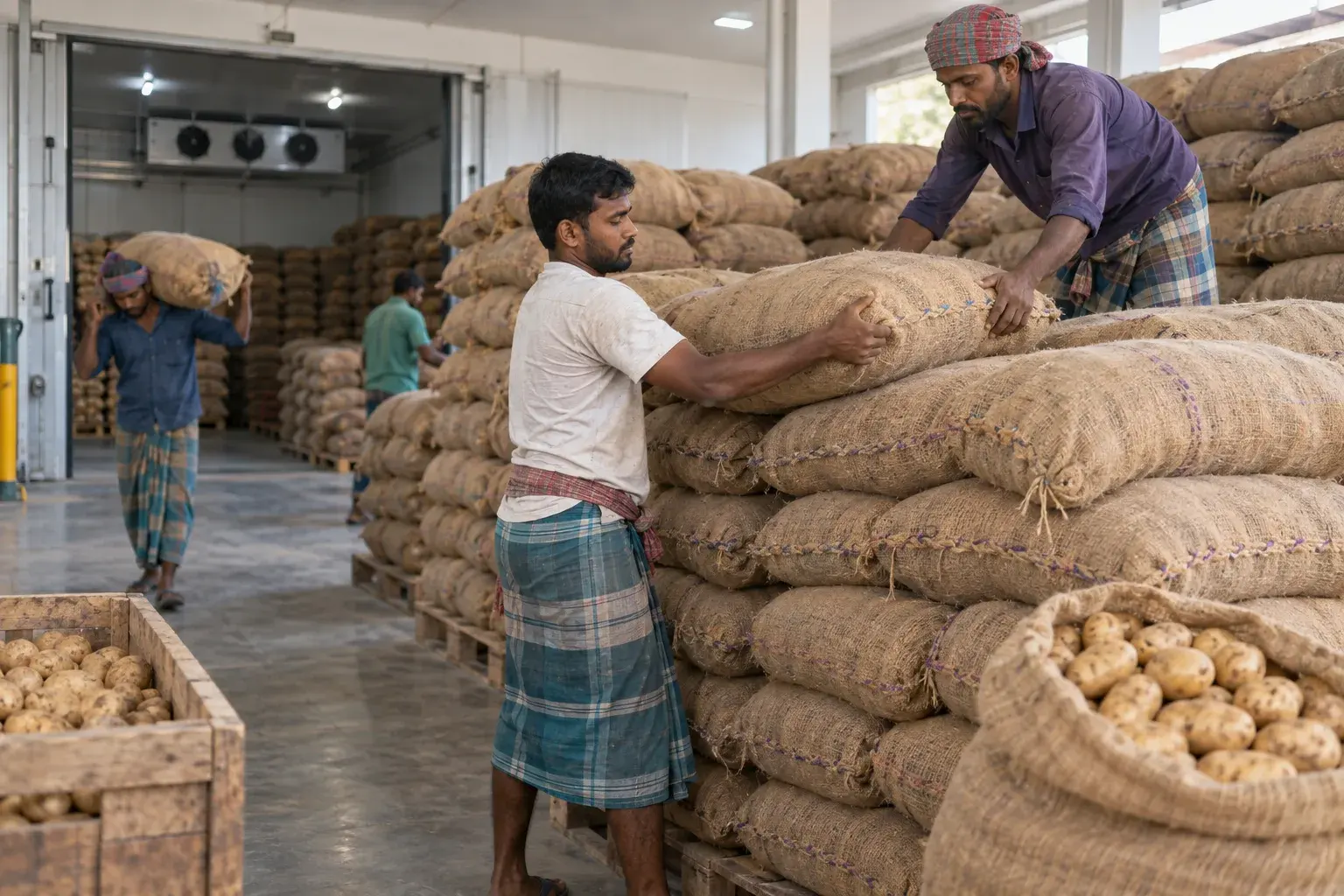
Buy potatoes cheap at harvest, store them in a cold storage, and sell months later when the price rises. Loading runs from February to April; then the money sits still for seven to eight months with no income at all. The rent is capped by government: on 31 August 2026 the Department of Agricultural Marketing notified a maximum of Tk 6.00 per kg until 31 December, down from the Tk 6.75 set on 3 March 2025 - Tk 300-400 on a 60 kg sack. The point of this trade is that the profit comes from the price swing, not from your work, and for two years running the swing has gone the wrong way. In Joypurhat on 12 September 2026 an all-in 60 kg sack had cost Tk 1,150-1,300 to buy, bag, carry and store, and was selling at Tk 800-870 - a loss of Tk 300-500 a sack. In the same week Dhaka retail potato was Tk 25-30 a kg, up 22 percent in a year. The trader releasing at Tk 13-14 a kg at the storage gate and the Dhaka shopper paying Tk 25-30 are separated by transport and two or three changes of hand, and whoever cannot ship to a distant market is stuck at the gate price. Space is not guaranteed either: national cold storage was already 80 percent full by April. Only money that can be left lying for a whole season belongs in this trade.
Unit economics
| Item | Range | Evidence | Suggest a correction |
|---|---|---|---|
| Monthly working capital | ৳1,15,000 – ৳1,30,000 | Editorial estimate | |
| Selling price | ৳13 – ৳15 / kg | Market quote | |
| Variable cost | ৳19 – ৳22 / kg | Market quote | |
| Gross margin | -63% – -32% | Editorial estimate | |
| Time to first revenue | 150 – 270 days | Editorial estimate | |
| Break-even time | 8 – 20 months | Editorial estimate | |
| Cash cycle | 180 – 270 days | Editorial estimate | |
| Waste / loss | 3% – 6% | Editorial estimate | |
| Daily capacity | 50 – 250 | Editorial estimate |
What you need to start
- Potatoes and sacks. Getting one 60 kg sack into store cost Tk 1,150-1,300 all in during 2026.Starting stock
- Trade licence from the city corporation, municipality or union parishad: form Tk 10, licence book Tk 50, standard tax Tk 30, stamp Tk 150-300, licence fee Tk 100-60,000 by trade type, normally issued in 3-5 working days.Licence
- Agricultural marketing licence from the Department of Agricultural Marketing, applied for and renewed on Form-1. It covers traders in farm produce; ask your district marketing office for the current fee and validity.Licence
- Judging potato quality and weight by eye, and reading the market. Which week you release is the single decision that makes or loses the season.Skill
- Growers or field-level middlemen to buy from in season, and one particular cold storage. Munshiganj has 62, Joypurhat 22 and Rajshahi 37.Supplier
- Booked chamber or rack space in a cold storage, with the storage receipt or bond. Rent is capped by government at Tk 6.00 per kg from 31 August 2026 to 31 December.Workspace
How the work is done
- 1Pick your cold storage and book your sacks in November or December. National capacity is about 80 percent full by April, so looking for space then is pointless.
- 2Put it in writing with the storage: the rent per kg, whether a sack is counted as 50 or 60 kg, when the rent falls due, and the interest if they advance you a loan against the stock.
- 3Take the trade licence and the agricultural marketing licence from the Department of Agricultural Marketing. Traders in farm produce need it, and it is the same office that sets the rent ceiling.
- 4Buy in February and March, from the field or the haat. Buying standing in the field is cheaper, but the grading becomes your problem.
- 5Grade before you bag: throw out cut, undersized and wet potatoes. One rotten potato takes the sack with it, and the storage will not carry that loss.
- 6Take the storage receipt or bond when the sacks go in. That paper is your title to the stock, and it is what a bank or a moneylender lends against.
- 7Go and look at your chamber at least once a month. Load-shedding lifts the temperature and the potatoes sweat, and that is exactly how stock rotted in Rajshahi this year.
- 8From August, write down the gate price every day. Do not release the whole lot on one day, because selling in parts gives a better average.
- 9Do not depend on the gate alone. Shipping to an arat in Dhaka or Chattogram fetches far more, but the truck hire and the spoilage on the road are yours.
- 10The storage must be emptied by December. Whatever is left then competes with the new crop, and the price falls further.
Seasons
- JanLow
- FebHigh
- MarHigh
- AprHigh
- MayLow
- JunLow
- JulLow
- AugHigh
- SepHigh
- OctHigh
- NovHigh
- DecNormal
Where it works well
- Strong fitBogura · The northern trading hub: cold storages and wholesale arats are both dense, and trucks to Dhaka run all year.
- Strong fitDinajpur · With Thakurgaon and Panchagarh it has 46 facilities and about 4 lakh tonnes of capacity against over 23 lakh tonnes of production, so the squeeze on space is worst here.
- Strong fitJoypurhat · Its 22 cold storages hold about 2.16 lakh tonnes, and the per-sack economics and the gate price are most clearly quoted here.
- Strong fitMunshiganj · The biggest potato district, with 62 cold storages and the Dhaka market next door, but space is short against production so booking must be early.
- Strong fitRangpur · A big potato area where buying is cheap, but local purchasing power is low, so without shipping out you do not get a price.
- PossibleJashore · Grows little potato itself but is a big selling market for the south-west, and northern traders truck stock in.
- PossiblePanchagarh · Same northern belt: cheap to buy, but far from the big consumer markets so transport has to come out of the margin.
- PossibleRajshahi · Thirty-seven working cold storages with 4,33,250 tonnes of capacity, but this is where load-shedding rot was reported most in 2026.
- PossibleThakurgaon · High production, few storages: field prices drop to Tk 8-10 a kg in season, which is good for buying but finding space is the hard part.
Risks and cautions
- HighDemand: The price simply not rising is the main risk here, and it is not hypothetical. In Joypurhat on 12 September 2026 a 60 kg sack cost Tk 1,150-1,300 and sold at Tk 800-870, a loss of Tk 300-500 a sack, for the second year running. A hundred sacks loses Tk 30,000-50,000 in one season.
- HighWorking capital: All the money leaves in March and nothing comes back before September. Without separate money to live on for those seven months you end up dumping stock at half price, which is where the real loss happens. Borrowing to store adds interest on top of rent.
- HighSpoilage: Every power cut lifts the temperature inside and the potatoes sweat and rot. In Rajshahi on 21 August 2026 there was one to two hours of load-shedding a day and generators were costing owners Tk 8,000-10,000 an hour. Chambers packed beyond capacity rot worse, and that loss is yours, not the storage's.
- MediumCompliance: The rent rate changes mid-season. It was fixed at Tk 6.75 per kg on 3 March 2025 and cut to Tk 6.00 on 31 August 2026, and even that only runs to 31 December. So when you load in March a large line of your cost is still undecided, and storage owners are pressing for Tk 9.62.
- MediumDependency: No space, no business. National cold storage was 80 percent full by April 2026, and Munshiganj had roughly 5 lakh tonnes of capacity against 10.82 lakh tonnes of potato. A newcomer is served after the established traders.
Sources
কৃষি বিপণন লাইসেন্স ও ফরম-১ (লাইসেন্স গ্রহণ ও নবায়নের আবেদন)
Collected: 16 Sept 2026Supports: Starting capital · বাংলাদেশ
সিটি কর্পোরেশন থেকে ট্রেড লাইসেন্স প্রাপ্তির ধাপ সমূহ
Collected: 16 Sept 2026Supports: Starting capital · বাংলাদেশ
- Collected: 15 Sept 2026
Supports: Selling price · ঢাকা মহানগর — সিপাহীবাগ, মিরপুর-৬, মোহাম্মদপুর টাউন হল, নিউমার্কেট, রামপুরা, মহাখালী বাজার
What changed
No corrections have been published yet.
Questions and answers
No questions yet. Be the first to ask.
Stories about this business
Potato bought at 26-27 taka is selling at 12-13
Eight truckloads of potato bought at 26-27 taka a kg now fetch 13 wholesale, 12 for graded stock out of store and 9-10 ungraded.
- Reasons
- Price drop, Working capital
A 6-8 taka loss on every kilo, and 95,000 sacks still sitting in store
Potatoes stored in the hope of a rise cost 18-19 taka a kg all-in while the market fell to 11-12. Of 125,000 sacks stored, about 95,000 were still unsold.
- Reasons
- Price drop, Working capital
Similar businesses
 Retail & wholesale
Meat retail shop
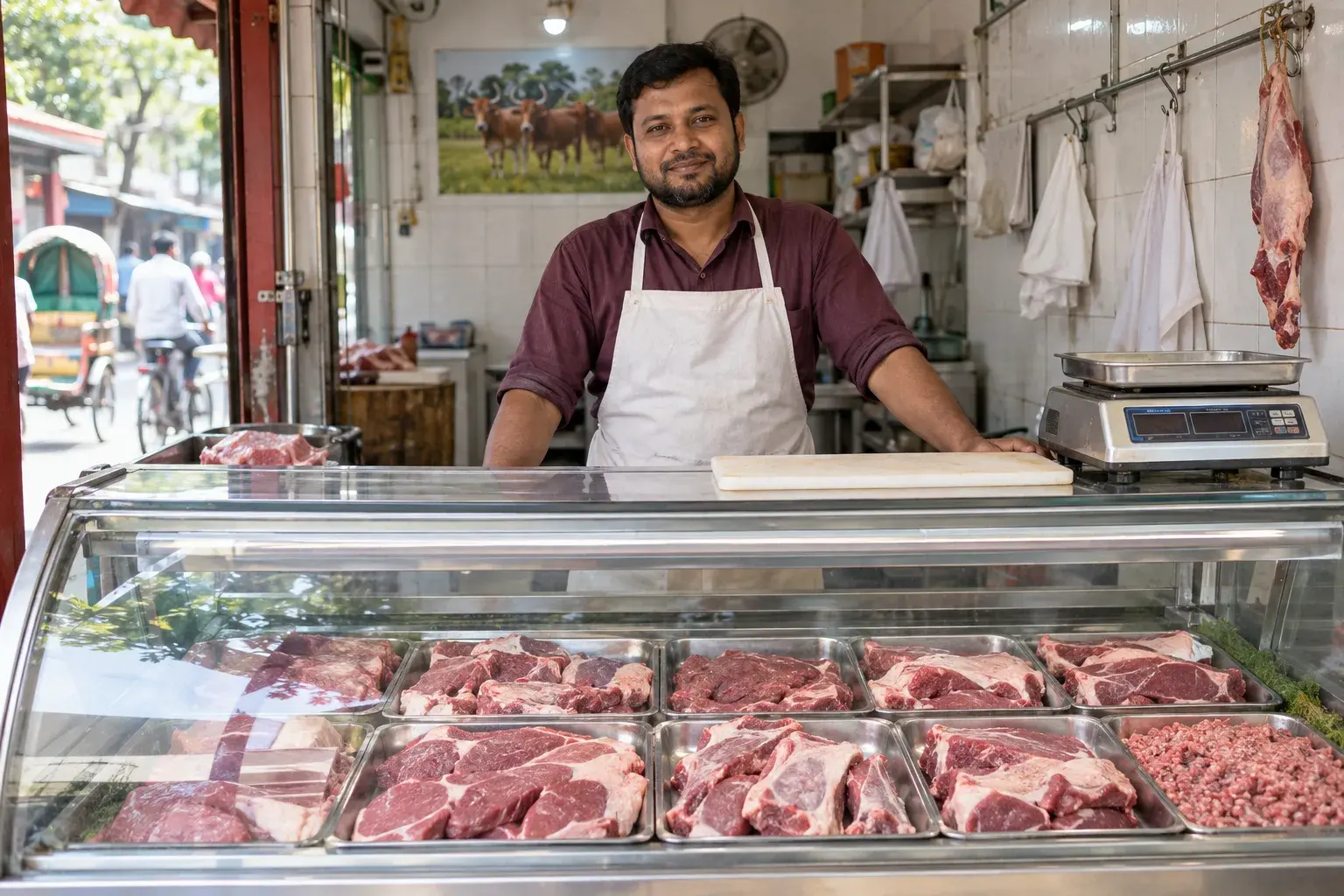
Buying, cutting and selling meat fresh daily. Dhaka beef is Tk 780-850/kg and mutton Tk 1,200-1,350/kg, and selling without the 'tested' seal now closes the shop.
- Capital
- ৳1.2 lakh – ৳5 lakh
- People
- 1 – 4
- First income
- 15 – 45 days
 Retail & wholesale
Fishing gear shop
Selling hooks, rods, reels, nets and fish medicine. Rods Tk 455-1,552, reels Tk 641-6,705. Current jal and China duari nets are illegal - stocking them means seizure and a mobile court.
- Capital
- ৳1.2 lakh – ৳6 lakh
- People
- 1 – 3
- First income
- 20 – 50 days
 Retail & wholesale
Betel nut trading
Buying betel nut from households and selling at the hat, or soaking and drying it to sell later. In Lakshmipur in October 2025 a kaun fetched Tk 2,500-2,800 and a pon Tk 150-250.
- Capital
- ৳1 lakh – ৳25 lakh
- People
- 1 – 8
- First income
- 1 – 240 days
 Retail & wholesale
Clothing and boutique shop
A shop selling fabric and ready-made clothes. Cotton runs Tk 300-700 a yard in Dhaka, and most of the year's takings arrive in the last ten days of Ramadan.
- Capital
- ৳1 lakh – ৳8 lakh
- People
- 1 – 5
- First income
- 15 – 45 days