
Biofloc fish farming
Dense fish farming in tanks. High output from a small space is possible, but in Thakurgaon one farmer put in Tk 4 lakh and sold only Tk 60,000 of fish.
- Last reviewed: 19 September 2026
- Version 1

Biofloc fish farming
- Starting capital
- ৳3,00,000 – ৳4,00,000 Practitioner verified
- Manpower
- 1 – 3 people
- First sale
- 150 – 180 days Editorial estimate
- Break-even
- 6 – 24 months Editorial estimate
- Kind of work
- Farm · Hard
About the business
Stocking fish densely in tarpaulin or cement tanks, running motors to keep oxygen up and building a colony of useful bacteria to hold the water. Facebook and YouTube are full of videos about it right now. This page is the other side. Abdur Rahman of Thakurgaon trained in Narayanganj and started with two tanks, tarpaulin, fingerlings and electrical gear, about Tk 4 lakh in all. He stocked koi first; the fingerlings were poor and 18,000 to 19,000 of them died. Then a sudden flood, with no drainage in place, carried much of the stock away. He then stocked tilapia, and poor fingerlings and a low fish price cost him again - Tk 1.8 lakh on fish alone across the two rounds, on top of very high electricity bills from the motors. In the end he sold Tk 60,000 of fish, shut the operation and sold off the equipment. District fisheries officer Khaliduzzaman says people start from a YouTube video or from what somebody told them, meet reality and lose money; anyone who cannot keep oxygen, ammonia and the bacteria under control drops out. Raihan Hossain, who made it work, has one piece of advice: when the power goes the oxygen stops, so a generator or a battery has to be in place beforehand. This is not a fish business. It is an electricity and fingerling business, and if either goes wrong nothing else matters.
Unit economics
| Item | Range | Evidence | Suggest a correction |
|---|---|---|---|
| Monthly working capital | ৳20,000 – ৳40,000 | Editorial estimate | |
| Selling price | ৳150 – ৳450 / kg | Editorial estimate | |
| Variable cost | ৳120 – ৳260 / kg | Editorial estimate | |
| Gross margin | 20% – 42% | Editorial estimate | |
| Time to first revenue | 150 – 180 days | Editorial estimate | |
| Break-even time | 6 – 24 months | Editorial estimate | |
| Cash cycle | 120 – 180 days | Editorial estimate | |
| Waste / loss | 12% – 100% | Practitioner verified | |
| Daily capacity | 400 – 450 | Practitioner verified |
What you need to start
- Meters for pH, TDS, oxygen and temperature. Oxygen has to stay between 6 and 10 and temperature between 25 and 30, and there is no way to know without measuring.Equipment
- A generator or battery, which is not a backup but the main piece of equipment. When the power goes the oxygen stops, so the successful grower's advice is to have one in place from the start.Equipment
- Tanks and tarpaulin, an oxygen machine and nano tubes. These sell at widely varying prices and have to be bought carefully; complaints of being cheated are common in this trade.Equipment
- Trade licence from the union parishad, municipality or city corporation: form Tk 10, licence book Tk 50, standard tax Tk 30, stamp Tk 150-300, licence fee Tk 100-60,000 by trade type. Needed for a bank account or a loan in the farm's name.Licence
- Understanding the water chemistry - pH, TDS, ammonia and the balance of useful bacteria. In the district fisheries officer's words, farmers drop out exactly when they cannot control these. It is not learnable from YouTube.Skill
- Fingerlings from a good hatchery. Poor fingerlings are the biggest single cause of loss here: in both documented cases thousands of fish died from them.Supplier
- A small space is enough - a roof, a yard or a patch beside the house, which is the whole attraction of the method. But it has to be high ground with drainage.Workspace
How the work is done
- 1Find out first how many people in your upazila are doing biofloc and how many have stopped. The district fisheries office recorded 30 in Thakurgaon Sadar, one in Ranishankail and one in Pirganj. One conversation with somebody who shut down teaches more than ten YouTube videos.
- 2Go to the upazila or district fisheries office and ask about training. The Thakurgaon district fisheries officer says several of his officers have been trained in biofloc and that training can be arranged for interested farmers who get in touch.
- 3Buy the equipment yourself and do not leave it to anyone else. The successful growers say young people were talked into buying things at inflated prices and over-investing at the start, and could not carry it afterwards. Tarpaulin, oxygen machines and nano tubes are all sold at widely different prices.
- 4Buy the generator or battery before the tanks go in. When the power fails the oxygen stops and the fish die quickly. This is not an optional extra; it is the core equipment.
- 5Build in drainage and put the tanks on high ground. One Thakurgaon farmer lost much of his stock in a sudden flood because there was no drainage.
- 6Get fingerlings from a good source; it is the single biggest decision. Raihan Hossain puts it plainly: good fingerlings from a good place put an operator a step ahead. Poor fingerlings cost both of the failed growers heavily.
- 7Bring the water's pH under control and add some TDS before stocking, then raise the TDS gradually. That is Shahed Hossain's method, and skipping this step cannot be fixed later.
- 8Keep oxygen between 6 and 10 and water temperature between 25 and 30, and measure both every day. Feed three times a day at the start and twice a day once the fish have grown.
- 9Learn to manage ammonia and the bacterial colony. The district fisheries officer says people drop out exactly when they cannot keep oxygen, ammonia and the useful bacteria under control.
- 10Start with one tank, not two. Abdur Rahman started with two and spent about Tk 4 lakh; learning on one and expanding later would have halved the loss.
- 11Check the market rate before choosing the species. One Thakurgaon farmer lost on tilapia because the fingerlings were poor and the fish price was low - and one of those two reasons was simply the market.
Seasons
- JanLow
- FebNormal
- MarNormal
- AprNormal
- MayNormal
- JunNormal
- JulNormal
- AugNormal
- SepNormal
- OctNormal
- NovNormal
- DecLow
Where it works well
- PossibleChattogram · Interest in rooftop and courtyard biofloc grew here, and the shortage of urban space is the main argument for it.
- PossibleDhaka · The small-space argument works best in a city, on roofs and in yards, and the buyers for live fish are close. But both the electricity bill and the rent are higher here.
- PossibleGazipur · Close to Dhaka, with cheaper space and the live fish market within reach.
- PossibleJashore · A long-established hatchery and fingerling area, so there is more scope to check fingerling quality.
- PossibleMymensingh · The country's main fish farming and hatchery centre, so the best chance of good fingerlings is here - and good fingerlings are the precondition for this business.
- PossibleNarayanganj · A training centre: the Thakurgaon farmer who later lost money had trained in Narayanganj. It shows that having had training is not by itself enough.
- PossibleThakurgaon · The district fisheries office records 30 operators in the sadar upazila, one in Ranishankail and one in Pirganj, with no data at all for Haripur and Baliadangi. The district fisheries officer says many have now shut down.
Risks and cautions
- HighDependency: Total dependence on electricity. Motors off means oxygen off, and oxygen off means the fish die quickly. Raihan Hossain says it outright: the oxygen must never fail, so a generator or battery has to be ready before the power goes. On top of that come the bills - Abdur Rahman says the motors ran up very high electricity bills. The monthly amount was not found in any source, and that is the biggest hole on this page.
- HighDependency: Fingerling quality. Abdur Rahman stocked koi first and lost 18,000 to 19,000 because the fingerlings were poor; he then stocked tilapia and lost again for the same reason. Tk 1.8 lakh went on fish alone across the two rounds. The farmer has no way of testing quality at the point of purchase.
- HighOther: Being cheated. Shahed Hossain says young people are pushed by fraudsters into buying equipment at inflated prices and over-investing at the start, after which they cannot carry it and are ruined. Raihan Hossain says the same: buy the equipment yourself and do not depend on anyone else.
- HighSpoilage: Mass die-off, and it happens overnight. Mahabub Hossain stocked 17,000 shing fingerlings in 30,000 litres and lost two to three thousand for not understanding the method. In Abdur Rahman's case a sudden flood with no drainage simply carried the stock away. Tank fish are not pond fish: one mistake takes the whole tank.
- MediumDemand: A low fish price breaks the whole arithmetic. One of the two reasons Abdur Rahman lost on tilapia was simply that the price was low. Dense farming costs more per kilo - feed, power, fingerlings - but the fish sells at the ordinary market rate, the same as pond fish. There is no premium for biofloc fish.
Sources
সিটি কর্পোরেশন থেকে ট্রেড লাইসেন্স প্রাপ্তির ধাপ সমূহ
Collected: 16 Sept 2026Supports: Starting capital · বাংলাদেশ
What changed
No corrections have been published yet.
Questions and answers
No questions yet. Be the first to ask.
Stories about this business
Four lakh into biofloc tanks, 60,000 taka of fish sold
Two tanks, tarpaulin, fingerlings and electrical gear cost about 400,000 taka. Two stocking rounds took 180,000 taka of fish, and only 60,000 taka worth was ever sold.
- Capital
- ৳4 lakh
- Reasons
- Supplier problem, Skill gap
Similar businesses
 Agriculture & farming
Layer poultry farm for eggs
Feed alone is Tk 7.90-9.30 per egg and full production cost Tk 8.50-10. Through mid-2026 farmers were getting Tk 6-6.80, a loss on every egg.
- Capital
- ৳3 lakh – ৳15 lakh
- People
- 1 – 4
- First income
- 126 – 140 days
 Agriculture & farming
Dairy cattle farm
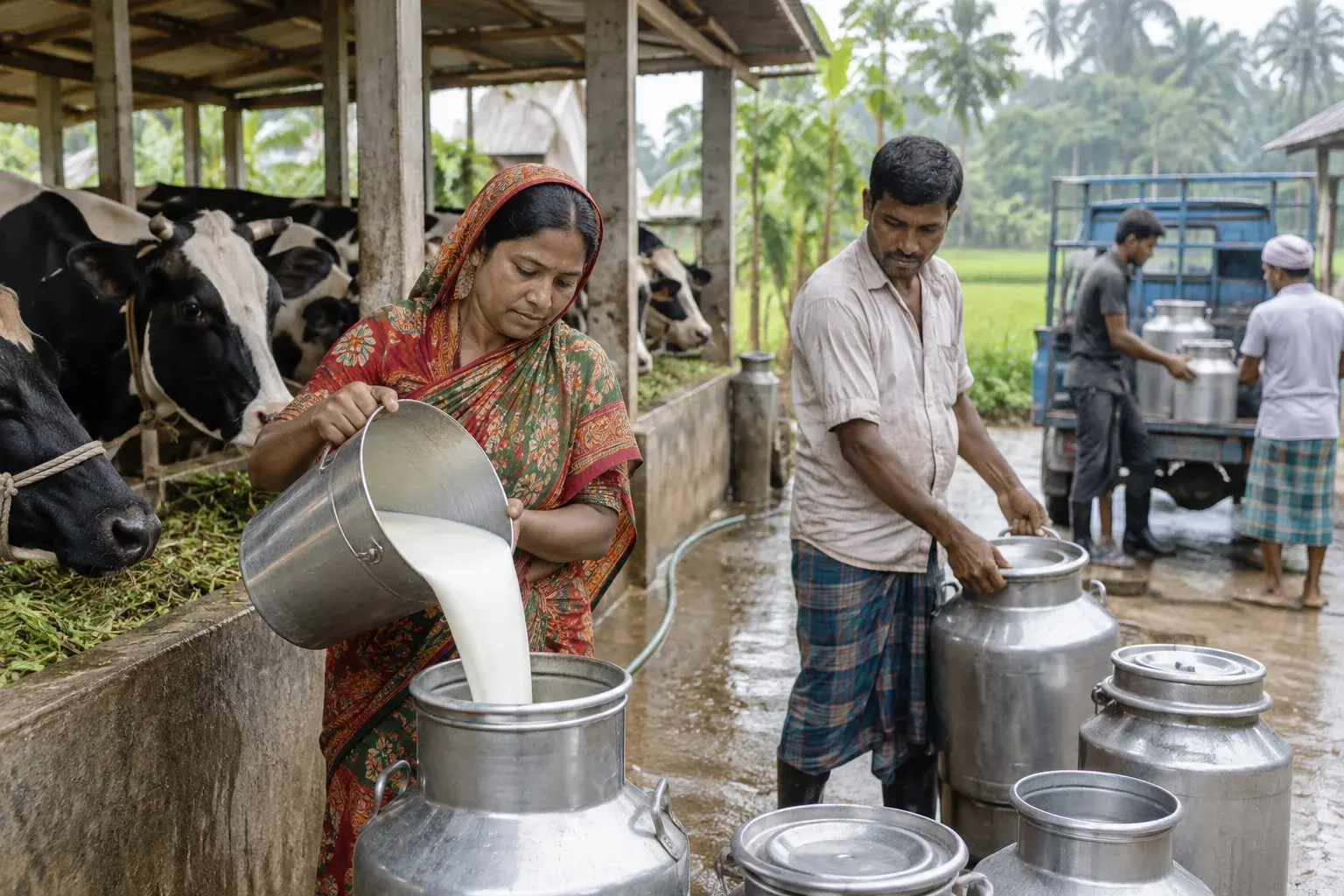
Rearing milch cows and selling milk daily. Milk Vita pays Tk 45-47 a litre and the open market about Tk 55, against a farmer-stated cost of roughly Tk 32.5 a litre. Output halves for three monsoon months.
- Capital
- ৳2.5 lakh – ৳12 lakh
- People
- 1 – 6
- First income
- 7 – 60 days
 Agriculture & farming
Strawberry farming
A winter crop fruiting in 72-75 days at Tk 400-1,000 a kilo, but about Tk 4 lakh goes into just 30 decimals and the fruit keeps only two or three days.
- Capital
- ৳4 lakh – ৳12 lakh
- People
- 2 – 12
- First income
- 72 – 75 days
 Agriculture & farming
Fish nursery and fry
Nursing hatchery spawn into fingerlings and selling them to fish farmers. On a government farm's 2026 targets, spawn runs about Tk 1,900 a kg and fingerlings about Tk 250 a kg.
- Capital
- ৳2 lakh – ৳22 lakh
- People
- 2 – 12
- First income
- 60 – 365 days