
Strawberry farming
A winter crop fruiting in 72-75 days at Tk 400-1,000 a kilo, but about Tk 4 lakh goes into just 30 decimals and the fruit keeps only two or three days.
- Last reviewed: 19 September 2026
- Version 1

Strawberry farming
- Starting capital
- ৳4,00,000 – ৳12,00,000 Practitioner verified
- Manpower
- 2 – 12 people
- First sale
- 72 – 75 days Practitioner verified
- Break-even
- 4 – 5 months Editorial estimate
- Kind of work
- Farm · Hard
About the business
Strawberries grown on raised beds in winter and sold from January to March. This page is here to stop losses, because two things about this crop are dangerous on their own: the price of the plants and the size of the market. Mohammad Kaisar of Chakaria in Cox's Bazar brought 4,000 American Festival plants from a Rajshahi nursery for 30 decimals of land at Tk 60 each - Tk 240,000 in plants alone, and about Tk 4 lakh in total with land preparation, fertiliser and labour. Four lakh taka on 30 decimals is the real story of this crop. He planted on 17 November and started picking on 28 January, 15 to 17 kg a day, and got up to about Tk 1,000 a kilo. Now the warning, and it is Kaisar's own. He first grew strawberries in 2007 and stopped two years later because local demand was too low, restarting only in 2021. The man who grows this fruit successfully once gave it up for want of a market. Strawberries do not keep beyond two or three days, the buyers are supershops and town fruit shops, and without those buyers lined up the crop rots in the field. Fix the buyer before you plant. That one sentence is the whole of this page.
Unit economics
| Item | Range | Evidence | Suggest a correction |
|---|---|---|---|
| Monthly working capital | ৳80,000 | Editorial estimate | |
| Selling price | ৳400 – ৳1,000 / kg | Practitioner verified | |
| Variable cost | ৳330 – ৳530 / kg | Editorial estimate | |
| Gross margin | 17% – 47% | Editorial estimate | |
| Time to first revenue | 72 – 75 days | Practitioner verified | |
| Break-even time | 4 – 5 months | Editorial estimate | |
| Cash cycle | 80 – 120 days | Editorial estimate | |
| Waste / loss | 10% – 25% | Editorial estimate | |
| Daily capacity | 15 – 17 | Practitioner verified |
What you need to start
- Mulch paper, irrigation, and a raised hut for guarding. A polynet house if you want to raise your own plants for next year.Equipment
- Plants, the single biggest cost. In Chakaria American Festival plants were Tk 60 each, 4,000 on 30 decimals, Tk 240,000 in total. In Birol 15,000 plants of four varieties including Winterdawn, Festival and American Festival went on 67 decimals.Starting stock
- Trade licence from the union parishad, municipality or city corporation: form Tk 10, licence book Tk 50, standard tax Tk 30, stamp Tk 150-300, licence fee Tk 100-60,000 by trade type. Supplying a supershop regularly normally means having a named firm and a licence.Licence
- Bed preparation, mulching, steady irrigation and picking at the right time every day. One day late and the fruit softens and the supershop sends it back.Skill
- Town supershops, fruit shops and wholesalers are the only buyers. Plants come from nurseries in Rajshahi, Joypurhat or Rangpur.Supplier
- Fertile loam to sandy loam land laid out in beds. Chakaria uses 30 decimals; Birol 87 decimals, of which 20 are a polynet house and 67 carry fruit.Workspace
How the work is done
- 1Fix the buyer before anything else. This fruit keeps two or three days and does not sell in an ordinary vegetable market. Which supershop, fruit shop or restaurant will take it, how many kilos and at what price - get that settled in writing.
- 2Do one season on a very small scale first. The Cox's Bazar grower started in 2007, stopped two years later for want of a market, and only restarted in 2021. Going in big in the first year is the biggest mistake in this crop.
- 3Choose fertile loam to sandy loam soil and grow on raised beds. This crop does not work without them.
- 4Plant between the last week of October and the end of November. Later than that and the plants get less cold, and more cold and fog means more fruit.
- 5Cost the plants first, because they are the biggest expense. In Chakaria each plant was Tk 60, 4,000 plants on 30 decimals, Tk 240,000 in plants alone. Write down the variety and where they came from.
- 6Use mulching. Mulch paper keeps the weeds down and keeps the fruit off the soil so it stays clean, and a dirty fruit is refused by supershops.
- 7Irrigate regularly and tend the crop daily. Twelve workers were employed on 87 decimals in Birol; labour is a large cost in this crop.
- 8Arrange to guard the field. In Birol a raised hut was built in a corner and the plot watched day and night; you cannot leave a thousand-taka-a-kilo fruit unguarded.
- 9Pick daily and deliver daily. From 28 January it was 15-17 kg a day, and that has to reach the shop the same day. There is no way to store it.
- 10Think about next year's plants this year. The Birol group put up a polynet house on 20 decimals to raise their own plants from runners so they need not buy from outside next year. Cutting the plant cost is the biggest single route to profit in this crop.
- 11Treat selling plants as a separate income, but check the buyer first. People are already asking the Birol growers to reserve plants - but everyone buying plants will be selling fruit into the same small market.
Seasons
- JanHigh
- FebHigh
- MarHigh
- AprNormal
- MayLow
- JunLow
- JulLow
- AugLow
- SepLow
- OctNormal
- NovNormal
- DecNormal
Where it works well
- Strong fitDinajpur · The upazila agriculture officer sees strong prospects here because it is a cold district. Four entrepreneurs in Rabipur village, Birol, work 87 decimals plus a 20-decimal polynet house for their own plants.
- Strong fitRajshahi · The source of plants: the Cox's Bazar grower brought 4,000 American Festival plants from a nursery here at Tk 60 each.
- PossibleCox's Bazar · Silt from the Matamuhuri char in Kakara union, Chakaria, gave a good yield, and the town's supershops and tourist trade put buyers close by. But the winter is mild, and it was a grower here who once stopped for want of a market.
- PossibleDhaka · Not a growing area but the selling one. The supershops and online fruit sellers are concentrated here, so anyone growing at scale has to find buyers in Dhaka.
- PossibleJoypurhat · Another source of plants: one of the Birol entrepreneurs brought his from here.
- PossiblePanchagarh · One of the coldest districts in the country, and more cold and fog means more fruit.
- PossibleRangpur · A plant source and a cold district; one Birol entrepreneur started with plants from a friend in Rangpur.
- PossibleThakurgaon · A cold district next to Dinajpur with the same climate and the same plant sources.
Risks and cautions
- HighDemand: The market is small, and that is the main risk in this crop. Mohammad Kaisar of Chakaria first grew strawberries in 2007 and stopped two years later because local demand was too low, restarting only in 2021. The man who is successful now once gave it up for want of buyers. The only outlets are town supershops, large fruit shops and wholesalers; this fruit does not move in an ordinary bazar.
- HighSpoilage: The fruit is highly perishable. Fifteen to seventeen kilos come off a day and have to reach the shop the same day; there is no storing it and no cold chain. Once soft, the supershop refuses it and nobody in an ordinary bazar will pay this price. No source gives a loss percentage, but one day's delay is enough.
- HighWorking capital: The plant money is paid in one lump, two and a half months before any fruit. Four thousand plants for 30 decimals is Tk 240,000, sixty percent of a Tk 4 lakh outlay, and it goes on planting day. Nothing comes in before the fruit does, while mulch, irrigation and labour keep costing.
- MediumOther: Theft. Fruit worth Tk 400 to 1,000 a kilo sits in an open field, so the Birol growers built a raised hut in a corner and watched it day and night. The cost of that watch belongs in the budget, and nobody counts it separately.
- MediumOther: Weather. More cold and fog means more fruit, so a mild winter means less. It is a rabi crop running from the last week of October to the end of March; the season is short and ends as soon as the heat comes. By how much a mild winter cuts the yield was not found anywhere.
Sources
সিটি কর্পোরেশন থেকে ট্রেড লাইসেন্স প্রাপ্তির ধাপ সমূহ
Collected: 16 Sept 2026Supports: Starting capital · বাংলাদেশ
What changed
No corrections have been published yet.
Questions and answers
No questions yet. Be the first to ask.
Stories about this business
1,200 taka a kilo early, 300 late, and another 4 lakh from selling seedlings
Strawberry on 25 shatak, at 150,000-200,000 taka a bigha to plant. Fruit brought 4-5 lakh taka or more this season, and selling runners and seedlings to other growers brought another 4 lakh.
- Reasons
- Weak demand, Working capital
Similar businesses
 Agriculture & farming
Biofloc fish farming
Dense fish farming in tanks. High output from a small space is possible, but in Thakurgaon one farmer put in Tk 4 lakh and sold only Tk 60,000 of fish.
- Capital
- ৳3 lakh – ৳4 lakh
- People
- 1 – 3
- First income
- 150 – 180 days
 Agriculture & farming
Layer poultry farm for eggs
Feed alone is Tk 7.90-9.30 per egg and full production cost Tk 8.50-10. Through mid-2026 farmers were getting Tk 6-6.80, a loss on every egg.
- Capital
- ৳3 lakh – ৳15 lakh
- People
- 1 – 4
- First income
- 126 – 140 days
 Agriculture & farming
Dairy cattle farm
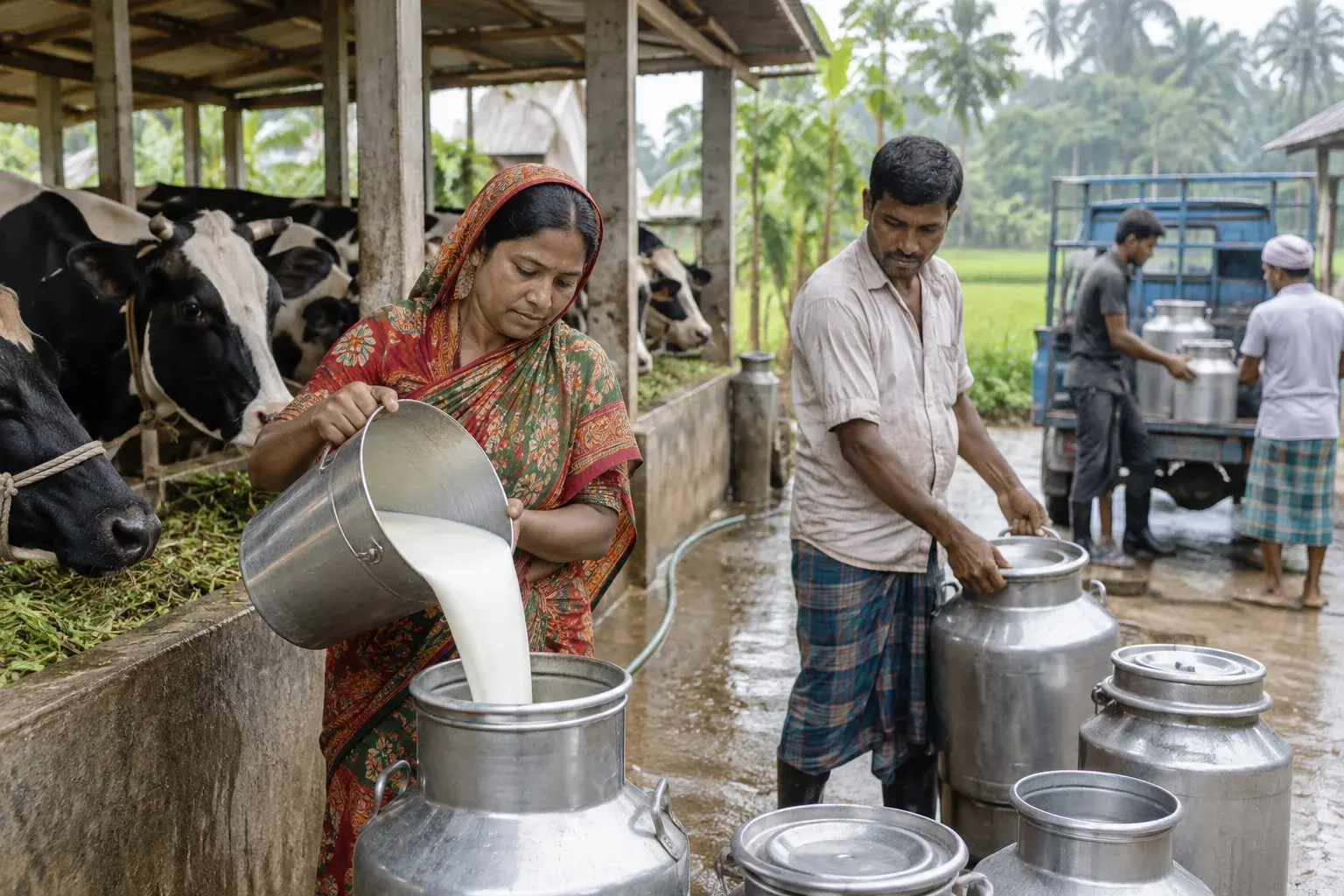
Rearing milch cows and selling milk daily. Milk Vita pays Tk 45-47 a litre and the open market about Tk 55, against a farmer-stated cost of roughly Tk 32.5 a litre. Output halves for three monsoon months.
- Capital
- ৳2.5 lakh – ৳12 lakh
- People
- 1 – 6
- First income
- 7 – 60 days
 Agriculture & farming
Fish nursery and fry
Nursing hatchery spawn into fingerlings and selling them to fish farmers. On a government farm's 2026 targets, spawn runs about Tk 1,900 a kg and fingerlings about Tk 250 a kg.
- Capital
- ৳2 lakh – ৳22 lakh
- People
- 2 – 12
- First income
- 60 – 365 days