
Dairy cattle farm
Rearing milch cows and selling milk daily. Milk Vita pays Tk 45-47 a litre and the open market about Tk 55, against a farmer-stated cost of roughly Tk 32.5 a litre. Output halves for three monsoon months.
- Last reviewed: 19 September 2026
- Version 1
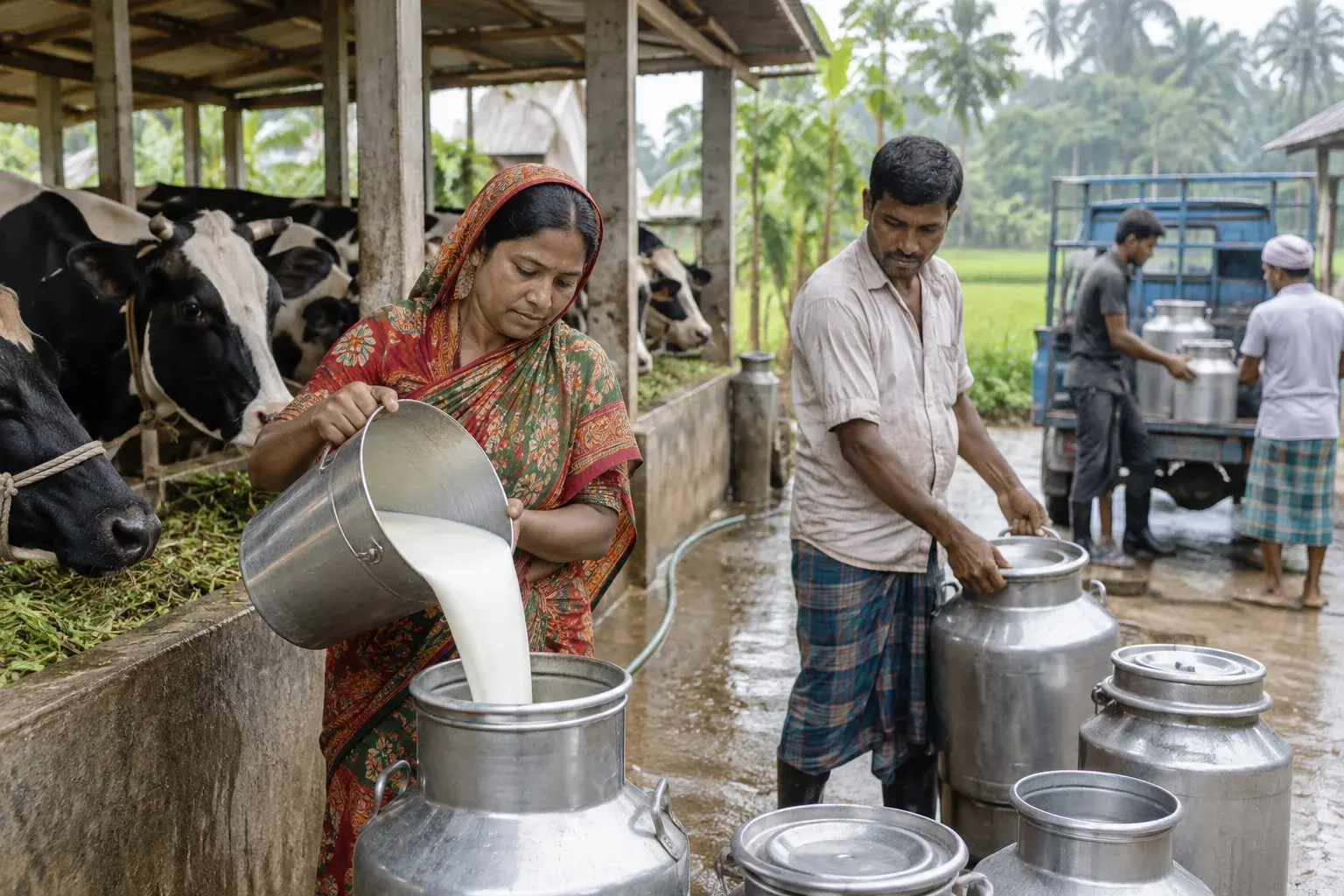
Dairy cattle farm — an illustrative AI-generated picture, not a real business
- Starting capital
- ৳2,50,000 – ৳12,00,000 Editorial estimate
- Manpower
- 1 – 6 people
- First sale
- 7 – 60 days Editorial estimate
- Break-even
- 20 – 32 months Editorial estimate
- Kind of work
- Farm · Medium difficulty
About the business
Keeping milch cows, milking twice a day and selling the milk to a cooperative, a processor or the open market. The price side is now well established: on 30 June 2026 farmers in Shahjadpur, Sirajganj said Milk Vita collects at Tk 45-47 a litre while the open market pays about Tk 55, and society members are obliged to sell at the Tk 45-47 rate. The cost side comes from the farmers themselves. Mizanur Rahman Mintu of Dakhalbari runs 100 cattle, 40 of them milch cows, producing about 400 litres a day at a daily cost of roughly Tk 13,000 for feed, medicine and labour - about Tk 32.5 a litre. That leaves Tk 12-14 a litre at the Milk Vita rate and about Tk 22 on the open market. An average milch cow gives 8-10 litres a day. The real danger is the monsoon. Farmers in Bera, Pabna reported on 29 August 2026 that when the green fodder fields go under water a cow that gave 20-22 litres drops to 7-10, while feed cost does not fall: Tk 500 of feed returns Tk 400-450 of milk, and straw runs at Tk 700 a maund. Many sell a calf to cover the three-month gap. The good news is that demand does not run out: the Department of Livestock Services puts 2025-26 milk demand at 16.279 million tonnes against production of 15.753 million tonnes. Unlike eggs and meat, milk is still short of demand.
Unit economics
| Item | Range | Evidence | Suggest a correction |
|---|---|---|---|
| Monthly working capital | ৳40,000 – ৳4,00,000 | Market quote | |
| Selling price | ৳45 – ৳55 / unit | Market quote | |
| Variable cost | ৳23 – ৳33 / unit | Market quote | |
| Gross margin | 27% – 41% | Market quote | |
| Time to first revenue | 7 – 60 days | Editorial estimate | |
| Break-even time | 20 – 32 months | Editorial estimate | |
| Cash cycle | 1 – 15 days | Editorial estimate | |
| Waste / loss | 2% – 5% | Editorial estimate | |
| Daily capacity | 8 – 22 | Market quote |
What you need to start
- Concentrate feed and straw. Bran, oilcake, maize, black gram and lentil prices have risen sharply over five years, and straw reaches Tk 700 a maund in the monsoon.Starting stock
- Dairy farm registration and renewal, a service on the Department of Livestock Services' simplified service list, applied for at the upazila livestock office. No fee amount is published on the department's site.Licence
- Food Safety (Registration and Licensing) Regulations 2026: dairy is on the compulsory list. Registration is Tk 1,000 new and Tk 500 renewal, valid three years; processing or packing raw milk attracts an establishment licence fee of Tk 1,000-5,000.Licence
- Trade licence from the union parishad, municipality or city corporation: form Tk 10, licence book Tk 50, standard tax Tk 30, non-judicial stamp Tk 150-300, licence fee Tk 100-60,000 by trade type.Licence
- Judging a cow's milking capacity, catching heat on time and getting her inseminated, and spotting mastitis or foot-and-mouth early. One missed breeding season costs a whole year's income.Skill
- A nearby Milk Vita society or company chilling centre, a vet, and a dependable cattle feed shop. Joining a society locks in the price, so decide knowing that.Supplier
- A shed and grazing or fodder land. One farmer in Bera, Pabna ran his farm on four bighas of fodder; on low land that fodder floods in the monsoon, and that is when the losses start.Workspace
How the work is done
- 1Decide who will take the milk before anything else. Check whether there is a Milk Vita society or a company chilling centre nearby; without one you will be stuck with the milk every single day.
- 2Compare the society rate with the open market. As a society member you must sell at Tk 45-47; the open market may pay Tk 55 but a buyer is not guaranteed every day.
- 3Arrange land and fodder first. Pushing milk with concentrate feed alone raises cost by about 30 percent, and fodder grown on low land will go under water in the monsoon.
- 4Register the farm with the upazila livestock office. Poultry and dairy farm registration and renewal is on the Department of Livestock Services' simplified service list, and registered farms get vaccination and artificial insemination support more easily.
- 5Take the trade licence from the union parishad or municipality; if you will process or pack milk you will also need BFSA registration.
- 6Buy the cow on her milk, not her looks. Have her milked in front of you, measure both milkings and ask about her previous calving.
- 7Get foot-and-mouth and anthrax vaccination from the upazila livestock office; in Shahjadpur both are given free. Deworming has to be regular too.
- 8Move the milk fast after milking. Without cans, ice or a nearby chilling centre it will sour in the heat and no one will take it.
- 9Buy straw and bran ahead for the three monsoon months. Straw touches Tk 700 a maund then, and many farmers sell a calf to buy feed.
- 10Keep a per-cow record of milk and feed every day. That book tells you which cow is eating more than she gives, and that is the basis for deciding which one to sell.
- 11Do not stay only in raw milk. The Shahjadpur upazila livestock officer himself advises moving into dairy products such as yoghurt or sweets to escape some of the price pressure.
Seasons
- JanHigh
- FebHigh
- MarHigh
- AprNormal
- MayNormal
- JunLow
- JulLow
- AugLow
- SepLow
- OctNormal
- NovHigh
- DecHigh
Where it works well
- Strong fitPabna · The district has 4,874 registered and 4,791 unregistered dairy farms producing 340,000 tonnes a year, but the chars and low land of Bera, Santhia, Bhangura, Faridpur and Chatmohar flood in the monsoon.
- Strong fitSirajganj · Shahjadpur has Milk Vita's processing plant and roughly 30,000 farms of all sizes; the upazila produces about 500,000 litres a day and 25,000 members supply through more than 500 cooperative societies.
- PossibleBogura · The north's trading hub and a large yoghurt and sweets market, so there are local buyers for raw milk.
- PossibleChattogram · Big-city demand and a good open-market rate, but feed transport costs more.
- PossibleGazipur · Dense settlement beside Dhaka means milk sells at the farm gate, but high land prices make fodder land hard to get.
- PossibleManikganj · Next to Dhaka, so the Tk 55 open-market rate is more attainable, and the chars offer fodder land.
- PossibleMymensingh · A centre of livestock and veterinary training, so veterinary care and artificial insemination are easy to reach.
- PossibleRangpur · High cattle density and cheaper feed, though there are fewer processing plants nearby.
- PossibleSatkhira · A recognised milk-producing area in the south, where distance to a chilling centre is the main obstacle.
- PossibleTangail · Close to the Baghabari dairy belt and a short haul to the Dhaka market.
Risks and cautions
- HighDemand: Costs rise, the price does not. Shahjadpur farmers said on 30 June 2026 that a labourer's daily wage was Tk 400 five years ago and is now Tk 600-650, with bran, oilcake, maize and feed all up, while the milk price has barely moved. Society membership forces many to sell at Tk 45-47 anyway. In Mintu's words, 'often I cannot make the accounts balance at all.'
- HighSpoilage: For three monsoon months output halves while cost does not. Bera, Pabna, 29 August 2026: with the fodder flooded, three cows fell from 40-50 litres a day to 20-25; the extra cost is Tk 250-300 per cow per day, Tk 30,000-35,000 a month on four cows and close to a lakh over three months. One farmer sold a calf for Tk 52,000 to buy Tk 40,000 of straw. Milk Vita's daily collection at Baghabari falls from about a lakh litres to 37,000-38,000 in this period.
- HighDependency: Milk is a one-day product and the buyers are few. Without a chilling centre or a society nearby it spoils within hours of milking, so the farmer has no bargaining room. Mintu in Shahjadpur stopped supplying Milk Vita once the bonus and farm credit dried up - but not everyone has that option.
- HighWorking capital: The money sits locked in the cow while income arrives drop by drop. A cow calves once a year, so a large part of the capital returns only through selling that calf. Farmers themselves say rearing cattle leaves nothing in the house, so when the monsoon comes or a cow falls sick there is no cash on hand.
- MediumCompliance: Dairy is on the compulsory list under the Food Safety (Registration and Licensing) Regulations 2026. Moving beyond raw milk into yoghurt, sweets or packed milk means BFSA registration, the correct trade named on the licence and, where applicable, a physical inspection.
Sources
Livestock Statistics at a Glance 2025-2026 (গবাদিপশুর সংখ্যা, দুধ-মাংস-ডিমের উৎপাদন ও চাহিদা)
Collected: 16 Sept 2026Supports: Starting capital · বাংলাদেশ
সহজিকৃত সেবার তালিকা — পোল্ট্রি ও ডেইরী খামার রেজিষ্ট্রেশন ও নবায়ন কার্যক্রম
Collected: 16 Sept 2026Supports: Starting capital · বাংলাদেশ
সিটি কর্পোরেশন থেকে ট্রেড লাইসেন্স প্রাপ্তির ধাপ সমূহ
Collected: 16 Sept 2026Supports: Starting capital · বাংলাদেশ
All food businesses now need safety registration
Collected: 22 Jul 2026Supports: Starting capital · বাংলাদেশ
What changed
No corrections have been published yet.
Questions and answers
No questions yet. Be the first to ask.
Stories about this business
Gold earrings bought one cow; a lakh a month now, but the flood took 28-30 lakh
A pair of gold earrings sold for 50,000 taka bought one Friesian cow nearly two decades ago. The herd is now 60 head giving 200 litres a day and about a lakh taka a month after costs, yet a flood killed 15 animals and brought 1,000 taka of assistance.
- Capital
- ৳50k
- Reasons
- Dependency, Other
Similar businesses
 Agriculture & farming
Biofloc fish farming
Dense fish farming in tanks. High output from a small space is possible, but in Thakurgaon one farmer put in Tk 4 lakh and sold only Tk 60,000 of fish.
- Capital
- ৳3 lakh – ৳4 lakh
- People
- 1 – 3
- First income
- 150 – 180 days
 Agriculture & farming
Fish nursery and fry
Nursing hatchery spawn into fingerlings and selling them to fish farmers. On a government farm's 2026 targets, spawn runs about Tk 1,900 a kg and fingerlings about Tk 250 a kg.
- Capital
- ৳2 lakh – ৳22 lakh
- People
- 2 – 12
- First income
- 60 – 365 days
 Agriculture & farming
Layer poultry farm for eggs
Feed alone is Tk 7.90-9.30 per egg and full production cost Tk 8.50-10. Through mid-2026 farmers were getting Tk 6-6.80, a loss on every egg.
- Capital
- ৳3 lakh – ৳15 lakh
- People
- 1 – 4
- First income
- 126 – 140 days
 Agriculture & farming
Duck farming
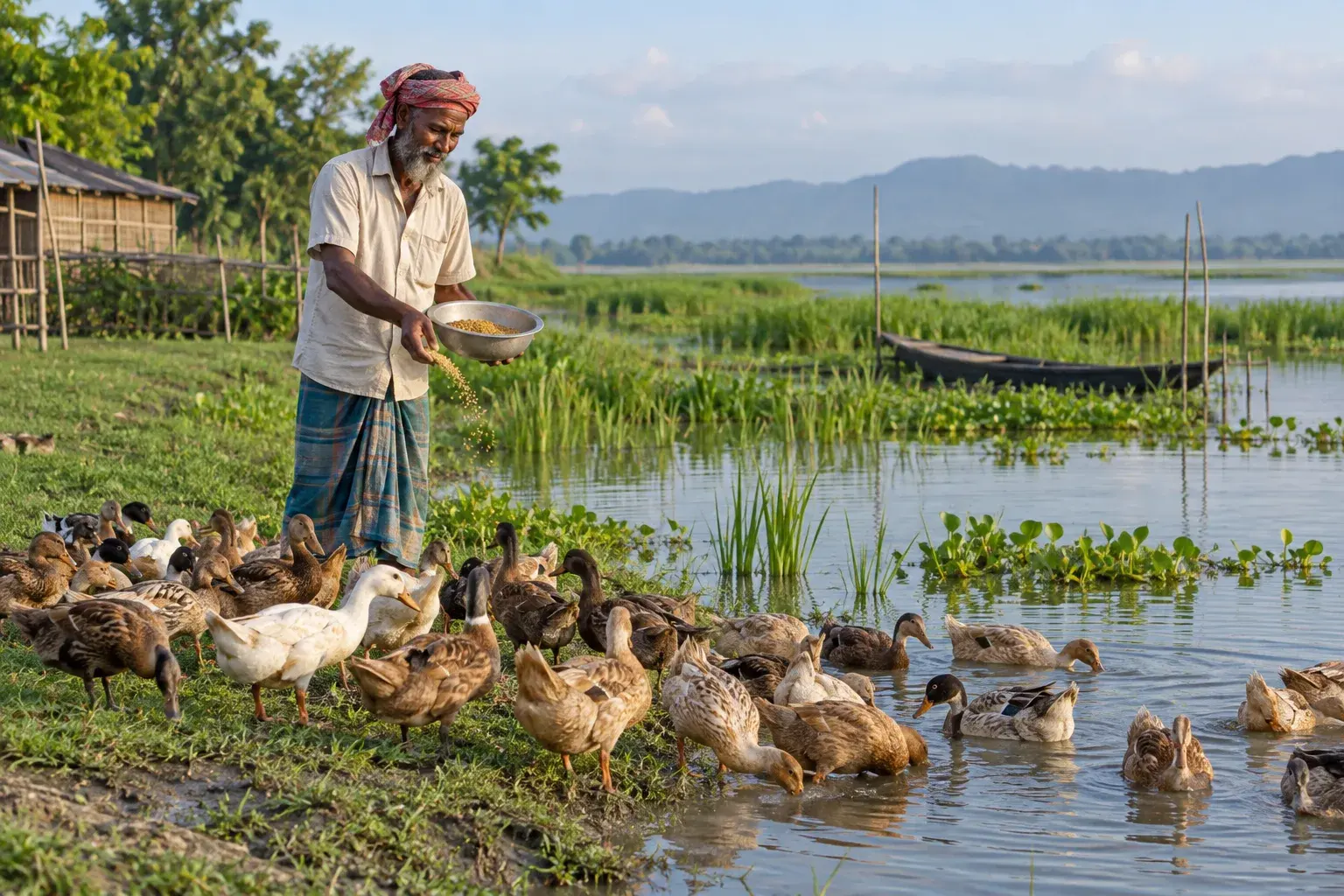
Free-range duck keeping on the haor. About 60 eggs a day per 100 ducks, feed at about Tk 2 per duck per day, and a hundred eggs selling for Tk 1,200-1,300.
- Capital
- ৳1.8 lakh – ৳2 lakh
- People
- 1 – 3
- First income
- 150 – 180 days