
Buffalo curd and dairy
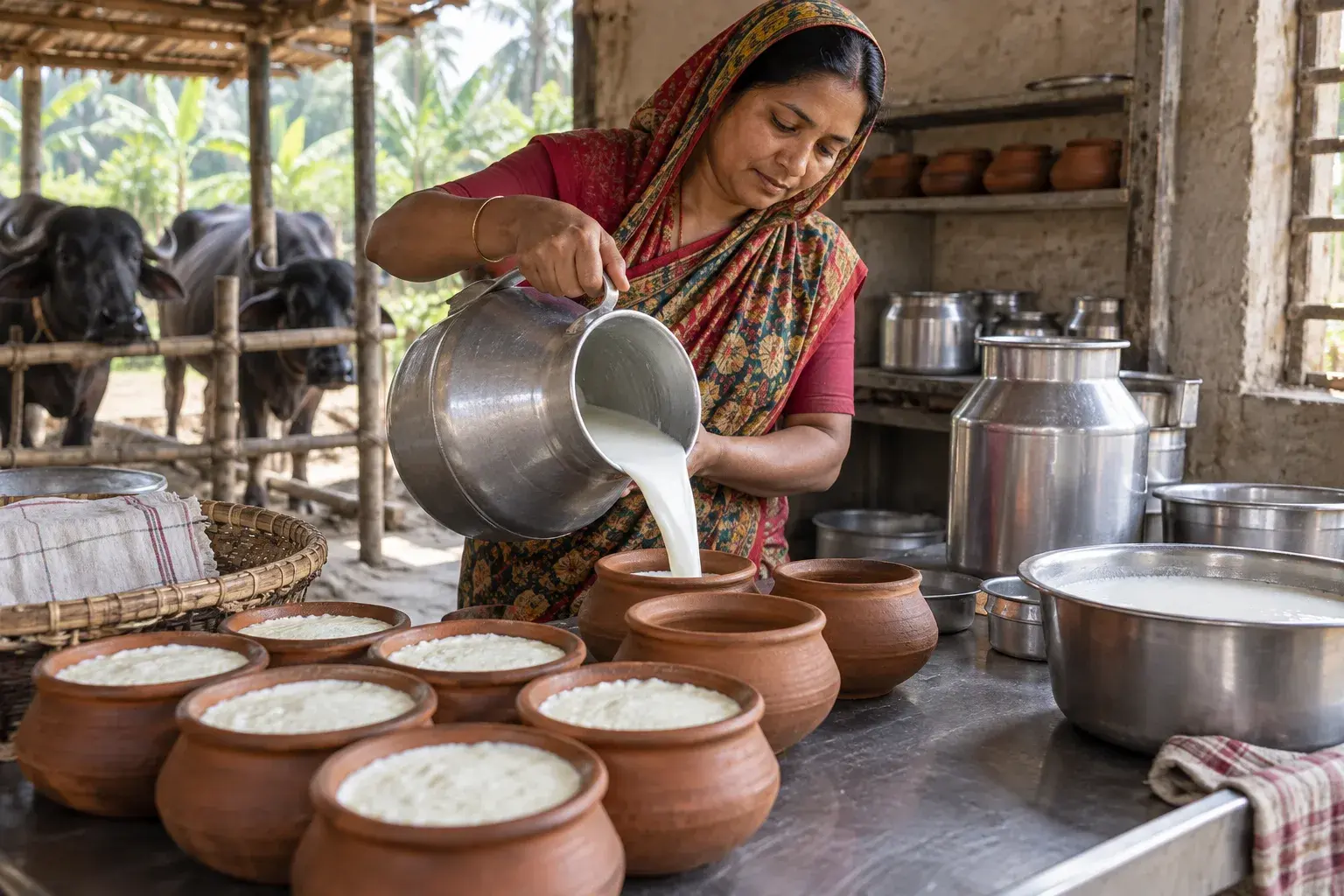
Raw buffalo milk set in clay pots. In Bhola milk costs Tk 150/kg and the curd sells at Tk 200/kg, so about Tk 50 a kg is left, and getting the milk at all is the hardest part.
- Last reviewed: 19 September 2026
- Version 1
Buffalo curd and dairy
- Starting capital
- ৳80,000 – ৳4,00,000 Editorial estimate
- Manpower
- 1 – 5 people
- First sale
- 7 – 30 days Editorial estimate
- Break-even
- 3 – 6 months Editorial estimate
- Kind of work
- Shop · Medium difficulty
About the business
Buffalo milk brought in from the char grazing herds and set in clay pots — Bhola has been doing this for two hundred years. Ordinary curd is made by boiling down cow milk; boisha dohi is set from raw buffalo milk and carries a thick butter layer on top, which is what the product is known for. The money is thin. Abdus Sattar of Gazipur Road in Bhola town, who has been setting curd for forty years, says he now buys milk at Tk 150 a kg and sells curd at Tk 200 a kg, and calls the profit small. That Tk 50 a kg has to cover the pot, the ice, the shop and his own labour. The real problem is supply. About 500 shops across Bhola's seven upazilas sell roughly 25,000 pots a day and need about 20,000 litres of buffalo milk, while only 8,000-10,000 litres are produced; the gap is filled with cow milk, which is where the adulteration complaints start. Grazing land shrinks in the monsoon and milk falls with it. Before Eid demand doubles or trebles and milk goes to Tk 150-200 a kg. On 30 April 2025 Bhola's raw buffalo-milk curd received a Geographical Indication certificate, but the certificate has not moved the price: Bangladesh still has no working GI tag or sticker, so pricing plans should not be built on it.
Unit economics
| Item | Range | Evidence | Suggest a correction |
|---|---|---|---|
| Monthly working capital | ৳70,000 – ৳4,00,000 | Editorial estimate | |
| Selling price | ৳200 – ৳233 / kg | Practitioner verified | |
| Variable cost | ৳90 – ৳150 / kg | Practitioner verified | |
| Gross margin | 25% – 55% | Practitioner verified | |
| Time to first revenue | 7 – 30 days | Editorial estimate | |
| Break-even time | 3 – 6 months | Editorial estimate | |
| Cash cycle | 0 – 7 days | Editorial estimate | |
| Waste / loss | 5% – 20% | Editorial estimate | |
| Daily capacity | 50 – 2,000 | Practitioner verified |
What you need to start
- Clay pots and covers, measuring vessels and scales, strainers, and an ice box or chiller. Because the curd is set from raw milk no boiling stove is needed, but cooling is.Equipment
- Bangladesh Food Safety Authority registration, compulsory for dairy and sweetmeat shops under the Food Safety (Registration and Licensing) Regulations 2026. Tk 1,000 new, Tk 500 renewal, valid three years.Licence
- Trade licence from the city corporation or municipality: form Tk 10, licence book Tk 50, standard tax Tk 30, non-judicial stamp Tk 150-300, licence fee Tk 100-60,000 by trade type, plus VAT and signboard fee. Issued in 3-5 working days with papers in order.Licence
- Setting curd from raw milk: how much starter, how long, and at what warmth. A properly set pot does not fall out when turned over and throws no water, and that is the local test of quality.Skill
- A char herd or a milk byapari. From chars like Sripur in Bhola, byaparis bring pitchers of milk to town by launch every day; in a good spell one byapari carries four or five maunds.Supplier
- A shop or room with water and shade, racks to stand the pots on, and a washing area. The premises are inspected for the BFSA registration.Workspace
How the work is done
- 1Fix the milk source first. Agree a year-round price and quantity with a char herd owner or a byapari; in Bhola the ghosh buys at Tk 60-80 a kg all year while the market rate is far higher.
- 2Work out how the milk actually reaches the shop. Bringing milk off the char costs Tk 20-30 a kg, and in many places the launch is the only route.
- 3Take a shop or room with water, shade and washing facilities. This is raw-milk work, so clean pots and clean hands are not optional.
- 4Take the trade licence from the municipality or city corporation and have the dairy food trade named on it.
- 5Register with the Bangladesh Food Safety Authority. It is compulsory for dairy and sweetmeat shops: Tk 1,000 for a new registration, Tk 500 to renew, valid three years.
- 6Arrange clay pots, covers and ice. Book the potter in advance; pots also run short before Eid.
- 7Write down how many kilos sell each day and bring in milk to match. Set too much and it spoils; too little and the customer goes elsewhere.
- 8Check the milk yourself. Cow milk gets mixed in when buffalo milk is short, and the adulteration complaints are exactly what is eroding the product's name.
- 9Plan separately from two weeks before Eid and Puja: demand doubles or trebles then, but milk also goes to Tk 150-200 a kg.
- 10Alongside counter sales, set up regular supply to sweet shops and launch-route wholesalers, but settle the payment terms before the first delivery.
Seasons
- JanNormal
- FebHigh
- MarHigh
- AprNormal
- MayHigh
- JunLow
- JulLow
- AugLow
- SepLow
- OctNormal
- NovNormal
- DecNormal
Where it works well
- Strong fitBhola · The home of boisha dohi. About 500 shops across seven upazilas selling roughly 25,000 pots a day, with an official count of about 124,000 buffalo on the chars.
- Strong fitPatuakhali · Coastal chars adjoining Bhola with the same herding pattern, and milk moves along the same launch routes.
- PossibleBarguna · Buffalo are kept on the coastal chars, but the market is small.
- PossibleBarishal · The divisional town's markets and sweet shops pull Bhola curd in, and launch supply is easy.
- PossibleChattogram · A big-city buyer base and sweet shops, but the buffalo milk has to be brought in from outside.
- PossibleJamalpur · The buffalo curd of Bakshiganj is a century old, the best known base outside the south.
- PossibleLakshmipur · Buffalo are herded on the Meghna chars, though milk output is falling as grazing land shrinks.
- PossibleMymensingh · The three-generation Senbarir dohi is made from buffalo milk, and the town has a market for it.
- PossibleNoakhali · A coastal char economy built on livestock, now at risk as grazing land contracts.
- PossibleSherpur · There is an old habit of buffalo-milk sour curd here, sold regularly in the local hats.
Risks and cautions
- HighDependency: Getting buffalo milk at all is the biggest risk. Bhola needs about 20,000 litres a day and produces 8,000-10,000. Grazing land on the chars is shrinking and output is falling further. The gap is filled with cow milk, which is destroying the name of boisha dohi. Without your own herd you are entirely in the hands of the ghosh and the arotdar.
- HighSpoilage: It is a raw-milk product: the milk must be set the same day and the curd does not keep beyond two or three days. Outside Eid, when sales fall, milk has to be thrown away, as the arotdar says himself. Losses are worst in the heat and during power cuts.
- MediumWorking capital: The milk price swings with the season but the curd price cannot follow. Milk is Tk 90-100 normally and Tk 150-200 at Eid. By the shopkeeper's own arithmetic he buys milk at Tk 150 and sells curd at Tk 200, leaving Tk 50 a kg. Another Tk 20 on the milk and the margin is close to gone, and the milk must be paid for in cash.
- MediumDemand: Sales lean on Eid and Puja, when demand doubles or trebles; the rest of the year the counter is much quieter. Milk falls in the monsoon, and when Eid lands inside the monsoon both problems arrive together.
- MediumCompliance: Do not treat the GI certificate as a price floor. Bhola's curd was certified on 30 April 2025, but Bangladesh still has no working GI tag or sticker and specialists say GI products are delivering no commercial benefit. What is enforceable is the other way round: a dairy shop cannot run without BFSA registration, and adulteration brings fines.
Sources
সিটি কর্পোরেশন থেকে ট্রেড লাইসেন্স প্রাপ্তির ধাপ সমূহ
Collected: 16 Sept 2026Supports: Starting capital · বাংলাদেশ
All food businesses now need safety registration
Collected: 22 Jul 2026Supports: Starting capital · বাংলাদেশ
জিআই স্বীকৃতিতে ভোলার মহিষের দধি নিয়ে নতুন সম্ভাবনা
Collected: 14 May 2025Supports: Daily capacity · ভোলা
What changed
No corrections have been published yet.
Questions and answers
No questions yet. Be the first to ask.
Stories about this business
A curd shop started on 1.3 lakh, with capital now at 10 lakh
A buffalo-curd business started with 130,000 taka now carries 10 lakh taka of capital. Four buffaloes bought two years ago for five lakh taka made it its own milk supplier, and 12-15 shops in the area move about 1,000 pots a day.
- Capital
- ৳1.3 lakh
- Reasons
- Good quality, Strong network
Similar businesses
 Food processing
Yogurt and chhana making
Buying raw milk at Tk 45-55 a litre and turning it into curd and chhana. Yield per litre and spoilage decide whether it makes money.
- Capital
- ৳80k – ৳4.5 lakh
- People
- 1 – 5
- First income
- 14 – 45 days
 Food processing
Mustard oil pressing (ghani)
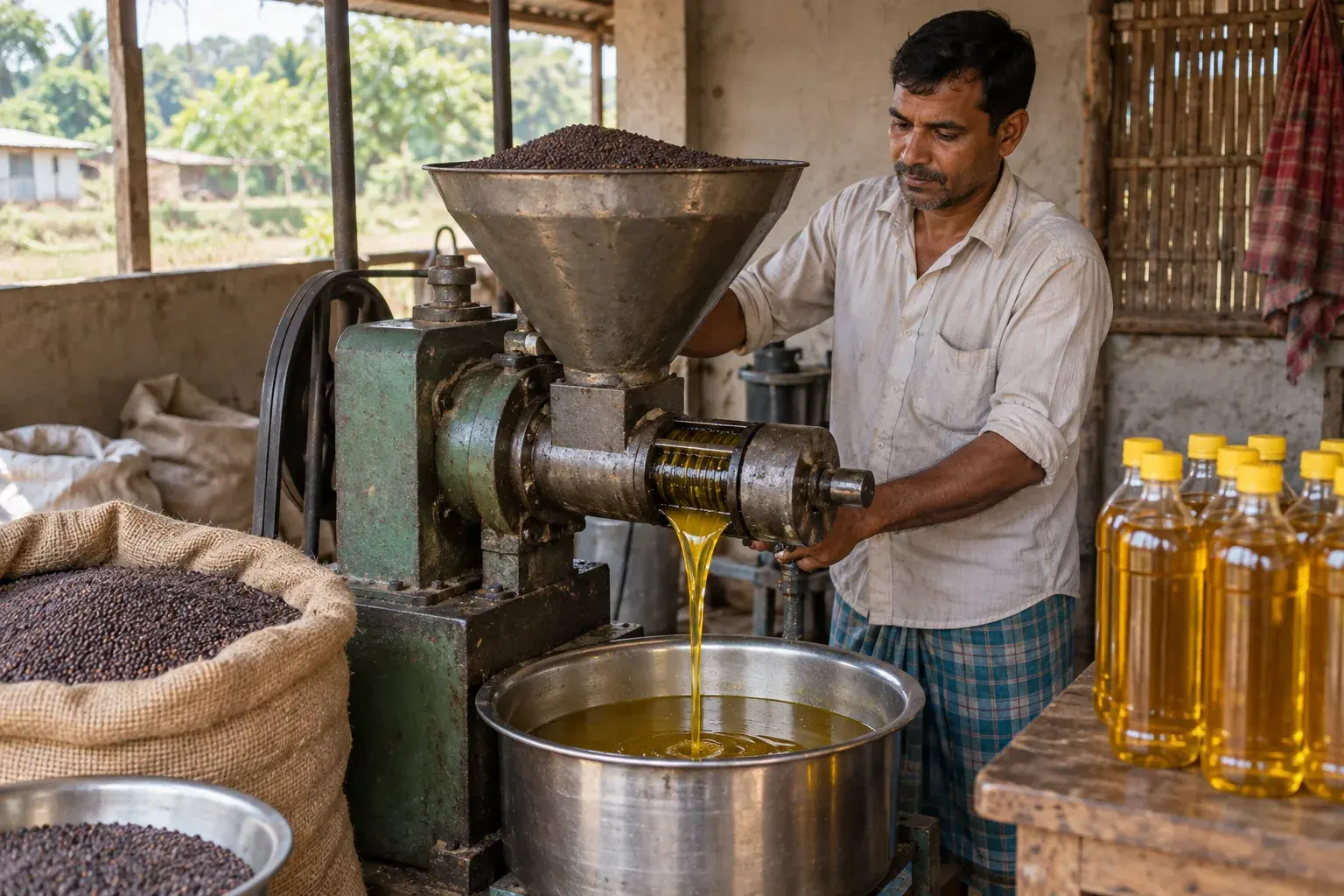
Crushing mustard seed for oil and cake. A maund of seed gives 16-19 litres of oil and 25 kg of cake; net of the cake a litre costs Tk 96-114 to make and sells loose at Tk 200.
- Capital
- ৳80k – ৳5 lakh
- People
- 1 – 4
- First income
- 30 – 90 days
 Food processing
Mustard honey bottling
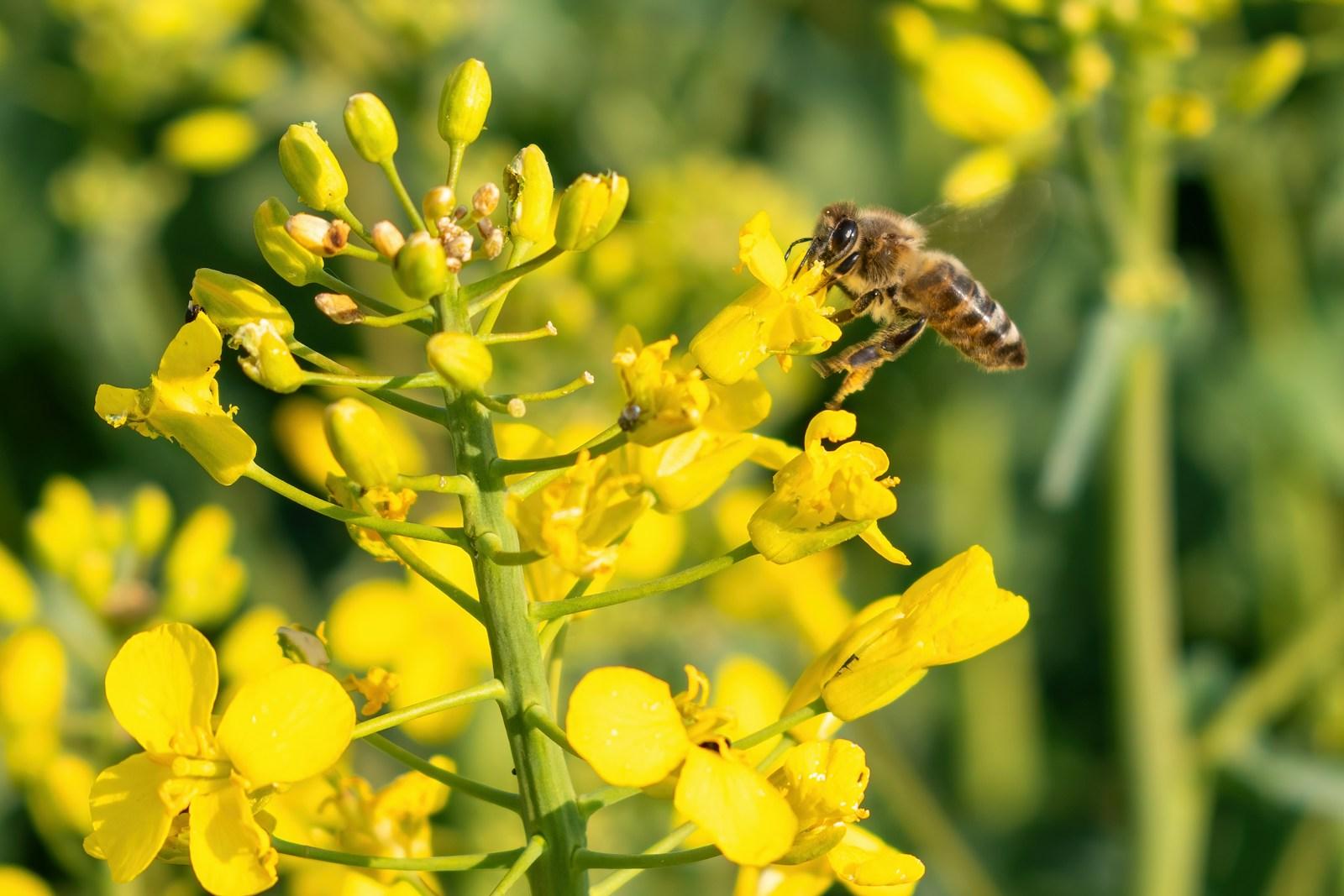
Place bee boxes in winter mustard fields, strain and bottle the honey, sell all year.
- Capital
- ৳1 lakh – ৳2.5 lakh
- People
- 2 – 3
- First income
- 60 – 90 days
 Food processing
Ghee and butter making
Separating milk into butter and ghee, with chhana or yogurt from the skim. One maund (40 kg) of milk gives 1.25 kg of ghee; cost about Tk 2,900 against Tk 3,040-3,260 of sales - a 5 to 11 percent margin.
- Capital
- ৳60k – ৳4 lakh
- People
- 2 – 6
- First income
- 15 – 60 days